
He said no to Led Zeppelin. He said no to Deep Purple. And the music world has spent fifty years wondering what might have been. Terrance James Reid — Superlungs, the artists’ artist, the greatest voice you never heard — was born on 13 November 1949 in the fens of Huntingdonshire, and he died on 4 August 2025, aged 75. Today he would have turned 77. His is not a story of failure. It is a story of a man who was offered the two biggest jobs in rock music, turned them both down, and went on living on his own terms anyway — recording six studio albums and four live albums, singing for everyone from Don Henley to Bonnie Raitt, and becoming the singer other singers talked about in hushed tones. Robert Plant praised his vocal “flexibility, power and control”. Graham Nash said he should have been “a gigantic star”. Rolling Stone called him an “artists’ artist”. This is the story of Terry Reid: the voice that said no, and the life that said yes to everything else.
A boy from the fens
Terrance James Reid was born on 13 November 1949 at the Paxton Park Maternity Home in Little Paxton, St Neots, Huntingdonshire, the only child of Walter Reid, a salesman of cars and agricultural equipment, and his wife Grace. The family lived in the fens village of Bluntisham, and Reid attended St Ivo School in St Ives. His musical education was wide and unusual for a boy in a small English village: he listened to classical music, Bulgarian folk and jazz, and he was particularly inspired by the sound of American rhythm and blues and soul singers such as Otis Redding and Marvin Gaye. He bought his first guitar at the age of ten, and at thirteen he formed his first group, the Redbeats, playing village halls and youth clubs with bandmates who were all in their late teens. At fourteen he wrote his first song, “Without Expression” — a song that would outlive his teenage years and travel further than he ever did, recorded later by the Hollies, by Crosby, Stills, Nash and Young, and by REO Speedwagon.
His father was the quiet hero of the story. Walter Reid was supportive from the start: he persuaded his mother to allow the boy to pursue music as a career instead of “picking up potatoes in a muddy field”, drove him to gigs, bought him guitars, and later accompanied him on tours. Without that support, there might have been no Superlungs at all — the nickname came later, for a voice that could move from a whisper to a scream in a split second, a voice that sounded too big for the rooms it first filled.
Singer, guitarist, artists’ artist
Reid was recognised by his contemporaries as an eminent talent in English rock music, both as a guitarist and as a vocalist. He was not only a singer who happened to play guitar; he was a musician whose voice and guitar worked as one instrument. He bought his first guitar at ten and was leading his own group by thirteen. On his records he played as well as he sang, and the musicians who hired him as a session singer in the 1980s — Don Henley, Jackson Browne, Bonnie Raitt — wanted the voice, but they got the musician too. Rolling Stone’s description of him as an “artists’ artist” was not a consolation prize. It was a job title: the singer other singers measured themselves against. Robert Plant, the man who got the job Reid turned down, praised Reid’s vocal “flexibility, power and control”. Graham Nash said he should have been “a gigantic star”. As a solo recording and touring artist, Reid released six studio albums and four live albums — a catalogue small enough to hold in two hands, and strong enough that other people’s greatest-hits albums still reach for it.
The Jaywalkers and the Rolling Stones
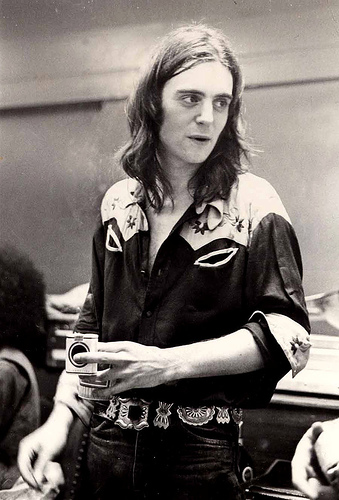
Reid left school at fifteen, and his career began the way so many careers of that era began: in a local club, in front of the right person at the right time. While he was playing with the Redbeats at the River Club in St Ives, he was spotted by Peter Jay, the drummer of Peter Jay and the Jaywalkers, who invited him to join as lead vocalist. In 1966, the Jaywalkers were named as a support act for the Rolling Stones on their 23-show British tour, from September to October 1966. Reid was sixteen years old, singing in front of the biggest band in Britain.
At the concert at the Royal Albert Hall, Graham Nash of the Hollies became friends with Reid and suggested the Jaywalkers sign with UK Columbia Records, an EMI label, to record with producer John Burgess. Their first single, the soul-inspired “The Hand Don’t Fit the Glove”, was a minor hit in 1967, but by then the Jaywalkers had disbanded. Reid, still a teenager, was on his own — and that was when Mickie Most came calling. Most, the producer behind Herman’s Hermits and the Animals, became Reid’s manager, at a time when Most was in partnership with Peter Grant, the man who would soon manage Led Zeppelin. Reid’s first single with Most, “Better by Far”, became a radio favourite. His debut album, Bang Bang, You’re Terry Reid, was released in 1968, with Eric Leese on organ and Keith Webb on drums, and a 1968 tour of the United States with Cream did much to gain him a loyal following. His final performance of that tour, at the Miami Pop Festival, received positive reviews from the music press. He was eighteen, he had an album out, and he had just toured America with the greatest live band on earth.
“Without Expression”, the song he had written at fourteen, was already travelling on its own. The Hollies released it as “A Man with No Expression” in 1968. Crosby, Stills, Nash and Young recorded it as “Horses Through a Rainstorm” in 1969, with Graham Nash once again singing lead, and the song was slated to appear on their album Déjà Vu before being replaced at the last minute by Stephen Stills’s “Carry On”. REO Speedwagon covered it in 1973 as “Without Expression (Don’t Be the Man)”, and John Mellencamp included it on his greatest hits album The Best That I Could Do: 1978–1988. A boy from Bluntisham had written a song that the biggest names in rock wanted to sing.
The two offers
Then came the offer that became rock legend. When the Yardbirds broke up, their guitarist Jimmy Page — managed by Peter Grant, who knew Reid’s work well — wanted Reid to sing in his proposed new group, the New Yardbirds, which later became Led Zeppelin. Reid had already committed to go on the road for two tours with the Rolling Stones and another with Cream as an opening act on the 1968 American tour. He told Page that if he were compensated for the gig fees he would lose, and if Page would call Keith Richards to explain why Reid had to pull out of the American tours, he would try some things out with Page. It never happened. Instead, Reid told Page to consider a young singer from Birmingham called Robert Plant, whom he had previously seen fronting Band of Joy as a support act at one of his concerts. Reid also suggested Page check out Band of Joy’s drummer, John Bonham.
He turned down Ritchie Blackmore too. Blackmore wanted him to replace the departing singer Rod Evans in Deep Purple, and Reid said the music was “too metal” and not really his style. When music journalists asked him about passing up Led Zeppelin and Deep Purple, Reid said he did not regret his decisions and was satisfied with his own career. In 2019 he was reported as saying, “I don’t sit around going over old coals.” It is one of the most graceful lines ever spoken about a missed chance — and it was true. Reid never sounded bitter. He sounded like a man who had made his choices and lived with them.
The wilderness years

In 1969, Reid played support on British tours, notably by Jethro Tull and Fleetwood Mac, and toured the United States again, opening for the Rolling Stones on their 1969 American tour. He did not appear at the Stones’ concert at the Altamont Music Festival. Also in 1969, he released his second solo album, the self-titled Terry Reid, which spent five weeks on the Billboard Top LPs chart. “Friends”, a song from the album, first appeared as a segue with his version of Bob Dylan’s “Highway 61 Revisited”, and was later covered by Arrival, becoming a UK Top 10 hit for them in January 1970.
Then the business caught up with him. In December 1969, Reid fell out with producer Mickie Most, who wanted him to become a balladeer and follow Most’s own formula. In a contract dispute with Most, Reid was unable to record or release his music for four years. He concentrated on live work, mostly in the United States, while awaiting the outcome of litigation, living in a “beach shack” in the hills of California and making sporadic appearances in Britain. In 1970 he returned briefly to England to perform at the Isle of Wight Festival with bass player Lee Miles — a former member of Ike and Tina Turner’s band, whom Reid had met while touring America with the Stones — along with David Lindley and Tim Davis. He took part in the second Atlanta International Pop Festival in 1969, opened and closed the first Glastonbury Fayre in 1970, and was filmed performing at Glastonbury in 1971. In 1971 he performed at Mick and Bianca Jagger’s wedding in Saint-Tropez, in front of the Beatles, David Bowie and Brigitte Bardot.
His fascination with Brazilian music and Latin rhythms began in 1969, when the singers Gilberto Gil and Caetano Veloso were exiled by the military dictatorship of Brazil. Reid’s attorney arranged for Gil to come to London, where he stayed at Reid’s apartment in Notting Hill with a group of Brazilian musicians who slept on his floor. When Reid performed at the Isle of Wight Festival on 27 August, Gilberto Gil and Caetano Veloso played on the same bill that night.
That same year, Reid was signed by Ahmet Ertegun to Atlantic Records, with a band consisting of David Lindley, Lee Miles and Alan White. They began recording in Britain and later switched to the United States. White left to join Yes, and Lindley left to tour with Jackson Browne. Lee Miles remained, and accompanied Reid in his musical career for many years afterwards. The recordings made during this period formed Reid’s third album, River, a “jazzy, moody album” that combined Latin American groove, soul-funk and rock. The musicians included Conrad Isidore on drums and Willie Bobo on percussion; the album was produced by Reid, engineered by Tom Dowd and mixed by Eddy Offord. River was released in 1973 and received favourable reviews, but failed commercially. The remainder of the material from those sessions was released in 2016 as The Other Side of The River. Around the time of River‘s release, Reid relocated from Britain to California and lived for the next three years in a commune in the desert mountains north of Los Angeles, on 180 acres of land owned by Bob Dylan, where he wrote his next album.
The long road back

Over the next decade, Reid switched labels in search of a winning formula. His fourth album, Seed of Memory — “a spiritual, ethereal piece of music” — was released by ABC Records in 1976, produced by Graham Nash. ABC Records filed for bankruptcy the week the album was released, which derailed its sales. The next effort, Rogue Waves, was produced by Chris Kimsey for Capitol Records and released in 1979, with Lee Miles on bass, Doug Rodrigues on lead guitar and John Siomos on drums, recorded at Brother’s Studios in Santa Monica, California.
In 1981, Reid retired his solo career to concentrate on session work, appearing on albums by Don Henley, Jackson Browne and Bonnie Raitt. In 1991 he returned with producer Trevor Horn for the WEA album The Driver, which featured a cover of “Gimme Some Lovin’” that also appeared on the soundtrack of the Tom Cruise film Days of Thunder. Reid later looked back on The Driver unfavourably and called it “unlistenable”. In the 1990s he fought “a bitter custody battle” over his daughters, which further slowed his career. He toured the United States and Hong Kong with Mick Taylor. “Rich Kid Blues” appeared on an album by Marianne Faithfull, produced by Mike Leander in 1984 but unreleased for fourteen years. In March 1993, Reid and several friends put together an informal group, calling themselves The Flew — Reid, Joe Walsh, Nicky Hopkins, Rick Rosas and Phil Jones. They played one show at The Coach House in San Juan Capistrano, California, which was Nicky Hopkins’ last public performance before his death. In 1998, Reid recorded “In Love and War” for the finale episode of the television series Conan the Adventurer, scored by Charles Fox.
The comeback

In late 2002, Reid returned to Britain with longtime bass player Lee Miles for three shows at the WOMAD festival near Reading — his first live appearance in years. He had previously held a Monday night residency at a bar in Beverly Hills, California, which had attracted the attention of WOMAD organiser Thomas Brooman, who invited him to perform. In 2005 he returned for a British tour, with London shows at the 100 Club and Ronnie Scott’s Jazz Club, and festival and club dates that took in the Jazz Cafe, the Borderline and Dingwalls. One venue billed him as “The Man with a Hell of a Story To Tell”. He was invited back to Ronnie Scott’s in 2009 for a week, and held residencies there for several years afterwards. In 2012, his album Live in London captured an entire set from one of his Ronnie Scott’s gigs, released with no remixes or overdubs. He appeared at the Glastonbury Festival several times, as well as at the Isle of Wight, The Secret Garden twice, The Rhythm Festival twice and All Tomorrow’s Parties.
The back catalogue began to catch up with him. EMI released a box set of his first two albums, including all the sessions he had recorded for them between 1966 and 1970, titled Superlungs. Seed of Memory and River became available on CD when they were reissued in the 2000s, bringing renewed interest in his music. He released a new live album, Alive, published by Sanctuary Records in 2004. Around this time, Reid began a residency at The Joint in Los Angeles with Waddy Wachtel, Bernard Fowler and other special guests, performing every Monday for four years; other artists who knew him joined in, including Robert Plant, Keith Richards, Bobby Womack, Roger Daltrey and Eric Burdon.
His songs found a second life on screen. “Dean”, from River, was used in the feature film The Criminal, produced in 1999 and released in 2001, and Reid became good friends with the film’s producer, Chris Johnson, who became his business adviser and persuaded him to return to live work in America in the early 2000s. Three of his songs — “Seed of Memory”, “To Be Treated Rite” and “Brave Awakening” — were featured in the 2005 film The Devil’s Rejects, directed by Rob Zombie, and his music appeared in its 2019 sequel, 3 from Hell. In the 2005 film The Greatest Game Ever Played, Reid had a cameo as a golf caddy. His songs “Faith To Arise” and “Dean” were featured in the 2003 film Wonderland, “Faith To Arise” was featured in the 2017 film Win It All, and in 2009 his song “Be Yourself”, which he had written for Graham Nash’s Songs for Beginners, appeared in the film Up in the Air, directed by Jason Reitman.
In 2007, Reid began touring with the American band Cosmic American Derelicts, who supported him on shows in 2008, 2014 and 2016 and became his “regular” band, as described by The Washington Post. He also performed with the Los Angeles-based music collective Wild Honey. In 2009 he worked with the French trip hop act Shine and spent a week in Paris recording several tracks as guest vocalist; Shine Featuring Terry Reid was released as an EP that November. In 2012 he provided vocals for “Listen” by DJ Shadow, a bonus track on the compilation Reconstructed: The Best of DJ Shadow. Around this time he worked on collaborations that remained unreleased, including a reworking of Seed of Memory with rap producer Dr. Dre — who had reportedly become “fascinated” with the 1976 album — and a guest appearance with the British band Alabama 3. A feature-length documentary about his life, Superlungs, began development in 2015 with music writer Richard Frias as director, but it faced difficulties, and as of 2025 it has never been fully released. Reid continued to perform in his later years and appeared on stage in 2019 for Africa Express: The Circus.
The voice that said no

Terry Reid died on 4 August 2025, aged 75. He left six studio albums and four live albums, a songbook that other singers still reach for, and a story that no other singer in rock music can tell. He was the man who turned down Led Zeppelin and Deep Purple and never once sounded sorry about it. He was the singer Robert Plant admired and Graham Nash said should have been a gigantic star. He was the teenager from Bluntisham who wrote a song at fourteen that Crosby, Stills, Nash and Young wanted to sing, the young man who opened for the Stones and toured with Cream, the exile who waited four years to record again and came back anyway, the session singer who held up other people’s records, and the old man at Ronnie Scott’s who could still silence a room with a whisper.
Seventy-seven years on from his birth, the greatest voice you never heard is still the one that said no. Saying no can be its own kind of legacy — and Terry Reid’s legacy is this: a life does not need a stadium to matter. Sometimes the quietest choice is the one that echoes longest.
Leave a Reply