
Photo: Buddah Records (public domain)
On 12 November 1971, a record appeared in British shops that sounded like nothing else on the shelves that autumn. It opened with the delicate chime of twelve-string guitars, as gentle as a music box winding up in a nursery, and within minutes it had turned into something far stranger and far louder: a Victorian ghost story, a killer plant from Russia, a Greek myth, and a man threatening to jump from a rooftop, all set to music that swung between pastoral calm and electric fury. The album was Nursery Cryme, the third studio album by Genesis, and fifty-five years later it still marks the moment when a band that had almost ceased to exist found its true voice.
A Band on the Edge
To understand Nursery Cryme, you have to start with the album that came before it. Genesis recorded their second album, Trespass, in July 1970, as a professional band for the first time. The sessions went well enough, but almost as soon as they were over, the group began to come apart. Anthony Phillips, a founding member and the band’s guitarist, left. The strain of touring, and the unhappiness it brought him, had become too much, and he walked away from the group he had helped to create.
The three founders who remained — singer Peter Gabriel, keyboard player Tony Banks, and bassist and guitarist Mike Rutherford — came close to splitting up altogether. Instead, they chose to carry on. But carrying on meant finding new people of the right calibre, and replacing their drummer, John Mayhew, with someone who could stand as an equal alongside the three founders.
That search led them, in August 1970, to Phil Collins. He arrived as the new drummer, and he brought far more than a steady beat. Collins quickly became an important backing vocalist, and his playing style and musical tastes gave the band a new dimension. Yet even with Collins behind the kit, the gap left by Phillips remained. For the first half of their 1970–1971 tour, Genesis performed as a four-piece. Rutherford covered rhythm guitar and bass pedals, while Banks, in addition to his own keyboard parts, played lead guitar lines on a Pianet through a distorted fuzz box amplifier. It was demanding, but Banks later credited it with improving his technique, because it required him to play two keyboards at the same time. Some songs, however, simply could not be played convincingly by four people, and the search for a lead guitarist went on.
In November 1970, Mick Barnard joined on the recommendation of David Stopps of Friars Aylesbury, and “The Musical Box” was added to the live set. But the rest of the group soon realised that Barnard was not playing at the same standard as Phillips, and they kept looking for a better player. The answer, when it came, arrived in the classified pages of a music newspaper.
Two New Men
In December 1970, Peter Gabriel spotted an advertisement in Melody Maker. It read: “Imaginative guitarist/writer seeks involvement with receptive musicians, determined to drive beyond existing stagnant music forms.” The advertiser was Steve Hackett, a young guitarist looking for a band that wanted to push further. Gabriel invited him to see Genesis play at the Lyceum Theatre in London on 28 December, and told him that Barnard would have to be replaced. Barnard was dismissed on 5 January 1971, and Hackett joined the band in early 1971.

Photo: Philippe Roos, CC BY-SA 2.0.
Hackett quickly developed a rapport with Rutherford. The two shared a love of twelve-string guitars and an appetite for new musical ideas, and that shared language mattered. Genesis were five again — Gabriel, Banks, Rutherford, Collins and Hackett — and, crucially, a different five from the group that had recorded Trespass. Collins brought humour and rhythmic snap; Hackett brought a guitarist’s imagination and a willingness to experiment with technique.

Photo: Dirk Haun, CC BY 2.0.
With Hackett in place, Genesis continued touring. They took part in the “Six Bob Tour” alongside their Charisma Records labelmates Lindisfarne and Van der Graaf Generator, played their first overseas shows in Belgium, and made the first of three appearances at the annual Reading Festival. Early attempts to work on material for their next studio album while still on the road were unproductive — as Hackett later described it, they were trying to write in “the odd day in a windy church hall”, and the songs would not come together that way. The group needed time set aside specifically for writing, and in July 1971 they began a three-month break from touring to write and record. It was Hackett’s first experience of rehearsing with a group to a professional standard. The break was hastened by an injury Gabriel sustained on 19 June during a show at Friars club in Aylesbury, when he attempted one of the first stage dives into an audience and ended up breaking his ankle.
Toad Hall
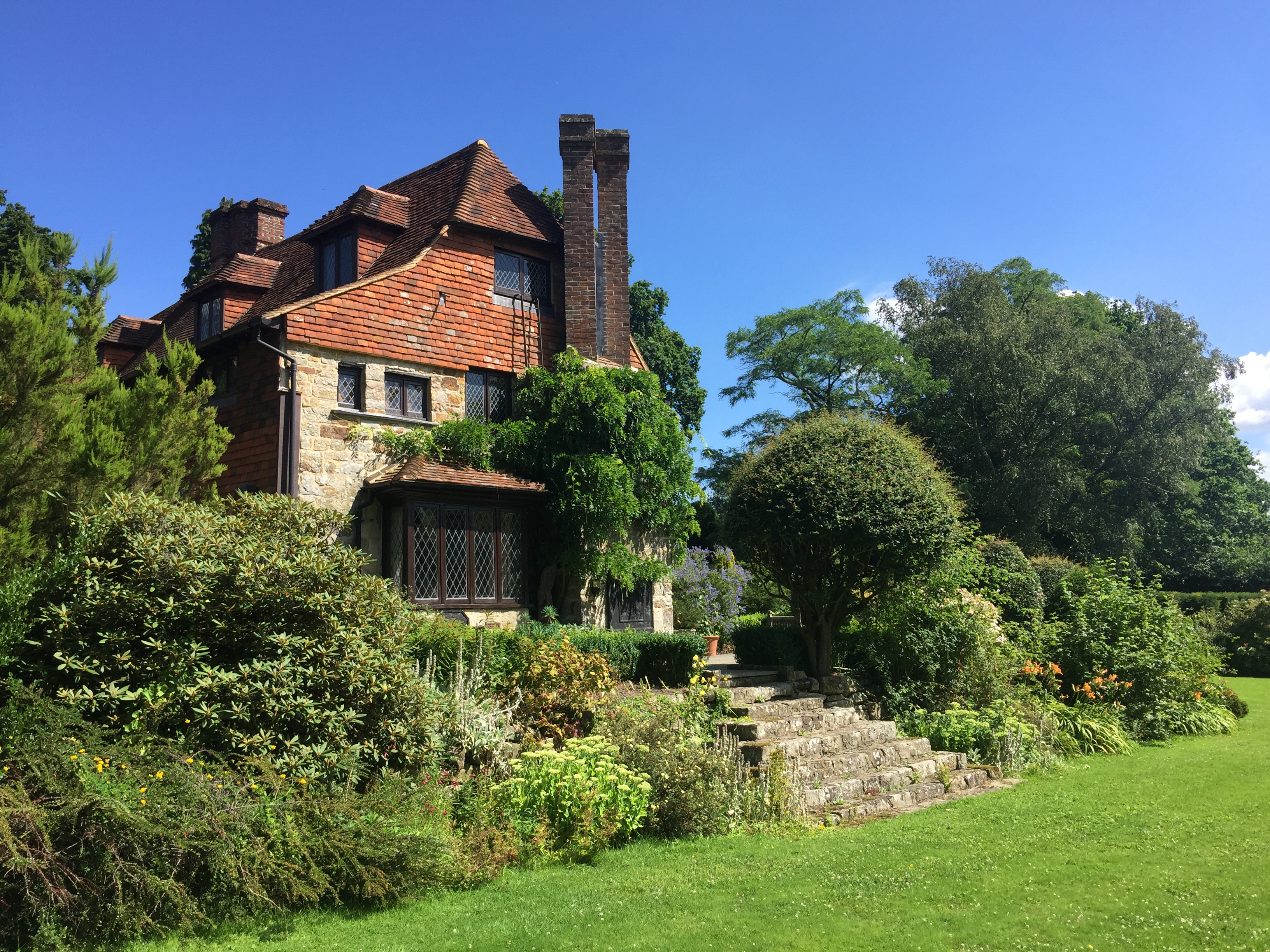
Photo: Lcook999, CC BY-SA 4.0.
The five musicians moved to Luxford House, the residence of Charisma owner Tony Stratton Smith, a sixteenth-century Grade II listed building in Crowborough, East Sussex. The group nicknamed the house “Toad Hall”, after the home of Mr Toad in The Wind in the Willows. For three months, the band lived and worked there, writing the songs that would become Nursery Cryme.
They arrived with a mixture of excitement and apprehension. Genesis were nervous about writing without Phillips, whose guitar work had shaped so much of their early sound, and both Collins and Hackett were unsure of how much they would be able to contribute musically. Some material had been written while Phillips was still in the band, and that material was reworked rather than discarded. Collins, in particular, proved to be a workaholic, happy to jam with anyone at any time. The group also bought a Mellotron. Banks had played a rented one on Trespass and had greatly liked the sound, and now the instrument was theirs to explore. It would become one of the defining sounds of the album.
At Trident Studios
Genesis recorded Nursery Cryme at Trident Studios in London between 2 August and 10 September 1971, with John Anthony as producer and David Hentschel as assistant engineer. Both men had performed the same roles for Trespass, so there was continuity in the studio even as the band itself had changed. The album runs for 39 minutes and 39 seconds, and all seven tracks are credited to all five members — Banks, Collins, Gabriel, Hackett and Rutherford — a sign of how collaborative the writing at Luxford House had become.
The sessions had their own small rituals and private language. Hackett played a Les Paul guitar that the band had bought for him, along with a Hiwatt stack amplifier, and he recalled some difficulty at first in understanding what Banks and Rutherford were talking about, because the two had devised their own sayings. A passage they had played well, for instance, was referred to as a “nice guy”.
“The Musical Box”: A Victorian Ghost Story

Photo: Jean-Luc, CC BY-SA 2.0.
“The Musical Box”, which opens the album and runs for ten minutes and thirty-two seconds, is the song that gave Nursery Cryme its cover, its title’s mood, and much of its reputation. It tells a macabre story set in Victorian Britain. A young boy, Henry, is accidentally decapitated by his friend Cynthia while the two are playing croquet. Returning to the house, Cynthia plays Henry’s old musical box, and the music unleashes Henry’s spirit — returned as an old man. Henry has become sexually frustrated, and he attempts to seduce Cynthia. Then the nurse enters the room and hurls the musical box at the wall, destroying both it and Henry.
It is a startling story for a rock song, told with a mixture of delicacy and menace that became a Genesis signature. The music itself had a long history before the album. The song originated while Phillips was still in the group, when he would often write with Rutherford on twelve-string acoustic guitars. Rutherford had begun to experiment with unorthodox guitar tunings, with the top three strings tuned to F sharp, which provided the jangly sound heard in the opening and the chord that signalled the start of the electric guitar solo. That tuning influenced the title of an acoustic piece, “F sharp”, that became the basis of “The Musical Box”, developed further after Phillips’s departure.
The opening section features both Rutherford and Banks on twelve-string guitar. The high-pitched sound of the opening guitar phrase was created using a varispeed technique: Rutherford’s guitar was recorded at half speed, so that when it was played back it sounded higher than it had when it was recorded. An earlier version, entitled “Manipulation”, had been performed with Phillips in 1970 for the soundtrack of an unreleased BBC documentary on the painter Michael Jackson. The guitar solos originated from Barnard’s brief time in Genesis, and Hackett modified sections that Phillips and Barnard had written while adding his own arrangements. He realised that neither of them had made a sound that resembled an actual musical box, so he recorded a guitar lick that is heard before the lyric “Here it comes again”.
Gabriel, a great admirer of the Who at the time, pushed for Rutherford to come up with an aggressive, attacking section in a style similar to that of the Who’s guitarist Pete Townshend, and he incorporated themes of violence and sex into the lyrics. Collins was inspired to play a rolling drum part during the middle section after hearing “The Weaver’s Answer” by Family. Banks wrote the chord sequence for the final section. Despite all these additions, the Genesis biographer Mario Giammetti reckoned that the original composition written by Rutherford and Phillips in September 1969 amounted to “a good two thirds of this track”.
“The Musical Box” became a live favourite during Gabriel’s time with the band, and it was on stage that it grew into something even more theatrical. Gabriel first decided on the idea of wearing costumes at a gig in the National Stadium, Dublin, in September 1972. He left the stage during the instrumental break and reappeared at the conclusion wearing his wife’s red dress and a fox’s head. Later he would wear an “old man” mask for the song’s ending, acting out the part of the aged Henry. The image of the singer in a red dress and a fox’s head became one of the most famous moments of early Genesis. The song was no longer just a recording; it was a piece of theatre.
The Other Songs: Friends, Hogweed and Myths
If “The Musical Box” is the album’s centrepiece, the six songs that follow show just how wide the new Genesis could range. “For Absent Friends”, at one minute and forty-eight seconds, is the shortest track on the record, and one of the most quietly radical. It is an acoustic song, and the first Genesis song with Collins on lead vocals. The twelve-string acoustic guitars were played by Rutherford and Hackett, supplemented by a Hohner Pianet played by Banks. Hackett had come up with the music himself and written the lyrics with Collins, and he recalled being shy when he presented it to Gabriel, because he and Collins were the new members of the group. Rather than feeling threatened, the original members were pleased that the newcomers were contributing to the songwriting, and Gabriel even approved when the other members suggested that Collins sing the lead. Hackett had been inspired by “Eleanor Rigby” by the Beatles to write a straightforward song about a relationship, and Collins suggested one about two old women who had lost their husbands. They wrote most of the lyrics together in the garden of Tony Stratton-Smith’s country house. The result is a small, tender portrait of loss, and the first time listeners heard Collins’s voice at the front of a Genesis song — a voice that would, four years later, take over as the band’s lead singer.

Photo: Appaloosa, CC BY-SA 3.0.
“The Return of the Giant Hogweed”, which closes side one at eight minutes and thirteen seconds, is the album’s great joke with teeth. It warns of the spread of the toxic plant Heracleum mantegazzianum, also known as giant hogweed, after it was “captured” in Russia and brought to England by a Victorian explorer. The real plant is extremely toxic and dangerous, but the song’s lyrics are a humorous exaggeration, suggesting that the plant is attempting to wipe out the human race. The lyrics were written by Gabriel. Most of the song was written while Genesis were still a four-piece, though Hackett wrote the introduction after joining. Both “The Musical Box” and “The Return of the Giant Hogweed” feature Hackett’s first use of guitar tapping, a technique in which the index finger of the plucking hand is applied directly to the guitar fretboard. Tapping would not attract mainstream attention until Eddie Van Halen demonstrated it in his instrumental “Eruption”, seven years after Nursery Cryme. The opening features Hackett and Banks playing triplets in harmony, and the song’s driving energy showed just how much harder the new rhythm section could push.
Side two opens with “Seven Stones”, five minutes and twelve seconds long, conceived by Banks, who used what Rutherford described as “his big, schmaltzy, music hall chords that he loved”. Hackett wrote the first half of the chorus, the part with wordless vocals. The Melody Maker reporter Chris Welch described the song as “strangely mournful and inconclusive”, and theorised that the old man addressed in the lyric is expressing his “profound belief that the secret of success and good fortune is based purely on random events and chance”.
“Harold the Barrel”, at three minutes and one second, showed a humorous side to Genesis that was encouraged by Collins. The lyrics show black humour, telling of a man contemplating suicide by jumping off a building. The song was written primarily by Gabriel, with Collins assisting him with the lyrics, and it was recorded with Gabriel and Collins singing as a duet. Their vocals were mixed onto the same audio track, so they cannot be separated.
“Harlequin”, two minutes and fifty-seven seconds, was written by Rutherford and Phillips, and it is the album’s most direct link to the band’s earlier incarnation. The instrumentation consists of two twelve-string guitars, organ, electric guitar, a Mellotron on the vibraphone setting, and tambourine, and the vocals feature Gabriel, Collins, Rutherford and Banks all singing in harmony. Rutherford played two separate guitar parts on a single twelve-string, which he thought produced “pretty dodgy” results, and he was also critical of his lyrics. Banks changed his mind about the song over time. Listening to the album in 2007, he commented: “I used to think ‘Harlequin’ was a very weak song, but on hearing it again I realise it was pretty good.”
The album closes with “The Fountain of Salmacis”, seven minutes and fifty-six seconds, which tells the Greek myth of Salmacis and Hermaphroditus. It originated from a short passage that Banks had come up with while at university, and an earlier version, entitled “Provocation”, had been recorded in 1970 for the soundtrack of the same unreleased BBC documentary on the painter Michael Jackson. The track makes use of the Mellotron, with an influence from King Crimson’s In the Court of the Crimson King. Banks thought the instrument greatly complemented his piece when combined with the organ, and it became the basis for “The Fountain of Salmacis”, which was taken further into a complete song as the result of group jams. Hackett particularly enjoyed the moment when he came up with his ending guitar solo, which occurred around midnight at Luxford House. The lyrics were written by Banks and Gabriel.
The Cover: Honey, Severed Heads and a Stolen Painting
The album’s sleeve was designed and illustrated by Paul Whitehead, who also designed the sleeves of Trespass and the band’s next album, Foxtrot. The cover depicts characters and scenes based on “The Musical Box” and Coxhill, the manor house with a croquet lawn, itself based on the Victorian home Gabriel grew up in. When the group first saw Whitehead’s painting, they said it did not look old enough, so he varnished it with honey, which made it look as though it was from the nineteenth century. When the album was originally released, the cover shocked some people, because of the severed heads pictured on it.
The inner sleeve resembled an old photo album, with a panel for each song along with an illustrated picture. Whitehead later picked his design for Nursery Cryme as his favourite of the three he did for Genesis, noting: “It just works very well with the music. It fits perfect. It’s the right colour, the right vibe.” The original illustrations for the three albums were later stolen from the Charisma archives when the company was sold to Virgin Records in 1983. Whitehead claimed that Charisma staff got wind of the imminent sale and proceeded to loot its office. A poster of the album cover can even be seen in the 1995 film Empire Records, hanging behind the cash register inside the record store.
Reception: A Slow Start, Then a Second Life
Nursery Cryme was released on 12 November 1971 on Charisma Records. The company promoted the album less than it had promoted Trespass, because it was busy with Lindisfarne’s Fog on the Tyne. The group felt discouraged by the general indifference from the record company, and believed that songs like “The Musical Box” could have been as popular as “Stairway to Heaven”, the Led Zeppelin song released at the same time. It was a bold comparison, and it showed how much faith the band had in the material they had made at Toad Hall.
Contemporary critical response was mixed. Richard Cromelin of Rolling Stone praised the band’s “outrageously imaginative and lovably eccentric” concepts and their long, multi-movemented structures, but blamed “the godawful production, a murky, distant stew” for holding the songs back. He nonetheless remarked positively on some of the songs, and noted that he saw promise in the band. In a full-page advertisement in Melody Maker, keyboardist Keith Emerson wrote: “This is not the start for Genesis neither is it the end. No bullshit: Their new album really is incredible”. The Village Voice critic Robert Christgau was less enthusiastic, giving the album a C− in Christgau’s Record Guide: Rock Albums of the Seventies (1981).
Commercially, the album was no hit at first. It did not enter the UK chart until May 1974, when it peaked at No. 39, and it charted there again when reissued in 1984, reaching No. 68. Though the group still had only a minor cult following at home, they started to achieve commercial and critical success in mainland Europe, with the album reaching No. 4 on the Italian charts. The album continued to sell, and it was certified Silver by the British Phonographic Industry on 22 July 2013, for sales in excess of 60,000 copies. It was also certified Gold in France.
On the Road and After
From November 1971 to August 1972, Genesis toured to support the album, playing in the UK and continental Europe, with further visits to Belgium and a first visit to Italy, where they played to enthusiastic crowds. The Italian leg in April 1972 was a particular success. During the tour, Genesis recorded “Happy the Man”, a non-album single, with “Seven Stones” from Nursery Cryme on its B-side. The group also played a thirty-minute set on Belgian television to promote the album, which is the earliest surviving full broadcast of the group and has been repeated numerous times. Gabriel had yet to develop his on-stage costume attire and performed the show in a more straightforward frontman role.
Retrospective appraisals have been mildly positive, and kinder than many of the first reviews. BBC Music praised the two new members as fundamental to Genesis’s artistic success, noting Collins’s drumming and Hackett’s tapping and swell techniques, and thought that “Genesis had virtually invented their own genre, Edwardian rock”. Stephen Thomas Erlewine of AllMusic deemed the album highly uneven, but considered “The Musical Box” and “The Return of the Giant Hogweed” to be “genuine masterpieces”, and concluded that they “still stand as pinnacles of what the band could achieve”. Geddy Lee of Rush included the album among his favourites in an interview with The Quietus.
Closing: The House That Saved a Band
Fifty-five years on, Nursery Cryme is best remembered not as a chart success — it never was one, at least not at first — but as a rescue. A band that had lost its guitarist and nearly lost itself moved into an old house in Sussex and wrote its way out of trouble. Listen to it today, and you can still hear that moment of becoming: the twelve-string guitars of the old Genesis, the tapping and drumming of the new one, and a singer discovering that a song could be a story, a costume and a ghost all at once.
The album that followed, Foxtrot, released in 1972, would take the band further still, and the costumes, the storytelling and the confidence that began on Nursery Cryme would grow into the full theatrical spectacle of the Gabriel years. But it was Nursery Cryme that made that future possible. It was the record on which Collins first sang lead, on which Hackett first tapped a guitar string, on which Banks first had a Mellotron of the band’s own to play with, and on which Gabriel first found the strange, dark stories that would define his time in Genesis.
Leave a Reply