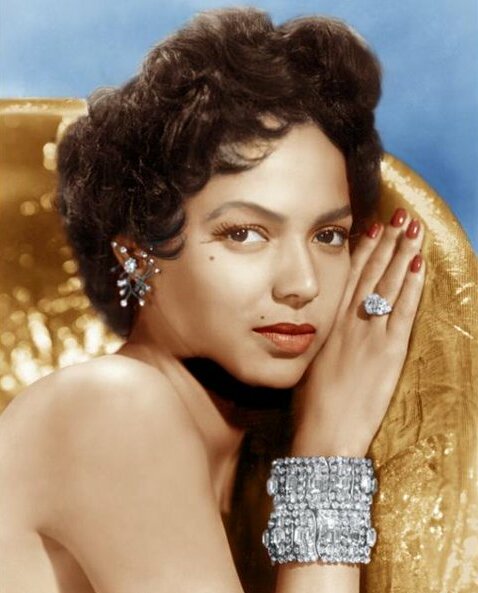
Photo: Studio Publicity / Wikimedia Commons, Public domain
On the night of March 30, 1955, Dorothy Dandridge sat in the RKO Pantages Theatre in Hollywood and waited for an envelope to open.
She was thirty-two years old, and she had already been on that stage once that evening.
Earlier in the ceremony, she had presented the Academy Award for film editing to Gene Milford for On the Waterfront.
Now the program had reached the award for Best Actress, and her own name was on the list of nominees.
Beside her name stood Grace Kelly, Audrey Hepburn, Judy Garland, and Jane Wyman.
No Black performer had ever been nominated in a leading acting category before that night.
The nomination itself had come from a single performance, filmed the previous summer in barely six weeks.
The film was called Carmen Jones, and it had turned a schoolteacher image into something electric.
The glorious singing voice on the soundtrack did not belong to Dorothy Dandridge at all.
Every note she appeared to sing had been recorded by a twenty-year-old opera singer named Marilyn Horne.
They borrowed her voice; the face was hers alone.
The presenter opened the envelope, and a theater full of people held its breath.
It began with an old French opera, a daring rewrite, and a director who refused every no.
This is the story of Carmen Jones.
An Opera Learns a New Accent
The story really starts in Paris in 1875, with the premiere of Georges Bizet’s opera Carmen.
Bizet had drawn his tale from an 1845 novella by Prosper Mérimée, a story of obsession set among soldiers and smugglers in Spain.
Nearly seventy years later, Oscar Hammerstein II decided the opera could live a second life in America.
He kept Bizet’s music almost note for note, but he wrote an entirely new book and new English lyrics.
His Carmen worked in a North Carolina parachute factory instead of a Seville cigarette plant.
The soldier Don José became Joe, a young corporal hoping to enter flight school.
The bullfighter Escamillo became Husky Miller, a heavyweight prizefighter with a manager and an entourage.
Producer Billy Rose mounted the stage production, and it opened on Broadway on December 2, 1943.
The show ran for 503 performances, a genuine wartime hit.
But Hollywood in the nineteen-forties was not ready to put that cast on a screen.
The Director Who Refused Every No
Otto Preminger had seen the Broadway production and had not been impressed.
He later dismissed it as a series of skits loosely based on the opera.
Preminger said he wanted to make a dramatic film with music, rather than a conventional film musical.
He went back past Hammerstein to the original Mérimée novella for the story’s bones.
He hired Harry Kleiner, a writer he had once taught at Yale, to build the screenplay.
Preminger assumed no major studio would finance an operatic film with an all-African-American cast.
He planned to produce it independently and took the project to United Artists first.
Darryl Zanuck, the head of Twentieth Century Fox, offered to finance the film outright.
By December 1953, Preminger had accepted and begun a long pre-production.
Fox gave the production a budget of about eight hundred thousand dollars, modest even for 1954.
The film would be shot in CinemaScope and DeLuxe Color, Fox’s prestigious new widescreen process.
The Censor at the Door
Before a single scene was filmed, Preminger had to survive the industry’s censor.
Joseph Breen ran the Production Code office, the moral gatekeeper of Hollywood pictures.
Breen had clashed with Preminger over The Moon Is Blue and still resented losing that fight.
On April 14, 1954, six weeks before filming, Breen raised formal objections to the screenplay.
He complained of an over-emphasis on lustfulness in the story.
He was angered that no voice in the script properly condemned Carmen’s lack of morals.
He filmed two versions of certain scenes Breen found objectionable.
Then he quietly used the stronger versions in the finished film.
Zanuck urged him to send the script to Walter White, the executive secretary of the NAACP.
White reviewed the story of an all-Black cast and raised no objection to it.
The film needed a Carmen, and Preminger did not believe he had found her.
Finding Carmen
Harry Belafonte, the folk singer who had introduced calypso to mainstream audiences, was cast as Joe.
Pearl Bailey, the great band singer familiar from television, took the role of the wisecracking Frankie.
Joe Adams, a Los Angeles disc jockey with no acting experience at all, became the boxer Husky Miller.
Preminger gave Carroll the smaller part of Myrt instead, and kept searching for his Carmen.
Eartha Kitt was tested for the role, and so was the singer Joyce Bryant.
In Bright Road, her one starring film, she had played a gentle schoolteacher opposite Belafonte.
Watching that performance, Preminger could not imagine her as opera’s most dangerous temptress.
He told her she was lovely, and that she looked like a beautiful butterfly.
He suggested she audition for Cindy Lou, the sweet fiancée Joe would leave behind.
Dandridge took the script home and made a decision that changed film history.

When she returned to Preminger’s office, she came dressed and behaving exactly as he had pictured Carmen.
Preminger was also shown her loose, joyful performance in an old Soundie short called Easy Street.
On May 21, 1954, the announcement was made: Dorothy Dandridge would play Carmen.
Within days she told her agent she wanted to withdraw, fearing she could not do the role justice.
Preminger drove to her apartment himself to talk her out of quitting.
The Voice That Wasn’t Hers
Carmen Jones was an opera, however American its setting, and the studio wanted operatic voices.
Dandridge was a genuine singer, a nightclub star with a lovely, intimate style.
The decision was made that her singing would be dubbed by another performer.
The job went to Marilyn Horne, a twenty-year-old mezzo-soprano from Bradford, Pennsylvania.
Horne was at the very beginning of a career that would make her an operatic legend.
She later recalled that she did everything she possibly could to imitate Dandridge’s own voice.
She spent many hours with the actress, studying how she spoke and phrased.
Belafonte, a star singer himself, was dubbed for exactly the same reason.
His singing voice in the film belongs to LeVern Hutcherson, a classically trained baritone.
Joe Adams was dubbed by Marvin Hayes, and Diahann Carroll was dubbed by Bernice Peterson.
Only Pearl Bailey, with her unmistakable comic growl, sang entirely for herself.
Soundtrack recording began on June 18, 1954, before the cameras ever rolled.
They borrowed her voice; the face was hers alone.
Six Weeks in CinemaScope
Filming began on June 30, 1954, after three weeks of rehearsal.
The town of El Monte doubled for the South in the exterior scenes.
The Chicago interiors were built and shot at the Culver Studios.
Cinematographer Sam Leavitt wrapped the whole story in the wide CinemaScope frame.
Herschel Burke Gilbert served as musical director, keeping Bizet’s score gleaming.
In the Gypsy Song number, the drummer driving the band is the great Max Roach.
Saul Bass designed the opening title sequence, the first of his career in film.
Bass also designed the posters, beginning a long partnership with Preminger.
Principal photography wrapped in early August, barely six weeks after it began.

On October 24, she appeared on live television to sing two songs from the film.
Four days later, the film itself would meet its audience.
Opening Night
Carmen Jones had its world premiere at the Rivoli Theatre in New York on October 28, 1954.
Variety praised a sultry Carmen whose performance maintains the right hedonistic note throughout.
Walter Winchell, the most powerful columnist in America, called her performance bewitching.
Bosley Crowther of the New York Times was cooler, calling the film a big musical shenanigan.
On November 1, 1954, Dandridge became the first Black woman ever featured on the cover of Life magazine.
The film went on to earn estimated rentals of 2.8 million dollars in the United States and Canada.
Worldwide, it eventually earned close to ten million dollars against its small budget.
It finished as one of the highest-earning films of its year.
In London and Berlin, it settled into exclusive runs that lasted more than a year.
The gamble that no studio had wanted had become a global success.
The Envelope and Everything After
Herschel Burke Gilbert was nominated for Best Scoring of a Musical Picture.
Dandridge was nominated for Best Actress, the first African American ever nominated for a leading role.
Carmen Jones won the Golden Globe for Best Motion Picture in the musical or comedy class.
Joe Adams won the Golden Globe as most promising male newcomer.
In Britain, the film was nominated for the BAFTA award for best film from any source.
Dandridge herself was nominated for the BAFTA award for best foreign actress.
At the Berlin festival, Preminger received the Bronze Berlin Bear.
At Locarno, he received the Golden Leopard, the festival’s top prize.
The film was chosen to open the 1955 Cannes Film Festival.
France itself, ironically, would not allow the film to play there for decades.
A copyright technicality involving the Bizet estate kept Carmen Jones banned in France until 1981.
The Album With Two Carmens
The music of Carmen Jones had a second life on record.
RCA Victor released the original soundtrack album, catalogue LM-1881, on LP.
The famous numbers kept their stage titles, like Dat’s Love and Stan’ Up an’ Fight.
Beat Out Dat Rhythm on a Drum let Pearl Bailey steal her scene all over again, in her own voice.
Home video arrived slowly, with the first American VHS release in 1994.
A DVD followed in 2002, and a sparkling 4K restoration reached Blu-ray in 2013.
One supplied the voice, and the other supplied everything the camera could see.
Film history would spend decades learning how to credit them both.
Why Carmen Jones Still Matters
In 1992, the Library of Congress selected Carmen Jones for the National Film Registry.
The registry protects works judged culturally, historically, or aesthetically significant.
The film proved that an all-Black cast could carry a prestige production to worldwide profit.
A Black woman could hold the center of a major film, and the world would come to watch.
James Baldwin examined it sharply in his 1955 essay collection, Notes of a Native Son.
Later critics have noted how completely segregation shadows every frame of the picture.
Yet the same critics concede its desire to showcase performers Hollywood had shut out.
The dubbing, once a routine studio solution, now reads as the era’s most symbolic compromise.
Dandridge was trusted with Carmen’s face, her body, and her fire, but not with Carmen’s voice.
Bizet wrote Carmen; Dandridge made her American.
Dorothy Dandridge: America’s First Black Film Star
Born in Cleveland
Dorothy Jean Dandridge was born on November 9, 1922, in Cleveland, Ohio.
Her mother, Ruby Butler Dandridge, was an entertainer who worked wherever work could be found.
Her father, Cyril Dandridge, was a cabinetmaker and a Baptist minister.
Her parents separated before she was born, and Dorothy grew up in her mother’s orbit.
Ruby was ambitious for her two daughters, Vivian and Dorothy, in a way that shaped everything.
In an era offering Black children few safe roads upward, the stage looked like one.
Ruby built her little girls an act and gave it a name: the Wonder Children.
Their childhood would be spent almost entirely in motion.
The Wonder Children
The act was managed day to day by Geneva Williams, Ruby’s partner.
Under Williams, the sisters toured the Southern United States almost nonstop for about five years.
They played the churches, theaters, and halls of what performers called the Chitlin’ Circuit.
Schooling came in fragments, squeezed between trains, rehearsals, and shows.
Then the Great Depression arrived, and bookings for acts like theirs nearly vanished.
Around 1930, she moved the family west to Hollywood, California.
There she found steadier work in radio and in small character parts in films.
Dorothy enrolled at McKinley Junior High School in Pasadena.
It would not stay settled for long, because the act was about to grow up.
The Dandridge Sisters
In 1934, the Wonder Children were renamed the Dandridge Sisters.
A dance schoolmate named Etta Jones joined Vivian and Dorothy to make the act a trio.
They were booked into the Cotton Club in New York, the cathedral of Harlem nightlife.
They played the Apollo Theater as well, before its famously unforgiving audiences.
Dorothy first appeared on screen at twelve, doubling for a young performer in the musical Mississippi.
The Dandridge Sisters appeared in The Big Broadcast of 1936, alongside Bill Robinson, the great Bojangles.
They danced through A Day at the Races with the Marx Brothers in 1937.
By her late teens she had a decade of professional experience behind her.

Hollywood, however, had very specific and very narrow ideas about where she fit.
Specialty Numbers and Soundies
Her first credited film role came in Four Shall Die in 1940.
She had decided early that she would refuse the demeaning servant stereotypes offered to Black actresses.
That decision protected her dignity and, unavoidably, limited her options.
She appeared with John Wayne in Lady from Louisiana and with Gene Tierney in Sundown, both in 1941.
Her real showcase that year was a single musical number in Sun Valley Serenade.
In the Chattanooga Choo Choo sequence, she sang and danced with the Nicholas Brothers.
Between 1941 and 1942, she also starred in a run of Soundies.
Soundies were three-minute musical films played on coin-operated jukebox projectors in bars and diners.
Dandridge and Gale Storm became the first true stars of that curious little format.
She appeared with Louis Armstrong in Atlantic City in 1944 and Pillow to Post in 1945.
She was famous in the rooms that mattered to musicians, and unknown almost everywhere else.
Marriage, Motherhood, and the Mocambo
During a Cotton Club engagement, Dandridge met Harold Nicholas, half of the Nicholas Brothers.
They married in Hollywood on September 6, 1942, in a ceremony attended by Oscar winner Hattie McDaniel.
Their daughter, Harolyn Suzanne, was born on September 2, 1943.
A difficult delivery left Harolyn with brain damage, and she would need constant care throughout her life.
Dandridge carried the weight of that quietly and spoke of her daughter publicly only once, decades later.
The marriage was unhappy, and Nicholas left the family in 1948.
Their divorce became final in October 1951.
That May, she opened at the Mocambo nightclub in West Hollywood.
It was the biggest opening in the club’s history, prepared with pianist and coach Phil Moore.
When she returned to the Mocambo in December 1952, a Metro-Goldwyn-Mayer man was in the audience.
He went back to production chief Dore Schary with a suggestion about a schoolteacher role.
Bright Road
The role Schary had in mind was Jane Richards, a caring schoolteacher in Bright Road.
It gave Dandridge her first starring role in a feature film.
The trailer promoted her as a wonderful, emotional actress, and critics agreed.
Opposite her, playing a fellow teacher, stood Harry Belafonte.
It was the first time the two shared a film, one year before Carmen Jones.
But Bright Road fixed a label on her that nearly cost her everything.
Hollywood now saw her as sweet, demure, and safe.
That was the image Preminger carried into their first meeting about Carmen.
It took one transformed afternoon in his office to erase it.
When Carmen Jones exploded, the schoolteacher image vanished overnight.
The Peak
On February 15, 1955, she signed a three-picture deal with Twentieth Century Fox.
He bought the film rights to The Blue Angel with her in mind for its saloon singer heroine.
She was also announced for a remake of Under Two Flags, in the role of Cigarette.
On April 11, 1955, she became the first Black performer ever to open at the Waldorf-Astoria’s Empire Room.
Her success there persuaded the hotel to book other Black headliners after her.
The Count Basie Orchestra, Pearl Bailey, and Lena Horne all followed her into that room.
Almost everyone has had a season when the door finally opened and the whole world seemed to applaud.
Almost everyone also knows how quickly a season like that can start to slip away.
Neither of Zanuck’s grand projects for her was ever filmed.
The industry that had crowned her did not quite know what to do with her next.
The Roles That Never Came
Preminger, now her closest career adviser, urged her to accept only leading roles.
Acting on that advice, she turned down the part of Tuptim in The King and I.
She also declined a flashy supporting role in The Lieutenant Wore Skirts.
Rita Moreno was cast in both parts, and both films were hits.
Dandridge later said she regretted following that guidance, and believed it stalled her momentum.
The harder truth was that Hollywood simply wrote very few leading roles for a Black actress.
For three years after Carmen Jones, she did not appear in a film at all.
She settled her own libel suit against the magazine for ten thousand dollars.
That September she testified in the criminal trial of the magazine’s publishers.
Her testimony described how segregation had confined her to her hotel during a Lake Tahoe engagement.
Island in the Sun, Tamango, and The Decks Ran Red
Her return to the screen came in 1957, in the ensemble drama Island in the Sun.
She played a West Indian shop clerk in a romance opposite John Justin.
The film’s interracial love story was controversial for its time, and the script was revised repeatedly for the censors.
Audiences came anyway, and the picture became one of the biggest successes of its year.

The film dramatized a revolt aboard a nineteenth-century slave ship bound from Africa to Cuba.
When the first script displeased her, she threatened to withdraw, and the script and wardrobe were changed.
Tamango included her first on-screen kiss with a white actor, her co-star Curd Jürgens.
Back home, she co-starred with James Mason in the MGM thriller The Decks Ran Red.
She played Mahia, a cook’s wife aboard an aging freighter gripped by a mutiny plot.
Critics dismissed the film, but audiences turned out to see her.
Co-star Stuart Whitman later remarked on the strength she showed during a personally turbulent production.
Porgy and Bess
In late 1958, producer Samuel Goldwyn offered her the female lead in Porgy and Bess.
It was her first major Hollywood production in five years, opposite Sidney Poitier.
Some in the Black community criticized the story itself as degrading, and her acceptance angered them.
A fire destroyed every set and costume, a loss of almost two million dollars.

Porgy and Bess opened in June 1959 to mixed reviews and disappointing returns.
She was nominated for both a Golden Globe and a Laurel Award for her performance as Bess.
Her final completed film was the British thriller Malaga, playing a woman caught in a jewel robbery.
American audiences did not see Malaga until 1962, two years after its British release.
The industry rewarded that achievement mostly with silence.
The Final Years
She married hotel owner Jack Denison in June 1959, and the marriage ended in divorce in 1962.
She discovered that the people handling her money had taken some one hundred fifty thousand dollars.
She owed another one hundred thirty-nine thousand dollars in back taxes.
She sold her Hollywood home and moved into a small apartment in West Hollywood.
The collapse forced a painful change in her daughter’s care, arranged through a California state hospital.
In 1962 she filmed scenes in Belgrade with Alain Delon for an adventure about Marco Polo.

That same year illness limited her to two performances as Anita in a stage production of West Side Story.
She filed for bankruptcy and withdrew from public view for a time.
In 1964 she resurfaced as a lounge act in Las Vegas, still singing, still working.
In 1965 she signed a contract in Mexico to star in a film about the outlaw Johnny Ringo.
Dorothy Dandridge died at her home in West Hollywood on September 8, 1965, at the age of forty-two.
The Legacy
The honors that Hollywood owed her arrived mostly after she was gone.
In January 1984, she received a star on the Hollywood Walk of Fame.
A statue of her stands among statues of Mae West, Dolores del Río, and Anna May Wong.
In 1958 she had recorded a full album for Verve with the Oscar Peterson trio.
The label shelved it, and the record stayed unreleased for more than forty years.
It finally appeared in 1999, proof that even her record company had underestimated her.
That same year, HBO released the television film Introducing Dorothy Dandridge.
Halle Berry produced it and played her, winning an Emmy, a Golden Globe, and a Screen Actors Guild Award.
They spoke of how Dandridge changed the image of Black Americans in motion pictures.
Recording artists kept her name alive, including Janelle Monáe with a song titled Dorothy Dandridge Eyes.
That character, played by Laura Harrier, was openly inspired by Dandridge’s story.
She was first, so that being first would one day stop being remarkable.
The door she opened has never closed since.
Return, one last time, to the Pantages Theatre on March 30, 1955.
The name read aloud that night belonged to Grace Kelly, for The Country Girl.
But consider what had already happened before that envelope ever opened.
A woman the studios had once confined to specialty numbers had been voted among the five finest actresses alive.
She had done it in a film whose singing she had not been permitted to sing.
She had done it as the first Black nominee in the history of the leading categories.
Nearly five decades later, Halle Berry won the same award and dedicated the moment to Dorothy Dandridge.
Berry named Lena Horne and Diahann Carroll in that dedication as well.
They borrowed her voice; the face was hers alone.
And it is the face, still, that the world cannot forget.
Leave a Reply