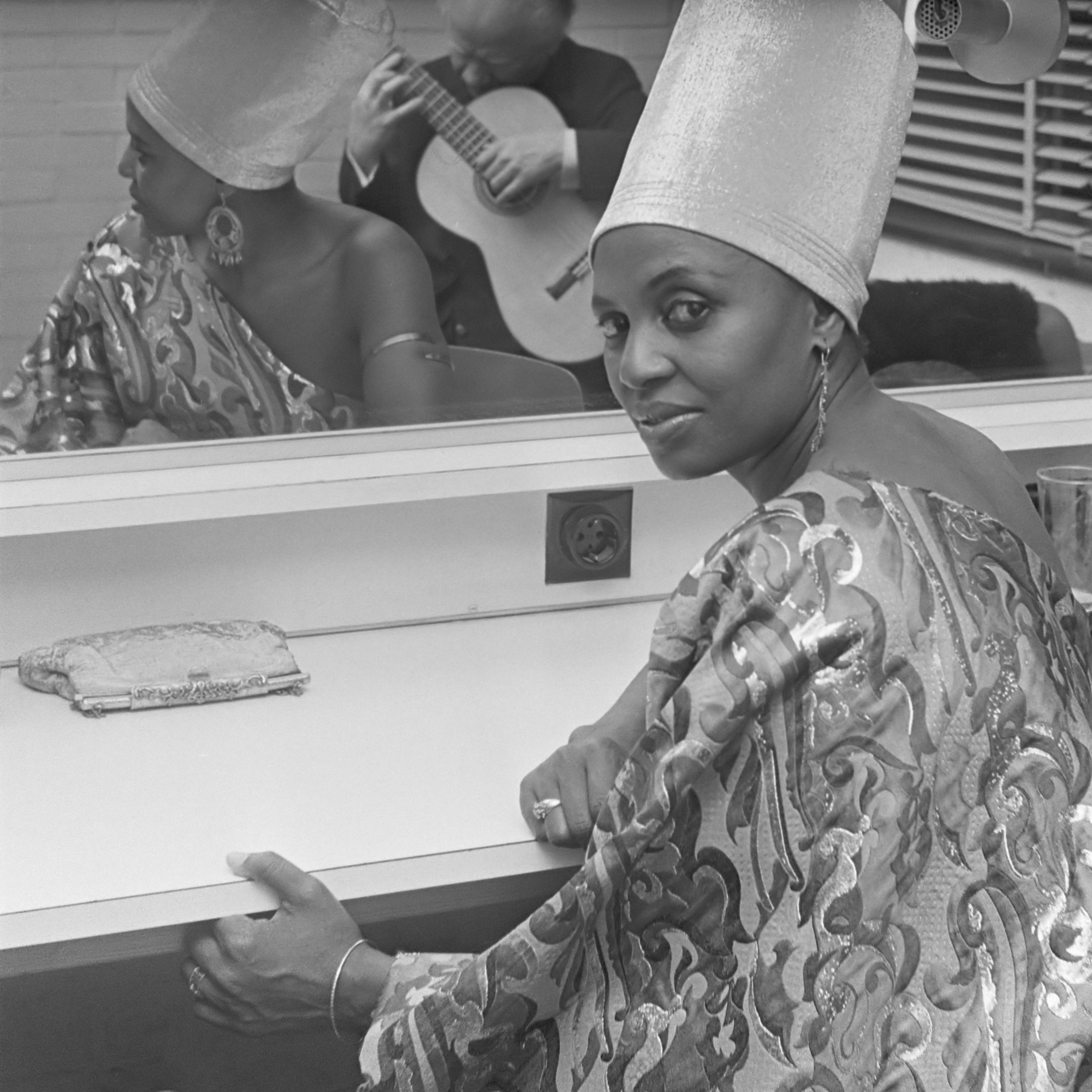
Photo: Rob Mieremet / Wikimedia Commons, Public domain
On the evening of November 9, 2008, a seventy-six-year-old singer walked onto a stage in Castel Volturno, Italy.
The concert was a benefit for a writer under threat for exposing organized crime.
The audience was small, the hall was modest, and the night was cold.
None of that mattered to Miriam Makeba, who had sung in far stranger rooms than this.
She had sung for emperors, presidents, and festival crowds of half a million people.
She had also sung in exile for thirty years, barred from the country of her birth.
That night, as she had done for more than half a century, she sang a little dance song.
It was a song about a dance from the townships of Johannesburg, and it lasted barely three minutes.
American teenagers had once danced to it without understanding a single word of Xhosa.
Her own government had banned it, along with everything else she ever recorded.
She used to introduce it with a smile and a shrug, because she considered it almost nothing.
Her voice went home long before she did.
The song was called “Pata Pata,” and that night in Italy she sang it one final time.
Nobody in the hall knew it would be the last song she ever performed.
To understand why, you have to go back to the shebeens of Johannesburg in the 1950s.
You have to follow a dance, a melody with several fathers, and a singer with nine passports.
It begins, as so many South African stories begin, with ordinary people making joy under pressure.
A Dance in the Shebeens of Johannesburg
The name “Pata Pata” simply means “touch touch” in Xhosa, Makeba’s mother tongue.
It was also the name of a dance beloved in the shebeens, the informal bars of Johannesburg’s townships.
Dancers crouched, rose, and spun, patting each other playfully in time with the beat.
It was cheeky, social, and impossible to perform without grinning.
Township bands built whole evenings around rhythms like it.
The dance belonged to the Saturday-night crowds of Johannesburg’s black townships.
It carried no message, no protest, and no politics whatsoever.
It was, quite simply, the sound of people enjoying themselves under a hard sky.
Which makes what happened to it later almost impossible to believe.
A Melody With Several Fathers
The tune itself was older than Makeba’s recording of it.
Her melody grew out of an instrumental record called “Phatha Phatha.”
That instrumental was made by Shumi Ntutu and Isaac Nkosi, two township musicians.
Their record, in turn, borrowed from an earlier song by Alson Mkhize.
Melodies in the townships were common property, passed hand to hand like gossip.
Dorothy Masuka, another great singer of the era, long claimed she had written Makeba’s version herself.
Accounts differ on that point, and they probably always will.
What is certain is who carried the melody out of the township and into history.
It was not carried by a hit songwriter in an office.
It was carried by a young singer from the all-woman group called the Skylarks.
First Sung With the Skylarks
Makeba first recorded “Pata Pata” in South Africa with the Skylarks, her Gallotone Records group.
Accounts differ on the exact year, placing the session in 1956 or 1959.
The Skylarks sang a blend of jazz and traditional South African melody.
Beside her stood Dorothy Masuka, whose singing Makeba had admired for years.
Music historians later called the Skylarks genuine trendsetters for their harmonies.
Makeba received no royalties at all for her work with the group.
That pattern, being celebrated and unpaid at the same time, would follow her for years.
In South Africa, the song lived as one township favorite among many.
Nobody involved imagined it ever crossing an ocean.
Then, in 1959, a film changed the singer’s life in four minutes flat.
Carried Across the Ocean
In 1959, Makeba appeared for just four minutes in the film “Come Back, Africa.”
The film had been shot in secret, because the authorities were expected to hate it.
Director Lionel Rogosin arranged for her to attend its premiere at the Venice Film Festival.
Her brief appearance, singing two songs, made an enormous impression on everyone who saw it.
From Venice she traveled on to London, and there she met Harry Belafonte.
Belafonte became her mentor and helped her record her first solo songs.
Among the songs she cut in London was an early version of “Pata Pata.”
The little township dance tune was now sitting in a London studio.
But the world was not ready to dance to it quite yet.
It would wait the better part of a decade for its moment.
The Long Wait
Makeba moved to New York and became a sensation in its jazz clubs.
She sang in Xhosa and Zulu, languages her audiences had never heard on a stage.
Her signature number became “Qongqothwane,” which Americans simply renamed “The Click Song.”
They gave it that name because they could not pronounce the Xhosa original.
In 1960, her mother died back in South Africa.
When Makeba tried to travel home for the funeral, her passport was cancelled.
That door stayed shut for thirty long years.
She testified before the United Nations against the system that barred her.
The government answered by revoking her citizenship and banning her records.
The singer was now stateless, famous, and unable to go home.
And still, the little dance song waited patiently in her repertoire.
She sang it in concert halls while the world slowly caught up.
Jerry Ragovoy and the 1967 Remake
In 1967, more than a decade after the Skylarks session, she recorded the song again.
This time the studio was American, and the producer was Jerry Ragovoy.
Ragovoy was a respected songwriter and producer in New York rhythm and blues.
He sharpened the arrangement into three minutes and ten seconds of pure bounce.
He also added a spoken passage in English, so that Americans could follow along.
In that passage, Makeba cheerfully explains where the dance came from.
Ragovoy’s name went onto the record as co-writer of the words and music.
Purists may argue about the credit, but the record itself is beyond argument.
It sounded like sunlight coming through a doorway.
Reprise Records released it as a single in November 1967.
The album that carried it was simply titled “Pata Pata” as well.

Number Twelve in America
The single climbed the Billboard Hot 100 and stopped at number twelve.
On the rhythm and blues chart, it climbed higher still, to number seven.
In Venezuela, the song went all the way to number one.
Radio stations played a Xhosa dance song between the biggest hits of the day.
Teenagers who could not find South Africa on a map knew every click and syllable.
Makeba herself remained cheerfully unimpressed by the whole phenomenon.
She called it “one of my most insignificant songs.”
She said it in interviews for the rest of her life, half laughing.
The record-buying public of three continents politely disagreed with her.
There was, however, one country where the hit was never heard on the radio.
Banned at Home, Sung Everywhere Else
In South Africa, “Pata Pata” was banned, like everything Makeba recorded.
Her records reached home audiences only through smuggled copies and word of mouth.
Even her cheerful, apolitical songs were treated as subversive by the authorities.
The singer herself had become the message, whatever the song was about.
Meanwhile, the rest of Africa adopted the song as a kind of anthem of joy.
At a stadium concert in Liberia, the crowd sang so loudly she could not finish it.
She stood there, by all accounts, laughing while thousands sang her own song back.
Her voice went home long before she did.
But the tune itself traveled without a passport, and it never once asked permission.
A Song With a Hundred Voices
Other singers quickly began recording “Pata Pata” for themselves.
The Supremes performed it for a television special in 1968.
Tito Puente gave it a Latin big-band treatment in 1969.
The Afro-rock band Osibisa recorded their own version in 1980.
In 1988, Makeba recorded a duet version with the singer Chayanne.
She revisited it again for her album “Welela” in 1990.
In 2000, she cheerfully updated it as “Pata Pata 2000” on the album “Homeland.”
Thalía carried it into Latin pop that same year, on “Arrasando.”
Pink Martini recorded it in 2016, and Herb Alpert followed in 2022.
It turned up in a Honda commercial in 2009 and in prestige television years later.
Every version is a postcard from the same Johannesburg dance floor.
Why the Dance Never Stopped
Part of the secret is the record’s sheer economy.
Three minutes, a bouncing rhythm, a smiling voice, and nothing wasted.
Part of it is the click consonants, which fascinated listeners raised on English.
Mostly, though, the song survives because it asks nothing and gives everything.
It never lectured, never mourned, and never tried to be important.
It simply invited everybody within earshot to get up and move.
Coming from a woman the world had tried to silence, that invitation meant more.
Her heavier songs carried the struggle, and this one carried the reason for it.
Joy, in her hands, was not the opposite of resistance but its engine.
The lightest song carried the heaviest exile.
Miriam Makeba: Mama Africa
A Baby in a Jail Cell
Zenzile Miriam Makeba was born on March 4, 1932, in Prospect Township near Johannesburg.
Her father, Caswell, was a Xhosa schoolteacher who played piano and sang.
Her mother, Christina, was a Swazi domestic worker with a house full of music.
The name Zenzile came from a Xhosa phrase meaning “you brought this on yourself.”
Her grandmother had muttered it over a difficult birth that nearly killed them both.
When Miriam was eighteen days old, her mother was arrested for selling homemade beer.
The family could not pay the small fine, so the baby went to jail too.
Miriam Makeba spent the first six months of her life behind bars.
It was an unpromising first address for a girl the world would call Mama Africa.
Music, thankfully, was waiting for her on the outside.
The Kilnerton Choir
Her father died when she was six, and the family scattered to survive.
Miriam was raised largely by her grandmother outside Pretoria.
She sang in the choir of the Kilnerton Training Institution for eight years.
There, teachers praised a voice that seemed far older than the girl.
She sang in English, Xhosa, Sotho, and Zulu at school and in church.
She later said she learned to sing in English before she could speak it.
Her brother collected records by Duke Ellington and Ella Fitzgerald.
She left school early and worked as a nanny and a laundress.
The work helped keep her mother’s household alive.
At seventeen, she entered a brief marriage, and in 1950 her daughter Bongi was born.
Diagnosed with breast cancer soon after, she survived, and she kept singing.
Within three years, she would be a professional.
The Only Woman in the Manhattan Brothers
Her professional start came with the Cuban Brothers, a close-harmony group.
At twenty-one, she joined the Manhattan Brothers, a popular jazz vocal group.
She was the only woman among them, and audiences noticed immediately.
In 1953, they recorded her first hit, “Lakutshona Ilanga.”
Its English version, “Lovely Lies,” released in 1956, quietly replaced the original’s sorrowful story with safer words.
It became the first South African record to chart on the American Billboard Top 100.
In 1955, she met a young lawyer named Nelson Mandela at a performance.
He later said he felt the girl he met “was going to be someone.”
In 1957, her face appeared on the cover of Drum magazine.
South Africa had made her a star, and then a film producer came calling.

King Kong and a Secret Film
In 1959, she sang the female lead in “King Kong,” a South African jazz opera.
The show played to racially mixed audiences, a rare sight under apartheid.
The young trumpeter Hugh Masekela was also in the cast.
That same year, director Lionel Rogosin cast her in “Come Back, Africa.”
The anti-apartheid film had to be shot in secret on Johannesburg streets.
Makeba appeared for only four minutes, singing two songs as herself.
Those four minutes helped the film win a critics’ prize at Venice and changed her life.
Rogosin arranged her visa, and she flew to Italy a township singer.
She came back a name the whole world was about to learn.
New York Fell for Her Overnight
On November 1, 1959, she made her American television debut on “The Steve Allen Show.”
Some sixty million viewers watched a South African singer perform in Xhosa and Zulu.
Her New York club debut followed soon after at the Village Vanguard.
Miles Davis and Duke Ellington were both in the audience that night.
Time magazine praised her as the most exciting new singing talent in years.
Belafonte, her mentor, handled the practical side of her early American career.
In 1962, she sang at President Kennedy’s birthday gala at Madison Square Garden.
Too ill for the party afterward, she was fetched by car at Kennedy’s own insistence.
She had arrived in America with almost nothing, and America was smitten.
Then, in 1960, terrible news had already arrived from home.
The Door Home Slams Shut
In 1960, two of her uncles were killed in the Sharpeville massacre.
Soon afterward, she learned that her mother had died back home.
When she tried to return for the funeral, she found her passport had been cancelled.
She was twenty-eight, famous on three continents, and effectively locked out of home.
In 1962, she testified before a United Nations committee and asked for sanctions.
She asked the world for an arms embargo against the South African government.
The reply from Pretoria was swift and total.
Her citizenship was revoked, her right to return was cancelled, and her music was banned.
Other nations stepped in, and over her life she held nine passports.
She was also granted honorary citizenship in ten countries.
Emperor Haile Selassie invited her to sing at the founding of the Organisation of African Unity.
She was the only performer invited to take part.
Almost everyone has stood at a window far from home, homesick for one ordinary street.
And almost everyone knows how a single familiar song can carry that street back.
Exile, however, came with an orchestra of unexpected gifts.
A Grammy With Belafonte
Her American career, meanwhile, kept climbing through the early 1960s.
She signed with RCA Victor and released her first solo album in 1960.
The album carried “The Click Song,” and American critics reached for superlatives.
Newsweek compared her phrasing to Ella Fitzgerald and her warmth to Frank Sinatra.
In 1965, she and Belafonte released “An Evening with Belafonte/Makeba.”
The album sang frankly about the plight of black South Africans.
On March 15, 1966, it won the Grammy Award for Best Folk Recording.
Makeba became the first African recording artist ever to win a Grammy.
She and Belafonte toured to sold-out halls across the United States.
During the album’s sessions, however, the two old friends had a serious disagreement.
They stopped recording together, though the music they made remains a landmark.
Her next chapter would cost her the country that had embraced her.
Exile Moves to Guinea
In March 1968, she married the activist Stokely Carmichael.
American promoters grew nervous, concerts were cancelled, and her American popularity collapsed.
Government agents placed her under surveillance, and microphones were hidden in her apartment.
While the couple traveled in the Bahamas, her American visa was revoked.
Unable to return to the United States, she and Carmichael settled in Guinea.
Guinea remained her home for the next fifteen years.
President Sékou Touré welcomed her, and she recorded for his state label, Syliphone.
In 1975, Guinea appointed her its delegate to the United Nations.
That year she addressed the General Assembly, pleading for South Africa’s liberation.
She performed at the great Zaire 74 festival in Kinshasa in 1974.

In 1976, schoolchildren rose in Soweto against being taught in Afrikaans.
Police opened fire on the students, and hundreds were killed.
Hugh Masekela wrote “Soweto Blues,” and Makeba sang it for decades afterward.
Her daughter Bongi died in 1985, leaving two grandchildren in Makeba’s care.
By then, her own road was bending toward yet another continent.
Brussels, and a Tour Called Graceland
After Bongi’s death, Makeba left Guinea and settled quietly in Brussels.
In 1986, Hugh Masekela introduced her to the American singer Paul Simon.

Simon invited her to join his “Graceland” tour, then crossing the world.
She performed part of that tour from a wheelchair after fracturing her leg.
Her presence drew criticism, because the album had been made during a cultural boycott.
The boycott was one she herself supported, which made the arguments sting.
The tour ended with two filmed concerts in Harare, Zimbabwe, in 1987.

A major American label signed her, and she released “Sangoma” in 1988.
The title honored her mother, who had trained as a traditional healer, a sangoma.
In June 1988, she sang at the televised Mandela birthday tribute at Wembley Stadium.
Some six hundred million people watched that concert around the world.
Going Home at Last
In February 1990, Nelson Mandela walked out of prison after twenty-seven years.
From exile, he urged his old friend Miriam to try coming home.
After months of effort, she received a visa lasting just six days.
On June 10, 1990, she entered South Africa on a French passport.
Thirty years of exile ended at an airport arrivals gate.
Singers and reporters crowded in, and Brenda Fassie sang at her welcome.
In 1991, she recorded “Eyes on Tomorrow” with Dizzy Gillespie and Nina Simone.
In April 1992, she performed in Johannesburg for the first time since 1960.
That year she also acted in “Sarafina!,” playing a mother with immense dignity.

In 1999, the United Nations named her a goodwill ambassador for its food agency.
She founded the Makeba Centre for Girls, a home for orphaned girls.

Home, at last, was not a memory but an address.
The Voice the World Kept
Across her career, she released more than thirty albums.
She sang in English and several African languages, but pointedly never in Afrikaans.
She explained that she would sing the rulers’ language when they sang hers.
Her natural hair and unadorned face helped define the “Afro look” worldwide.
South African schoolgirls copied her style despite rules that forced them to cut their hair.
In 2000, her album “Homeland” was nominated for a Grammy for Best World Music Album.
In 2005, she announced a farewell tour and then simply kept going.
Arthritis slowed her body, but it never once silenced the voice.
Musicians from Abbey Lincoln to Angélique Kidjo have traced their paths through hers.
Kidjo later dedicated a New York concert to the woman who paved her way.
Exile took her address, never her voice.
So return, finally, to that modest hall in Castel Volturno.
The writer she had come to support, Roberto Saviano, lived under guard for defying the Camorra.
Makeba understood that particular danger better than anyone in the room.
She had lost a country, a passport, and three decades for exactly that offense.
Naturally, she sang the dance song, the insignificant one, the township trifle.
The crowd heard three minutes of sunshine from a woman of seventy-six.
It was the last song she ever sang in public.
She died later that night, on November 9, 2008, at the age of seventy-six.
Mandela said that “her music inspired a powerful sense of hope.”
Her voice went home long before she did.
On the dance floors of the world, it is home still.
Leave a Reply