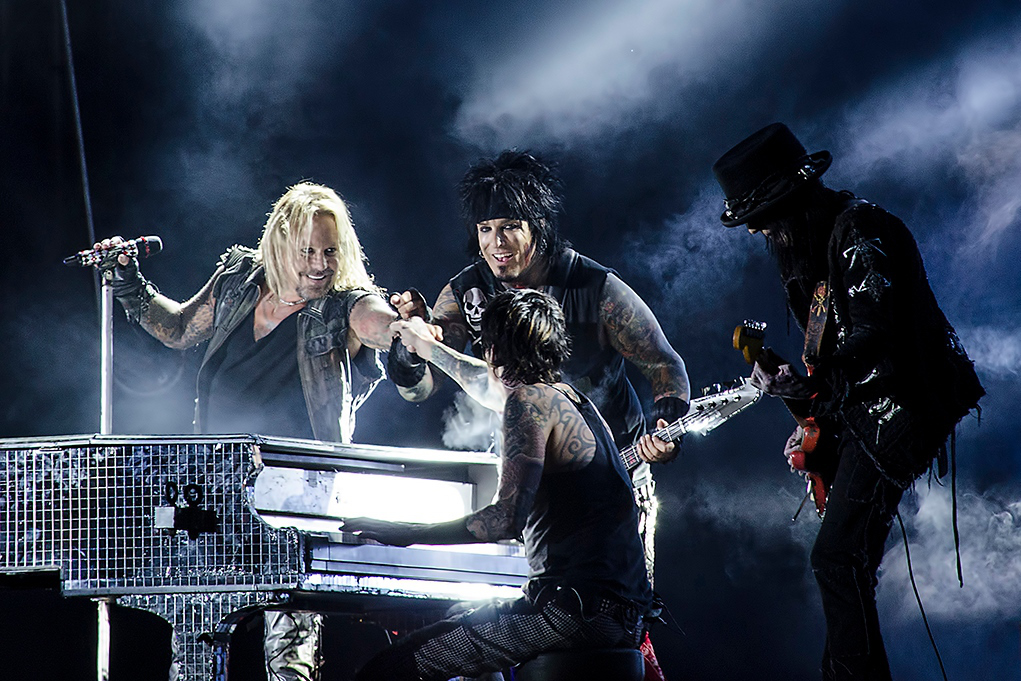
Photo: Bjornsphoto / Wikimedia Commons, CC BY 3.0
It is the spring of 1981, and four young men in Hollywood are trying to start a band that sounds like nothing else on the Sunset Strip.
The bass player has songs his old band rejected for being too heavy. The drummer has been banging on tables in time to those songs in the bass player’s living room. The guitarist answered a newspaper advertisement that read “Loud, rude and aggressive guitar player available.” And the singer — a high school friend of the drummer’s — has just agreed to join, after turning the band down once already.
They do not have a record deal. They do not have a name. Every label in town will pass on them. So they do what bands with no other option have always done: they press the record themselves.
On November 10, 1981, the first edition of 900 copies of Too Fast for Love was released on the band’s own label, Leathür Records. Forty-five years later, that scrappy debut — recorded in a few days in a small Los Angeles studio — stands as the starting point of one of the biggest-selling rock bands in American history, and one of the founding documents of glam metal. This is the story of how four unknown musicians from Hollywood made it, and what happened next.
Four Strangers in Hollywood
Mötley Crüe was formed in Hollywood, California, in 1981 by the bassist Nikki Sixx and the drummer Tommy Lee, with the guitarist Mick Mars and the lead vocalist Vince Neil joining right after. But the band almost did not happen at all — and its first line-up looked very different from the one that made the record.
The nucleus of the group first came together in early 1981, when the former Suite 19 guitarist and lead vocalist Greg Leon and Tommy Lee decided to form a new band. They attended the farewell gig of a popular local band called London, and Lee was already impressed by the image and stage presence of their bassist, Nikki Sixx. Even before meeting Sixx, Lee claimed he had posters of London on his bedroom walls. “Tommy just loved how Nikki looked,” Leon later recalled. “He was gung-ho about him, saying, ‘This is the guy we should get’.”
Sixx auditioned twice, but Leon felt he was “awful,” telling Lee, “He looks great. He’s great on stage. But he can’t play bass at all.” Lee subsequently became friends with Sixx and went to his Hollywood home to listen to new material he was working on. The music had been rejected by his London bandmates for being too heavy, and Lee said he immediately began banging on the table in time with the music and “everything just seemed to mesh.” Lee subsequently hired Sixx for the new band, prompting Leon to quit in protest. “I never played a show with Nikki Sixx,” Leon has said. “Tommy and I played together many times, but I was gone as soon as Nikki entered the picture.”
Sixx and Lee then began a search for new members and soon met the guitarist Bob Deal, better known as Mick Mars, after answering an advertisement he had placed in The Recycler that read: “Loud, rude and aggressive guitar player available.” Mars auditioned for Sixx and Lee, and was hired. Although a lead vocalist named O’Dean Peterson was auditioned, Lee had known Vince Neil from their high school days at Charter Oak High School in Covina, California, and the two had performed in different bands on the garage band circuit. Upon seeing Neil perform with the band Rock Candy at the Starwood in Hollywood, Lee suggested they have Neil join the band. At first Neil refused the offer. As the other members of Rock Candy started to think about moving in more of a New Wave direction, Neil grew anxious to try something else. Lee asked again; Neil was hired on April 1, 1981, and the band played its first gig at the Starwood nightclub on April 24.
Sixx later summed up what he wanted the band to sound like in a single sentence: “I wanted a band that would be like David Bowie and the Sex Pistols thrown in a blender with Black Sabbath.”
The band did not yet have a name. Neil has said that he told his bandmates he was “thinking about calling the band Christmas.” The other members were not very receptive to that idea. Then, while trying to find a suitable name, Mars remembered an incident that occurred when he was playing with a band called White Horse, when one of the other band members called the group “a motley looking crew.” He had remembered the phrase and later copied it down as “Mottley Cru.” After slight modification of the spelling, “Mötley Crüe” was eventually selected as the band’s name, with the stylistic decision suggested by Neil to add the two sets of metal umlauts, supposedly inspired by the German beer Löwenbräu, which the members were drinking at the time.
Nine Hundred Copies on Their Own Label
The band soon met its first manager, Allan Coffman, the thirty-eight-year-old brother-in-law of a friend of Mars’s driver. The band’s first release was the single “Stick to Your Guns” backed with “Toast of the Town,” released on its own record label, Leathür Records, which had a pressing and distribution deal with Greenworld Distribution in Torrance, California.
The first recording session for the album was in October 1981, a half year after the band first played the Starwood nightclub. They recorded for a few days with the engineer Avi Kipper at Hit City West, a small studio in South Robertson, Los Angeles. The album was self-produced by the band itself — credited simply to Mötley Crüe.
On November 10, 1981, the debut album Too Fast for Love was released on Leathür, selling 20,000 copies. The first edition was just 900 copies. There are three known vinyl pressings of the Leathür Records version, along with one known cassette. The first vinyl pressing had white lettering on the cover and the record label was white with black lettering. The back cover photo of Vince Neil shows him with a large airbrushed hairdo. The second pressing has red lettering on the cover and the record label is again white with black lettering, with a slightly different photo insert of the band. The third pressing has red lettering on the cover and the record label is black with white lettering.
It was a do-it-yourself record in the truest sense: a young band, a small studio, a few days of recording, and a label they had invented for themselves. Nobody in the music business expected it to go anywhere.
The Songs: Ten Tracks in Under Forty Minutes
The original Leathür release of Too Fast for Love runs 39 minutes and 37 seconds, with ten songs. All tracks were written by Nikki Sixx, except where noted — and Sixx wrote nearly all of them. Side one opens with “Live Wire,” followed by “Public Enemy #1” (written with Lizzie Grey), “Take Me to the Top,” “Merry-Go-Round” and “Piece of Your Action” (with lyrics by Vince Neil). Side two runs through “Starry Eyes,” “Stick to Your Guns,” “Come On and Dance,” the title track “Too Fast for Love” and the closer “On with the Show” (with lyrics by Neil).
The singles were “Stick to Your Guns,” released on May 3, 1981 — before the album itself — and “Live Wire,” released on August 16, 1982. “Live Wire” is the song that best captures what the band was in 1981: fast, loud, and direct, with a riff that sounds like it was written to be shouted along to in a crowded club. It became the band’s calling card, and it has stayed in their live set ever since.
Listening to the album today, what stands out is its rawness. The AllMusic reviewer Steve Huey later gave the album four stars and said that “Mötley Crüe essentially comes across as a bash-’em-out bar band, making up in enthusiasm what they lack in technical skill.” That is not an insult — it is the whole point. The record sounds like four young musicians playing as hard as they can in a small room, because that is exactly what it was.
Elektra Comes Calling
The Leathür release did its job. Coffman’s assistant Eric Greif set up a tour of Canada, while Coffman and Greif used Mötley Crüe’s success in the Los Angeles club scene to negotiate with several record labels, eventually signing a recording contract with Elektra Records in early 1982.
The album was remixed under the supervision of Roy Thomas Baker — the producer famous for his work with Queen — and rereleased on August 20, 1982, by Elektra. The Elektra version had a different track order and omitted “Stick to Your Guns,” as well as the first verse from the title track, and a re-recorded, shorter version of “Come On and Dance” appears on the re-release. The Elektra version runs 34 minutes and 4 seconds. The re-recorded album, with its slightly different artwork — red lettering on the cover and a different interior photograph of the band — has become the standard version from which all later reissues derive. The original mix remained unreleased on CD until 2002, when it was included in the Music to Crash Your Car To: Vol. 1 box set.
There was one wrinkle. The initial release of the album on Elektra in Canada, on both vinyl and cassette, was not the remixed version but the original Leathür version with an Elektra label on it, and it included “Stick to Your Guns.” This was released two months before the remixed version was released by Elektra worldwide, because Mötley Crüe was about to embark on a Canadian tour and Elektra wanted to ensure a product was available while the band was in the country.
“It was amazing because everyone had passed on us first time around…” Neil observed in 2000. “We were just happy that someone was prepared to mass-produce our records and that we could go out on real tours.”
Listening to Queen inspired Mötley Crüe to work with Roy Thomas Baker on Too Fast for Love. Tommy Lee later recalled: “He would come in, ‘Hello Darlings…’ and listen for maybe thirty minutes or so and leave. And we’re like, ‘What?! Where’s he going?’. But he produced Queen, so, man, we had to have him produce us, too.”
The Canadian tour that followed — the “Crüesing Through Canada Tour ’82” — produced several widely publicised incidents, including the band being arrested and then released at Edmonton International Airport for wearing their spiked stage wardrobe through customs, and a spurious “bomb threat” against the band that made the front page of the Edmonton Journal on June 9, 1982. Both, it later emerged, were staged publicity stunts arranged by the band’s management. The tour ended prematurely in financial disaster, but it gave the band its first international press.
The Reviews: Mixed Then, Revered Now
Too Fast for Love received mixed reviews on release; most reviewers found the music derivative and unoriginal, with negative comments about the band’s singing and playing, though a number did like the speed and rawness of the sound.
Retrospective reviews have been a lot more favourable. AllMusic’s Steve Huey gave the album four stars. Martin Popoff, in his Collector’s Guide to Heavy Metal, gave it 9 out of 10. Metal Storm rated it 8.8 out of 10, and PopMatters called it favourable. The Rolling Stone Album Guide gave it two and a half stars out of five.
The album’s reputation has only grown with time. In 2018, Collin Brennan of Consequence included it in his list of “10 Hair Metal Albums That Don’t Suck.” It ranks at No. 1 on Revolver’s list of “6 Glam-Metal Albums You Need to Own,” No. 1 on PopMatters’ “10 Essential Glam Metal Albums,” No. 9 on Rolling Stone’s “50 Greatest Hair Metal Albums of All Time,” No. 22 on Rolling Stone’s “100 Greatest Metal Albums of All Time,” and No. 1 on Guitar World’s “Top 20 Hair Metal Albums of the Eighties.”
The numbers tell their own story. While the album only reached No. 77 on the Billboard 200 in the United States, it would ultimately reach platinum status in the United States — certified Platinum by the RIAA for one million copies shipped — and Gold in Canada for 50,000 copies. Too Fast for Love was the earliest of seven consecutive Mötley Crüe studio albums to be certified gold or platinum by the RIAA — every album up to and including Generation Swine (1997) is at least certified gold.

What Came Next: From the Strip to the Stadiums
Too Fast for Love was only the beginning. The band became better known in the United States after playing at the US Festival on May 29, 1983. Their second album, Shout at the Devil, was released on September 26, 1983. It represented the band’s mainstream breakthrough in America and would eventually be certified four times platinum. They gained the attention of Ozzy Osbourne and became a support act on his 1984 tour for Bark at the Moon.
The band’s third album, Theatre of Pain, was released on June 21, 1985, and started a new glam metal phase in the band’s style. It reached No. 6 on the Billboard album chart and was eventually certified quadruple platinum. The fourth album, Girls, Girls, Girls, was released on May 15, 1987, and debuted at No. 2 on the Billboard 200. The band traded the glam elements of the previous album for a biker aesthetic.
The peak came with the fifth album, Dr. Feelgood, released in 1989 — the band’s only studio album to reach No. 1 on the Billboard 200. Its single “Kickstart My Heart” peaked at No. 16 on the mainstream chart in the United States. In all, the band has sold over 100 million records worldwide, achieved seven platinum or multi-platinum certifications, nine Top 10 albums on the Billboard 200, twenty-two Top 40 mainstream rock hits and six Top 20 pop singles.
The years of fame were also years of serious trouble. The band members became known for their hard-living lifestyles and wild stage style, and the excess took a heavy toll. In December 1984 Neil crashed his car, killing his passenger, the Hanoi Rocks drummer Nicholas “Razzle” Dingley. Neil was charged with DUI and vehicular manslaughter and sentenced to 30 days in jail, of which he served 18 days. Theatre of Pain was dedicated to Dingley’s memory. In February 1986, while in London, Sixx suffered a near-fatal heroin overdose. On December 23, 1987, Sixx suffered another heroin overdose and was declared clinically dead on the way to the hospital, but a paramedic revived him with two shots of adrenaline. His two minutes in death were the inspiration for “Kickstart My Heart.” Sixx eventually entered rehab in January 1988.

Why It Still Matters
Forty-five years on, Too Fast for Love is the sound of a band before it had anything to lose. There were no stadiums yet, no No. 1 albums, no film about their lives. There were four young men in Hollywood, a small studio in South Robertson, a few days of recording, and 900 copies of a record on a label they had made up themselves.
That is why the album still matters — and why it still sounds fresh. The songs are short, fast and direct. The playing is enthusiastic rather than polished. The whole record has the feeling of a band that knows it has one chance and intends to take it. Every label in town had passed on them, and they answered by pressing the record themselves and selling 20,000 copies of it. That is not just a good story; it is the story of how glam metal began — not in a boardroom, but in a club on the Sunset Strip, with a band that looked outrageous, played too fast, and refused to wait for permission.
The band that made Too Fast for Love went on to sell over 100 million records. But they never made another record quite like it: a debut made by four unknowns, on their own label, in a few days, with nothing but enthusiasm and a handful of songs Nikki Sixx had written in his living room. Forty-five years after November 10, 1981, it still sounds like the beginning of something — because it was.
Mötley Crüe: Four Unknowns from Hollywood Who Pressed Their Own Record
To understand Too Fast for Love, you have to understand the band that made it — and how quickly they went from nobodies to one of the biggest rock bands in the world.
The Formation: Spring 1981
Mötley Crüe was formed in Hollywood, California, in 1981 by the bassist Nikki Sixx and the drummer Tommy Lee, with the guitarist Mick Mars and the lead vocalist Vince Neil joining right after. The nucleus first came together in early 1981, when Greg Leon and Tommy Lee decided to form a new band. Lee was impressed by Sixx’s image and stage presence in the local band London, and after Sixx auditioned twice — Leon thought he could not play bass at all — Lee hired him anyway, after hearing the heavy new material Sixx was writing at home. Leon quit in protest.
Mars was found through his advertisement in The Recycler: “Loud, rude and aggressive guitar player available.” Neil, a high school friend of Lee’s from Charter Oak High School in Covina, California, was spotted performing with the band Rock Candy at the Starwood in Hollywood. He refused the offer at first, then accepted, and was hired on April 1, 1981. The band played its first gig at the Starwood nightclub on April 24, 1981.
The name came from a phrase Mars remembered from his time in the band White Horse, when another member called the group “a motley looking crew.” After slight modification of the spelling, “Mötley Crüe” was selected, with the two sets of metal umlauts suggested by Neil, supposedly inspired by the German beer Löwenbräu the members were drinking at the time.
The Leathür Years and the Elektra Deal
The band’s first release was the single “Stick to Your Guns” backed with “Toast of the Town,” on its own label, Leathür Records. The debut album Too Fast for Love followed on November 10, 1981, self-produced and released on Leathür, selling 20,000 copies. The band’s first manager, Allan Coffman, and his assistant Eric Greif used the band’s success in the Los Angeles club scene to negotiate with several record labels, eventually signing with Elektra Records in early 1982. The album was remixed under the supervision of Roy Thomas Baker and rereleased on August 20, 1982, by Elektra, with a different track order, without “Stick to Your Guns,” and with a shorter, re-recorded “Come On and Dance.” That Elektra version became the standard version from which all later reissues derive.
Breakthrough and the Big Years
The band’s mainstream breakthrough came with its second album, Shout at the Devil, released on September 26, 1983, which would eventually be certified four times platinum. Theatre of Pain followed on June 21, 1985, reaching No. 6 on the Billboard album chart and also going quadruple platinum. Girls, Girls, Girls was released on May 15, 1987, and debuted at No. 2 on the Billboard 200. Dr. Feelgood, released in 1989, became the band’s only studio album to reach No. 1. In all, the band has sold over 100 million records worldwide and achieved seven platinum or multi-platinum certifications.
Farewell, Reunion and the Long Afterlife
The band’s line-up changed over the years, leaving Sixx as the only consistent member. John Corabi replaced Neil as lead vocalist from 1992 to 1996, and Randy Castillo filled in on drums after Lee’s departure in 1999; Lee rejoined in 2004. What was planned to be the band’s final show took place on New Year’s Eve, December 31, 2015. After two and a half years of inactivity, the band reunited in 2018, and on March 22, 2019, it released new songs on the soundtrack for the Netflix biopic The Dirt. In the summer and fall of 2022 the band co-headlined a North American tour with Def Leppard. In October 2022, after 41 years of service, Mick Mars announced his retirement from touring, with John 5 replacing him.
Leave a Reply