
The tape was already rolling at Kaye-Smith Studios in Seattle when Randy Bachman told the band to run through the throwaway song one more time.
It was 1974, and Bachman–Turner Overdrive were deep into the sessions for their third album, Not Fragile.
The song on the studio floor that day was not meant for the album, the radio, or anyone outside a very small circle.
The band used it the way a carpenter uses a scrap of wood, striking it simply to test the tools.
Engineers walked the room adjusting microphones while guitar amplifiers warmed up and found their levels.
Robbie Bachman settled behind the drums and drove the beat hard, because even a test run deserved a real performance.
Fred Turner and Blair Thornton leaned into the riff as if the red light actually mattered.
Then Randy stepped to the microphone and sang the way a man sings when he believes nobody important will ever hear him.
His voice stumbled and stuttered through the chorus on purpose, tripping over the words in a private imitation.
The performance was loose, slightly sharp, slightly flat, and entirely unguarded.
At the end of the take, the singer can be heard laughing at his own joke.
The plan, such as it was, involved exactly one listener, and he was not in the building.
The joke was never meant to leave the room.
A Song Kept for Warm-Ups
Every working band keeps a piece of music that exists for practical reasons rather than artistic ones.
In the studio, engineers need a steady, familiar sound source while they position microphones and set recording levels.
Bachman–Turner Overdrive used this particular song for exactly that unglamorous purpose during the Not Fragile sessions.
The band called it their work song, a label that promised nothing and asked for nothing.
Because it carried no pressure, the musicians played it with a looseness they rarely allowed on the keeper takes.
Randy Bachman produced the band’s records himself, which meant the work song answered to nobody’s quality control but his own.
Had the track been intended for the public, the stumbling vocal would have been the first thing fixed.
Instead, the stutter stayed, because the stutter was the entire point of the exercise.
Written Out of the Blue
The song began its life as an instrumental built around a strutting rhythm-guitar figure.
Bachman has said the groove was inspired by the guitar work on Dave Mason’s “Only You Know and I Know.”
The words arrived the way the singer later described them, suddenly and almost out of the blue.
The lyric told of a smooth-talking narrator finally meeting a woman completely unimpressed by his lines.
Into that boast, Bachman folded a stutter, a private joke aimed at his brother Gary, who stuttered in everyday speech.
By Bachman’s own account, Gary took the teasing in good humour, as brothers in that family apparently did.
The arrangement was simple enough to be nearly indestructible: verse, chorus, guitar, and a beat like a door slamming.
The band recorded the vocal once, in a single laughing pass, and considered the joke complete.

Eight Good Tracks and No Single
By the time the album sessions wound down, the band had eight finished tracks they believed in.
The songs were heavy, confident, and built for the arenas the band was beginning to fill.
What they did not obviously contain was a single, the one bright track radio could carry everywhere.
Charlie Fach, the Mercury Records executive who had signed the band, listened to the album and said exactly that.
The eight songs had power, Fach felt, but they lacked the particular magic that makes a hit single.
Somebody in the room finally asked the question that changed the album: what about the work track?
Bachman resisted, explaining that the ninth song was a joke he had sung once for his brother.
He warned them it was sharp, it was flat, and he was laughing by the end of it.
Fach, smiling at the description, asked to hear the joke for himself.
The Take They Could Not Beat
The work tape rolled, and the room heard what the microphones had captured weeks earlier.
The performance sounded loose and bright, as if it were floating above the polished tracks around it.
Fach gave his verdict in three words: “That’s the track.”
Bachman agreed to add the song to the album only if he could re-record the vocal properly, without the stutter.
He went back into the studio and sang it straight, carefully, like a professional.
By his own cheerful admission, the result made him sound like Frank Sinatra, and it fit the band not at all.
The clean version had technique, but the joke version had life, and everyone in the room could hear the difference.
Fach told him to leave the stutter exactly where it was.
So the first, laughing take went onto the album unchanged, stumbles and all.
The joke was never meant to leave the room.

An Album Built to Be Dropped and Kicked
Not Fragile arrived in August 1974, its title a tongue-in-cheek answer to Fragile, the delicate-sounding hit album by Yes.
Bachman liked to say that BTO’s music could be dropped and kicked without breaking, and the new record set out to prove it.
The album introduced guitarist Blair Thornton, billed in the liner notes as the band’s second lead guitar.
His twin-guitar attack with Bachman gave the record a thicker, more flexible sound than its predecessors.
Fred Turner’s gravel voice carried songs like the title track and “Roll on Down the Highway.”
Thornton also contributed “Free Wheelin’,” the only instrumental in the band’s entire catalogue.
By late October, Not Fragile had climbed to No. 1 on the Billboard 200 and topped the Canadian album chart as well.
It has since sold more than eight million copies and remains the group’s best-selling studio album.

Radio Refused to Wait
Nobody at Mercury had planned to release the joke song as a single at all.
Then American radio stations began pulling it straight off the album and playing it on their own initiative.
Listeners responded immediately, requesting the stuttering track that sounded like nothing else on the dial.
Bachman, by his own account, was embarrassed, convinced the song was a stupid thing he had written as a joke.
Charlie Fach kept telephoning with airplay reports and one recurring request: permission to release the single.
Bachman refused for three full weeks, using the producer’s final say that he held over the band’s output.
Then he remembered that some of his favourite records were gloriously silly things like “Louie Louie.”
He called Fach, gave his permission, and offered a prediction in five words: “I bet it does nothing.”
A Single Nobody Expected
Mercury released the single in September 1974, backed with Thornton’s instrumental “Free Wheelin’” on the flip side.
It entered the Billboard Hot 100 at No. 65 in the week ending September 21, 1974.
The trade papers heard something familiar in it and said so in print.
Record World compared its charge to The Who’s “My Generation” and “Pinball Wizard,” hearing the same youthful stutter turned into a hook.
Billboard praised the melody and the vocal hook, and Cash Box called it among the best rockers of the year.
The stutter that had been a brother’s private joke was suddenly being debated by critics as a stroke of pop genius.
Radio, which had started the whole stampede, kept the record spinning week after week.
November 9, 1974
Seven weeks after its chart debut, the single completed its climb.
In the week of November 9, 1974, “You Ain’t Seen Nothing Yet” reached No. 1 on the Billboard Hot 100.
Fifty-two years later, that date still marks the summit of the band’s American chart history.
The same week, the song also topped Canada’s RPM singles chart, giving the band a coronation at home and abroad.
It went on to reach No. 1 in Germany, Denmark, and South Africa as well.
In Britain it climbed to No. 2, held off the top only by Mud’s festive hit “Lonely This Christmas.”
It remains the only No. 1 single Bachman–Turner Overdrive ever scored in the United States.
It also made Randy Bachman one of the very few musicians to top the American chart with two different bands.
The Strangest Chart Ride in Rock
Most No. 1 singles fade politely, sliding down the chart a few places at a time.
This one fell out of the sky, dropping all the way to No. 34 within two weeks of its peak.
Then, defying every rule of chart gravity, it climbed back into the top ten at No. 8 for two more weeks.
The second surge owed much to the flip side, as curious buyers flipped the record over for “Free Wheelin’.”
The song still holds the record for the farthest fall from No. 1 before returning to the top ten.
Its split calendar even cheated it out of the year-end honours its peak should have guaranteed.
Billboard’s point system scattered its strength across two chart years, leaving it off the 1974 list entirely and at No. 98 for 1975.
The Afterlife of a Throwaway Song
In 1976, the single won a Juno Award in Canada, where it was honoured as the year’s best-selling single.
The record earned gold certification in the United States, and the album behind it kept selling for decades.
Other artists returned to it, most successfully Figures on a Beach, whose 1989 cover reached No. 67 on the Hot 100.
A remixed version later served as the theme for ITV’s Formula One coverage in Britain between 2003 and 2005.
That television run introduced the song to a new British generation and sent the original back onto the radio.
Its title even echoed the old show-business catchphrase that Al Jolson had made famous in The Jazz Singer.
Half a century on, the track opens classic-rock playlists with the same grin it wore in the studio.
The throwaway take outlived every careful one.
Bachman–Turner Overdrive: The Blue-Collar Rockers
A Winnipeg Guitarist
Randolph Charles Bachman was born in Winnipeg, Manitoba, on September 27, 1943.
He won a children’s singing contest at the age of three and took up the violin at five.
Formal lessons bored him, but he discovered he could play almost anything after hearing it only once.
At fifteen, he saw Elvis Presley play guitar on television and decided his own future on the spot.
At sixteen he met jazz guitarist Lenny Breau, who spent two years teaching the teenager fingerstyle technique.
He also helped Les Paul set up for a Winnipeg supper-club show and received a guitar lesson as thanks.
The Guess Who Years
In 1960, Bachman co-founded a Winnipeg band with singer Chad Allan that eventually became The Guess Who.
Their cover of “Shakin’ All Over” topped the Canadian chart in 1965 and announced a serious new act.
After Burton Cummings took over as lead singer, the band’s songwriting sharpened considerably.
Bachman wrote or co-wrote most of the group’s material, including the 1969 international breakthrough “These Eyes.”
In 1970, “American Woman” climbed to No. 1 on the Billboard Hot 100, a first for any Canadian band.
The song’s three weeks at the summit made The Guess Who the biggest rock act Canada had ever produced.
Bachman stood at the centre of it, a hit songwriter with a hit band at the age of twenty-six.
Walking Away at the Top
Almost immediately, he walked away from all of it.
He played his final concert with The Guess Who in May 1970, while “American Woman” still sat at No. 1 in America.
His health had broken down under the touring schedule, and a gall bladder condition demanded a doctor’s regular care.
He had also converted to the Church of Jesus Christ of Latter-day Saints, whose lifestyle sat uneasily beside rock-band life.
By his own account, he also wanted more time with his family than the road would ever allow.
Some in the business, he later recalled, called him a lunatic and a loser for leaving.
Before departing, he had recorded a solo album, Axe, in just three days in March 1970.
It was a strange exit: a man leaving the biggest band in the country to start over in Winnipeg.
Brave Belt
Back home in Winnipeg, Bachman started again with the least glamorous material imaginable: country rock.
The new band, Brave Belt, reunited him with Chad Allan and put his eighteen-year-old brother Robbie behind the drums.
Another brother, Gary, managed the band’s business affairs during its first incarnation.
Brave Belt’s first album leaned toward the crossover sound of bands like Buffalo Springfield and sold poorly.
On Neil Young’s suggestion, Bachman hired a Winnipeg bassist and vocalist named C. F. Turner, called Fred by everyone who knew him.
Turner’s throaty roar dragged the band’s sound toward hard rock almost immediately.
Chad Allan soon departed, and a third Bachman brother, Tim, joined as second guitarist.
Even so, Brave Belt II stalled commercially, and its supporting tour was cancelled halfway through.
The Night the Floor Filled Up
The band’s true sound was discovered by accident at Lakehead University in Thunder Bay, Ontario.
A promoter, unhappy with the crowds for their country-flavoured sets, fired Brave Belt from the weekend shows.
When the replacement rock band failed to appear, the promoter begged them to stay and play covers instead.
They tore through standards like “Proud Mary,” “Brown Sugar,” and “All Right Now,” and the dance floor filled instantly.
Bachman later said the lesson was obvious: people would jump up for music they could dance to.
Certain their label would drop them, Bachman asked for his release from the contract instead.
He then emptied his own bank account to finance one more set of recordings.
The finished tapes were rejected by label after label, twenty-two rejection letters in all.
The Demo That Missed the Trash Can
The rescue, when it came, arrived through Charlie Fach of Mercury Records and a lucky bounce.
Fach returned from a trip to France to find his desk stacked with demonstration tapes he did not want.
He swept the pile into a trash can, but one tape missed the can and landed on the floor.
Picking it up, he saw Bachman’s name and remembered promising the guitarist a listen the year before.
Mercury had just lost Uriah Heep and Rod Stewart, and Fach needed new rock acts urgently.
He played the tape, heard the boogie of “Gimme Your Money Please,” and called Winnipeg.
The band had a record deal, signed by the one executive who had dropped their tape and picked it up again.
A Name on a Napkin
The rescued demo still carried the working title Brave Belt III, and Fach insisted the band needed a new name.
Driving back from a Toronto engagement, the musicians stopped at a steak house in Windsor, Ontario.
Someone picked up a copy of Overdrive, a magazine aimed at professional truck drivers.
Turner wrote three words on a napkin, joining the two surnames to the magazine’s title.
Bachman–Turner Overdrive, the band agreed, described their music exactly: heavy machinery at full throttle.
The initials B.T.O. fit on a marquee, and the gear-shaped logo fit everywhere else.
Takin’ Care of Business
The first album, released in May 1973, broke through in American border cities like Detroit and Buffalo.
It had no hit single, so the band promoted it the hard way, playing wherever radio gave them a chance.
That first year reportedly included more than three hundred concert dates across North America.
Bachman–Turner Overdrive II followed in December 1973 and carried the band into the American top five albums.
Its singles “Let It Ride” and “Takin’ Care of Business” became the group’s calling cards.
Bachman had drafted the second song years earlier, in his Guess Who days, under the title “White Collar Worker.”
A Winnipeg disc jockey’s sign-off phrase gave him the new chorus, and Turner’s voice gave it its blue-collar growl.
Fans adopted the band’s gear logo and a nickname of their own, calling themselves gearheads.
Early in 1974, Tim Bachman departed and Vancouver guitarist Blair Thornton took his place.

The Biggest Years
The run that followed made BTO one of the biggest rock exports Canada had ever produced.
Not Fragile spent the autumn of 1974 at No. 1 while its joke single conquered the singles chart.
Four Wheel Drive arrived in May 1975 and reached the top five in both the United States and Canada.
Its single “Hey You” gave the band a second Canadian No. 1, though it stalled at No. 21 in America.
Head On followed that December, with Little Richard guesting at the piano on “Take It Like a Man.”
The 1976 compilation Best of B.T.O. (So Far) became the group’s best seller to that point, earning double platinum in the United States.
The band worked at a pace of two albums a year, plus tours that circled the continent.
Across the decade, the band placed five albums in the American top forty and seven at home in Canada.
Burnout and Freeways
Success at that speed eventually presented its bill, and the band was too tired to argue with it.
Freeways, released in February 1977, found the members pulling in different musical directions.
Bachman wanted to stretch the sound with horns and strings, while the others wanted simply to stop and regroup.
Turner later recalled that the band told its leader plainly: they were burned out and disliked the new songs.
Bachman, who was financing the operation, pushed the album through anyway, and it underperformed badly.
In 1977 he left the band he had built, conceding that they had run out of common interests.
He later admitted they should have taken six months off, lived a little, and returned with fresh ideas.
The remaining members bought the rights to the BTO name and carried on without him.
BTO Without Bachman, and the Returns
The Turner-led lineup released Street Action in 1978 and Rock n’ Roll Nights in 1979 to disappointing sales.
By early 1980, the original incarnation of the band had officially disbanded.
Bachman, meanwhile, recorded solo work and formed the short-lived band Ironhorse.
The reunions began in 1983, producing a new self-titled album the following year with Garry Peterson on drums.
That lineup opened for Van Halen on the enormous 5150 tour in 1986, playing to the biggest crowds of its life.
In 1988, the classic Not Fragile lineup reformed and toured together until Randy Bachman departed again in 1991.
A version of BTO without him then toured steadily for more than a decade, keeping the catalogue on the road.
In 2009, Bachman and Turner reteamed under their own names, and their reunion soon carried them to the Grey Cup halftime stage in Edmonton.
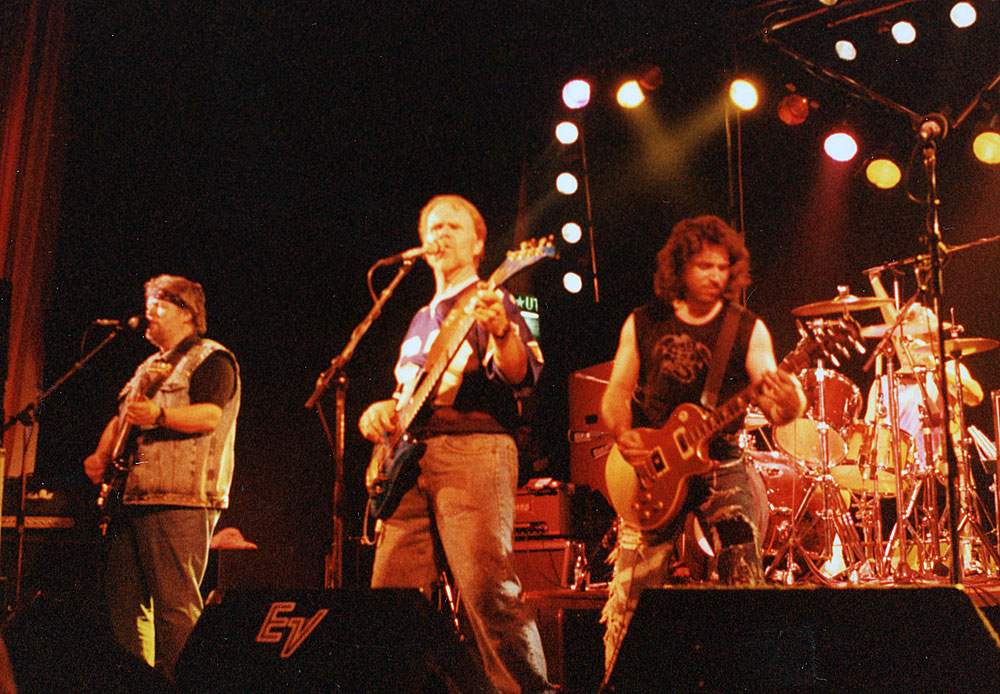

Honours, and a Shift That Never Ended
Canada, which had watched the band conquer America first, eventually made the honours official.
BTO won seven Juno Awards during the 1970s, including Group of the Year in both 1975 and 1976.
An attempted Canadian Music Hall of Fame induction in 2003 collapsed over disagreements about which lineup would perform.
In March 2014, the classic lineup was inducted at last, presented by astronaut Chris Hadfield.
The four men performed together that month for the first time since 1991.
Turner retired from music in 2018, closing the partnership that had powered the band’s sound.
Drummer Robbie Bachman died in January 2023, and guitarist Tim Bachman followed in April of the same year.
That same year, Randy Bachman relaunched BTO on the road, carrying the gear logo into its sixth decade.
The band’s influence hides in plain sight, in every bar band that chooses sweat over subtlety.
Bachman himself became a beloved Canadian broadcaster, hosting the CBC radio show Vinyl Tap for sixteen seasons.
He was made an Officer of the Order of Canada in 2008 and entered Canada’s Walk of Fame twice.
In 2000, the band even appeared as themselves on The Simpsons, an honour reserved for genuine institutions.
The group’s catalogue has sold more than thirty million albums worldwide.
Somewhere tonight, a driver on a late highway is turning this music up just as the chorus stumbles in.
Every listener knows that feeling, when the song you never planned to love becomes the one the drive cannot do without.
The shift ended; the songs never clocked out.

The studio in Seattle is a quieter place these days, its moment of carelessness long since absorbed into rock history.
But go back to that work tape for a moment, to the amplifiers humming and the microphones being nudged into place.
Nothing about the performance suggests destiny, and that is precisely its charm.
A singer fooled around for an audience of one, stumbled over the chorus on purpose, and laughed at the end.
The tape was supposed to be mailed away, filed, and forgotten, the way most jokes are.
Instead it was pressed into vinyl, shipped to radio stations, and sung back by millions of strangers.
Fifty-two years after it reached No. 1, it still sounds like four men enjoying themselves far too much to be professional.
The joke was never meant to leave the room.
Leave a Reply