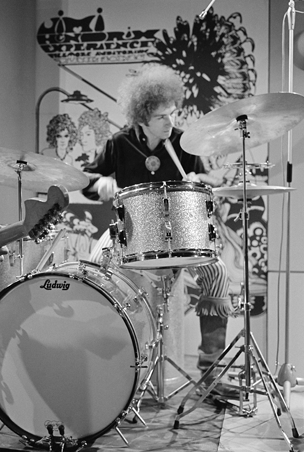
On the morning of Wednesday, 12 November 2008, in a hotel room in Portland, Oregon, the music stopped for John Graham “Mitch” Mitchell. He was sixty-two years old, and he had spent the night exactly where he had spent most of his life: on the road, with drums waiting somewhere nearby and the songs of Jimi Hendrix still ringing in his ears. Five days earlier he had played the final night of the Experience Hendrix tour in that same city. He had stayed on for a four-day holiday before heading home. He never left.
It was a quiet ending for a man who had lived at full volume. Mitch Mitchell was not the kind of drummer who kept time in the background and waited to be noticed. He played like a jazzman who had wandered into a rock band — and in a sense, that is exactly what happened. His drumming was fast, restless and melodic, a storm of cymbals and tom-toms answering every phrase of Hendrix’s guitar as if the two instruments were finishing each other’s sentences. When the Jimi Hendrix Experience was inducted into the Rock and Roll Hall of Fame in 1992, it was as a trio: Hendrix, bassist Noel Redding, and the drummer from Ealing who had won his place in the band on the toss of a coin. In 2016, Rolling Stone ranked him the eighth-greatest drummer of all time.
A Boy from Ealing

John Graham Mitchell was born on 9 July 1946 in Ealing, Middlesex, in west London, the son of Phyliss and Thomas Mitchell. Before he was a drummer, before he was a musician at all, he was an actor.
At thirteen, he took a leading role in the British comedy film Bottoms Up (1960), appearing alongside the comedian Jimmy Edwards. As a teenager he went on to star in the children’s television programme Jennings at School, and he had a small part in the 1963 film Live It Up!, a pop musical whose cast included the singer Heinz Burt, the actor David Hemmings and a young Steve Marriott, who would go on to front the Small Faces and Humble Pie.
But acting was not where his heart settled. Music was. And the place where music found him was one of the most famous shops in British rock history: Jim Marshall’s drum shop, where the teenage Mitchell worked on Saturdays while he was still at school. Marshall ran a shop that was a meeting place for every drummer in London, and the boy behind the counter was listening to all of them. It was there, surrounded by drums and drummers, that Mitchell became a musician.
His heroes were not rock drummers at all. They were jazzmen: Elvin Jones, the volcanic force behind John Coltrane; Tony Williams, the teenage prodigy who rewrote the rules of jazz drumming with Miles Davis; Max Roach, the bebop pioneer whose drums sang like a horn; and alongside them Philly Joe Jones and Joe Morello. These were drummers who did not simply keep time — they conversed, provoked and soloed around the beat. Years later, when people tried to explain what made his playing with Hendrix so different from every other rock drummer of the era, the answer always came back to jazz. He played rock with a jazz drummer’s ears and a jazz drummer’s hands.
His first band was the Soul Messengers, formed at the Ealing Club with saxophonist Terry Marshall — Jim Marshall’s son. The Ealing Club, a basement venue at 42A The Broadway, was one of the cradles of British rhythm and blues, the room where Alexis Korner and Cyril Davies had lit the fuse of the London blues boom. To start a band there was to step into the very current of British music.
The years that followed were the hard education of a working musician. Mitchell toured and recorded as a session player, moving from band to band: Pete Nelson and the Travellers, Frankie Reid and the Casuals in 1962, Johnny Harris and the Shades, Bill Knight and the Sceptres, and the Riot Squad. He even sat in as a session drummer with the Who while the band was replacing Doug Sandom with Keith Moon. In 1965, he temporarily replaced Viv Prince as the drummer of the Pretty Things, one of the rawest rhythm-and-blues bands in London. He was nineteen, and he had already played with some of the most ferocious bands in Britain. He did not know it yet, but he was being prepared for something no drummer had ever been asked to do.
The Blue Flames School
In December 1965, Mitchell joined Georgie Fame and the Blue Flames, one of the finest bands on the London scene. Fame was a superb singer and keyboard player whose band played a cool, swinging mixture of rhythm and blues, jazz, ska and soul, and the Blue Flames were famous for their precision: tight arrangements, crisp horn lines, and a rhythm section that swung like a jazz group while it grooved like a soul band. Mitchell stayed with them for ten months, from December 1965 until October 1966, and he played on their 1966 album Sweet Things.
It was a demanding school: it taught him how to play with discipline inside a tight arrangement, and how to let loose when the music asked for it. Georgie Fame remembered him fondly years later. In a 2015 interview, Fame recalled that Mitchell’s great hero was the jazz drummer Ronnie Stephenson, and that the young drummer even carried himself like Stephenson — “if you look at early film clips of Mitch, he had that Ronnie Stephenson look, the way he set his jaw.” What Fame also had to manage was Mitchell’s love of crashing around on the cymbals like his hero. “In my band I liked the arrangements pretty tight,” Fame said. “When he started splashing around I’d say ‘just play the hi-hat!’”
It is a small, affectionate memory, and it tells you everything about the drummer Mitchell already was: a jazz drummer at heart, bursting with ideas, happiest when he was allowed to splash and crash and fill every corner of the music. The Blue Flames taught him control. What he needed next was a band that would let him use all of it.
The Coin Toss

In September 1966, the American guitarist Jimi Hendrix arrived in London. He had been discovered playing in a Greenwich Village nightclub in New York by Chas Chandler, the bassist of the Animals, who was leaving his band to become a manager and producer. Convinced this unknown guitarist was something the world had never heard, Chandler brought Hendrix to England on 24 September 1966 and set about building a band around him.
The auditions were held in London in the first week of October. Mitchell, twenty years old and fresh from the Blue Flames, walked in on 6 October 1966 to try out for a guitarist nobody in Britain had heard of. Also auditioning was Aynsley Dunbar, a fine and experienced drummer who would go on to play with John Mayall, Frank Zappa and Jefferson Starship. The two men were, by most accounts, evenly matched. The decision, famously, came down to a coin toss — and the coin fell Mitchell’s way.
It is one of the great sliding-doors moments in rock history. Had the coin landed the other way, the Jimi Hendrix Experience would have had a different drummer, a different sound, a different heartbeat. Instead, the job went to the twenty-year-old from Ealing with the jazz heroes and the restless hands. Alongside him, Chandler had recruited Noel Redding, a guitarist who switched to bass for the job. Within weeks, the trio was rehearsing, recording and playing live.
Mitchell’s fast, driving, jazz-influenced playing meshed perfectly with Hendrix’s open-ended, revolutionary approach to the electric guitar. Where most rock drummers of the time anchored the beat and stayed out of the way, Mitchell played across it, around it, through it — filling the spaces Hendrix left, answering the guitar’s wildest flights with drum patterns of his own. It was not accompaniment; it was conversation. Hendrix played like no one before him, and he needed a drummer who could keep up with a mind that never stopped moving. Mitchell could.
Three Albums That Changed Everything
What the Experience achieved in the eighteen months after that audition remains one of the most astonishing runs in the history of recorded music. The band’s first single, “Hey Joe”, was released in December 1966, and “Purple Haze” followed in March 1967, reaching No. 3 in the United Kingdom. Then, on 12 May 1967, Track Records released the band’s debut album, Are You Experienced. It spent thirty-three weeks on the British album chart, peaking at No. 2 — held off the top only by the Beatles’ Sgt. Pepper’s Lonely Hearts Club Band — and in the United States, where Reprise released it on 23 August 1967, it reached No. 5 on the Billboard chart and stayed there for 106 weeks.
Mitchell’s drumming is all over that record. On “Fire” he drives the band like a runaway train. On “Manic Depression” he plays a rolling, jazz-waltz pattern that no rock drummer had ever attempted on a pop record. Listen today and the drums still sound startling — busy, melodic, fearless, unlike the drumming on any other record of 1967.
On 18 June 1967, just five weeks after the album’s British release, the Experience played the Monterey International Pop Festival in California. Hendrix was still largely unknown in America; Brian Jones of the Rolling Stones introduced the band, and the Experience played a fierce set that included “Killing Floor”, Bob Dylan’s “Like a Rolling Stone” and “Foxy Lady”. Hendrix ended with “Wild Thing”: he knelt over his Stratocaster, poured lighter fluid on it, set it on fire, and smashed the guitar against the stage. It was one of the most famous moments in rock history, and Mitchell was there behind him, playing through all of it on the Premier drum kit he had debuted with the Experience that year. He switched to Ludwig drums later that summer and stayed with Ludwig through 1968 and 1969, with a Ludwig Supraphonic 400 snare as his constant companion — except at Woodstock, where he played a Rogers Powertone snare.
The band barely paused. On 1 December 1967, the Experience released their second album, Axis: Bold as Love, which reached No. 5 in Britain and No. 3 in the United States. It was a more delicate, more lyrical record than the debut — “Little Wing”, “Spanish Castle Magic”, “Up from the Skies” — and Mitchell’s playing grew lighter and more spacious with it. And then, on 25 October 1968, came the third album, Electric Ladyland, a double album recorded mostly in New York at the Record Plant studio, with guests including Steve Winwood of Traffic and Jack Casady of the Jefferson Airplane. It reached No. 1 in the United States and No. 6 in Britain: “All Along the Watchtower”, Bob Dylan’s song transformed into a towering epic; “Voodoo Child (Slight Return)”; “Crosstown Traffic”. Mitchell played on all three albums, and his drumming grew with each one — more confident, more inventive, more his own.
The Wildest Nights
The Experience was, above all, a live band. The band toured relentlessly — Britain, Europe, America. In January 1968 alone, they embarked on a gruelling American tour encompassing fifty-four concerts in forty-seven days. Mitchell played every one of them, at a pace that would have broken most drummers. He did not break. He got better.

In December 1968, Mitchell took part in one of the strangest one-night stands in rock history. He played drums with the Dirty Mac, an impromptu band assembled for The Rolling Stones Rock and Roll Circus, a filmed television special. The line-up was extraordinary: John Lennon as vocalist and rhythm guitarist, billed under the pseudonym “Winston Leg-Thigh”; Yoko Ono providing improvised primal screams; Eric Clapton on guitar; and Keith Richards on bass. The group recorded a cover of the Beatles’ “Yer Blues” and a free-form jam called “Whole Lotta Yoko”. For one night, the drummer from the Experience sat at the centre of a band made up of a Beatle, a Rolling Stone and the guitarist of Cream — and he held it together as if he had been playing with them for years.

The following summer came the biggest stage of all. The Experience had broken up in June 1969, when Noel Redding quit, but Mitchell remained with Hendrix, and he performed with Hendrix’s expanded line-up at the Woodstock festival in August 1969. Hendrix was the festival’s closing act, and delays pushed his set to the morning of Monday, 18 August. It was there that he played his famous, searing interpretation of “The Star-Spangled Banner” — and there, behind him, was Mitch Mitchell, keeping the music grounded while Hendrix’s guitar soared over the fields of upstate New York.
After Woodstock, Hendrix formed the Band of Gypsys with drummer Buddy Miles and bassist Billy Cox, and Mitchell was briefly replaced for the Band of Gypsys album in 1970. But the separation did not last. Mitchell rejoined Hendrix, with Billy Cox on bass, for the Cry of Love Tour, which ran from April to September 1970 — the last tour of Hendrix’s life. For that final stretch, Mitchell switched to a double-bass Gretsch drum set, the biggest kit he had ever played.
After the Music Stopped
On 18 September 1970, Jimi Hendrix died in London, at the age of twenty-seven. He had been working on a new album, tentatively titled First Rays of the New Rising Sun, and the sessions were left unfinished. For Mitchell, twenty-four years old, it was the end of the world he had lived in for four extraordinary years — and the beginning of a long afterlife as the keeper of that music.
He threw himself into finishing what Hendrix had started. Working with the engineer Eddie Kramer, Mitchell completed production work on the incomplete Hendrix recordings, and the results were released as The Cry of Love in 1971, on which Mitchell is also listed as a co-producer, and Rainbow Bridge, also in 1971, followed by War Heroes in 1972. He played drums on most of the songs on those posthumous albums — an act of loyalty as much as musicianship, making sure the world heard what Hendrix had intended.
Life after Hendrix was never the same, and Mitchell never found another band that fit him the way the Experience had. In 1972, he teamed up with guitarists Mike Pinera and April Lawton to form Ramatam. They recorded the first of the band’s two albums and opened for Emerson, Lake & Palmer at a number of concerts. Ramatam never achieved commercial success, and Mitchell left before their second album was released.
He kept playing, in the way that working musicians do: concerts with Terry Reid, Jack Bruce and Jeff Beck, where he stood in as a substitute for the drummer Cozy Powell; a place alongside John Halsey in the 1970s jam band Hinkley’s Heroes, the only time in his career he played alongside another drummer; and session work, including an appearance on Junior Brown’s album Long Walk Back in 1998. He was, as ever, in demand.
In 1974, he auditioned for Paul McCartney’s band Wings — and lost the part to Geoff Britton in another coin toss. The first coin toss had given him everything. The second took something away.
For the rest of the 1970s through to the 1990s, Mitchell lived in Europe, semi-retired, performing and occasionally recording. In 1986, he teamed up with the jazz musician Greg Parker and made a music video session of Led Zeppelin’s “Black Dog”. In 1999, he was part of the Gypsy Sun Experience, alongside the former Hendrix bassist Billy Cox and the guitarist Gary Serkin.
The Last Tour
Mitchell never really left Hendrix’s music behind, and in the 2000s it came calling again. He played as a guest musician on the first Experience Hendrix tour, which opened in Seattle, Washington, and ran from 22 to 26 February 2004. And then, in the autumn of 2008, he joined the Experience Hendrix Tour for a full run: an eighteen-city tour of the United States, featuring Billy Cox, Buddy Guy, Jonny Lang, Robby Krieger, Kenny Wayne Shepherd, Eric Johnson, Cesar Rosas, David Hidalgo, Brad Whitford, Hubert Sumlin, Chris Layton, Eric Gales and Mato Nanji. Mitchell was sixty-two, playing the music of his youth for audiences who had not been born when it was made — as if no time had passed at all.
The tour ended in Portland, Oregon, on 7 November 2008. Mitchell stayed on in the city for a four-day holiday, and he had planned to leave on 12 November. The tour’s spokesman, Bob Merlis, said Mitchell had appeared healthy and upbeat. Then, on the morning of 12 November, five days after the final show, Mitchell was found dead in his Portland hotel room. Erin Patrick, a deputy medical examiner, said that Mitchell appeared to have died of natural causes. He was sixty-two.
The Guardian reported that Mitchell had just completed the Experience Hendrix tribute tour at the time of his death. Janie Hendrix, the chief executive of the Experience Hendrix Tour and Jimi Hendrix’s stepsister, said of him: “He was a wonderful man, a brilliant musician and a true friend. His role in shaping the sound of the Jimi Hendrix Experience cannot be underestimated.”
He had played Hendrix’s music for the last time on a stage in Portland, and he had died in Portland five days later.
The Drummer Other Drummers Worship

In 1992, the Jimi Hendrix Experience was inducted into the Rock and Roll Hall of Fame. In 2009, the year after his death, Mitchell was inducted into the Modern Drummer Hall of Fame. And in 2016, Rolling Stone ranked him the eighth-greatest drummer of all time.
The tributes that matter most, though, come from other drummers. Queen’s Roger Taylor has described Mitchell as his early role model. “I still think listening to Mitch Mitchell, especially the early stuff with Hendrix, is just fantastic,” Taylor said. Matt Sorum, the drummer of the Cult, Guns N’ Roses and Velvet Revolver, has praised Mitchell’s “pure musicianship” and called him “one of the greatest drummers of all time”. Stewart Copeland, the drummer of the Police, named the Experience’s debut album Are You Experienced as one of the twelve records that changed his life, saying: “Mitch Mitchell blew me away, of course… the shit he did was remarkable. All of this stuff I did that I was rather proud of, I thought I came up with it. But no, I got it from Mitch.”
That is the truest measure of a musician: not the awards, but the fingerprints. He taught rock drumming that it could be more than timekeeping. He taught it that it could sing.
His memory is kept alive by the people who loved his playing most. In 2013, the American drummer and Mitch Mitchell historian Kevin John Simon founded the Mitch Mitchell Fan Club on Facebook, a community of listeners and drummers who share recordings, photographs and memories of his work. Simon has also built three perfect replicas of Mitchell’s 1967, 1968 and 1969 drum kits, constructed from the same style of Ludwig drums and Rogers hardware that Mitchell used, and the kits have appeared at drum shows in the United States since 2022.
Closing: The Coin That Kept Spinning
Eighteen years have passed since that November morning in Portland, and the music Mitch Mitchell made has not aged a day. Put on Are You Experienced and the drums still leap out of the speakers — still the sound of a young man who cannot sit still, who hears a jazz drummer in his head and plays rock and roll with those ears. Put on “Fire” or “Manic Depression” and you can hear the coin toss that changed everything: the luck, the nerve, the sheer joy of a twenty-year-old who walked into a room, picked up his sticks, and played as if his life depended on it.
Mitchell’s story is a reminder of how much of music is accident, and how much is character. The accident was the coin toss on 6 October 1966. The character was everything that came after it: the jazz discipline learned in a drum shop on Saturdays, the tight arrangements of the Blue Flames, the willingness to play as hard and as fast and as freely as the music demanded, and the loyalty that kept him finishing Hendrix’s recordings, playing Hendrix’s songs, and carrying Hendrix’s music to new audiences for nearly forty years after Hendrix was gone.
He was a child actor who became a drummer, a jazzman who became a rock star, and a sideman who became essential — the third member of a trio that changed the sound of the world. He refused to sit still, right up to the final night in Portland, and the drums are still ringing.
Leave a Reply