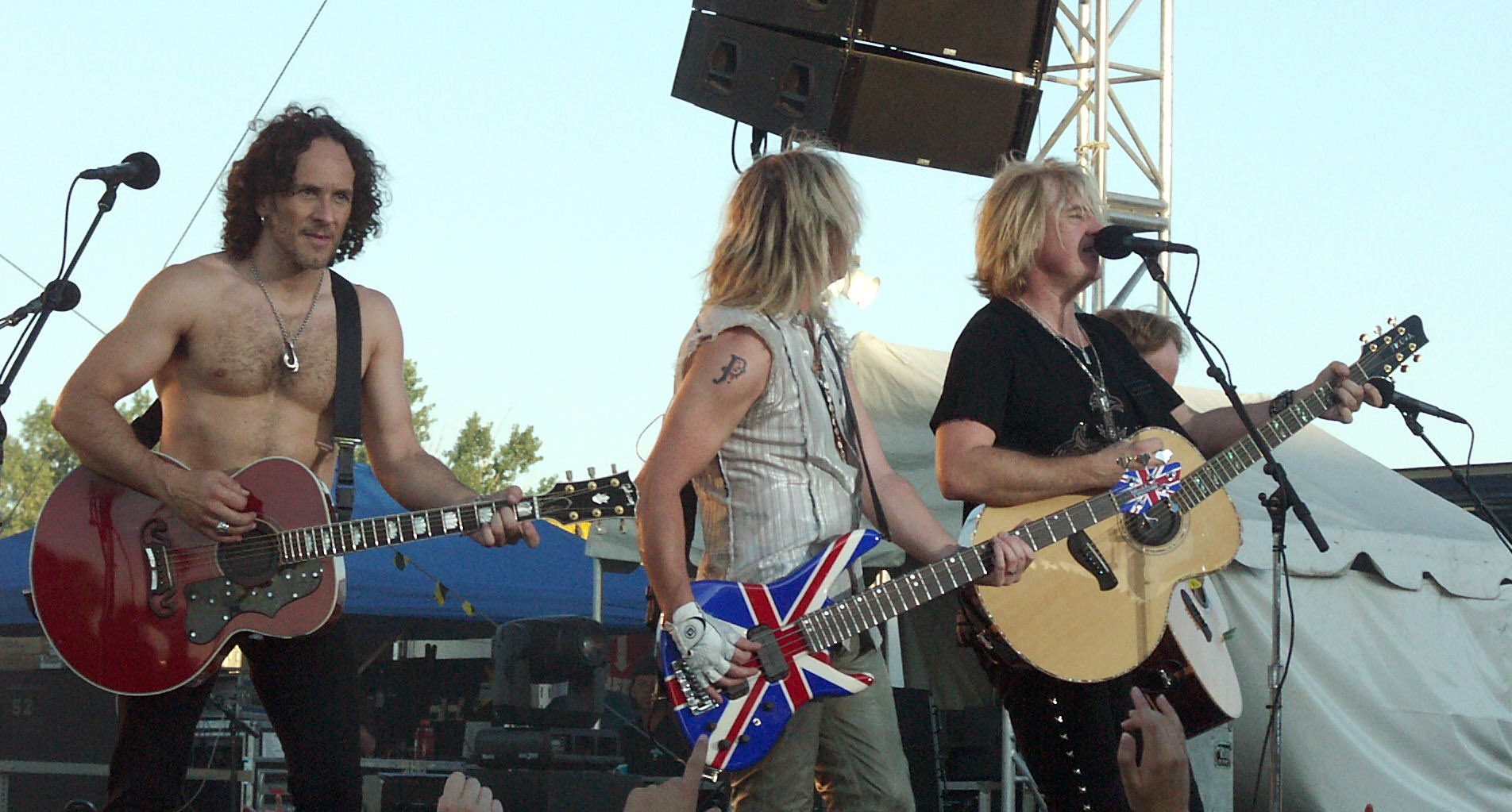
In 1981, the loudest young band in Britain did something no one expected: they slowed down. Def Leppard had built their name on speed, sweat and noise, on guitars played like weapons and choruses shouted back by thousands. Then, for their third album, they recorded a power ballad — a song that ached instead of attacked, that let the singer breathe and the guitar cry. It was called “Bringin’ On the Heartbreak”, and it was released as a single in the United States on 13 November 1981. Nobody bought it. The single never appeared on the American charts at all. And yet, within a year, it had become one of the most important records the band ever made — the song that introduced Def Leppard to America, the song that taught a brand-new television channel what rock music could look like, and the song that, two decades later, would be sung by Mariah Carey. This is the story of a hit that refused to behave like a hit, and of a band that learned to slow down without losing its nerve.
Sheffield, 1976: Atomic Mass
Def Leppard began in Sheffield, in the industrial north of England, in 1976. Three schoolboys from Tapton School — Rick Savage, Tony Kenning and Pete Doubleday — formed a band called Atomic Mass. Pete Willis joined on guitar in 1977, and the line-up shifted and settled through rehearsals at Portland Works, an old cutlery works in the city. In November 1977, an eighteen-year-old named Joe Elliott missed a bus, bumped into Willis by chance, and tried out for the band as a guitarist. During the audition it became clear he was better suited to be the singer, and the band had found its voice.
Elliott had been designing posters in art class, and one of his imaginary band names was “Deaf Leopard”. Kenning suggested changing the spelling slightly, so it would look less like a punk band’s name, and Def Leppard was born. In January 1978, Steve Clark joined on guitar, winning his audition by playing Lynyrd Skynyrd’s “Free Bird” in its entirety. By the end of that year the band had a three-song release, The Def Leppard E.P., and a fifteen-year-old drummer named Rick Allen, who had joined as the full-time drummer after Kenning left abruptly just before the sessions. Sales of the EP soared after the BBC Radio 1 DJ John Peel — then the most important champion of punk and new wave in Britain — gave heavy airtime to its track “Getcha Rocks Off”.
Through 1979 the band built a loyal following among British hard rock and heavy metal fans and were counted among the leaders of the new wave of British heavy metal, the movement that also produced Iron Maiden and Saxon. A deal with the major label Phonogram/Vertigo followed — Mercury Records in the United States. Their original local management was fired after a fistfight on the road between one of the managers and Elliott, and the band approached Peter Mensch of Leber-Krebs management, who had booked them on a British tour supporting AC/DC. Mensch, who admitted he had already had his eye on the band, became their manager, and the road to America began to open.
On Through the Night and the Reading storm
Def Leppard’s debut album, On Through the Night, was released on 14 March 1980. It reached the Top 15 in Britain, but many early fans were turned off by what they saw as the band trying too hard to appeal to America — recording songs such as “Hello America” and touring the United States supporting Pat Travers, AC/DC and Ted Nugent. The tension came to a head at the Reading Festival in August 1980, when audience members expressed their displeasure by pelting the band with beer cans and bottles filled with urine. The incident was partly blamed on a cover story in the music newspaper Sounds by the journalist Geoff Barton, titled “Has the Leppard changed its spots?”, which accused the band of selling out to the American market. Barton later recalled his guilt over the story, and Elliott has said the media exaggerated an incident in which every band on the day took abuse from the crowd. But the damage was real: at home, Def Leppard were in danger of being written off as a band that had abandoned its own audience.
What saved them was a producer. AC/DC’s producer, Robert John “Mutt” Lange, had caught the band’s attention, and he agreed to work on their second album. Lange’s meticulous approach in the studio — his patience, his ear for harmony, his insistence on getting every vocal and guitar part exactly right — helped the band begin to define its sound. High ’n’ Dry was released on 6 July 1981. It peaked at only No. 26 in Britain and No. 38 in the United States, and its sales figures looked unimpressive. But something else was happening, something no chart position could measure: the band’s video for “Bringin’ On the Heartbreak” became one of the first metal videos played on MTV in 1982, and it brought the band a kind of visibility in America that no amount of touring had managed.

The song: three writers, one ache
“Bringin’ On the Heartbreak” was written by three of the band’s members: lead guitarist Steve Clark, rhythm guitarist Pete Willis and singer Joe Elliott. It was the second single from High ’n’ Dry, and it was a deliberate change of pace. Where the album’s other tracks drove hard and fast, the ballad opened up space. Elliott’s voice carried the song — dramatic, exposed, reaching for notes that sounded like they hurt — while Clark’s lead guitar answered him with long, crying phrases. Record World, reviewing the record at the time, wrote that “Joe Elliot’s dramatic vocals and the estranged guitar cries plod over a sledge-hammer beat.” AllMusic’s Steve Huey would later call it an “unabashedly dramatic rock ballad.”
The album was recorded at Battery Studios in London between March and June 1981, with Lange producing. The sessions were long and exacting, and the band’s sound began to take the shape that would make them famous: big choruses built from stacked backing vocals, guitars layered until they sounded like a wall, and a rhythm section — Savage on bass, Allen on drums — that hit with the force of a hammer. On the ballad, all of that machinery was turned down low. There was no sprint here, no swagger. Just a voice, a guitar, and a chorus that ached.
The song has been described since as glam metal, hard rock and soft rock, and the argument over the label is part of the point. It was a hard rock band playing a soft song without apology, and in 1981 that was a risk. Ballads were what bands did when they ran out of ideas, or so the thinking went. Def Leppard treated the ballad as the bravest track on the record — the one that proved they could hold a room without raising their voices.
The single that never charted
“Bringin’ On the Heartbreak” was released commercially in the United States on 13 November 1981, with “Me and My Wine”, a non-album track, and “You Got Me Runnin’” as B-sides. It did not appear on the US charts. Not at No. 90, not for a week — nowhere. For a band that had spent two years chasing America, it looked like another door closing. In Mexico it was released under the Spanish title “Llevarlo en la Desilusión”, with “Yo y mi Vino” as the B-side, using the cover art from the single “Too Late for Love”. That, too, changed nothing.
But the single had something the charts could not see: a video. The first music video for the song was directed by Doug Smith and was a live recording of Def Leppard performing the song at the Royal Court Theatre in Liverpool on 22 July 1981. It had been filmed, along with clips for “Let It Go” and “High ’n’ Dry”, as part of Don Kirshner’s Rock Concert, the American television series on ABC. When MTV — the brand-new music television channel, launched in August 1981 — picked the video up, it played it again and again. The channel was hungry for rock videos, and Def Leppard’s was exactly what it needed: a young band, playing live, looking like the future.
The exposure did what the single could not. Viewers who had never heard of Def Leppard suddenly knew the song by heart, and sales of High ’n’ Dry surged until the album had sold more than two million copies. The band had discovered, almost by accident, the formula that would carry them through the decade: the video mattered as much as the record, and a song that failed on the radio could succeed on television. After the album’s release, European and American tours followed, with the band opening for Ozzy Osbourne and Blackfoot, and the slow climb toward the top of the American charts had begun.
The second life: 1984
Def Leppard did not forget the song that had opened the door for them. In May 1984, High ’n’ Dry was re-issued with two new tracks, one of which was a synthesiser-heavy remix of “Bringin’ On the Heartbreak”. A new video was filmed for it, directed by David Mallet and shot in February 1984 in Jacob’s Biscuit Factory in Lake, Dublin, Ireland. It featured the band’s new guitarist, Phil Collen, playing Pete Willis’s part. Willis had been fired on 11 July 1982, during the recording of the band’s third album, for excessive alcohol consumption on the job, and Collen — formerly of the band Girl — had replaced him the next day.
The remix was released as a single, and this time the charts did listen. It peaked at No. 61 on the Billboard Hot 100 — modest, but a real chart position for a song that had been ignored three years earlier. The original version of the song later appeared on three of the band’s compilation albums: Vault: Def Leppard Greatest Hits (1980–1995) in 1995, Best of Def Leppard in 2004, and Rock of Ages: The Definitive Collection in 2005. The original version of the second video, featuring the remix, survives only on the VHS and LaserDisc versions of the band’s video compilation Historia; later DVD reissues replace the remix soundtrack with the original album recording.
By then, of course, the band had moved far beyond the song. Pyromania, released on 20 January 1983 and also produced by Lange, had made them a household name. Its lead single, “Photograph”, supplanted Michael Jackson’s “Beat It” as the most requested video on MTV, held the No. 1 position on the US Album Rock Tracks chart for six weeks, and reached No. 12 on the Hot 100; “Rock of Ages” also topped the Rock Tracks chart and reached No. 16. Pyromania sold six million copies in 1983 alone — more than 100,000 copies every week — and was held from the top of the US album chart only by Michael Jackson’s Thriller. In 2004 it was certified Diamond, having sold more than ten million copies in the United States, and it became the catalyst for the whole 1980s pop-metal movement.
Mariah Carey takes it to the dance floor
The strangest chapter in the song’s life came twenty years after its release. In 2002, Mariah Carey covered “Bringin’ On the Heartbreak” for her album Charmbracelet, co-producing her version with Randy Jackson. It was one of Carey’s few songs with a heavy rock influence, and she treated it with unusual respect: the arrangement stayed faithful to the original, and the single version featured a newly recorded guitar solo and extra overdubs by Dave Navarro. Joe Elliott told the Las Vegas Sun that he thought she had done a very good job — faithful to the arrangement, but not done like a rock song — and praised her “astonishing vocal gymnastics toward the end”, saying they made Minnie Riperton sound like Tom Waits. Phil Collen called her version a “genuine version of our song” and defended it against the band’s more critical fans, saying the fans sometimes got it wrong, that she was on the band’s side, and that it was an honour she had done it.

The cover was released as the album’s third and final single on 2 June 2003, by Island Def Jam and Carey’s own label, MonarC. It was also the final single from MonarC before she shut the label down in 2004. Critics were kind: Barry Walters of Rolling Stone called it the catchiest song on Charmbracelet and “a fascinatingly overblown orchestral remake”; Michael Paoletta of Billboard called it “the set’s crowning glory”; Kelefa Sanneh of The New York Times called it a “high point”; Sal Cinquemani of Slant Magazine called the cover “daring” and praised its live instrumentation; Stephen Thomas Erlewine of AllMusic said it was the best song on the album. The single failed to enter the Billboard Hot 100, but it reached the top thirty in Switzerland and the top forty in Belgium, and club remixes by Junior Vasquez, Mike Rizzo and Ruanne carried it to the top five of the Billboard Hot Dance Club Play chart. It also reached No. 24 on VH1’s “Least Metal Moments”, in a segment subtitled “Bringin’ On the Headache” — because many metal fans and musicians did not like the remake.
The video, shot in Los Angeles on 8 March 2003 by director Sanaa Hamri and set to the RJ Janman remix, was based on the 1979 film The Rose, in which a rock star played by Bette Midler struggles to find happiness as she goes from her rock and roll lifestyle to her final high-profile concert. It featured cameo appearances by Randy Jackson, Dave Navarro, Evan Marriott as a helicopter pilot and bodyguard, and model Damon Willis. On 7 December 2002, Carey performed the song, along with “Through the Rain” and “My All”, in front of 50,000 people at the closing concert of the Mexican Teletón in the Azteca Stadium, announced as the concert’s star and performing in a black dress. A song that had once failed to chart in America had been carried, by a voice from another world entirely, into the top five of the dance charts.
The drummer who would not stop
The band that recorded “Bringin’ On the Heartbreak” was tested, three years after Pyromania, in a way no band expects to be tested. In February 1984 they moved to Dublin to begin writing the follow-up to Pyromania. Lange joined the songwriting sessions at first, then suddenly declined to return as producer, exhausted. Jim Steinman — the man behind Meat Loaf’s Bat Out of Hell — was brought in, but he worked with the band only briefly, and none of that recording work was released. Then, on the afternoon of 31 December 1984, drummer Rick Allen was driving on the A57 road a few miles west of Sheffield when he tried to pass another car at high speed, lost control of his Corvette, hit a dry stone wall and went into a field. His left arm was severed. Doctors first reattached it, but it was later amputated because of an infection.
Allen refused to stop drumming. He realised he could use his legs to do some of the work his arms had done, and he worked with the Simmons company to design a custom electronic drum kit. The other members of the band supported his recovery and never looked for a replacement. Allen practised alone in a separate studio for months, and then he gathered the band together and played them the introduction to Led Zeppelin’s version of “When the Levee Breaks” to show them how far he had come. Elliott later called it a very emotional moment. In August 1986 the band brought in Jeff Rich to play alongside Allen on a warm-up mini-tour of Ireland, but when Rich turned up late for a gig, they realised Allen could drum alone. His comeback was sealed at the 1986 Monsters of Rock festival in England, with an emotionally charged ovation after Elliott introduced him. After more than three years of recording, Hysteria was finally released on 3 August 1987.

Aftermath and legacy
The band that recorded “Bringin’ On the Heartbreak” did not stand still. Pyromania’s success had already changed their lives: the tour began in England at the Marquee Club on Wardour Street in Soho in February 1983, the American leg opened for Billy Squier and ended with a headlining show before 55,000 people at Jack Murphy Stadium in San Diego that September, and a Gallup poll in 1984 voted Def Leppard America’s favourite rock band, ahead of the Rolling Stones, AC/DC and Journey. Rolling Stone counted them among the artists of the Second British Invasion. Hysteria, their fourth album, released in 1987 and more pop-oriented than anything they had done before, topped the charts in Britain, the United States, Canada and Australia and stayed on the charts for more than two years. It has sold more than fifteen million copies worldwide, making it one of the best-selling albums of all time, and it spawned six Top 20 American singles, including the Billboard Hot 100 No. 1 “Love Bites”, “Pour Some Sugar on Me” at No. 2, “Armageddon It” at No. 3 and “Animal” at No. 6 — the band’s biggest hit in Britain. After the death of guitarist Steve Clark in 1991, the band recorded Adrenalize as a four-piece; it reached No. 1 in Britain, the United States and Australia and sold more than eight million copies worldwide. Retro Active followed in 1993, with the acoustic Top 5 hit “Two Steps Behind”, and the greatest-hits album Vault arrived in 1995 with the British No. 2 hit “When Love & Hate Collide”.

The numbers, in the end, are almost absurd. Def Leppard have sold more than one hundred million records worldwide. They hold RIAA Diamond certification for two albums, Pyromania and Hysteria, making them one of only five rock bands — the others are Led Zeppelin, the Beatles, Van Halen and Pink Floyd — with two original studio albums that have sold more than ten million copies in the United States. VH1 ranked them No. 31 in its “100 Greatest Artists of Hard Rock” and No. 70 in its “100 Greatest Artists of All Time”. In 2019, they were inducted into the Rock and Roll Hall of Fame.

And through all of it, “Bringin’ On the Heartbreak” stayed in the set, stayed in the story, stayed in the memory of everyone who saw that video on MTV in 1982. It is a song about heartbreak that was itself rejected, ignored and left for dead — and then found its audience anyway, first on television, then on a remix, then in a voice nobody expected. Forty-five years after its release, it still does the same thing it did on the night it was recorded in London: it takes the quietest moment of a loud band and turns it into the loudest memory of all. Some heartbreaks arrive with the volume turned all the way up — and some of them never really leave.
Leave a Reply