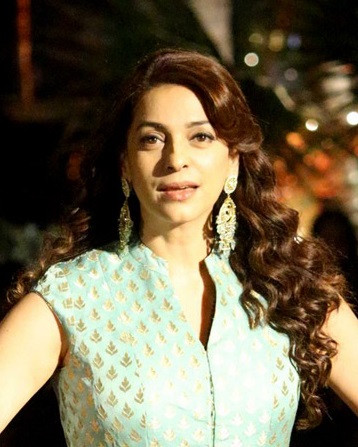
Some stars arrive with thunder. Juhi Chawla arrived with laughter — bright, unguarded, and impossible to ignore. It was there in her first great screen romance, in the comedies that made her the most sought-after heroine of the 1990s, and, decades later, in the quiet confidence of a woman who had stopped chasing stardom and started choosing her work instead. On 13 November 2026, she turns fifty-nine.
The Girl from Ambala
Juhi Chawla was born on 13 November 1967, in Ambala, in the Indian state of Haryana. Her father was an officer of the Indian Revenue Service. This was not a film family. There was no studio waiting for her, no famous surname to open a door. What there was, instead, was a household that valued education and steady work, and a girl who grew up between the discipline of that world and the pull of something altogether less predictable.
She completed her schooling at Fort Convent School in Bombay — the city we now call Mumbai — and went on to graduate from Sydenham College, Bombay. Ambala gave her her beginnings; Bombay gave her her stage.
A Crown at Sixteen
In 1984, at sixteen, Juhi Chawla won the Miss India title. She was still a schoolgirl, and yet there she was, crowned the most beautiful young woman in India. The win sent her on to the Miss Universe contest the same year, where she took home the Best Costume Award. It is easy, looking back, to treat a beauty pageant as a footnote. In her case it was a doorway.
The pageant world of the early 1980s was a different place from the one we know now. There was no social media, no instant fame. A crown meant photographs in newspapers, a handful of modelling assignments, and a question that must have followed her everywhere: what now? For Juhi, the answer was the cinema — but not at once, and not easily.
First Steps, Far from Bombay
Her first film role was a small one, in Sultanat in 1986. It was a beginning, not a breakthrough — a brief appearance that put her name on a cast list and little more. Many young actors would have been discouraged. Juhi, characteristically, went looking for work where the work was.
In 1987 she starred in Premaloka, a Kannada–Tamil bilingual film directed and produced by V. Ravichandran, released in Tamil as Paruva Ragam. The Kannada version was a major commercial success. Juhi herself would later describe Premaloka as her acting school. The Premaloka team reunited in 1989 for the Kannada film Kindari Jogi, a musical hit, and in the same year she made her Telugu debut with Vicky Daada, opposite Nagarjuna. These were not the films that made her famous in Bombay. They were the films that made her an actress. By the time Hindi cinema came calling in earnest, she had already learned her craft in three languages — a grounding that would return two decades later, when she turned to small, independent films that bigger stars would not touch.
The Turning Point: A Modern Romeo and Juliet
Then came Qayamat Se Qayamat Tak in 1988. Juhi was twenty years old. Her co-star, Aamir Khan, was making his debut as a leading man. Directed by Mansoor Khan, the film was a modern-day adaptation of Shakespeare’s Romeo and Juliet — two young lovers, Raj and Rashmi, caught between families whose hatred is older than they are, in a story everyone already knew could only end one way.
It should not have worked as well as it did. The leads were new, the story was old, and yet the film carried a sincerity that Hindi cinema, in the late 1980s, had rather lost the habit of. But it did work — enormously. The film was both a major critical and commercial success, and Khan and Chawla became, in the phrase that followed them everywhere, “overnight stars”. It won the Filmfare Award for Best Film, and Juhi became the first actress to win the Filmfare Award for Lux New Face of the Year — the award now known as Best Female Debut — while also receiving her first nomination for Best Actress.
Looking back, it is striking how much of her later career was already visible in Rashmi. There was the warmth, and the smile that seemed to arrive a half-second before the line did. But there was also a stubbornness, a willingness to choose for herself. Writing years later, the critic Premankur Biswas observed that Juhi, “with her flouncy ghagra and passive but assertive demeanor was an early predecessor to the sexually liberated Bollywood heroines of today”. The film has since attained cult status, and The Times of India ranked it among its “Top 25 Must See Bollywood Films”. For Juhi, the overnight success was real, but misleading. She had already been working for two years, in three languages, before Bombay noticed her. The stardom was sudden. The preparation was not.
The Nineties Begin: Learning to Last
Stardom, once won, has to be kept. The years after Qayamat Se Qayamat Tak tested whether Juhi Chawla was a moment or a career. She passed, not by repeating the same role, but by moving steadily through the films that built a leading lady in that era: dramas, family stories, thrillers, and, increasingly, comedies.
In 1990 she starred in Pratibandh, for which she received her second Best Actress nomination at Filmfare. Her other releases that year included the family drama Swarg, alongside Rajesh Khanna and Govinda, which marked the first of several collaborations with director David Dhawan. In 1992 she appeared in Bol Radha Bol alongside Rishi Kapoor, for which she received her third Filmfare nomination for Best Actress. By the early 1990s, she was no longer the new girl. She was a working star, and the industry was beginning to understand what she was best at: comedy — timing, lightness, the ability to be funny without ever seeming to try.
1993: Four Films, One Triumph
If one year made Juhi Chawla, it was 1993. In twelve months she appeared in four films, and each of them mattered. Her first release was the action romance Lootere, directed by Dharmesh Darshan and starring Sunny Deol, Naseeruddin Shah, Chunkey Pandey and Anupam Kher. She played a young woman under witness protection, guarded by Deol’s bodyguard, with whom she eventually falls in love. It was the first movie in which she was cast in a glamorous role.
Later, she was cast in two films produced by Yash Chopra. The first was the romantic drama Aaina, in which she and Amrita Singh played sisters falling for the same man, played by Jackie Shroff. Her third film that year was Mahesh Bhatt’s romantic comedy Hum Hain Rahi Pyar Ke, opposite Aamir Khan, released on 23 July 1993. Based on the 1958 Hollywood film Houseboat, it gave her the role that would define her: Vyjayanti Iyer, a bubbly Tamil runaway who becomes governess to the three mischievous children in Rahul’s care. The part required her to master Tamil language and dialect, and she did it so convincingly that the performance established her as a comic actress. Writing for The Indian Express, Udaya Tara Nayar noted that she played her role “to perfection”. The film won the Filmfare Award for Best Film and the National Film Award — Special Jury Award, and brought Juhi the Filmfare Award for Best Actress, her first win in that category.
The last film she appeared in that year was the musical psychological thriller Darr, directed by Yash Chopra. She played Kiran, a young woman about to marry her fiancé, played by Sunny Deol, when she becomes the object of a young man’s obsession, played by Shah Rukh Khan. The film was one of the highest-grossing films of the year, making it her fourth consecutive box office hit of the year. She received another Filmfare nomination for Best Actress for it. Four films. Four hits. A Best Actress award, a Best Actress nomination, and a place, beyond argument, at the very top of Hindi cinema. She was twenty-five years old.

The Mid-Nineties: A Star in Full Flight
The years that followed 1993 were the years of consolidation. She played Saraswati in David Dhawan’s Andaz (1994), Laxmi in Saajan Ka Ghar (1994), Bela in Rajiv Mehra’s Ram Jaane (1995), Sandhya in Naajayaz (1995), one of her rare collaborations with Ajay Devgn, and Kiran in David Dhawan and Boney Kapoor’s Loafer (1996). All of them emerged as critical and commercial successes.
She was not only doing comedy. She received critical acclaim for her performance as a battered wife in Abbas–Mustan’s thriller Daraar (1996), and a Filmfare nomination for Best Actress for it.
Away from the screen, her life was changing too. In 1995 she married industrialist Jay Mehta. The couple would go on to have two children.
1997: The Year of the Laugh
If 1993 was the year Juhi Chawla proved she could do everything, 1997 was the year she proved she could make it look effortless. She regained mainstream success that year with the romantic comedies Yes Boss, Deewana Mastana and Ishq, all of which became box office hits. Ishq became one of the top earners of the year, and earned critical praise for the performances of its four leads.
In Yes Boss, she played a model who becomes the love interest of an advertising agency owner, played by Aditya Pancholi, and his ambitious employee, played by Shah Rukh Khan. The film did well commercially, and Juhi received a seventh Filmfare nomination for her portrayal, described by Screen as “spirited”. In Deewana Mastana, she played Dr. Neha Sharma, love interest to both Anil Kapoor and Govinda, and ended up marrying Salman Khan.
By now she had worked with the leading men of her generation: Aamir Khan and Shah Rukh Khan, Salman Khan and Akshay Kumar, Anil Kapoor and Govinda, Sunny Deol and Rishi Kapoor, Jackie Shroff and Sanjay Dutt. Her pairings with Aamir Khan and with Shah Rukh Khan were among the most successful on-screen partnerships of the decade. And yet, for all those famous co-stars, it was her timing that directors kept coming back for. As The Hindu would later observe, she had an “unfailing sense of humour” and timing that “few can match”. She appeared in Box Office India’s “Top Actresses” list from 1992 to 1997, and India Today named her in its “Top Bollywood Actresses” list.
The Dip — and the Decision That Followed
No career runs in a straight line, and Juhi’s did not. In 1998 she appeared once again alongside Shah Rukh Khan in Duplicate, which underperformed at the box office despite ranking as the twelfth highest grosser of the year. The same year she appeared in Hrishikesh Mukherjee’s swan song, Jhooth Bole Kauwa Kaate, and in Priyadarshan’s Saat Rang Ke Sapne, of which the critic Khalid Mohamed wrote that she was its “only saving grace”. In 1999 she appeared in Arjun Pandit, opposite Sunny Deol, playing a woman who seeks revenge — a role, she said, “with negative shades” — and worked free of charge in the Punjabi biographical film Shaheed Udham Singh. The big commercial roles were beginning to thin out, as they do for every actress in an industry that has never been kind to women over thirty. Instead of fighting for the same parts and fading slowly, she took a break, saying she intended to come back with more serious roles — and she meant it.
Behind the Camera: Dreamz Unlimited
Before that second act began, there was a venture that showed another side of her ambition. In 2000, alongside Shah Rukh Khan and director Aziz Mirza, she opened a production company called Dreamz Unlimited. The romantic comedy Phir Bhi Dil Hai Hindustani was the company’s first production, starring Chawla and Khan. Upon release, the film underperformed at the box office, though over the years it has been appreciated for its bold theme on media wars. Her performance as the journalist Ria Banerjee received appreciation from the critics.
The company went on to produce two more films, Asoka (2001) and Chalte Chalte (2003), making three in all. The venture did not last, and its story is often told as a failure. But that misses the point. In an era when actresses were rarely invited into the business of cinema, Juhi Chawla had put her own money, time and reputation into making films, alongside one of the biggest stars in the country. She was not content to be cast. She wanted to choose, to produce, to build.
The Brave Later Roles
Having taken a one-year break from film work, Juhi Chawla started appearing in independent and art films, and the work that followed included some of the most critically acclaimed performances of her life: Jhankaar Beats and 3 Deewarein (both 2003), 7½ Phere and My Brother Nikhil (both 2005), and Bas Ek Pal (2006).
Jhankaar Beats, a musical comedy and a tribute to music director R. D. Burman, saw her play the wife of an aspiring musician. 3 Deewarein was something else entirely. Its director, Nagesh Kukunoor, wrote it with Chawla in mind, aspiring to change her image. She won a Star Screen Award for Best Supporting Actress for her performance. Robert Koehler of Variety wrote that “Chawla gradually settles into a role that contains at least three different character layers”. Juhi herself called 3 Deewarein a mould-breaking film in her career.
She acted opposite Gurdas Maan in the Punjabi-language feature Des Hoyaa Pardes (2004), which won the National Film Award for Best Feature Film in Punjabi. Then came My Brother Nikhil, set in Goa between 1986 and 1994. Directed by Onir, it centres on Nikhil, played by Sanjay Suri, a young man who tests HIV-positive. Juhi co-starred as Anamika Kapoor, a schoolteacher and Nikhil’s loving and supportive elder sister, who accepts his same-gender partner and stands by his side through his struggle. Her performance was particularly praised. Khalid Mohamed wrote: “Above all, Juhi Chawla is perfect. Her effortless blend of conflicting emotions is what A-class acting is all about. Ms Chawla is a diamond in this little gem of a movie.”
In 2008 she appeared in Ravi Chopra’s Bhoothnath with Amitabh Bachchan, in which she made her singing debut with the song “Chalo Jaane Do”. In 2009 she appeared in a cameo in Luck By Chance, and featured as a talent judge for the third season of the dance reality show Jhalak Dikhhla Jaa.

I Am, Gulaab Gang — and the Villain No One Expected
The next decade brought intermittent work, but the choices remained striking. She starred in Onir’s critically acclaimed anthology film I Am (2010), in an episode named “I Am Megha”, alongside Manisha Koirala. She played a Kashmiri Pandit who travels back to her hometown in Srinagar, having been driven out of it years ago. For her performance, she was awarded the Best Actress award at the 13th London Asian Film Festival and the Award for Excellence in Hindi Cinema at the Asiavision Movie Awards, and earned a nomination for the Filmfare Award for Best Supporting Actress.
After a period of limited work, she made a comeback in 2014 with Gulaab Gang, opposite Madhuri Dixit — once, in the press telling of the 1990s, her great rival. The film, in which Chawla and Dixit played ruthless political rivals, marked her first role as an antagonist. Her portrayal of Sumitra Devi, a shrewd and conniving politician, was widely appreciated. Rajeev Masand called her “terrific” and concluded: “if you must watch this film, watch it for Juhi Chawla’s inspired performance.” She received a second Filmfare nomination for Best Supporting Actress.
Think about that, for a moment. The actress who had made her name as the brightest smile in Hindi cinema was now, at forty-six, playing a woman audiences were meant to hate — and playing her so well that critics said the film was worth seeing for her alone.
The same year she also appeared, in a guest role, with Helen Mirren and Om Puri in the Steven Spielberg-produced Hollywood film The Hundred-Foot Journey. In 2017 she played an Indian defence minister in the web series The Test Case. More recently, she had supporting roles in the streaming series Hush Hush (2022) and The Railway Men (2023), and appeared in the comedy Sharmaji Namkeen (2022), in a memorable on-screen reunion with the late Rishi Kapoor.
The Cricket Field: A Second Empire
If the films tell one story, the business ventures tell another. In 2008, Juhi Chawla, in partnership with Shah Rukh Khan and her husband Jay Mehta, acquired ownership rights for the franchise representing Kolkata in the Indian Premier League, for US$75.09 million, and named the team the Kolkata Knight Riders. The IPL was brand new, and the Knight Riders struggled at first. Then, in 2012, they became IPL champions, defeating Chennai Super Kings in the final. They repeated the feat in 2014, defeating Kings XI Punjab, and won the title for a third time in 2024, beating Sunrisers Hyderabad. Three championships, across twelve years, for a team that began as a gamble. Juhi was there from the purchase, through the lean years, through the titles — a co-owner, not a mascot.
The Laugh, the Legacy
So what remains, at fifty-nine? The numbers are part of it, and they are worth setting down plainly. Two Filmfare Awards: Best Female Debut for Qayamat Se Qayamat Tak, and Best Actress for Hum Hain Rahi Pyar Ke. Six more Best Actress nominations, for Qayamat Se Qayamat Tak, Pratibandh, Bol Radha Bol, Darr, Daraar and Yes Boss. Two Best Supporting Actress nominations, for I Am and Gulaab Gang. A Star Screen Award for Best Supporting Actress for 3 Deewarein. A career that ran, at the top, from the late 1980s through the early 2000s, and that continued, on her own terms, for two decades after that.

But the numbers are not the legacy. The legacy is a style. Juhi Chawla’s great gift was comic timing — not the loud, broad comedy of the era, but something lighter and harder to copy: a pause held a half-beat too long, a glance that said what the dialogue did not. She was, as Wikipedia’s summary of her career puts it, “recognised for her comic timing and vivacious on-screen persona”, and that recognition was earned, film after film, in parts that could easily have been forgettable.
There is also a quieter legacy. She showed that a Hindi film heroine could have a second act — not as a mother in someone else’s story, but as a leading performer in her own, in smaller films, in harder parts, in a villain’s clothes. She showed that an actress could become a producer, and a producer could become a team owner, and that none of those identities had to cancel out the others.
Her life, like any life, has carried loss as well. Her brother Bobby Chawla, who was chief executive of Red Chillies Entertainment, suffered a massive stroke in 2010, and after being in a coma for about four years, died on 9 March 2014. Her sister Sonia died of cancer on 30 October 2012. They are part of why the later performances carry a weight the early ones did not, and why the laugh, when it comes now, feels earned rather than easy.
Fifty-Nine, and Still Laughing First
On 13 November 2026, Juhi Chawla turns fifty-nine. Fifty-nine years since a girl was born in Ambala. Forty-two years since a sixteen-year-old won a crown and went out to face the world. Thirty-eight years since a twenty-year-old in a ghagra laughed her way into a nation’s heart, and the nation, quite simply, never let her go.
If you want to understand her career, do not start with the awards, though there are enough of them. Start with the laugh. It is there in Qayamat Se Qayamat Tak, when Rashmi decides what she wants. It is there in Hum Hain Rahi Pyar Ke, when Vyjayanti turns a household upside down and makes it better. It is there in Yes Boss and Deewana Mastana and Ishq, when the whole screen seems to lift a little because she has walked into the frame. And it is there, transformed but unmistakable, in 3 Deewarein and My Brother Nikhil and Gulaab Gang, when the laugh is gone and what remains is the actress underneath it — steady, brave, and entirely herself.
Hindi cinema has had bigger stars and louder stars. It has had very few like Juhi Chawla: a heroine who laughed first and worried later, and who, when the easy years ended, proved she had been a serious actress all along.
A laugh that lit up a whole industry. Fifty-nine years on, it still does.

Leave a Reply