THE STORY BEHIND THE SONG
A Whisper That Filled the Room
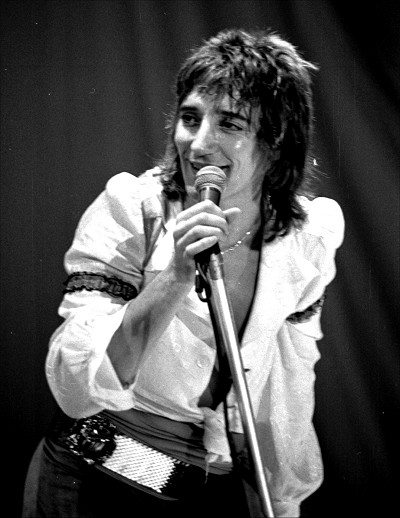
Put the record on, turn the lights low, and listen to the first few seconds. There is no crash of drums, no guitar riff announcing itself, no chorus rushing in to claim the room. Instead there is a voice, close to the microphone and lower than usual, and an acoustic guitar moving gently underneath it, as if the singer were leaning across a table rather than standing on a stage. Rod Stewart does not so much begin “Tonight’s the Night (Gonna Be Alright)” as confide it.
That intimacy is the whole secret of the song, and also the reason it caused such a fuss. In the autumn of 1976, a record that sounded like a private conversation became the biggest single in America. It stayed at No. 1 on the Billboard Hot 100 for eight consecutive weeks, longer than any other song that year, and longer than any American No. 1 since the Beatles’ “Hey Jude” eight years before. It finished as Billboard’s No. 1 song of 1977 and the best-selling American single of that year — after the BBC had banned it and several American radio stations had refused to play it, or played it only in an edited form.
Banned from the airwaves, crowned by the charts. The very qualities that made broadcasters nervous — the low voice, the direct words, the whispered French at the end — were the qualities that made listeners lean in. A song about a moment between two people, sung as if there were nobody else in the room, somehow became a record that millions of strangers shared at the same time.
The Singer at the Centre of It
To understand why the whisper worked, it helps to remember who was doing the whispering. Roderick David Stewart was born on 10 January 1945 in Highgate, London, the youngest of five children. He had come up the long way: busking with a harmonica, singing in rhythm-and-blues groups, joining the Jeff Beck Group in 1967 and Faces in 1969, and building a solo career in parallel. His early solo albums mixed rock, folk, soul and rhythm and blues, and his rough-edged, warm voice became one of the defining sounds of British rock in the early 1970s.
The breakthrough came with his third solo album, Every Picture Tells a Story, released in May 1971. Its single “Maggie May”, first issued as the B-side to his cover of Tim Hardin’s “Reason to Believe”, was taken up by radio disc jockeys and climbed to No. 1 in both Britain and the United States, spending five weeks at the top of the Billboard Hot 100.
By the middle of the decade, the ground under him had shifted. Faces broke up in 1975. Stewart had moved to Los Angeles, and his music was changing with him. His sixth solo album, Atlantic Crossing, released in August 1975, was smoother and more American in feel than the Mercury records that had made his name, built around American studio musicians and produced by Tom Dowd, and its ballad “Sailing” became a major hit. The rough folk-rock singer of “Maggie May” had not disappeared, but he was now working with a producer who understood how to give a raspy voice space to breathe.
That is the Stewart who walked into the sessions for his seventh album. He was thirty-one, already a star on both sides of the Atlantic, and still looking for the song that would define his American career. He had had one American No. 1, five years earlier. The next one would be slower, softer, more deliberate, and far more daring in what it said out loud.
A New Album, a Slow Side and a Fast Side
The album was A Night on the Town, released on 18 June 1976. It was Stewart’s seventh studio album, recorded between December 1975 and April 1976 at Cherokee Studios in Los Angeles, Muscle Shoals Sound Studio in Sheffield, Alabama, Criteria Studios in Miami, and Caribou Ranch in Nederland, Colorado, with Tom Dowd producing throughout. The cover, designed by John Kosh, was based on Pierre-Auguste Renoir’s painting Bal du moulin de la Galette, with Stewart inserted in the centre in period costume.
For the original vinyl release, Stewart divided the album openly into a “Slow Side” and a “Fast Side”, continuing an idea he had begun with Atlantic Crossing. Side one, the Slow Side, opened with “Tonight’s the Night (Gonna Be Alright)”, followed by his cover of Cat Stevens’ “The First Cut Is the Deepest”, “Fool for You”, and “The Killing of Georgie (Part I and II)”. Side two, the Fast Side, offered “The Balltrap”, “Pretty Flamingo”, “Big Bayou”, “The Wild Side of Life” and “Trade Winds”.
Commercially, the album did almost everything an album could do in 1976. It reached No. 1 in Britain, Australia, Canada, New Zealand, Norway and Sweden, and No. 2 on the US Billboard 200, where it spent 57 weeks on the chart. It was certified Platinum in Britain and twice Platinum in the United States, and it would remain Stewart’s last UK No. 1 studio album until Time in 2013. But the album’s centre of gravity was its opening track. “Tonight’s the Night” was released as a single in May 1976 outside the United States and in September 1976 in America, on Riva in Britain and Warner Bros. in the United States, with “The Ball Trap” as the British B-side and “Fool for You” as the American one. The album version ran 3 minutes 56 seconds; the single edit ran 3 minutes 34 seconds. The song was credited to Stewart alone as songwriter, and to Dowd as producer.
An Afternoon in Muscle Shoals

The song itself, by Stewart’s own account, arrived without ceremony. He later told the Star Tribune in 2014 that he had been working with guitarist Steve Cropper at Muscle Shoals in the afternoon, “just strumming around”, when someone said the line that became the title. “I wish I could give you some elaborate explanation,” he said. “But it’s more luck than judgment.” In his Storyteller anthology, he added that songs often came to him in the middle of the night, and he kept a notepad and a cassette recorder by his bed. The arrangement was worked out with Cropper on a Friday morning and recorded by Friday night, with the lyrics finished the following evening.
The place mattered. Muscle Shoals Sound Studio, at 3614 Jackson Highway in Sheffield, Alabama, had been opened in 1969 by four session musicians — Barry Beckett, Roger Hawkins, Jimmy Johnson and David Hood — who had left Rick Hall’s nearby FAME Studios to run a studio of their own. Known as the Muscle Shoals Rhythm Section, and nicknamed the Swampers, they had already played on defining soul records by Aretha Franklin, Wilson Pickett and Etta James, and their studio had drawn the Rolling Stones, Paul Simon, Bob Seger, Cher and Lynyrd Skynyrd.

Stewart was a natural fit for that room, and Cropper was a natural partner for him. Cropper, the guitarist of Booker T. and the M.G.’s and a central figure in the Stax Records sound, had co-written “In the Midnight Hour” and “(Sittin’ On) The Dock of the Bay”, and he later said Stewart ranked alongside Otis Redding as the finest singer he had ever worked with. For A Night on the Town, the guitars included Cropper, Joe Walsh, David Lindley, Jesse Ed Davis, Pete Carr and Fred Tackett, with Donald “Duck” Dunn and David Hood among the bass players. Yet for all that firepower, “Tonight’s the Night” was built to sound spare. The arrangement leaves Stewart’s voice almost nowhere to hide, and that is the point: the song is a performance of closeness, and closeness needs quiet around it.
The Voice from the Mountains

If Muscle Shoals gave the song its rhythm and its feel, the mountains of Colorado gave it its final vocal. Although the track was primarily recorded at Muscle Shoals, the final vocal was recorded at Caribou Ranch studios in Nederland, Colorado, where Stewart, his girlfriend Britt Ekland and producer Tom Dowd spent several days. Caribou Ranch was a high-altitude studio retreat that had already drawn Elton John and Chicago, a place where artists went to record away from the city. The vocal that came back from Colorado is the one we still hear: soft at the start, gathering warmth as the song goes on, never shouting, never hurrying.
Dowd was the right producer to hold all of this together. Born in New York in 1925, he had worked at Atlantic Records for more than twenty years, recording Aretha Franklin’s “Respect”, John Coltrane, Ray Charles, Otis Redding, Cream and Derek and the Dominos’ “Layla”, and helping to pioneer stereo and eight-track recording. His work with Stewart showed his gift for taking a singer with a rough, blues-soaked voice and placing him inside a polished, spacious arrangement without smoothing the roughness away. On “Tonight’s the Night”, Dowd’s production is almost invisible: acoustic guitar, a gentle rhythm section, strings that enter like evening light, and a tenor saxophone solo by Jerry Jumonville that arrives exactly when the song needs a second voice.
That second voice, in a sense, is also the song’s most famous detail. The French spoken passage at the end of the record was provided by Britt Ekland, Stewart’s girlfriend at the time. Ekland, born Britt-Marie Eklund in Stockholm on 6 October 1942, was a Swedish actress who had appeared in Get Carter (1971) opposite Michael Caine, in The Wicker Man (1973), and as Mary Goodnight, the primary Bond girl, in The Man with the Golden Gun (1974). She and Stewart were partners from 1975 to 1977, and she was present at the Caribou Ranch sessions. Her whispered French closes the record as if the song were slipping out of the studio and into a private room. It was a small contribution in running time, and an enormous one in effect.
What the Song Actually Says
It is worth listening to the words slowly, because the controversy that followed the record was not about a single rude word. There is no profanity in “Tonight’s the Night”. There is, instead, a sustained act of persuasion, delivered in the second person, in the present tense, as if the singer were speaking to one listener and one listener only.
The opening sets the scene with tender urgency: the night is here, and the singer is asking — not demanding, but asking with growing confidence — for the evening to become what both of them, he implies, already want it to become. Then come the lines that would be quoted in newspapers and in complaints to radio stations for years afterwards: “C’mon angel, my heart’s on fire / Don’t deny your man’s desire / You’d be a fool to stop this tide / Spread your wings and let me come inside.”
The most discussed line is the last of those four. “Spread your wings and let me come inside” is a metaphor that barely bothers to be a metaphor. But the song’s suggestiveness is not confined to that one couplet. Elsewhere Stewart sings of loosening “that pretty French gown” and pouring “a good long drink”, and addresses the woman in the song as “my virgin child”. The whole lyric is built around a single situation — a young woman on the edge of a first sexual experience, and a man urging her not to hesitate — and it is the directness of that situation, as much as any individual phrase, that made the record feel shocking in 1976. The song does not wink at its subject. It plays it straight, in a low voice, over a beautiful melody, and asks the listener to find the moment romantic rather than crude.
That is a judgement each listener has had to make for themselves ever since, and it is worth being honest about how the song sounds to modern ears. The “virgin child” line lands very differently now than it did in the mid-1970s, and the power imbalance in the lyric — an older, confident man persuading a nervous younger woman — is impossible to ignore today. What can be said without taking sides is that the lyric was written to be intimate, and that its intimacy is what made it both a hit and a scandal. A louder, cruder song would have been easier to dismiss. A quieter one would have been easier to ignore. This one was neither.
The Ban
The reaction was swift. The BBC banned the record, and several American radio stations followed, or played only edited versions that shortened the coda and cut the whispered passages. The Reverend Jesse Jackson protested the song, and his organisation, Operation PUSH — People United to Save Humanity — used it as an example of the loosening morals of young people. Before many listeners had even heard the record, they had heard that it was the record they were not supposed to hear.
It is a familiar pattern in popular music. A ban tells the cautious listener that there is something here worth avoiding, and it tells the curious listener that there is something here worth finding. In 1976, when radio was still the main way a new single reached most people, a ban could have killed a record outright. Instead, it gave the record a story that radio itself kept retelling, every time a disc jockey explained why the station was playing the edited version, or why it was not playing the record at all. Later accounts say the BBC eventually relented as public demand grew.
Riva and Warner Bros. kept the single in front of the public, and the edited versions that some stations played had the paradoxical effect of making the full version even more desirable. If you had only heard the radio edit, you had a reason to buy the single or the album to hear what had been taken out. Either way, the song travelled by word of mouth as much as by airplay.
There was also a simpler reason the ban did not work: the song is genuinely beautiful. Record World, reviewing the single in September 1976, said simply, “Here Stewart’s as relaxed and moving as he can be.” A scandal can get people to listen once. It cannot make them listen for eight weeks.
The Climb: From No. 81 to No. 1

The numbers tell the next part of the story plainly. “Tonight’s the Night (Gonna Be Alright)” entered the Billboard Hot 100 at No. 81 on 2 October 1976, a modest debut for a record by an established star. For the next few weeks, the single climbed steadily, as radio play, word of mouth and the controversy around it all fed into the same upward movement.
On 13 November 1976, it climbed from No. 8 to No. 1. It stayed there for eight consecutive weeks, until 8 January 1977, making it the final No. 1 of 1976. That eight-week run was the longest stay at No. 1 of any song in 1976. It was the longest run at the top for a single in the United States in more than eight years — since the Beatles’ “Hey Jude”, which had spent nine weeks at No. 1 in 1968 — and it remains the longest stay at No. 1 of Rod Stewart’s entire recording career. As of 2018, Billboard ranked the song as the 19th most popular song in the history of the Hot 100.
The success was not confined to America. The single reached No. 5 in Britain, despite the BBC ban. It spent six weeks at No. 1 in Canada, and finished as the No. 1 song on both Billboard’s 1977 year-end chart and the year-end Canadian singles chart. It reached No. 3 in Australia, No. 2 in New Zealand, No. 6 in Ireland, No. 5 in the Netherlands, No. 7 in Sweden and No. 26 in Germany. In the United States it was certified Gold for one million units shipped, and it was certified Gold in Canada for 75,000 units and in New Zealand for 15,000. When the accounting for 1977 was done, “Tonight’s the Night” was the best-selling single of the year in the United States.
This was Stewart’s second American No. 1, after “Maggie May” five years earlier, and it was a very different kind of No. 1: not a folk-rock story-song that had started life as a B-side, but a deliberate, carefully produced ballad placed at the very front of a new album. Eight weeks is a long time to be the most popular record in America. It means the song was not just a moment, but a season.
The Album Around It, and What Came After
The single’s success lifted the album with it, and the album gave the single a context a standalone release would not have had. Its Slow Side, after the opening track, offered Stewart’s version of “The First Cut Is the Deepest”, a Cat Stevens song that would become one of Stewart’s signature performances and a hit in its own right when released as a single in April 1977, coupled with “I Don’t Want to Talk About It”. The same side included “The Killing of Georgie (Part I and II)”, a six-and-a-half-minute narrative about a gay friend who is cast out by his family, becomes a sensation in New York nightlife, and is murdered during an attempted robbery.
The immediate follow-up album, Foot Loose & Fancy Free (1977), contained “You’re in My Heart (The Final Acclaim)” and “Hot Legs”. The year after that came Blondes Have More Fun (1978) and its disco-tinged single “Da Ya Think I’m Sexy?”, which also went to No. 1 in Canada, Australia, the United States and Britain.
The song itself began a second life as a standard. In 1978, Roy Head took a country version to No. 28 on the American country chart and No. 17 in Canada. In 1993, Stewart recorded a live version during his session for MTV Unplugged, included on the album Unplugged…and Seated. Other artists remade it too, including Linda Clifford, Nicky Moore, Terry Steele — whose version reached No. 44 on the R&B singles chart — and Alison Crawford. The most famous reinterpretation came in 1997, when Janet Jackson covered the song on her album The Velvet Rope, changing the lyrics so that the song implied a threesome, opening with the line “This is just between me and you… and you”. Neil McCormick, reviewing the album in The Daily Telegraph, called it a “bizarre lesbian reinterpretation” of Stewart’s song — a phrase that captures how far the material could travel once it left its original context.
Critical reassessment has been kinder to the record than the moral panic of 1976 might have suggested. In 2024, Ultimate Classic Rock critic Michael Gallucci rated it as the 23rd greatest soft rock song, saying that it “[merged] impassioned soul with not-so-subtle sexed-up soft rock”. That soul — in Stewart’s voice, in Cropper’s guitar, in the Muscle Shoals rhythm section, in Jumonville’s saxophone — is the reason the record still sounds warm rather than dated.
Fifty Years On

It is now fifty years since that autumn in Muscle Shoals and that winter at the top of the American chart. Rod Stewart has gone on to sell more than 120 million records worldwide, to be inducted into the Rock and Roll Hall of Fame as a solo artist in 1994 and again as a member of Faces in 2012, and to be knighted in Britain’s 2016 Birthday Honours for services to music and charity. He has had ten No. 1 albums in Britain and sixteen top-ten singles in the United States, four of them No. 1. And yet, when the story of his career is told in a single song, “Tonight’s the Night” is still one of the first records people reach for — not because it was his loudest hit, but because it was his quietest.
That is the paradox that has kept the song alive. It is a record about a private moment that became a public event, a whispered song that filled stadiums, a banned record that became the best-selling single of its year. Banned from the airwaves, crowned by the charts. What remains is the sound itself: a voice, low and close, an acoustic guitar, a saxophone, and a melody that still knows how to make a room lean in.
You know that feeling, the one the song is built around. A record comes on that sounds as if it were sung only for you, and for a few minutes the rest of the world goes quiet. “Tonight’s the Night” was written for that feeling, and it has been delivering it for half a century. A whisper can outlast a shout. This one did.
Leave a Reply