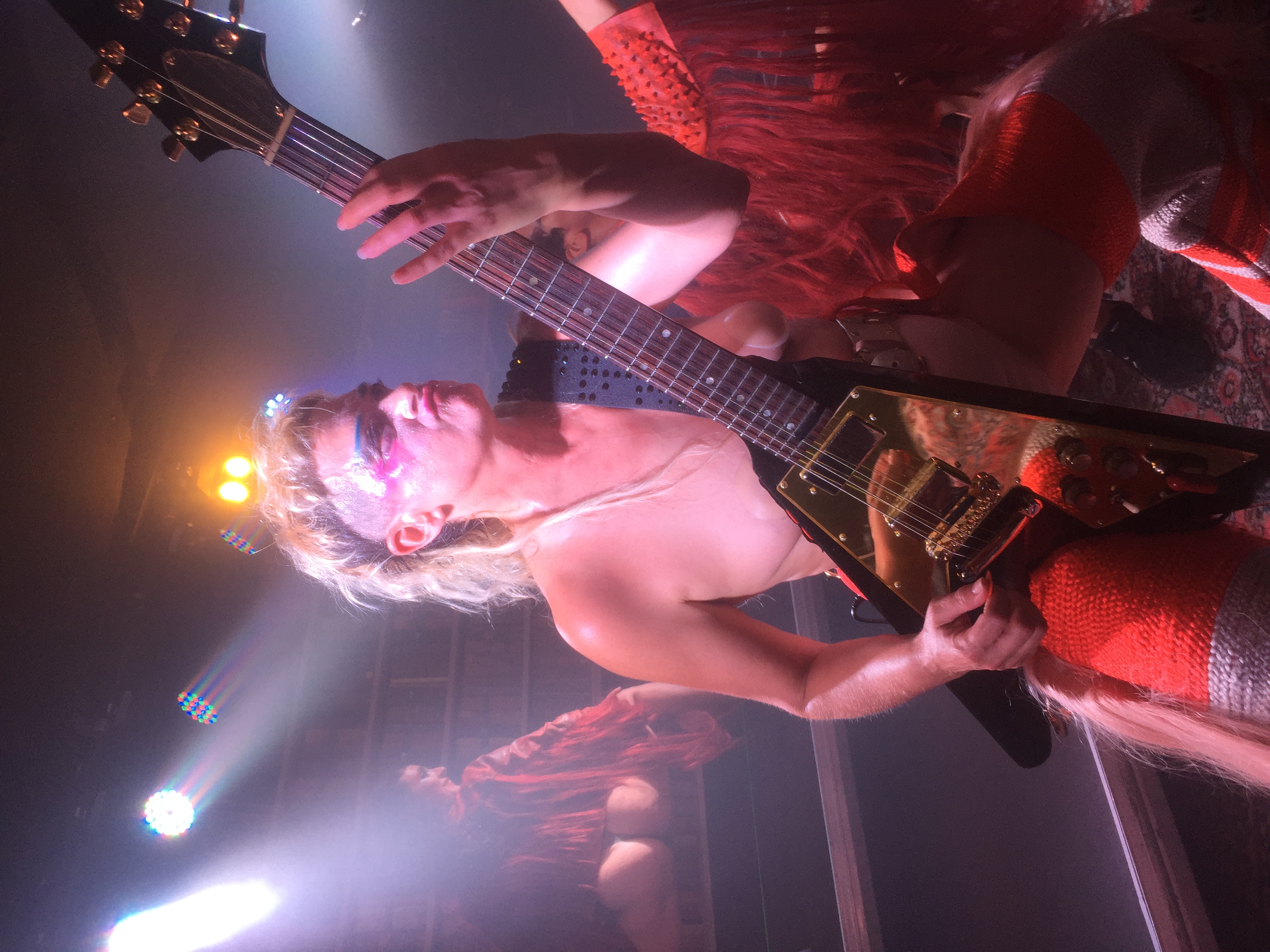
In the autumn of 2000, a record arrived from Berlin that sounded like nothing else on the shelves. It was made almost entirely on a cheap groovebox, by a Canadian woman in her thirties who had spent the previous decade as a folk singer and a schoolteacher. The songs were loud, funny, confrontational, and deliberately rude. The album was called The Teaches of Peaches. The woman who made it called herself Peaches.
Within a year, she had been signed by Sony, dropped by Sony, played Top of the Pops, and become one of the defining figures of a new genre the press called electroclash. Over the next quarter of a century, she would release seven studio albums, tour the world, direct a rock opera, perform a one-woman Jesus Christ Superstar, and be described by Variety as a “feminist and queer icon.”
Merrill Nisker was born on November 11, 1966, in Toronto, Ontario. On November 11, 2026, she turns sixty. This is the story of how a teacher from Toronto became Peaches — and how Peaches became one of the most uncompromising artists of her generation.
Growing Up in Toronto
Merrill Nisker was born in 1966 in Toronto, Ontario, into a culturally Jewish family. Her maternal grandparents had immigrated to Canada from Ustrzyki Dolne in Poland; her paternal grandparents were from Galicia, in what is now western Ukraine. Growing up, she experienced antisemitism from students at a nearby Catholic school, who threw stones at her and called her names.
As a teenager, she appeared in two plays alongside Steven Page, who would later become the singer of the Barenaked Ladies — including a musical called My Brother’s Keeper. Before she became a full-time musician, she worked as a teacher.
That background — the classroom, the folk clubs, the outsider’s eye — would shape everything she did next.
The Folk Trio and the Name
During the early 1990s, Nisker was part of a folk trio called Mermaid Cafe. The name was taken from the Joni Mitchell song “Carey.” In 1995, she released her first solo album, Fancypants Hoodlum. Later that year, she joined The Shit, a four-piece band with Jason Beck — better known as Chilly Gonzales — bassist Sticky Henderson, and Dominic Salole, known as Mocky.
Every member of the band had a stage name, and Nisker’s was Peaches — inspired by Nina Simone’s song “Four Women,” in which Simone shouts at the end, “My name is Peaches!”
In Toronto, she lived above the sex shop Come as You Are, with her roommate Feist — who would later become a star in her own right. Feist sang backup at Peaches’ shows, using a sock puppet and the stage name “Bitch Lap Lap.” The two toured together in England from 2000 to 2001, staying with Justine Frischmann of Elastica and the young artist who would become M.I.A. M.I.A. went on to film Peaches’ 2000 American tour and make clothes for her, while Peaches inspired M.I.A. to use the Roland MC-505 groovebox in her own music.
The Teaches of Peaches
After creating a six-track EP called Lovertits, Peaches moved to Berlin, where she was signed by the Kitty-Yo label. The label gave her the chance to record a new album back in her hometown of Toronto, and the EP was released in the summer of 2000. The full-length album, The Teaches of Peaches, followed that autumn.
The album contains her signature song, “Fuck the Pain Away” — a track built on a pounding drum-machine beat and a vocal that sounded like a dare. Peaches appeared on the British television show Top of the Pops, although her performance was not aired.
She signed a European contract with Sony after the album’s release. She then made a music video for the song “Set It Off,” and Sony subsequently dropped her. It was a pattern that would repeat throughout her career: the mainstream would reach for her, and she would refuse to be held.
In 2001, her bust was one of the first female busts cast by Cynthia Plaster Caster, the artist famous since the 1960s for making moulds of rock musicians. In 2002, Peaches appeared in “Hideous Man,” a short film directed by John Malkovich, made as a showcase for clothing designed by Bella Freud, with poetry by Gary Sinise.
Fatherfucker and the Iggy Pop Duet
In 2003, Peaches released her second album, Fatherfucker, on XL Recordings and Kitty-Yo, after years of touring and opening for artists like Marilyn Manson and Queens of the Stone Age. She wrote and programmed all of the album’s music herself. The single “Kick It,” which features Iggy Pop, was described by Peaches to Rolling Stone as “more about rock ’n’ roll than sex.”
For Fatherfucker, she was nominated in the Outstanding Music Artist category at the 15th GLAAD Media Awards. She was nominated again for her next album, Impeach My Bush, released in 2006, at the 18th GLAAD Media Awards.
One song from Impeach My Bush, “Boys Wanna Be Her,” became one of her most widely heard recordings. It served as the theme music for the late-night television series Full Frontal with Samantha Bee, was featured in an episode of the television series Orphan Black, and appeared in the 2022 film The 355.
I Feel Cream and the One-Woman Superstar
Peaches’ fourth album, I Feel Cream, was released in May 2009. The first single was a double A-side of “Talk to Me” and “More.” She enlisted contemporaries including Simian Mobile Disco, Soulwax, Digitalism, and Shapemod to co-produce tracks, while her longtime collaborator Chilly Gonzales co-wrote some of the songs, and Shunda K of Yo Majesty sang on “Billionaire.”
In 2010, Peaches and her backing band, Sweet Machine, toured Australia, playing sold-out Big Day Out festivals. On March 14, 2010, she won Electronic Artist of the Year at the 10th Annual Independent Music Awards in Toronto.
That same month, she performed a one-woman version of Jesus Christ Superstar at Berlin’s HAU1 theatre, with Gonzales accompanying her on piano. The critic Travis Jeppesen, writing in Artforum, said she managed “not only to set it off, but to surprise us all by showing off an expansive vocal range, a musician’s natural sensitivity to the dynamics of Andrew Lloyd Webber’s score, and an emotive prowess that is rarely if ever displayed in her own, less holy, music.”
She appeared as a guest musician on R.E.M.’s 2011 album Collapse into Now, contributing vocals to “Alligator_Aviator_Autopilot_Antimatter.”
Rub, the Stage, and Sixty
Peaches’ sixth studio album, Rub, was released on September 25, 2015, produced by Vice Cooler in her Los Angeles garage, with guest appearances by Kim Gordon, Feist, and Simonne Jones. In 2019, she premiered a large-scale stage production, There’s Only One Peach with the Hole in the Middle, at Kampnagel in Hamburg, featuring an ensemble of twelve musicians and dancers.
In February 2019, she made her debut with the Staatstheater Stuttgart, co-directing and performing as Anna I in Kurt Weill and Bertolt Brecht’s Die sieben Todsünden (The Seven Deadly Sins).
In 2022, she toured to mark the twentieth anniversary of The Teaches of Peaches. The tour was profiled in the documentary Teaches of Peaches, which premiered at the 74th Berlin International Film Festival, and she was the subject of a second film the same year, Marie Losier’s Peaches Goes Bananas.
On February 20, 2026, her seventh studio album, No Lube So Rude, was released. It was shortlisted for the 2026 Polaris Music Prize, Canada’s most prestigious music award.
The Woman Behind the Name
Peaches is bisexual, and she has been described by Variety as a “feminist and queer icon.” Gender is one of the central themes of her work: her lyrics and her live shows deliberately blur the line between male and female. She appeared on the cover of Fatherfucker with a full beard, and she has said that the title was chosen to take an extreme word and bring it into the open rather than shy away from it.
Age is another theme. The lyrics of several songs on I Feel Cream take on ageing directly, and she has criticised ageism directed against her, telling the New York Daily News that “I’m going to make aging cool.”
In 1999, before recording her debut album, she was diagnosed with thyroid cancer, which was treated with surgery. She has also worked as a visual artist: in 2019, she opened her first institutional solo art exhibition, “Whose Jizz Is This?”, at the Kunstverein in Hamburg.
She lists the filmmaker John Waters, the artist Cindy Sherman, the artist Paul McCarthy, and the films Tron, Grease, Liquid Sky, and Phantom of the Paradise among the inspirations for the visuals in her live shows.
Why She Still Matters
Peaches never had a Top 40 hit. She never won a Grammy. She was signed by a major label and dropped by it within months. By the ordinary measures of the music business, she should have disappeared.
She did not disappear, because she never played by those measures. She built her career the way she built her records: by herself, on a groovebox, in a room in Berlin, with a name taken from a Nina Simone song and a sound that owed nothing to anyone.
Sixty years after her birth in Toronto, she is still touring, still recording, still directing, still refusing to be filed under anyone else’s heading. The teacher became a folk singer. The folk singer became Peaches. And Peaches became something the music business had never seen before — and has never quite known what to do with since.

Peaches: The Teacher from Toronto Who Became Electroclash
To understand Peaches, you have to start with the name — and with the woman who chose it.
Merrill Nisker, Before Peaches
Merrill Nisker was born on November 11, 1966, in Toronto. She grew up in a culturally Jewish family, appeared in school plays with the future Barenaked Ladies singer Steven Page, and worked as a teacher before she became a full-time musician. In the early 1990s, she sang in a folk trio called Mermaid Cafe and released a solo folk album, Fancypants Hoodlum, in 1995.
Nothing about that biography predicts what came next. But the folk years taught her two things that never left her: how to write a song, and how to hold a room.
The Name from Nina Simone
The name Peaches came from Nina Simone’s “Four Women,” in which Simone shouts, “My name is Peaches!” Nisker took the name in the band The Shit, alongside Chilly Gonzales and Mocky, and kept it when she went solo. It was a declaration of intent: this music would be Black American music — Simone, the blues, the shout — filtered through a white Canadian woman with a drum machine and no interest in asking permission.
Berlin and the Breakthrough
The move to Berlin changed everything. Signed to the small Kitty-Yo label, Peaches recorded The Teaches of Peaches in Toronto in 2000, and the album became the founding document of electroclash — a genre that mixed punk attitude, electronic beats, and pop hooks, and that briefly made Berlin the centre of the musical world.
The major labels came calling. Sony signed her, then dropped her after the “Set It Off” video. She went back to the independents — XL, Kitty-Yo, Kill Rock Stars — and kept making records on her own terms: Fatherfucker (2003), Impeach My Bush (2006), I Feel Cream (2009), Rub (2015), No Lube So Rude (2026).
More Than a Musician
Peaches has always been more than a recording artist. She has directed films, staged a rock opera, performed a one-woman Jesus Christ Superstar, co-directed a Brecht opera in Stuttgart, exhibited her art in Hamburg, and been the subject of two documentary films.
She has collaborated with Iggy Pop, R.E.M., Feist, Kim Gordon, and Chilly Gonzales. Her song “Boys Wanna Be Her” became a television theme. Her 2022 tour, marking twenty years of The Teaches of Peaches, filled concert halls across Europe and North America.
Sixty, and Still Refusing to Be Filed
On November 11, 2026, Peaches turns sixty. She has spent more than thirty years making music that refuses to be categorised — too punk for pop, too pop for punk, too funny for the serious, too serious for the funny.
That refusal is the point. Peaches never asked the music business what it wanted. She made the record she wanted to make, on the machine she wanted to use, under a name she took from Nina Simone — and then she spent the next twenty-five years daring anyone to keep up.
Leave a Reply