Oldies Music Timeline

Chiquito de la Calzada in 1995. Photo: unknown author / Wikimedia Commons, Public domain
It is the summer of 1994, and a television studio in Madrid is waiting for a joke.
The man walking onto the set is sixty-two years old. He is small, wiry, and dressed like a man who has spent his life on stage — because he has. He does not hurry. He walks from one side of the stage to the other with a strange, shuffling gait, one hand pressed to the small of his back as if it aches, his face already creasing into a grin before he has said a word.
Then he starts to talk. The words come out bent and stretched, half Andalusian, half invented: fistro, jarl, ¿cómooor? The joke itself is simple — almost childishly simple. But the way he tells it, pausing, doubling back, acting it out with his whole body, turns the studio upside down. The audience is laughing before the punchline arrives. The other comedians on the panel are laughing. The camera operators are laughing.
Nobody in that studio knows it yet, but Spain has just met the man who will define its sense of humour for the next decade. His name is Chiquito de la Calzada. Within weeks, his words will be on everyone’s lips, his walk will be imitated in schoolyards and offices across the country, and a man who had spent forty years singing flamenco in small theatres will become the most famous comedian in Spain.
This is the story of how that happened — and of the little boy from Málaga who waited a lifetime to be discovered.
The Summer Spain Discovered Chiquito
Chiquito de la Calzada was discovered for television by the producer Tomás Summers, who hired him for Genio y figura, a comedy show on Antena 3. The programme began broadcasting in the summer season of 1994. Chiquito was sixty-two years old, and he had never been on television before.
His style was unlike anything Spanish audiences had seen. As the English-language Wikipedia puts it, his comedy was “strongly based on a surreal and histrionic approach to jokes and language, and constant gesticulation and movement while telling his jokes, placing his hands on his waist as if he had lower backache.” He did not so much tell jokes as perform them, walking back and forth across the stage, stretching words until they sounded like something else entirely, and punctuating everything with invented expressions that meant nothing and somehow meant everything.
The effect was immediate. Within weeks he stood out above all his fellow performers on the show, and Genio y figura shot to the top of the ratings. The critic Rafael Torres, writing in El Mundo on 2 September 1994, captured the strangeness of it: here was a man, Torres wrote, who acted his jokes out rather than telling them, whose comic force was so strong that no sooner did he rise from his seat than everyone in the studio — from the host Pepe Carrol to the technicians, the audience and his fellow comedians — dissolved in laughter. And the curious thing, Torres added, was that Chiquito’s humour was not the crude or obvious kind; it was born of “the pranks of intelligence and the surreal winks of reason.” His jokes were terrible, Torres concluded — but nobody could tell them as well as he did.
The ratings proved him right. On 27 October 1994, a compilation of Chiquito’s best jokes drew 4.5 million viewers — half a million more than the football match between Karlsruhe and Real Madrid broadcast the same evening. A comedian nobody had heard of three months earlier had beaten a European football night.
The success spilled over into every corner of Spanish popular culture. In December 1994, Warner Home Video and Antena 3 released a video compilation of his performances from Genio y figura. In three months it sold 280,000 copies, taking in 500 million pesetas — around three million euros — a record at the time for a Spanish comedian. Earlier that same year, his face had appeared on the cover of Bolero Mix 11, a dance compilation nicknamed Bolero Mix Fistro y Pecador, his head pasted onto the body of a bodybuilder, with his famous catchphrases mixed into the megamix. Spain had not just discovered a comedian. It had found a new language.
A Language All His Own
What made Chiquito unforgettable was not his material. His jokes were, by his own tradition’s standards, short and simple — the kind of jokes that had been told in bars and theatres for generations. What made them his was everything he did to them.
First there were the comparisons: wild, exaggerated, and instantly quotable. He had “more nerves than a five-peseta steak.” He was hungrier “than Tarzan’s tailor.” In English, the most famous of these lines is usually rendered as “you work less than Tarzan’s tailor” — a comparison so odd that it lodges in the memory and refuses to leave.
Then there was the language itself. Chiquito filled his routines with words and interjections of his own invention, built from distortions of formal Spanish, Andalusian speech and even English: fistro, jarl, ¿cómooor? They were nonsense words, but they were delivered with such conviction that audiences understood them perfectly. Before long, fistro and jarl had escaped the television screen and entered everyday Spanish slang, where they remain part of the informal language of Spain to this day.
And then there was the body. Chiquito told his jokes on the move, pacing from one side of the stage to the other, one hand pressed to his lower back as though it hurt, his face and arms doing as much work as his voice. It was a walk that could be recognised from across a crowded room — and soon it was being imitated everywhere, in school playgrounds, in offices, on other television shows.
His influence ran so deep that other comedians built entire characters around him. On Pepe Navarro’s show Esta noche cruzamos el Mississippi, Florentino Fernández played Lucas Grijander, a character created in imitation of Chiquito that eventually led to a plagiarism lawsuit. Other television characters, such as Crispín Klander and Nuñito de la Calzada, were likewise built entirely around his image, style and influence. There is even a modification for the video game Doom that features his voice. Few comedians have ever been imitated so widely, or so lovingly.
From Flamenco Stages to the Big Screen
Fame on television opened doors that had been closed to Chiquito for decades. In 1996 he starred in his first film, Aquí llega Condemor, el pecador de la pradera, a comedy western in which he played Condemor, a gunslinger with his unmistakable walk and way of speaking. A sequel, Brácula: Condemor II, followed in 1997, and Papá Piquillo in 1998. He went on to appear in Franky Banderas and El oro de Moscú in 2003, in the comedy Spanish Movie in 2009 — alongside the Canadian actor Leslie Nielsen — and in Torrente 5 in 2014.
Television kept calling too. After Genio y figura he appeared in the series Señor alcalde in 1998, ¡Ala… Dina! in 2000, El burladero in 2000–2001, and Mucho que perder, poco que ganar in 2011. From September 1995 he also worked on the radio, joining the COPE network’s programme La mañana with Paz Padilla and El Fary, where he performed jokes sent in by listeners. In August 1996 he was invited to give the opening proclamation of the Málaga Fair, his home city’s great summer festival — an honour the city council defended by praising his simplicity and humility, calling him a much-loved man of the Málaga streets with a special gift.
He also lent his image to causes and campaigns far beyond comedy. In 2009, his Facebook page drew attention for a parody of the Barack Obama presidential campaign’s imagery, in the style of Shepard Fairey, under the slogan “Yes, We Jarl.” It was a joke, but it was also a measure of how far his invented language had travelled: a word that had started life as a comic’s nonsense syllable was now being used to parody a presidential slogan.
Through all of it, Chiquito remained what he had always been: a performer from Málaga who had spent his life on stage and was quietly astonished to have become famous at an age when most people retire.

The Comedian Who Became Slang
It is hard to overstate what Chiquito meant to Spain in the nineteen-nineties. He arrived at a moment when Spanish television was crowded with comedians, and he stood out from all of them by being stranger, gentler and more original than any of his rivals. His humour was not cruel and it was not crude. It was surreal, physical and warm — the humour of a man who had spent sixty years learning how to make a room laugh, and who finally had a room big enough to hold the whole country.
The words he invented outlived the television shows that made him famous. Fistro and jarl passed into Spanish slang. His walk, his hand on his back, his stretched-out vowels became a shared reference that Spaniards of a certain generation can still summon with a single word. Tribute compilations of his television appearances were released on video and DVD. Races were even held in which participants imitated his singular walk and movements. He became, in the words of one Spanish commentator, a sociological phenomenon — a comedian whose style was studied, argued over and imitated as though it were a movement in art.
That is the real measure of Chiquito de la Calzada. He did not just tell jokes. He gave Spain a new way of speaking, a new way of walking across a stage, and a new way of laughing at itself. And he did it all after the age of sixty-two, after a lifetime in which almost nobody outside Málaga knew his name.
The Last Years and the City’s Farewell
In his later years Chiquito lived quietly in Málaga, in the Huelin neighbourhood where he spent his final years. He still appeared on television from time to time — in Las Campos and Mi casa es la tuya in 2016 — and he remained a beloved figure in his home city, where he was often seen in the streets he had sung about as a boy.
On 14 October 2017 he fell at his home and was taken to hospital in Málaga by firefighters. He recovered, but on 31 October he was admitted again to the Hospital Carlos Haya in Málaga with chest pain. He died there on 11 November 2017, aged eighty-five, after heart trouble and a cardiac catheterisation. He was cremated the following day, and his ashes rest with those of his wife in the columbarium of the Church of San Pablo in Málaga.
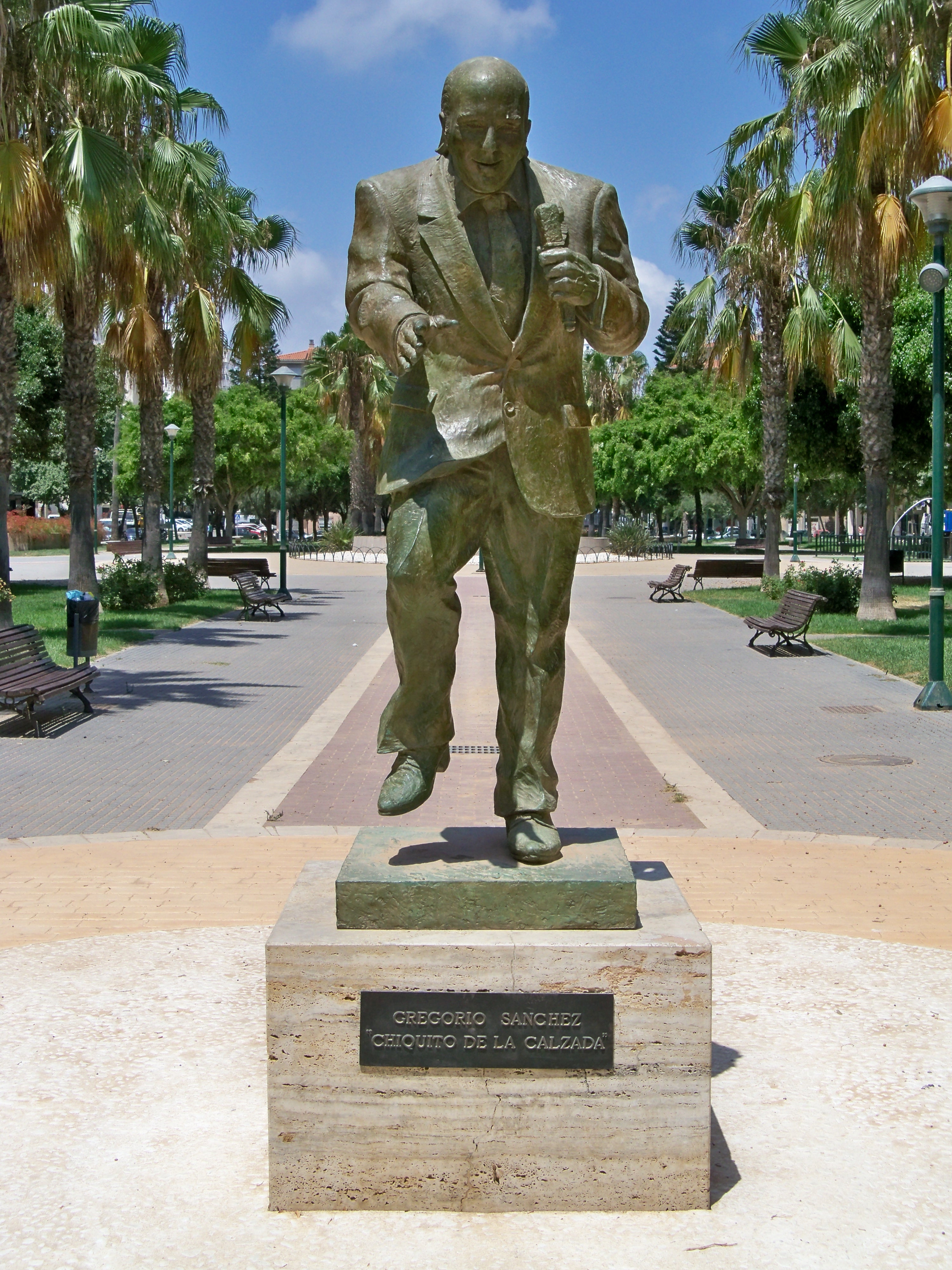
The tributes came quickly. He was posthumously awarded Spain’s Gold Medal of Merit in the Fine Arts, and in February 2018 he received the Medal of Andalusia posthumously. In 2018 the documentary tribute Chiquito, el cantaor de atrás was released, and in 2019 his life was retold as a graphic novel, Las legendarias aventuras de Chiquito. In late 2021 a bronze statue of him by the sculptor Ramón Chaparro was unveiled in Málaga. And in the summer of 2022, at the crossing of Tomás Echeverría and Antonio Soler streets in Huelin, the city installed a pedestrian traffic light whose figures are modelled on the comedian, playing recordings of his most famous expressions — Quietooorrr! Al ataque! — as people cross the street.
It is a fitting memorial for a man who spent his life making people stop and smile: a traffic light that makes an ordinary street crossing feel like the start of a joke.
Why He Still Matters
Nine years after his death, Chiquito de la Calzada remains one of the most loved figures in modern Spanish popular culture — not because he was the most polished comedian of his generation, but because he was the most himself. He invented a language, a walk and a way of telling a joke that nobody else could copy without becoming him. His words entered the dictionary of everyday Spanish. His face became a traffic light. His voice, incredibly, ended up inside a video game.
He also stands as a reminder that it is never too late. He sang flamenco for forty years in theatres most of Spain had never heard of, and then, at sixty-two, became the most famous man on Spanish television. He did not change to fit the medium. Television changed to fit him — and Spain laughed along.
Listen to a recording of Chiquito today and the jokes themselves are almost beside the point. What you hear is a man who knew exactly who he was: a little boy from the Calle Calzada de la Trinidad who grew up to make an entire country laugh, one stretched-out word at a time. Fistro. Jarl. ¿Cómooor? The words meant nothing. And they meant everything.
Gregorio Sánchez Fernández: The Little Boy from La Trinidad Who Became Chiquito
A Childhood on the Calzada
Gregorio Esteban Sánchez Fernández was born in Málaga on 28 May 1932, the second of three brothers, the son of an electrician. He grew up on the Calzada de la Trinidad, and the name he would later take as a performer came directly from that street: Chiquito — “little one” — because he started working when he was very small, and de la Calzada for the street where he was born.
He first stepped onto a stage at the age of eight. Soon afterwards, as a member of a children’s company called the Capullitos Malagueños, he began to develop his skills as a flamenco singer — a cantaor — under the nickname “Chiquito de la Calzada.” It was a name he would carry for the rest of his life.
Sixty Years on Stage Before Television
Long before the summer of 1994, Chiquito had already lived a whole career. As a young flamenco singer he travelled widely, performing in Madrid on renowned stages such as the Teatro Calderón, the Circo Price and the Teatro de La Latina, and appearing abroad — at one point spending two years living in Japan for his work. A photograph from the Málaga Fair in July 1963 shows him on stage in his home city, already a seasoned performer, more than thirty years before television would discover him. In 1985 he even appeared briefly as a palmero — a hand-clapper — in an episode of the American television series The Love Boat (Vacaciones en el mar).
It was a long, hard-working life in show business, and for most of it he was known only to the audiences of the theatres and festivals where he sang. When the producer Tomás Summers found him, Chiquito was sixty-two years old and had been performing for more than half a century. Television did not make him a performer. It simply gave the rest of Spain a chance to see what Málaga had known for decades.
Love, Loss and Málaga
Chiquito married Josefa “Pepita” García Gómez in 1950. He met her while working at the Teatro Chino de Manolita Chen. The couple had no children. Pepita stayed out of the spotlight during the early years of his fame, though she was often seen in the audience when her husband performed, always discreetly, never giving interviews about herself or his fame. She died suddenly of a cardiac arrhythmia on 3 March 2012, and was cremated in Málaga. Five years later, his ashes would rest beside hers.
He never left Málaga, and Málaga never left him. He was named a favourite son of the province of Málaga and, posthumously, a favourite son of the city itself, which also awarded him its Gold Medal. A park in the city bears his name. The statue, the traffic light, the church where his ashes rest — all of them are in the city where he was born, on the streets he walked as a boy.
The Man Behind the Laugh
Those who knew Chiquito described a man of striking simplicity and humility. When the city council of Málaga invited him to open the 1996 Málaga Fair, the councillor Antonio Romero defended the choice by praising what he called the “greatness of simplicity” and the “elevation of the ordinary man” — a man of the Málaga streets, he said, with a special gift, and much loved. It was the same quality that came across on television: a performer who never seemed to be acting a part, but simply being himself, a little louder and a little stranger than life.
That, perhaps, is why his comedy lasted. He was not playing a character. The walk, the hand on his back, the invented words — they were his, built over sixty years on stage, and they belonged to no one else. When other comedians imitated him, audiences could tell the difference at once. There was only one Chiquito.

Leave a Reply