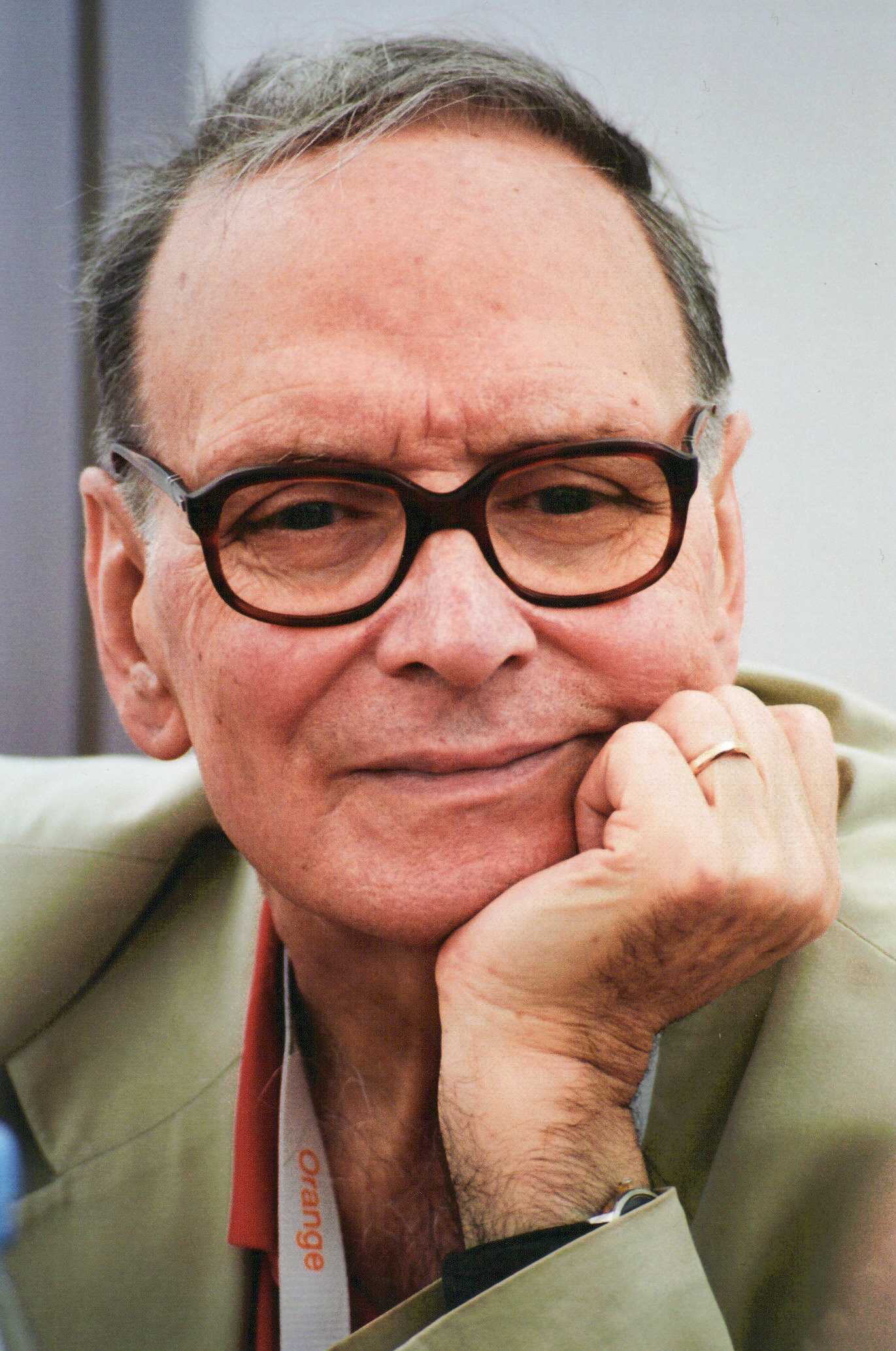
Close your eyes and listen. Two notes on an ocarina. A whistle. The crack of a whip. A man’s voice, wordless, rising over a desert that stretches to the horizon.
You know that sound instantly. You have heard it a thousand times — in films, in commercials, in concert halls, in the opening moments of a Metallica show. It is the sound of the Wild West.
Here is the strange part: the man who invented it never learned to speak English. He spent his entire life in Rome, in the same city where he was born, writing music in a small studio without even a piano in it — and the West he scored was a place he knew only from the cinema.
His name was Ennio Morricone. He was born in Rome on November 10, 1928. He wrote more than 400 scores for cinema and television. And he did something no one else has ever done: he made the whole world hear a place he had never seen.
This is the story of how a trumpet player from Rome gave the Wild West its sound — and then spent the next fifty years proving he could do everything else, too.
Two Notes That Changed the Movies
The score begins with a film called The Good, the Bad and the Ugly, released in 1966. It was the third film in Sergio Leone’s Dollars Trilogy, three westerns starring a young American actor named Clint Eastwood as the Man with No Name.
Morricone’s main theme for the film is one of the most famous pieces of music ever written for the screen. It opens with two notes — a howling, coyote-like cry — and then builds into a galloping, swaggering march, full of whistles, gunshots, voices and electric guitar. It does not sound like any western music that had come before it. The westerns of John Ford had orchestral scores, sweeping and romantic. Morricone’s west was dusty, ironic and strange.
The score sold more than three million copies worldwide, and the original soundtrack was certified Gold in the United States in August 1968 for 500,000 copies sold. A cover version of the main theme by Hugo Montenegro became a hit in 1968 — a No. 2 single on the Billboard pop chart in America, and a No. 1 single in Britain for four weeks.
The score is now regarded as one of the most influential soundtracks in history. It was inducted into the Grammy Hall of Fame in 2008.
Hidden inside the same score was another piece: “The Ecstasy of Gold,” a slow, soaring melody written for the scene in which Eastwood’s character runs through a vast cemetery, searching for a grave that holds $200,000 in gold. It has become one of Morricone’s best-known compositions. The Ramones used it as a closing theme at their live shows, Metallica has used it as the introductory music for its concerts since 1983, and Metallica’s 2007 version of it, for the tribute album We All Love Ennio Morricone, was nominated for a Grammy Award.
A piece of music written for a cemetery scene in a low-budget Italian western became the entrance music for the biggest metal band on the planet. That is the kind of afterlife Morricone’s music has.
The Schoolmates Who Reinvented the Western
Morricone and Sergio Leone had known each other since they were boys — classmates in Rome, from the same neighbourhood. When Leone hired Morricone to score A Fistful of Dollars in 1964, it was the turning point of both men’s careers.
The film was a different kind of western — violent, cynical and funny, shot in Spain on a tiny budget — and it was the film that changed everything.
The budget was so small that Morricone could not afford a full orchestra. So he improvised. He used gunshots, cracking whips, a whistle, voices, a Jew’s harp, trumpets, and the new Fender electric guitar, instead of the orchestral arrangements that westerns had always used. The strange sounds punctuated the action and hinted at the hero’s ironic, detached attitude. As memorable as Leone’s close-ups and black comedy, Morricone’s score helped to expand what film music could do.
For the film, Morricone was billed under the name Dan Savio, an Anglicised pseudonym he had used before to help the film’s appeal on the international market. A Fistful of Dollars came out in Italy in 1964 and was released in America three years later, where it helped to popularise the so-called Spaghetti Western. Over its theatrical release, it grossed more than any other Italian film up to that point.
With the score, Morricone began a twenty-year collaboration with his childhood friend Alessandro Alessandroni and Alessandroni’s vocal group, the Cantori Moderni. Alessandroni provided the whistling and the twanging guitar, and Morricone drew in particular on the group’s solo soprano, Edda Dell’Orso, a voice he later described as “an extraordinary voice at my disposal.”
Morricone went on to score Leone’s other two Dollars Trilogy westerns: For a Few Dollars More (1965) and The Good, the Bad and the Ugly (1966). All three starred Clint Eastwood, and all three showed Leone’s own intense vision of the mythical West.
Music Before the Film
There was something unusual about the way Leone and Morricone worked together. In most films, the music is written last, fitted to the finished picture. Leone did it the other way round.
“Some of the music was written before the film, which was unusual,” Morricone said in 2007. “Leone’s films were made like that because he wanted the music to be an important part of it; he kept the scenes longer because he did not want the music to end.” That, Morricone explained, is why the films feel so slow.
It was a radical idea: the music was not decoration, it was a character. The long silences, the staring close-ups, the endless walks across the desert all exist so the music has room to breathe — the film was built around its music.
Once Upon a Time in the West
After the Dollars Trilogy, Morricone scored Once Upon a Time in the West (1968), Leone’s grand, elegiac western about the end of the frontier. The score is one of the best-selling original instrumental scores in the world, with as many as ten million copies sold, including one million in France and more than 800,000 in the Netherlands.
The score gives each character a musical theme — the stranger’s lonely harmonica, the villain’s cold electric guitar, the widow’s sweeping romance — and it tells the story of the film before a word is spoken. It confirmed what the Dollars Trilogy had suggested: Morricone was not writing background music. He was writing the film itself.
The collaboration with Leone is considered one of the great partnerships between a director and a composer. Morricone’s last score for Leone was for his final film, the gangster epic Once Upon a Time in America (1984). Leone died in 1989, at the age of 60, while planning a film about the Siege of Leningrad. He had already convinced Morricone to compose its score. The project died with him.
Beyond the West: The Mission and “Gabriel’s Oboe”
By the 1980s, Morricone was famous far beyond the western, scoring political dramas, horror films for Dario Argento, comedies like La Cage aux Folles (1978), and John Carpenter’s The Thing (1982).
His most beloved score of the period was for The Mission (1986), directed by Roland Joffé. The film tells the story of Spanish Jesuit missionaries in South America, whose work among a tribe of Paraguayan natives is destroyed by a territorial dispute between Spain and Portugal. At one point, the score was one of the world’s best-selling film scores, selling more than three million copies worldwide.
At its heart is a piece called “Gabriel’s Oboe” — a slow, pure melody for solo oboe, played by the priest Gabriel, played by Jeremy Irons, as he walks alone into the jungle to win the trust of the tribe. It is one of the most beautiful melodies Morricone ever wrote, and it has since become a concert staple, played at weddings, funerals and memorial services around the world.
Morricone received his second Oscar nomination for The Mission, losing to Herbie Hancock’s jazz score for Round Midnight — a controversial result, since much of that music was pre-existing. In a 2001 interview, Morricone said plainly that he felt he should have won. His score was later ranked number one in a poll of the all-time greatest film scores by forty film composers, and it stands at number 23 on the American Film Institute’s list of the 25 greatest film scores.

Hollywood, From Rome
One of the strangest facts about Morricone’s career is that he never left Rome to compose his music, and he never learned to speak English. Hollywood came to him — not the other way round.
His first Oscar nomination came for Days of Heaven (1978), Terrence Malick’s luminous film about wheat farmers in Texas. It was remarkable that it took so long: Morricone had already produced some of the most popular and widely imitated film music ever written, and Days of Heaven was his first nomination.
His third nomination came for The Untouchables (1987), Brian De Palma’s Prohibition-era gangster film. De Palma, Morricone said, respected music and respected composers. But the director wanted one piece Morricone did not want to write: a triumphal piece for the police. Morricone wrote nine different versions and warned De Palma not to choose the sixth, because it was the worst. De Palma chose the sixth. As Morricone later admitted, it really suits the movie.
He went on to score Bugsy (1991) for Barry Levinson, who noticed something extraordinary about the way Morricone worked. “He doesn’t have a piano in his studio,” Levinson said. “I always thought that with composers, you sit at the piano, and you try to find the melody. There’s no such thing with Morricone. He hears a melody, and he writes it down. He hears the orchestration completely done.”
That was Morricone’s gift: he did not need to search for the music. It arrived in his head, fully formed — every instrument, every voice, every silence — and all he had to do was write it down.
In 1988, he began a collaboration with the Italian director Giuseppe Tornatore that would last the rest of his life. His first score for Tornatore was for Cinema Paradiso, the tender story of a projectionist and a boy who loves the movies. Morricone received a BAFTA award for the score, shared with his son Andrea, and a David di Donatello. He went on to score every one of Tornatore’s subsequent films, including The Legend of 1900 (1998), for which he won a Golden Globe, and Malèna (2000), which brought him his fifth Oscar nomination.
The Oscar That Took Fifty Years
For all his fame, the Academy Award eluded Morricone for decades: five nominations for Best Original Score — Days of Heaven, The Mission, The Untouchables, Bugsy and Malèna — and five losses.
In 2007, the Academy gave him the Honorary Award, “for his magnificent and multifaceted contributions to the art of film music.” But it was not a competitive Oscar — and Morricone and Alex North are the only composers to have received the Honorary Award since its introduction in 1928.
The competitive Oscar finally came in February 2016, for Quentin Tarantino’s The Hateful Eight (2015) — the first western Morricone had scored since 1981, and the first original score he had written for Tarantino, who had previously used his existing music in Inglourious Basterds and Django Unchained. It won the Golden Globe for Best Original Score, and then the Academy Award.
Morricone was 87 years old. He became the oldest person at the time ever to win a competitive Oscar. His nomination had made him the second-oldest nominee in Academy history. He had waited more than fifty years for the award — and he won it for a western, the genre where it had all begun.
Why His Music Endures
Morricone’s influence is everywhere. Hans Zimmer has spoken of his debt to him, and so have Danger Mouse, Muse and Radiohead. Metallica opens every concert with his music, hip-hop artists sample him, and directors still ask their composers for “something like Morricone.”
Part of the reason is the range. In a single career, Morricone wrote the whistle of a spaghetti western, the oboe of a Jesuit priest, the strings of a love story, the dread of a horror film, and the swing of a pop song for Mina. He composed more than 400 scores for cinema and television, and more than 100 classical works. He won three Grammy Awards, three Golden Globes, six BAFTAs, ten David di Donatello awards, eleven Nastro d’Argento awards, the Golden Lion Honorary Award and the Polar Music Prize.
But the deeper reason is simpler. Morricone’s music sounds like memory. The whistle from The Good, the Bad and the Ugly is the sound of a landscape most of us have never visited, and yet somehow recognise. “Gabriel’s Oboe” is the sound of a man walking alone into a jungle, carrying nothing but faith. His music works because it is direct, emotional and unmistakable — the sound of a composer who heard the whole orchestra in his head and wrote it down exactly as he heard it.
Ennio Morricone: The Boy from Trastevere Who Heard the Whole Orchestra in His Head
To understand the music, you have to understand the man. Morricone’s story begins in Rome, in a working-class neighbourhood, in a house full of music.
A Father’s Trumpet
Ennio Morricone was born in Rome on November 10, 1928, the son of Libera Ridolfi and Mario Morricone, a professional trumpeter who performed in light-music orchestras. He had four siblings, and the family lived in Trastevere, in the centre of Rome. His father taught him to read music and to play several instruments, and one of his early classmates was Sergio Leone, the boy who would one day change his life.
Morricone entered the Saint Cecilia Conservatory to take trumpet lessons under Umberto Semproni. He formally entered the conservatory in 1940, at the age of twelve, completing a four-year harmony programme within six months. He studied trumpet, composition and choral music under Goffredo Petrassi, received his diploma in trumpet in 1946, and finished his studies in 1954 with a Diploma in Composition under Petrassi, marked 9.5 out of 10.
He had written his first compositions at six. By graduation he was already a working musician: playing trumpet in jazz bands, arranging for RAI, and becoming a top studio arranger at RCA Victor.
Arranger, Ghost Writer, Pop Hitmaker
After graduation in 1954, Morricone wrote and arranged music as a ghost writer for films credited to better-known composers, and arranged for light-music orchestras of the RAI television network, sometimes under Anglicised pseudonyms such as Dan Savio and Leo Nichols. His first real film credit came in 1961, with Luciano Salce’s The Fascist.
But he was not only a film composer. Throughout his career, he composed songs for some of the biggest pop artists in Italy and beyond: Gianni Morandi, Edoardo Vianello, Rita Pavone, Françoise Hardy, Milva and Zucchero. He wrote for Paul Anka, and in 1987 he co-wrote a song with the Pet Shop Boys. In 2001, he wrote a song for Sting.
His most famous pop arrangement was “Se telefonando,” performed by Mina in 1966: melodic trumpet lines, driving drums, strings, a 1960s Europop female choir and deep, subsonic-sounding trombones, with eight changes of key building tension throughout the chorus. It became a No. 7 hit in Italy. Decades later, in a poll conducted by the newspaper la Repubblica to celebrate Mina’s 70th anniversary, 30,000 voters picked it as the best song she ever recorded.

The Group
Alongside his film work, Morricone was part of something stranger: the Gruppo di Improvvisazione Nuova Consonanza — the Group of New Consonance Improvisation — a collective of composers who performed and recorded avant-garde free improvisations. He was a member from 1964 until the group disbanded in 1980, playing trumpet and directing them on many occasions.
The Group was one of the first experimental composers’ collectives, and its work influenced free improvising ensembles across Europe. It was a laboratory: a place where Morricone could explore sounds that had nothing to do with the cinema. Some of that exploration found its way into his film scores, especially in the 1960s and 1970s, in films like A Quiet Place in the Country (1969) and Cold Eyes of Fear (1971).
It is easy to forget this side of Morricone — the avant-garde composer, the man who wrote more than 100 classical works and who was commissioned to write an opera, Partenope, in 1995. But it matters. The whistle, the whip-crack, the Jew’s harp, the wordless voice: those sounds did not come from nowhere. They came from a composer who had spent his life listening to everything, and who was not afraid to use any sound at all.
The Man Who Never Left Rome
In 1956, Morricone married Maria Travia. They were married for 64 years, until his death. He never left Rome to compose his music, and he never learned to speak English — a fact that never seemed to hold him back. Directors from all over the world came to his studio in Rome, or sent him their films, and the music came back.
He continued to compose into his nineties: in 2015 he premiered his Missa Papae Francisci, a Mass for Pope Francis, at the Church of the Gesù in Rome, and scored The Correspondence, his last film with Tornatore. In 2016, at 87, he won his first competitive Oscar.
On July 6, 2020, Ennio Morricone died at the Università Campus Bio-Medico in Rome, aged 91, as a result of injuries sustained to his femur during a fall. Following a private funeral in the hospital’s chapel, he was entombed in the Cimitero Laurentino.
He left behind more than 400 film and television scores, more than 100 classical works, two Academy Awards, three Grammys, three Golden Globes, six BAFTAs, ten David di Donatello awards and eleven Nastro d’Argento awards. His score for The Good, the Bad and the Ugly sits in the Grammy Hall of Fame. His score for Once Upon a Time in the West is one of the best-selling film scores in history.

The Sound of a West That Never Was
There is a wonderful irony at the heart of Ennio Morricone’s life. The most famous sound of the American West — the whistle, the whip, the two lonely notes on the ocarina — was invented by a man who had never been there and who wrote it all down in a small studio in Rome, without a piano.
The West he scored never really existed. It was Leone’s West: a mythical place of staring gunmen, empty deserts and buried gold, filmed in Spain with Italian actors and an American star. Morricone’s music made it feel real. It gave the myth a sound, and the sound became more famous than the films themselves.
That is why his music has outlived the western. You do not need to have seen The Good, the Bad and the Ugly to know its theme. You do not need to have seen The Mission to feel something when you hear “Gabriel’s Oboe.” The music has escaped the films and gone out into the world — into concert halls, into stadiums, into the opening moments of a Metallica show, into the memory of anyone who has ever heard two notes on an ocarina and thought, suddenly, of a desert.
Morricone was born in Rome on November 10, 1928. He would have been 98 today. He spent his life proving that music does not need a passport — only someone who can hear it, the whole orchestra, all at once, in his head, and write it down before it fades.
Leave a Reply