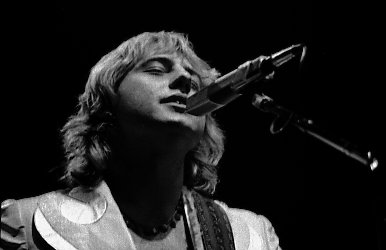
It is late in the afternoon on Saturday, August 29, 1970, and the Isle of Wight Festival is a sea of people.
Somewhere between 500,000 and 600,000 fans have crowded onto the island. Jimi Hendrix is still to come. The Who and The Doors are on the bill. And a band almost nobody in that enormous crowd has ever heard is about to walk on stage for only the second concert of its life.
Keith Emerson attacks his keyboards like a man possessed. Carl Palmer drums as if the stage is on fire. And standing between them, singing over the top of it all with a voice that is warm, clear and impossibly confident, is a 22-year-old from Poole in Dorset named Greg Lake.
By the end of the set, the band is playing its version of Mussorgsky’s Pictures at an Exhibition, and two cannons are fired into the night sky. The crowd erupts. Atlantic Records signs the band on the spot.
It was one of the most extraordinary debuts in rock history — and for Greg Lake, it was the second time he had done it in less than a year.
This is the story of a singer, bassist, guitarist and songwriter who stood at the centre of progressive rock — twice.
The Boy From Poole Who Wrote a Classic at Twelve

Gregory Stuart Lake was born on November 10, 1947, in the Parkstone area of Poole, in Dorset, on the south coast of England. His father, Harry, was an engineer. His mother, Pearl, was a housewife and a pianist.
The family was poor. Lake later said he was “born in an asbestos prefab housing unit,” and he remembered cold winters at home. But he also described his upbringing as a happy one, and he credited his parents for sending him money and food during his years as a struggling musician.
He grew up in the residential suburb of Oakdale, attending Oakdale Junior School and then Henry Harbin Secondary Modern School, which he left in 1963 or 1964. He discovered rock and roll in 1957, when he bought Little Richard’s “Lucille.” At the age of twelve, he first learned to play the guitar — and wrote his first song.
The song was called “Lucky Man.”
He did not write it down. He simply committed it to memory. More than a decade later, it would become one of the most famous songs in progressive rock, and the song that carried Emerson, Lake & Palmer into the American charts.
His mother was his first musical influence. She bought him a second-hand guitar to learn on. He then took lessons from Don Strike, who ran a shop in Westbourne, near Bournemouth. Strike taught him musical notation, violin pieces by Niccolò Paganini, and 1930s pop tunes. After about a year, Lake ended the lessons because he wanted to learn songs by the Shadows, a favourite band of his, and Strike “wouldn’t have any of it.” His second guitar was a pink Fender Stratocaster.
After leaving school, Lake worked loading and unloading cargo at the Poole docks, and for a short period as a draughtsman. Then, at the age of seventeen, he decided to become a full-time musician.
Learning the Trade in the Clubs
Lake’s first band was Unit Four, a covers group in which he sang and played guitar. When the band split in 1965, he and Unit Four bassist Dave Genes formed another covers group, the Time Checks, which lasted until 1966.
He then joined the Shame, and appeared on their single “Don’t Go Away Little Girl,” written by Janis Ian. During a stay in Carlisle for a gig, Lake contracted pneumonia and still performed on stage, then spent the night sleeping in the band’s van.
After a brief stint in the Shy Limbs, Lake joined the Gods in 1968. The band, based in Hatfield, secured a residency at the Marquee Club in London. Lake left the group later that year over creative differences, just as they were about to enter the recording studio. Their keyboardist, Ken Hensley, later said that Lake “was far too talented to be kept in the background.”
Hensley was right. By then, Lake had already met the man who would change his life.
A Friendship Forged in Guitar Lessons
In the 1960s, Lake formed a friendship with guitarist Robert Fripp. Both were from Dorset, and both had received lessons from Don Strike. Fripp saw Lake perform with Unit Four in Poole, and was once asked to be a roadie for a gig at Ventnor on the Isle of Wight. When no audience turned up, Lake and Fripp decided to play the tunes from their guitar lessons that Strike had taught them.
In 1968, Fripp formed King Crimson, after his earlier band Giles, Giles and Fripp ended. Michael Giles stayed on drums, and Ian McDonald joined on keyboards, flute and saxophone. When vocalist and bassist Peter Giles left the group, Lake replaced him.
It was Lake’s first time playing bass guitar. He had been a guitarist for eleven years. He took to the instrument quickly, and his warm, melodic bass playing became one of the band’s signatures.
Peter Sinfield was the band’s primary lyricist, with Lake contributing some of the lyrics for their debut album. After their contracted producer Tony Clarke walked away from the project, Lake produced the album himself.
In the Court of the Crimson King was released in October 1969. It was an immediate commercial and critical success, and it remains one of the most influential albums ever made.
“21st Century Schizoid Man” and the Court of the Crimson King
The album opens with “21st Century Schizoid Man,” a ferocious blast of distorted guitar, saxophone and drums, with Lake’s voice cutting through the noise like a warning siren. It is followed by “I Talk to the Wind,” a gentle, flute-led ballad, and then “Epitaph,” a sweeping, melancholy song about the collapse of civilisation, with Lake singing one of the most beautiful vocal lines of his career.
The album closes with the title track, “The Court of the Crimson King,” a grand, stately piece that gave the band its name and its identity. Lake’s voice carries it all — powerful, clear and emotional, equally at home in a scream and a whisper.
King Crimson toured the album in the UK and the United States, with some shows featuring the Nice as the opening act. Audiences loved the band. Critics loved the band. Lake later remembered: “There was this huge wave of response. The audiences were really into us because we were an underground thing — the critics loved us because we offered something fresh.”
But behind the scenes, the band was already coming apart. In San Francisco, during the American tour, Lake struck up a friendship with the Nice’s keyboardist, Keith Emerson. The two shared similar musical interests, were both ready to leave their respective bands, and talked about the benefits of forming a new group together.
When King Crimson returned to the UK in early 1970, Lake agreed to sing on the band’s second album, In the Wake of Poseidon, and to appear with them on the television show Top of the Pops, performing the song “Cat Food.” Then, in April 1970, he left King Crimson for good.
Three Men, One Supergroup
Lake joined Emerson and drummer Carl Palmer — formerly of the Crazy World of Arthur Brown and Atomic Rooster — to form Emerson, Lake & Palmer. It was one of the first supergroups of the 1970s, and it would become one of the most successful bands of the decade.
Lake began with a Fender bass before switching to a Gibson Ripper. He also contributed acoustic and electric guitar, and his voice had a wider and more diverse range than anything the Nice had previously recorded. He was also the band’s producer.
ELP’s live debut came at the Guildhall in Plymouth on August 23, 1970. Six days later came the Isle of Wight Festival, the cannons, and the record deal with Atlantic. The band’s self-titled debut album was released on November 20, 1970, in the UK, and in January 1971 in the United States. It reached No. 4 on the UK album chart and No. 18 on the Billboard 200.
The album’s closing track was “Lucky Man” — the song Lake had written at the age of twelve. It is a gentle acoustic ballad about a man who has everything: money, power, land and a horse. Then he goes to war, is wounded, and dies alone. The song ends with one of the most famous sounds in rock: Keith Emerson’s Moog synthesizer solo, swooping and bending through the final minute of the track.

Released as a single, “Lucky Man” reached No. 48 on the Billboard Hot 100 in the United States. It was the first of several Lake songs that would become ELP classics.
The Carpet, the Classics and the Arguments
Lake became known for performing on an expensive Persian carpet on stage. It was sometimes criticised as one of the band’s lavish, egocentric stage pieces, but Lake said it served a practical purpose: it covered a rubber mat he stood on at his microphone, because he was afraid of being electrocuted after once receiving an electric shock from a microphone on stage.
The band’s second album, Tarkus, was released on June 14, 1971. It went to No. 1 in the UK and No. 9 in the United States. But it was not made without argument. Lake initially rejected the title track, a complex suite about a half-tank, half-armadillo creature. He was only persuaded to record it after a band meeting with management — and the addition of his own song, “Battlefield,” into the suite.
The tension was real, and it never fully went away. Emerson was drawn to complex, classically influenced music. Lake had more straightforward rock tastes, and complained that Emerson chose to play in keys that were not a good fit for his voice. Yet the friction also produced extraordinary music.
Trilogy, released in 1972, contained “From the Beginning,” which reached No. 39 in the United States. Brain Salad Surgery, released in November 1973, with cover art by H. R. Giger, reached No. 2 in the UK and No. 11 in the United States. It contained “Karn Evil 9,” the band’s great showpiece, and “Still… You Turn Me On,” another of Lake’s gentle acoustic songs — proof that, even in the middle of ELP’s grandest excesses, there was always room for a quiet, human voice.

In 1974, ELP took a break. By then the band were tax exiles, living in Switzerland, France, Canada and the Bahamas, restricted to two months a year in England. Lake used the time to focus on his family life, to travel, and to write and release music.
“I Believe in Father Christmas”
In 1975, while ELP were on hiatus, Lake achieved solo chart success. His single “I Believe in Father Christmas” reached No. 2 on the UK Singles Chart — held off the top spot only by Queen’s “Bohemian Rhapsody.” In the UK, the single sold more than 13,000 copies in two days. It has become a Christmas perennial, played on the radio every December for half a century.
The song is a remarkable piece of work. The music is warm and stately, and the riff between the verses comes from the “Troika” section of Sergei Prokofiev’s Lieutenant Kijé Suite — an idea suggested by Keith Emerson. But the lyrics are not the cheerful words of a Christmas card. They are about a child growing up and discovering that the magic of Christmas was never quite what it seemed — and about an adult looking back at that loss with sadness rather than bitterness.
Works, Love Beach and the Break-Up
In March 1977, ELP released Works Volume 1, a double album in which each member was given one side for his solo music, with the fourth side for the group. Lake wrote five acoustic songs with lyrical assistance from Sinfield, making a conscious effort not to record “just ballads,” but a wider variety of musical styles. One of them, “C’est la Vie,” was released as a single. Lake later called the album the “beginning of the end” of the band, as he stopped producing their albums. Works Volume 2 followed in November 1977.
The band split up in 1979, after the unsuccessful album Love Beach, which the group were contractually obliged to record. The 1970s, the decade ELP had helped to define, were over.
The Greg Lake Band and Gary Moore
Several months after ELP broke up, Lake began writing new songs for his first solo album. He travelled to Los Angeles and worked with session musicians, but found the music lacked personality. He realised he wanted to play as part of a group, and began assembling the Greg Lake Band.
The result, Greg Lake, was released in September 1981 on Chrysalis Records, and reached No. 62 in both the UK and the United States. The debut concert for the tour took place in August 1981 at the Reading Festival, with guitarist Gary Moore, drummer Ted McKenna, keyboardist Tommy Eyre and bassist Tristram Margetts.
Lake’s second solo album, Manoeuvres, was released in July 1983. He disbanded the Greg Lake Band soon after completing it, without promoting or touring the album, and split with his record company. Lead guitarist Gary Moore had written solo material that brought him a recording contract of his own.
Three Nights in Tokyo with Asia
In October 1983, at Carl Palmer’s request, Lake briefly joined the supergroup Asia, replacing fellow King Crimson alumnus John Wetton for four scheduled concerts in Japan. Lake spent six weeks learning Asia’s songs, culminating in the “Asia in Asia” concert at the Nippon Budokan Hall in Tokyo on December 6, 1983 — the first concert broadcast by satellite to MTV in the United States. Lake left the group after the tour, having joined as a favour for the Japanese concerts only.
In 1986, Lake and Emerson decided to reform ELP to record another album. But Palmer was committed to Asia, so they auditioned other drummers. They found a good rapport with Cozy Powell, and recorded an album as Emerson, Lake & Powell.
The Reunions and the Later Years

ELP reformed for a number of years in the mid-1990s, releasing Black Moon in 1992 and In the Hot Seat in 1994, before permanently disbanding — except for one reunion concert in 2010 at London’s High Voltage Festival.
Lake kept working. In 2001, he toured as a member of the seventh incarnation of Ringo Starr & His All-Starr Band. In 2003, he played bass on the Who song “Real Good Looking Boy” — the group’s usual bassist, Pino Palladino, was touring at the time. In 2005, Lake toured Germany and the UK with a new Greg Lake Band, but the shows were not sell-outs and the American leg was cancelled.
He also sponsored other artists, producing their recordings and helping them to get recording contracts, and he was a fundraiser for the National Center for Missing & Exploited Children.
In 2026, Loudwire ranked him as the 5th greatest progressive rock singer of all time.
The End of 2016
Lake died in London on December 7, 2016, at the age of 69, after suffering from pancreatic cancer. His manager, Stewart Young, who was also his best friend, described his battle with the illness as long and stubborn. Lake had faced his difficulties privately.
His death came nine months after the death of ELP keyboardist Keith Emerson, leaving Carl Palmer the only surviving member of Emerson, Lake & Palmer.
Tributes poured in from across the music world, including Rick Wakeman and Steve Hackett, Ringo Starr, John Wetton, Opeth’s Mikael Åkerfeldt, Jethro Tull’s Ian Anderson, and Carl Palmer himself. Palmer wrote: “It is with great sadness that I must say goodbye to my friend and bandmate. Greg’s soaring voice and skill as a musician will be remembered by all who knew his music. I have fond memories of those great years we had in the 1970s and many memorable shows that we performed together. Having lost Keith Emerson this year as well has made this particularly hard for all of us. As Greg sang at the end of Pictures at an Exhibition, ‘death is life’. His music can now live forever in the hearts of all who loved him.”
Greg Lake: The Boy From Poole Who Sang for Two Legends
To understand Greg Lake’s music, you have to understand where he came from — and how unlikely his journey was.
A Poor Boy With a Second-Hand Guitar
Gregory Stuart Lake was born on November 10, 1947, in the Parkstone area of Poole, Dorset, to Harry, an engineer, and Pearl, a housewife. He grew up in the suburb of Oakdale, in a family that had little money but plenty of love.
He was twelve years old when he picked up a guitar for the first time. His mother, a pianist, bought him a second-hand instrument and encouraged him. His teacher, Don Strike, drilled him in notation, Paganini and 1930s pop tunes. Lake wanted to play the Shadows. Strike would not have it. The boy learned his discipline anyway — and then went his own way, exactly as he would do for the rest of his life.
He left school in 1963 or 1964, worked on the Poole docks and briefly as a draughtsman, and at seventeen decided to become a full-time musician. It was a leap of faith from a poor boy in a prefab house. It took him to London, to the Marquee Club, and to a residency with the Gods.
The Voice in the Middle
Lake’s great gift was his voice. It was warm, strong and clear, with a range that could carry a delicate ballad and cut through the loudest rock band on earth. It was the human centre of two bands that were famous for their excess.
In King Crimson, he was the voice that made “Epitaph” heartbreaking and “21st Century Schizoid Man” terrifying. In ELP, he was the voice that made “Lucky Man” tender and “From the Beginning” intimate, standing between Keith Emerson’s keyboards and Carl Palmer’s drums like a calm eye in a storm.
Two Bands, One Legacy
Very few musicians can claim to have founded one legendary band. Greg Lake founded two.
Lake’s own songs were the quiet heart of both bands. “Lucky Man,” “From the Beginning,” “Still… You Turn Me On,” “C’est la Vie” — songs about ordinary people, written in plain language, sung with sincerity. They are the reason ELP’s music still reaches listeners who have never heard of progressive rock.
A Christmas Song That Never Goes Away
If there is one piece of evidence for Lake’s lasting place in British life, it is “I Believe in Father Christmas.” Every December, it returns to the radio, to the shops and to the television. Millions of people who have never heard of King Crimson or ELP know that voice.
The Last of a Generation
When Greg Lake died in December 2016, it was the end of a year that had taken too many musicians. Keith Emerson had died nine months earlier. For fans of progressive rock, losing Lake and Emerson in the same year felt like losing the music itself.
But the music did not die. In the Court of the Crimson King is still played, still studied, still startling. “Lucky Man” is still sung. “I Believe in Father Christmas” is still heard every December.
Greg Lake was that twelve-year-old once. He was lucky. And so were we.
Leave a Reply