Oldies Music Timeline

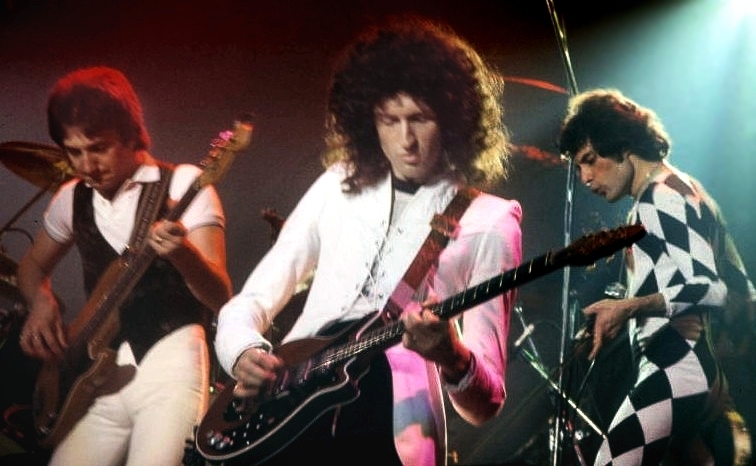
Queen in 1977, the year before “Jazz” — John Deacon, Brian May, Freddie Mercury and Roger Taylor. Photo: Christopher Hopper / Elektra Records / Wikimedia Commons, Public domain
It is a Sunday afternoon in September 1978, and a bicycle race is about to start at Wimbledon Stadium in London.
There is nothing ordinary about it. The riders are all women. They are all naked. They are all riding brand-new bicycles, borrowed for the occasion, around a stadium track while photographers try to keep up.
At the side of the track, four men in rock-star clothes are watching it all happen. They are Freddie Mercury, Brian May, Roger Taylor and John Deacon — Queen, the biggest band in Britain — and this strange, noisy, faintly scandalous race is their idea.
They are not racing. They are promoting a record.
The single is “Bicycle Race”, backed with “Fat Bottomed Girls”, and the album it comes from will be released on November 10, 1978. It is called Jazz. It contains no jazz. It contains hard rock, disco, vaudeville, funk, a tribute to Elvis Presley, a song in several languages at once, and a closing track that stitches pieces of the whole album together like a collage.
It also contains “Don’t Stop Me Now”, a song that was only a modest hit when it came out — and that would go on to become one of the most loved songs Queen ever recorded.
This is the story of how Jazz was made — in Switzerland and the south of France, in a summer of tax bills, birthdays, thunderstorms and bicycles — and why, nearly fifty years later, it still sounds like a band having the time of its life.
A Tax Bill Sent Them Out of Britain
To understand Jazz, you have to start with a bill.
In June 1978, Queen received a large tax bill. The band decided to record outside the United Kingdom, and they had to decide quickly: Brian May would be forced to leave the UK on July 2 because of the tax situation. It was shortly after the birth of his first child, Jimmy.
Rehearsals for the album began during the first week of July 1978. May first went to Canada, while the rest of the band flew to Nice, in the south of France, to begin rehearsing. May soon joined them there.
It was the first Queen album recorded outside the UK, and the change of scenery mattered. The band were no longer working in familiar London studios. They were in the sunshine, on the French Riviera, with a whole summer in front of them — and with a new record to make in a matter of months.
Montreux, David Bowie and the Tour de France
From Nice, the band travelled to the Montreux Jazz Festival, which probably inspired the album’s title. There they ran into David Bowie, who was working on his album Lodger between tour dates. Bowie convinced them to record at Mountain Studios in Montreux, on the shore of Lake Geneva.
Before the band moved to Montreux, they finished preliminary recordings of “Don’t Stop Me Now”, “Fat Bottomed Girls”, “In Only Seven Days” and “More of That Jazz”. Production then moved to Montreux the day after the jazz festival.
Then, on July 19 — Brian May’s 31st birthday — the band went to watch the 18th stage of the 1978 Tour de France. The sight of the riders, the crowds and the summer road race stayed with Freddie Mercury. It inspired him to write the album’s lead single, “Bicycle Race”.
For the next three weeks the band worked at Mountain Studios, mainly on “Fun It”, “Jealousy”, “Leaving Home Ain’t Easy” and “Let Me Entertain You”. They took a few days off along the way, most notably on July 26, when they celebrated Roger Taylor’s 29th birthday with a party at a Montreux hotel that got out of hand.

Super Bear, and an Album Finished in October
After a short holiday in the middle of August, the band moved production back to France, to Super Bear Studios at Berre-les-Alpes, in the hills above Nice. There they spent the rest of the month recording “Mustapha”, “Bicycle Race”, “If You Can’t Beat Them”, “Dead on Time” and “Dreamer’s Ball”.
The band finished overdubbing the songs in September. They mixed the lead single early and sent it to New York for mastering, which was completed on September 14. They mixed the rest of the album from the middle of the month, and Jazz was officially completed on October 14, during a mastering session at Super Bear Studios.
The whole album, from the first rehearsals in July to the finished master in October, had taken about three months. It was produced by Queen themselves with Roy Thomas Baker, the producer who had worked with them since their earliest records. It was released by EMI in the United Kingdom and Elektra in the United States, and it runs for 44 minutes and 39 seconds.
The cover art was suggested by Roger Taylor, who had seen a similar design painted on the Berlin Wall.
Thirteen Songs, and No Two Alike
Jazz is thirteen songs long, and its most striking quality is how different they are from one another. Every member of the band wrote songs for it, and each of them brought a different mood to the record.
It opens with “Mustapha”, written by Mercury. The lyrics mix English, Arabic and Persian with words that may have been invented altogether, built around the phrases “Allah, Allah, Allah we’ll pray for you” and “salaam alaykum”. It is a strange, thrilling opening — a song that sounds like nothing else on the radio in 1978, and that announces at once that this album is not going to play by the rules.
Then comes “Fat Bottomed Girls”, written by Brian May, with lead vocals shared by Mercury and May, who sings the chorus. Both guitar and bass are played in drop-D tuning, a rarity for Queen. On stage, Mercury sang the whole song, with Taylor and May on harmonies. It is a big, swaggering rock song, and it was released as a double A-side single with “Bicycle Race” on October 13, 1978.
“Jealousy”, also by Mercury, is quieter and stranger. May plays his Hallfredh acoustic guitar, which had been given a replacement hardwood bridge, chiselled flat, with a small piece of fret wire placed between it and the strings, so that the strings produce a buzzing effect like a sitar. All the vocals were recorded by Mercury. The song was later released as a single in the United States, on April 27, 1979.
“Bicycle Race” itself is one of Mercury’s most complex compositions. It moves through several modulations and unusual chord changes, shifts meter from 4/4 to 6/8 and back again, and includes a section in which the guitars race each other, imitating a bicycle race. It is clever, funny and unmistakably Queen — a pop song built like a piece of classical music, with a joke at its heart.
“If You Can’t Beat Them”, by John Deacon, is another hard rock track, and a live favourite for the band in the late 1970s. It is one of the few Deacon songs on which May plays all the guitars. “Let Me Entertain You”, by Mercury, is written directly to the audience, and even names the band’s tour manager, Gerry Stickells, and their record labels, Elektra and EMI, in its lyrics.

Side Two: Thunder, Elvis and a Disco Detour
The second side of the album opens with “Dead on Time”, written by May. It contains two high notes from Mercury that reach C-sharp 5, and it was never played in concert, although May would use parts of it in his guitar solos on the Jazz Tour and the later Works Tour. The song ends with the sound of a thunderbolt, followed by Mercury shouting “You’re dead!” The thunderbolt was recorded by May himself on a portable recorder during a thunderstorm. The album’s liner notes credit the thunderbolt to God.
“In Only Seven Days” is Deacon’s other song on the album. He plays acoustic and electric guitar on it, and it was the B-side of “Don’t Stop Me Now”.
“Dreamer’s Ball” is May’s tribute to Elvis Presley, who had died one year before the album was released. It is a gentle, old-fashioned song, closer to the music of Elvis’s era than to anything else Queen had recorded, and the concert version was arranged completely differently, with May and Taylor singing vocal brass parts.
“Fun It” is Roger Taylor’s funk track with a disco feel, on which he and Mercury share the vocals — Taylor singing lead, Mercury on backing vocals. Taylor used Syndrum pads and played most of the instruments himself. It is the sound of Queen listening to what was happening on the dance floor in 1978 and deciding to join in, on their own terms.
“Leaving Home Ain’t Easy” is a ballad by May, who sings all the vocals, lead and harmony. His voice was speeded up for the bridge in order to create a feminine voice.
Then comes the song that would outlive them all.
“Don’t Stop Me Now”: A Modest Hit That Became Immortal
“Don’t Stop Me Now” was written by Mercury and recorded in August 1978 at Super Bear Studios. It is the twelfth track on the album, and May’s only contribution is a short guitar solo and backing vocals. The rest is Mercury at the piano, driving the song forward with pure, unstoppable energy.
It was released as a single on January 26, 1979. It reached No. 9 in the UK, but only No. 86 on the US Billboard Hot 100. At the time, it looked like a solid but unremarkable single — a good album track that had done reasonably well.
History had other plans. The song appeared on the band’s 1981 compilation Greatest Hits, it was used in the bar scene of the film Shaun of the Dead, and the BBC television show Top Gear named it the top song in a viewer poll of the best driving songs. Google used it for a Google Doodle to mark Mercury’s 65th birthday on September 5, 2011. In the streaming era it has gone multi-platinum in the United Kingdom and the United States, and it is now one of Queen’s most famous and most loved songs — the sound of pure joy, played at full speed.
The album closes with “More of That Jazz”, written by Taylor, who plays most of the instruments and sings all the vocals. Its coda contains short clips from many songs on the album, including “Dead on Time”, “Bicycle Race”, “Mustapha”, “If You Can’t Beat Them”, “Fun It” and “Fat Bottomed Girls” — a final joke, and a reminder of everything you have just heard.
The Bicycle Race: A Poster, a Pair of Panties and a Bill for the Seats
The promotion for Jazz was as bold as the music. To promote the album and the “Fat Bottomed Girls” / “Bicycle Race” single, the band staged a bicycle race with nude women. It took place on September 17, 1978, at Wimbledon Stadium in London, and a poster of the start of the race was included with copies of the LP. A smaller part of the poster image was also used as an alternative single cover for “Bicycle Race”.
The picture sleeve showed a rear view of one of the riders on her bicycle — but a pair of red panties had been painted on, to avoid public outcry.
According to the album’s liner notes, the band borrowed the bicycles from a shop, and when they returned them they were told they would have to buy all the seats, because the bicycles had been used without clothing.
The Critics Hated It. The Public Bought It Anyway.
When Jazz was released on November 10, 1978, the critics were divided, and some of them were furious.
Reviewing for Rolling Stone in 1979, Dave Marsh dismissed Jazz as “more of the same dull pastiche” from Queen, and finished by famously calling Queen “the first truly fascist rock band”. Mitchell Cohen of Creem called the album “absurdly dull”. Robert Christgau of the Village Voice gave it a C+, although he found “Bicycle Race” humorous.
The public disagreed. Jazz reached No. 2 on the UK Albums Chart and No. 6 on the US Billboard Top LPs & Tape chart. It was certified Platinum in the United States, for more than a million copies shipped, and Gold in the United Kingdom.
Time has been kinder to the album than the critics of 1979 were. In a retrospective review, Stephen Thomas Erlewine of AllMusic described it as “one of their sleekest albums”, and said that its diversity and exaggeration made it “more fun than any of their other albums”. Alexis Petridis wrote in The Guardian that “Jazz was hysterical in every sense of the word, but the music press comprehensively failed to get the joke, particularly in the US”. When Louder ranked every Queen album from best to worst, Jazz came fourth. Ultimate Classic Rock placed it third, calling it one of the band’s finest albums and praising its depth beyond the hit singles.
Four singles were released from the album in total: “Bicycle Race” / “Fat Bottomed Girls” in October 1978, “Don’t Stop Me Now” in January 1979, “Mustapha” in April 1979 in Germany and a small number of other countries, and “Jealousy” in April 1979 in the United States. The band then took the album on the road on the Jazz Tour, and the live album Live Killers followed in 1979.
Why “Jazz” Still Matters
Nearly fifty years after its release, Jazz is best understood as Queen at their most free. The band had already proved they could write anthems and a masterpiece. On Jazz, they proved they could do almost anything else as well: hard rock, disco, music hall, funk, a ballad, a joke, a tribute, and a piano song that sounds like a rocket taking off.

Queen: Four Students Who Became the Biggest Band in the World
To understand Jazz, you have to understand the band that made it. Queen did not come from nowhere. They came from west London, from art college and physics lectures, and from a simple idea: that a rock band could be larger, louder and more theatrical than anyone had dared before.
From Smile to Queen
The founding members met in west London in the late 1960s. Guitarist Brian May had built his own guitar with his father in 1963, and formed the group Smile with singer Tim Staffell and drummer Roger Taylor, a young dental student who had answered an advertisement on a college notice board for a “Mitch Mitchell/Ginger Baker type” drummer.
While attending Ealing Art College, Staffell became friends with a fellow student, Farrokh Bulsara, who was from Zanzibar and of Indian Parsi descent. Bulsara became a keen fan of Smile, and ran a stall in Kensington Market with Taylor. In 1970, Staffell quit Smile, and the remaining members accepted Bulsara as their lead singer. He suggested the group should be renamed “Queen” — the others were uncertain at first, but he said, “it’s wonderful, dear, people will love it”. At the same time, he changed his surname to Mercury, inspired by the line “Mother Mercury, look what they’ve done to me” in the song “My Fairy King”.
The band played their first gig at a fundraising event in Truro on June 27, 1970, and their first London gig on July 18, 1970. In February 1971, John Deacon joined on bass, completing the classic line-up of Mercury, May, Taylor and Deacon. On July 2, 1971, Queen played their first show with that line-up at a college in Surrey.
The First Albums and the Breakthrough
Queen’s self-titled debut album was released in 1973, after the band had recorded demos at De Lane Lea Studios in exchange for helping the studio test its equipment. They had been taken up by producers John Anthony and Roy Thomas Baker, and Trident Studios offered them a management deal that gave them access to professional recording facilities. The debut was well received by critics, but it drew little mainstream attention.
Queen II followed in March 1974, reaching No. 5 on the British album chart and giving the band their first hit single, “Seven Seas of Rhye”, which reached No. 10 in the UK. Later that year, Sheer Heart Attack brought them international success, and in 1975 A Night at the Opera featured “Bohemian Rhapsody”, which topped the UK singles chart for nine weeks and helped popularise the music video format.
By 1977, Queen were one of the biggest rock bands in the world. Their album News of the World contained “We Will Rock You” and “We Are the Champions”, songs that have become anthems at sporting events ever since. Jazz, released the following year, was their seventh studio album — the next step in a run of records that had taken them, in five years, from art-college hopefuls to stadium headliners.
After “Jazz”: The Game, Live Aid and Beyond
Queen did not slow down after Jazz. Their next studio album, The Game, was released in 1980, and its single “Another One Bites the Dust” became their best-selling single. Their 1981 compilation Greatest Hits is the best-selling album in the United Kingdom, and has been certified 9× Platinum in the United States.
By the early 1980s, Queen were one of the biggest stadium rock bands in the world. Their performance at the Live Aid concert in 1985 is ranked among the greatest in rock history by various publications. In August 1986, Mercury gave his last performance with Queen at Knebworth, in England.
The band released two more albums, The Miracle in 1989 and Innuendo in 1991. Mercury, who had been diagnosed with AIDS in 1987, publicly revealed his diagnosis on November 23, 1991, and died the next day of bronchopneumonia, a complication of AIDS. One more album featuring Mercury’s vocals was released, Made in Heaven, in 1995. Deacon retired in 1997, while May and Taylor continued to make sporadic appearances together. Since 2004, they have toured as “Queen +”, with vocalists Paul Rodgers (until 2009) and Adam Lambert (since 2011).
Estimates of Queen’s record sales range from 250 million to 300 million, making them one of the world’s best-selling music artists. In 1990, they received the Brit Award for Outstanding Contribution to British Music. They were inducted into the Rock and Roll Hall of Fame in 2001, and all four members were inducted into the Songwriters Hall of Fame in 2003. In 2018, they were presented with the Grammy Lifetime Achievement Award.
The Album That Proved Queen Could Do Anything
Jazz is not Queen’s most famous album, and it is not their most serious. It is something rarer: an album by a band at the height of its powers, enjoying itself so much that it forgot to be careful.
Listen to it today and what you hear is four musicians who could play almost any style they wanted — and who decided, for one summer in Switzerland and France, to play all of them at once. There is a song about a bicycle race, a song that ends with a thunderbolt credited to God, a song in several languages, a disco song, a tribute to Elvis, and a piano song about never stopping that the whole world now sings along to.
Forty-eight years after November 10, 1978, that is still the point of Jazz. It was never meant to be a jazz album. It was meant to be Queen, doing whatever they liked, as loudly and as joyfully as they could — and daring the rest of the world to keep up.
Leave a Reply