
On November 11, 2016, the jazz world lost one of its great bassists. Victor Bailey was fifty-six years old. He had spent the last years of his life teaching at the Berklee College of Music in Boston, the same school he had entered as an eighteen-year-old in 1978, and playing a bass guitar that he had made famous with his own hands.
Ten years later, his name is still spoken with respect wherever bass players gather. He was the man who took over the bass chair in Weather Report after Jaco Pastorius — the most celebrated bassist in jazz history — and held it for four years and four albums. He was the man who turned the bass into a voice, who sang through his instrument in solos that sounded like a human voice scatting. And he was a musician who kept playing, and kept teaching, even as a disease slowly took away the strength in his hands and legs.
This is the story of Victor Bailey: a Philadelphia kid who became a bass player by accident, and ended up carrying one of the hardest jobs in jazz.
A Drummer Who Became a Bassist
Victor Randall Bailey was born on March 27, 1960, in Philadelphia, Pennsylvania. He was raised in a deeply musical family. His father, Morris Bailey Jr., was an active musician and composer. His uncle, Donald “Duck” Bailey, was a jazz drummer who played on numerous Blue Note records, with artists including the Jimmy Smith Trio, Hampton Hawes, Carmen McRae, and Dizzy Gillespie.
As a child, Bailey played the drums. He switched to the bass guitar almost by accident: the bassist in his neighbourhood band walked out of a band practice, and young Victor picked up the instrument. He took to it immediately, and his father encouraged him to make the bass his own.
In 1978, at the age of eighteen, Bailey entered the Berklee College of Music in Boston. He had first tried to join the navy, but he was disqualified from naval service because of asthma. Berklee became his path instead — and it would become his home, as a student, as a teacher, and, at the end of his life, as the place where he taught his final lessons.
The Hardest Job in Jazz
In 1982, Bailey got the call that would define his career. Weather Report, the jazz-fusion band founded in 1970 by keyboardist Joe Zawinul and saxophonist Wayne Shorter, needed a new bassist. Their previous bassist was Jaco Pastorius, who had revolutionised the instrument — popularising the fretless bass guitar, melodic bass soloing, and the use of harmonics — and whose shadow fell across every bassist of his generation.
Bailey was twenty-two years old. He took the job.
He was the bassist for Weather Report during their final years, from 1982 to 1986, and he played on four of their studio albums: Procession (1983), Domino Theory (1984), Sportin’ Life (1985), and This Is This! (1986). The band broke up in 1986, the year the last of those albums was released.
It was an extraordinary apprenticeship. Weather Report was one of the defining bands of jazz fusion, a group that had won the DownBeat readers’ poll for best album five years in a row and whose 1977 single “Birdland” had become a jazz standard. Bailey played alongside Zawinul, whose synthesizers had redefined the sound of jazz keyboards, and Shorter, whose economical, listening style on the saxophone had made him one of the most respected improvisers in the music.
Bailey did not try to copy Jaco Pastorius. He brought his own sound: a driving, funky pulse, a rich tone, and a signature style of scat-bass solos, in which he sang along with his own bass lines, turning the instrument into a voice. It became his trademark — the thing other bassists recognised instantly.
The Solo Career
When Weather Report ended, Bailey launched a solo career in 1988. His debut album as a leader, Bottom’s Up, was released on Atlantic Records in 1989. It was followed by Petite Blonde in 1992, recorded with drummer Dennis Chambers, keyboardist Mitch Forman, guitarist Chuck Loeb, and saxophonist Bill Evans; Low Blow in 1999; That’s Right! in 2001; Electric in 2005 and Traffic in 2006, both recorded with guitarist Larry Coryell and drummer Lenny White for Chesky Records; and Slippin’ ’n’ Trippin’ in 2009.
He also played with Steps Ahead, recording the albums Magnetic (1986) and Vibe (1995), and worked as a sideman with artists including Michael Brecker, on Now You See It… (Now You Don’t) (1990), and Omar Hakim, on Rhythm Deep (1989).
His instruments became almost as famous as his playing. He played a 1986 Pensa-Suhr J-4 koa bass and a fretless Ibanez Roadstar, among others. Fender released a Victor Bailey Signature acoustic bass guitar, as well as the Victor Bailey Jazz Bass in its Artist series, available in four- and five-string, fretted and fretless versions. He also used Markbass amplifiers.
The Disease, and the Teaching
Like his father, Bailey suffered from Charcot–Marie–Tooth disease for most of his adult life. It is a hereditary condition that weakens the muscles, starting in the legs and hands. As the disease progressed, Bailey began using a cane to offset his weakened legs. The weakness eventually spread to his upper body, and in 2015 he retired from performing and from his teaching position at Berklee College of Music.
He died on November 11, 2016, in Stafford, Virginia, at the age of fifty-six, likely from complications of Charcot–Marie–Tooth disease and amyotrophic lateral sclerosis — Lou Gehrig’s disease.
It was a cruel ending for a musician whose gift had always been in his hands. But the teaching mattered as much as the playing. At Berklee, Bailey had taught a generation of young bassists, passing on what he had learned in Weather Report and on the road — not just technique, but the idea that the bass could be a voice, that it could sing, and that it could lead.
Why He Still Matters
Victor Bailey’s career was short — thirty-five years, from his first professional work in 1980 to his retirement in 2015. But it contained two things that very few musicians ever achieve.
The first was the hardest job in jazz: following Jaco Pastorius in Weather Report, and doing it not by imitation, but by being himself. He held the chair for four years and four albums, and he left it with his own sound intact.
The second was the teaching. The bassists he taught at Berklee carry his ideas forward — the scat-bass solos, the singing tone, the belief that the bass is not a background instrument but a voice in its own right.
Ten years after his death, his instruments are still played, his records are still studied, and his students are still teaching what he taught them. The voice he made out of a bass guitar has not gone quiet.
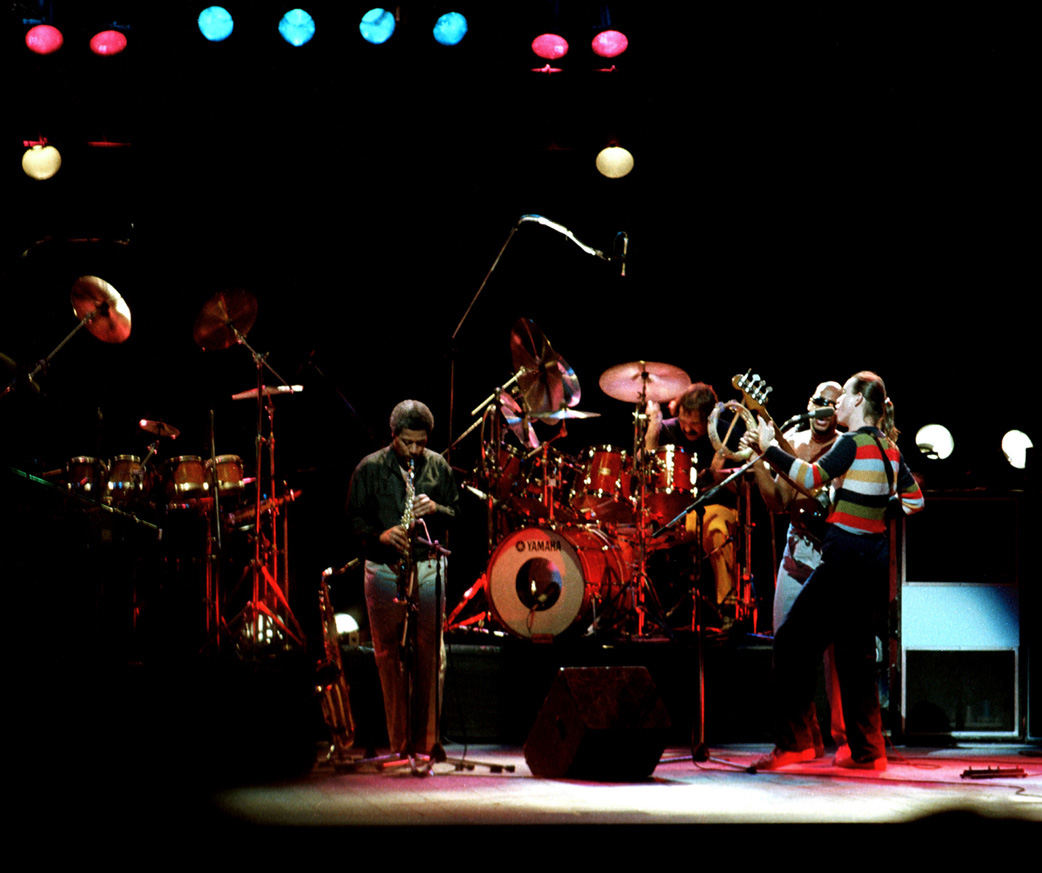
Victor Bailey: The Philadelphia Kid Who Carried Weather Report
To understand Victor Bailey, you have to understand two things: the family he came from, and the band he joined.
A Family of Musicians
Victor Randall Bailey was born on March 27, 1960, in Philadelphia, into a family where music was not a hobby but a way of life. His father, Morris Bailey Jr., was a musician and composer. His uncle, Donald “Duck” Bailey, was a jazz drummer who had played on Blue Note records with Jimmy Smith, Hampton Hawes, Carmen McRae, and Dizzy Gillespie.
Bailey started on drums, like his uncle. He switched to bass when the bassist in his neighbourhood band walked out of a rehearsal — an accident that became a career. His father encouraged him, and by the time he was eighteen, he was at Berklee College of Music in Boston, the school that would shape the rest of his life.
Weather Report: The Band He Joined
Weather Report was founded in 1970 by Joe Zawinul, an Austrian keyboardist, and Wayne Shorter, an American saxophonist who had played in Miles Davis’s second great quintet. The band began as a free-improvising group with avant-garde leanings, then moved, under Zawinul’s direction, towards a funky, groove-oriented sound built on R&B, synthesizers, and rhythms from around the world.
Alongside the Mahavishnu Orchestra, Return to Forever, and Herbie Hancock’s Headhunters, Weather Report is widely considered one of the defining bands of jazz fusion. Its 1977 single “Birdland,” written by Zawinul, became one of the most famous jazz recordings of all time.
The band’s bass chair had been held by three remarkable players before Bailey: the Czech bassist Miroslav Vitouš, who co-founded the group; Alphonso Johnson, who brought the funk; and Jaco Pastorius, who, between 1976 and 1982, changed what the bass guitar could do — fretless playing, melodic solos, harmonics, and a driving R&B pulse that became the band’s signature.
When Pastorius left, Bailey stepped into that chair. He was twenty-two. He stayed for four years, through four albums, until the band itself came to an end in 1986.
The Voice in the Bass
What made Bailey different was the sound he made. Where Pastorius had made the bass sing with harmonics and melody, Bailey made it sing literally — his signature scat-bass solos, in which he sang along with his own lines, turned the bass into a second voice. It was a style that other bassists recognised instantly, and that his students at Berklee would spend years trying to learn.
He played a 1986 Pensa-Suhr J-4 koa bass — an instrument so associated with him that, after his death, it sold at auction for $10,455 — and a fretless Ibanez Roadstar. Fender honoured him with signature basses in its Artist series. They are still made, and still played, by bassists who never met him.
The Teacher
Bailey’s last years were shaped by illness. Charcot–Marie–Tooth disease, the same condition his father had lived with, weakened his legs, then his hands. He used a cane. He kept teaching. In 2015, when the weakness reached his upper body, he retired from performing and from Berklee.
He died on November 11, 2016, in Stafford, Virginia. He was fifty-six.
The teaching was his second legacy. At Berklee, he had shown a generation of bassists that the instrument could be a voice — that it could scat, that it could sing, that it could lead a band rather than follow it. Those students are still playing, and still teaching, and the sound he made is still being passed on, hand to hand, the way music always is.
Leave a Reply