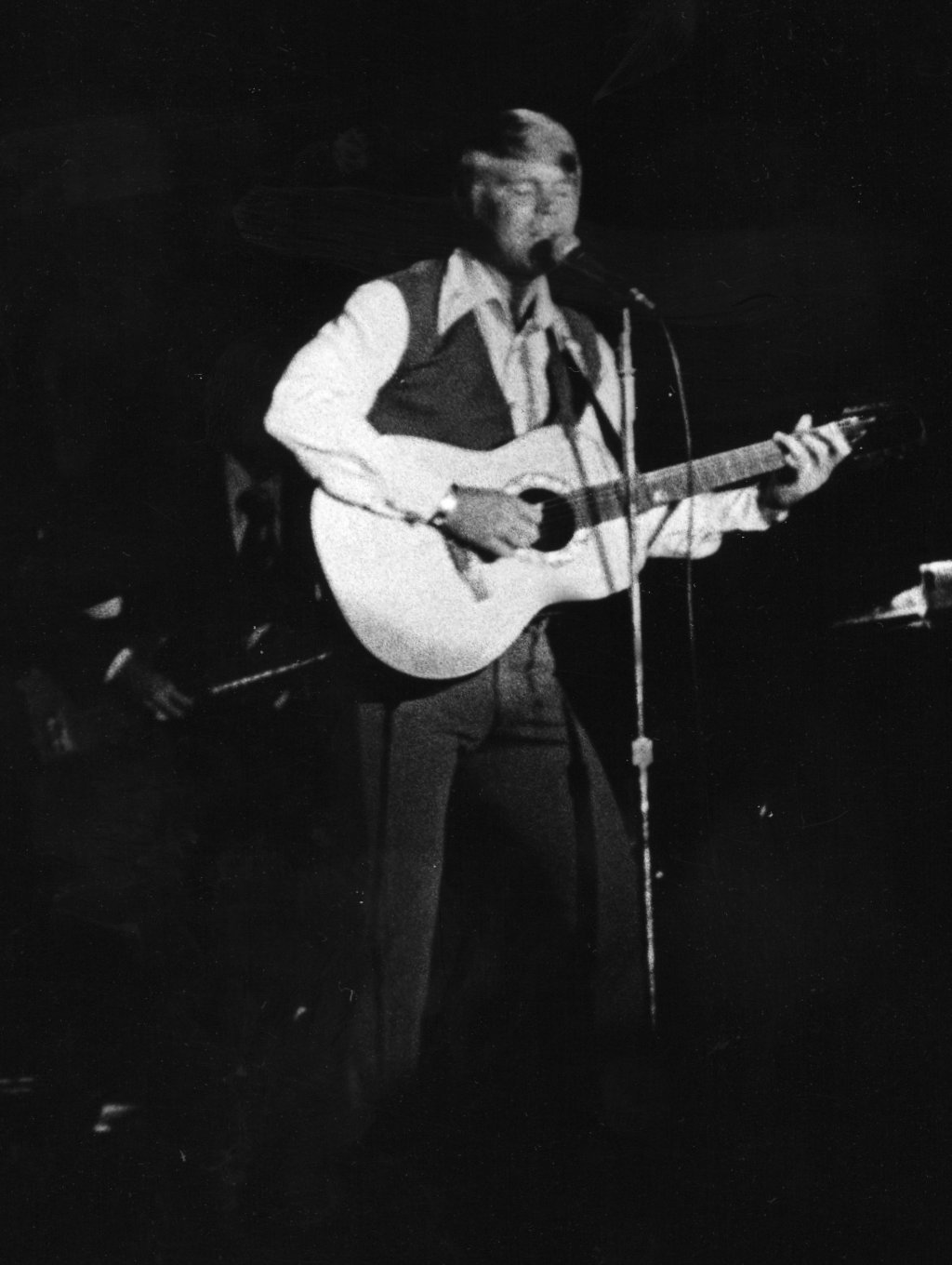
By the end of 1974, Glen Campbell was yesterday’s news, and he knew it. The television show was gone. The movie offers had dried up. He hadn’t had a hit single in years — not since “Manhattan, Kansas” in 1972, and even that had barely dented the charts. The boy from Billstown, Arkansas, who had once seemed to be everywhere — on radio, on television, on movie screens — was pushing forty, divorced, drinking too much, and watching the seventies roll past without him.
Then, on a long drive through the Australian outback, he played a cassette tape so many times he said he could have whistled it backwards. The song on that tape would become the biggest hit of his life.
This is the story of how a forgotten songwriter’s last gamble and a faded star’s desperation collided on a 650-mile highway — and produced “Rhinestone Cowboy.”
The Faded Star
To appreciate the comeback, you have to feel the fall. In 1968, Glen Campbell had been the biggest thing in American music: four Grammys in one night, the “Glen Campbell Goodtime Hour” beaming his aw-shucks charm into living rooms every week, “Wichita Lineman” and “Galveston” defining the new country-pop sound. By 1974, it was all gone. The Goodtime Hour had been cancelled in 1972. His singles were struggling to reach the country Top 40. The session guitarist who had become a superstar was becoming a trivia question.
Campbell wasn’t taking it well. His marriage to Billie Jean Nunley was collapsing — they would divorce in 1976. He was drinking heavily, drifting toward the cocaine problems that would plague him for years. The tabloids were more interested in his personal life than his music. He was, as one retrospective put it, divorced, drinking, and involved with drugs a little too much — and yet, underneath it all, still the beautiful soul with the golden voice and the magic hands.
He needed a song. Not just a good song — a song that understood exactly who he was and where he’d been. He just didn’t know it was waiting for him on the other side of the world.
Larry Weiss’s Last Roll of the Dice
Larry Weiss was a New York songwriter with an enviable track record and a stalled career. In the sixties, he’d written “Bend Me, Shape Me,” a hit for the American Breed and Amen Corner, and “Hi Ho Silver Lining,” the Jeff Beck classic. But by 1974, those triumphs were years in the rearview mirror, and Weiss was trying to reinvent himself as a recording artist. Russ Regan — the man who had named the Beach Boys — gave him a deal with 20th Century Records, and Weiss cut an album called “Black and Blue Suite.”
The lead single was a quasi-autobiographical song he’d written himself: “Rhinestone Cowboy.” Weiss had grown up on the singing cowboys of his childhood — Roy Rogers, Gene Autry, Tex Ritter — and he’d poured his own professional frustration into the lyric: a performer down on his luck, walking the streets of Broadway, getting “a load of compromises,” but refusing to be beaten. “Like a rhinestone cowboy,” he sang, “riding out on a horse in a star-spangled rodeo.”
The single went nowhere. It peaked at number seventy-one in Australia in August 1974 and barely registered anywhere else. Weiss was seriously considering quitting music altogether and opening a furniture store. He’d even offered the song to Elvis Presley, who turned it down. It looked like the end of the line — for the song, and maybe for Weiss.
The Cassette on the Long Australian Road
Here’s where fate intervened. In late 1974, Glen Campbell was driving in Hollywood, listening to an album-cut radio station — KNX-FM, by some accounts — when “Rhinestone Cowboy” came floating out of his speakers. “It just blew me away,” he recalled. He had to pull over. He bought a cassette of Weiss’s album and took it with him on a three-week tour of Australia.
Then an airline strike hit, and the tour’s travel plans collapsed. Instead of flying between dates, Campbell found himself facing a roughly 650-mile drive from Sydney toward Brisbane through the Australian countryside. He put the cassette in and played “Rhinestone Cowboy” over and over and over. By his own account, he heard it so many times he could have whistled it backwards.
Why did it grab him so hard? Because Larry Weiss had written Glen Campbell’s life without knowing it. The sharecropper’s son who’d played on everyone else’s records while remaining invisible. The small-town kid who’d ridden into the big time on talent and charm. The faded star still walking the street, still believing. Campbell recognized himself in every line. He knew the man in that song — because he was that man.
Al Coury’s Office
When Campbell got back to the United States, his label was already one step ahead of him. Capitol Records vice president Al Coury — the man who had persuaded John Lennon to release “Whatever Gets You Through the Night” — summoned Campbell to his office and played him a song. It was “Rhinestone Cowboy.”
“I went into Al Coury’s office and he said I had to listen to a song and then cut it for him,” Campbell remembered. “The song turned out to be ‘Rhinestone Cowboy.’”
Coury even had a production team in mind: Dennis Lambert and Brian Potter, the duo who’d shaped hits for the Four Tops and Dusty Springfield before forming their own successful Haven imprint. Lambert, in a 2013 interview, remembered the sequence vividly. He’d been brought in to do A&R for Campbell, talking with the singer about his feelings, bringing him songs. Then Larry Weiss came to play him tracks from his recent album. “One of them was ‘Rhinestone Cowboy,’” Lambert recalled. “I said, ‘Larry, this is amazing,’ and my mind was racing, because I was already thinking about Glen.”
A whirlwind followed — within days, everyone from Coury to Lambert had converged on the same conclusion. Campbell loved the song. The deal was done.
Sound Labs, February 1975
In February 1975, Campbell and Lambert went down to Sound Labs in Hollywood to cut the record. The sessions ran from February 24 through March 19, and Lambert was determined not to simply copy Weiss’s version. “We didn’t copy Larry’s version,” he said, “but took the essence of it, which was right on the money.”
The studio band was top-shelf: Dean Parks and Ben Benay on electric guitars, Fred Tackett on acoustic, David Paich on piano, Scott Edwards on bass, Ed Greene on drums, with Lambert himself adding clavinet and those low piano notes at the end of the chorus. And in a move that surprised everyone, Lambert convinced Campbell — the former session ace who usually left the guitar work to the hired guns on his own records — to play the twelve-string acoustic himself.
The result was a masterclass in seventies country-pop production: Campbell’s warm, effortless vocal gliding over a bed of chiming guitars and swelling strings, the whole thing building to that triumphant final chorus. It sounded like a comeback because it was one — you could hear a man reclaiming his place in the world, three minutes at a time.
Then, perversely, Capitol sat on it. Despite all the in-house enthusiasm, the track languished in its can for two months. It might have stayed there if Campbell hadn’t sung it on a television telethon. Radio programmer Paul Drew saw the performance, called Capitol, and got a test acetate. “Rhinestone Cowboy” picked up national airplay across the RKO chain, and Capitol was forced to rush-release it as a single on May 26, 1975.
The Songwriter’s Vindication
Spare a thought, amid all this triumph, for Larry Weiss — the man who wrote the song and almost gave up music to sell furniture. When “Rhinestone Cowboy” hit number one, Weiss was vindicated beyond anything he could have imagined. The single he’d watched die at number seventy-one in Australia was now the biggest record in America. The song Elvis had rejected was being sung by a man who’d played guitar on Elvis’s own sessions.
Weiss’s story is the mirror image of Campbell’s: two men at the end of their respective ropes, each holding the thing the other needed. Weiss had the song but no singer. Campbell had the voice but no song. The music business is full of near-misses like this — great songs that never find their singer, great singers who never find their song. “Rhinestone Cowboy” is the rare case where the stars aligned, and both men were saved.
Weiss never did open that furniture store. He went on writing — he’d already given the world “Bend Me, Shape Me” and “Hi Ho Silver Lining,” and he kept at it for decades. But “Rhinestone Cowboy” was his masterpiece, the song that proved what he’d always believed: that a well-written lyric about holding on, sung by someone who’d lived it, could move millions. He wrote it about himself. Glen Campbell made it about everybody.
Number One and Immortality
The song moved fast. It debuted on the country charts in May and climbed to number one on the Billboard Hot 100 in September 1975 — Campbell’s first-ever pop chart-topper — while simultaneously topping the country chart, a crossover feat few artists achieved. It sold more than two million copies, earned Grammy nominations for Record of the Year and Best Pop Vocal Performance, and won the Country Music Association’s Single of the Year.
But numbers don’t capture what “Rhinestone Cowboy” became. It became Campbell’s signature — the song that defined him more than “Wichita Lineman” or “Gentle on My Mind” ever had. It inspired the 1984 Dolly Parton and Sylvester Stallone movie “Rhinestone.” It turned up in films and television shows for decades. And in 2012, at the Grammy Awards, a seventy-five-year-old Glen Campbell — already living with the Alzheimer’s diagnosis that would take his life — walked onto the stage in rhinestones and sang it one more time, his final televised performance. The cowboy rode out exactly the way the song said he would: still standing, still shining.
Larry Weiss never opened that furniture store. His song had found its singer — a faded star on a long Australian highway who heard his own life in somebody else’s lyric and had the courage to sing it. That’s what comebacks are made of: not just a good song, but the right song, in the right hands, at the exact moment when everything depends on it.
Glen Campbell needed “Rhinestone Cowboy.” And “Rhinestone Cowboy” — drifting unheard on a failed album, rejected by Elvis, one step from oblivion — needed Glen Campbell just as badly. Some songs are just songs. This one was a rescue, in both directions.
Leave a Reply