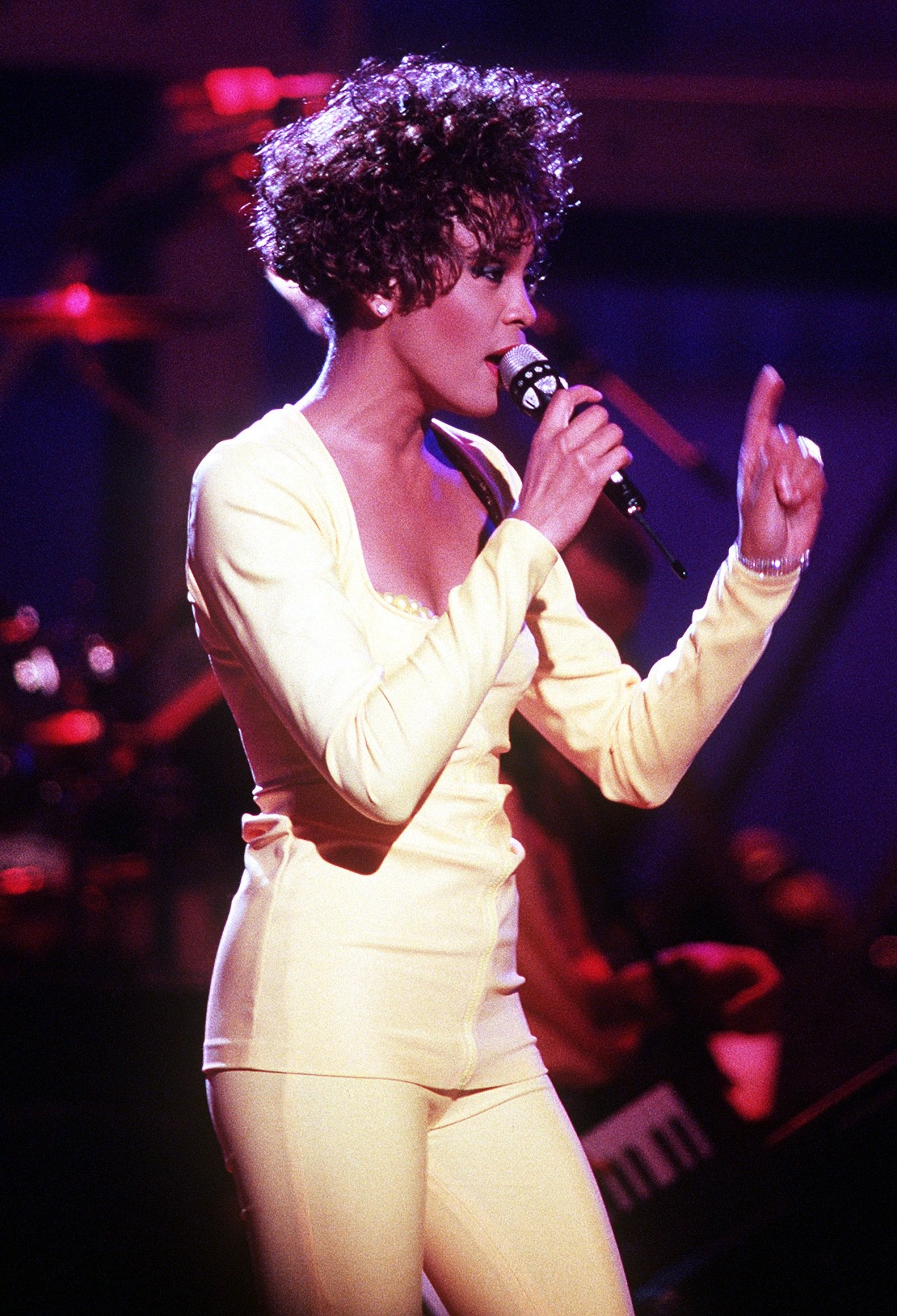
Every great debut needs the song that opens the door the ballads can’t. Clive Davis had built Whitney Houston’s first album around her voice as an instrument of grandeur — “You Give Good Love,” “Saving All My Love for You,” the great soaring ballads. What the album did not have, as Davis’s A&R man Gerry Griffith put it, was a pop crossover song: something fast, bright and young enough to carry a twenty-one-year-old singer onto MTV. “How Will I Know” was that song — and it arrived by rejection. It had been written for Janet Jackson, who passed on it. Rebuilt by producer Narada Michael Walden, sung with her mother Cissy in the background choir, and launched with a candy-colored video that made Houston a teenage phenomenon, it became her second No. 1 single and the record that proved The Voice could dance.
Written for Janet
The songwriters were George Merrill and Shannon Rubicam, a husband-and-wife team — later the duo Boy Meets Girl — who in 1984 had sung backup on Deniece Williams’ chart-topper “Let’s Hear It for the Boy.” They wrote “How Will I Know” as a demo with Janet Jackson wholly in mind. Jackson, then being steered by A&M executive John McClain, was assembling the material that would precede her Control breakthrough, and her management passed, judging the song a poor fit for what was already in development. “We were pretty upset,” Merrill admitted, “because we thought it was perfect for her at the time.”
The demo landed instead with Brenda Andrews at the duo’s publisher, Almo-Irving Music, who played it for Gerry Griffith — an A&R director working across A&M and Arista who was then compiling songs for Houston’s debut. Griffith heard instantly what the album was missing. “We had a lot of R&B-based tunes, we had a few ballads, but we didn’t have a pop crossover song,” he recalled. “So when I heard ‘How Will I Know,’ I said ‘this is absolutely perfect.’ I played it for Clive [Davis] and he fell in love with it.”
History’s sense of humor deserves a footnote here. The song had been shaped for Janet Jackson at eighteen, before she had any say over her own records; by the time “How Will I Know” reached No. 1 in February 1986, Jackson was weeks into the release of Control — the album with which she seized that control, title and all. The two singers would define the next decade of pop between them, and the hinge was a demo one camp misjudged and the other rebuilt. Merrill and Rubicam, for their part, got their own hit out of the songwriting life: as Boy Meets Girl, they took “Waiting for a Star to Fall” into the Top 5 in 1988 — a song that, like “How Will I Know,” had first been offered to other singers. Rejection, it turns out, was their muse too.
Narada Rebuilds It
Griffith turned to Narada Michael Walden, then in the middle of producing Aretha Franklin’s Who’s Zoomin’ Who? Hearing how much the song mattered to the project, Walden agreed to take it on — and then immediately complicated things. Unimpressed by the demo’s bones, he asked permission to change some of the lyrics and the chord progression. Merrill and Rubicam, protective of their song, at first refused him the right to touch it. After a long back-and-forth, the compromise was struck: Walden could deconstruct the song — change the key, quicken the tempo, rebuild it as a sleek synth-funk dancer at 120 beats per minute — and he brought in Premik Russell Tubbs to play the saxophone solo that answers Houston’s vocal like a second singer.
Houston recorded her vocal late in 1984. For the background session, Walden gathered a choir with a special guest: her mother, Cissy Houston, the great gospel and session singer. Whitney, reluctant, wanted to sit back and simply enjoy hearing her mother sing. Walden was having none of it. “No, get out there and sing,” he told her — and mother and daughter stacked the harmonies together. “The background sounded incredible,” Walden remembered. “Clive Davis heard the mix and immediately gave it a 10, which is outrageous for him, because he doesn’t like anything!”
What Walden built around her was precision-tooled pop: a synth-funk dancer in G-flat major at 120 beats per minute, all forward motion, under a lyric that turned the usual love song inside out. The singer isn’t declaring anything — she’s asking, working through the evidence like a detective of her own heart. Her friends warn her that love can be deceiving; she’s too shy to pick up the phone; the feeling might be a dream — except there’s no mistaking it. Houston sings the uncertainty at the top of her range and the certainty in her chest voice, and the record’s joy is the sound of the second one winning. Critics heard it immediately: Don Shewey, reviewing the debut in Rolling Stone, allowed that while the song was reminiscent of the Pointer Sisters’ “He’s So Shy,” it remained “irresistibly danceable,” and AllMusic’s Stephen Thomas Erlewine would later single it out as the album’s breakthrough — the light track that impressed most, twenty years on.

The Video That Opened MTV
Arista released “How Will I Know” as the album’s third single on November 22, 1985, and its director, Brian Grant — who had made videos for “Pop Muzik” and Olivia Newton-John’s “Physical” — built Houston a playground of video screens, mirrors and pastel partitions, choreographed by a young Arlene Phillips. Houston, until then marketed in gowns, suddenly appeared as what she actually was: a joyful twenty-two-year-old dancing through a pop-art maze — with her idol Aretha Franklin flashing up on one of the video screens as a kind of blessing.
The exposure was transformative. The clip put Houston in front of MTV’s teenage audience for the first time, and at the 1986 MTV Video Music Awards it won Best Female Video, beating out the field and announcing that the ballad singer was now a pop star in the full modern sense.
Number One — and a Second Life
The record itself completed the job. In February 1986, “How Will I Know” reached No. 1 on the Billboard Hot 100 and stayed there for two weeks — Houston’s second chart-topper, following “Saving All My Love for You” — while also becoming her first No. 1 in Canada and a Top 10 hit across Britain, Ireland, Australia, Sweden and Norway. Coming after two ballad smashes, it permanently fixed the template of her career: the voice of a gospel giant, set loose on the dance floor.

The song has never really left. Houston performed it on tour from the Greatest Love Tour of 1986 to her final Nothing But Love world tour in 2009–10. Its a cappella mix, released decades later, became a quiet phenomenon among singers — proof, as Entertainment Weekly noted, of her precision long before Auto-Tune. The critics kept re-electing it: The Guardian called it “a perfectly formed slice of mid-80s bubblegum soul — booming drums, sax solo and all,” and in December 2022 USA Today ranked it Houston’s best song of all, writing that beneath the Lite-Brite video the record lets you feel her shyness and uncertainty. Sam Smith slowed it into a reverent ballad in 2014, a version later folded into an episode of Grey’s Anatomy; the Lemonheads had already covered it, in both electric and acoustic takes, back in 1996; David Guetta built a 2021 dance track on its interpolation; and that same year Clean Bandit’s remix carried Houston’s original vocal back onto the UK chart — making her the first female artist with certified singles in five consecutive decades. By the music industry’s count it has sold more than eleven million copies worldwide. Not bad for a demo Janet Jackson didn’t want — and a reminder that pop history often turns on the song somebody passed on, landing in exactly the right throat.
Leave a Reply