It is the most dishonest promise in soft rock, and it is dishonest on purpose. The singer of I’ll Be Over You swears he will get over the woman he lost — but read the conditions he attaches and the promise dissolves in your hands. He will be over her, he sings, as soon as his heart stops breaking. He will be over her as soon as forever is through. In other words: never. Steve Lukather knew exactly what he was writing. “What the song is basically saying is, the guy has broken up with a girl, and realized that he should never have broken up with this girl, and he’s still really deeply in love with her,” he explained. “Sort of like a warning to people — you never know how good you got it until you don’t have it anymore.” In the summer of 1986, that warning became Toto’s comeback single.
A New Singer, and the Guitarist Steps Forward
Toto needed a comeback. At the close of the Isolation tour in 1985, the band had parted company with singer Fergie Frederiksen, whose harder-edged voice had never quite settled into the group’s studio perfectionism. Auditions followed, and in early 1986 the job went to Joseph Williams — son of film composer John Williams — a singer with the polish the band’s sound demanded. The album they made together, Fahrenheit, released on 20 August 1986, was Toto’s sixth, a deliberate return to the sleek pop-rock of their early records after the heavier detour of Isolation. It was also the last album to feature keyboardist Steve Porcaro as a full-time member, and, true to the band’s session-world roots, it was crowded with distinguished guests: Don Henley sang on Steve Porcaro’s Lea, and Miles Davis himself played on the closing instrumental, Don’t Stop Me Now.
Yet when Columbia needed a lead single to introduce the new line-up, the voice on it was not the new singer’s. It was Lukather’s — the guitarist, a founder member, stepping up to the microphone to sing a ballad he had written with an outside collaborator. Williams sang backing vocals on his own debut album’s flagship song and, by all accounts, was happy to do it. Toto had always worked that way: whoever’s voice the song needed got the song.
Written With the Man Who Finished Songs
The collaborator was Randy Goodrum, one of the most reliable hit writers in American music. Goodrum had written Anne Murray’s You Needed Me and co-written Steve Perry’s solo hits Oh Sherrie and Foolish Heart; for Lukather, he became the partner who turned sketches into finished records. “When you co-write with people, there is a certain chemistry that has to be there,” Lukather said of him. “We finish things; that’s the key. A lot of people write a lot of stuff, but do you finish it?” He praised Goodrum’s refusal of the obvious: “Randy’s sense and knowledge of music, of not doing the cliché thing, is there.”
You can hear that refusal in the chorus. A lesser breakup song promises recovery and means it; this one builds its promise out of impossible conditions, so that the hook itself becomes the confession. The verses drift through a little philosophy — some people live their dreams, some people close their eyes, some people’s destiny passes by — before the title line arrives, smiling and hopeless at once. Recorded in 1985 and produced by the band, the track runs barely three minutes and fifty seconds, with David Paich’s keyboards setting the soft-focus frame, Steve Porcaro’s synthesizers glowing at the edges, Mike Porcaro on bass, Jeff Porcaro playing with his usual feather-light authority, and percussionists Lenny Castro and Paulinho da Costa adding the faintest Latin shimmer. And then there is the second voice.
The Guitarist Who Sang the Ballads
Lukather fronting a ballad was, by 1986, something of a Toto tradition. He had sung lead on Georgy Porgy back on the band’s debut album, and on 99 a year later, his voice carrying the group’s softer, stranger material while Bobby Kimball handled the rockers. Most tellingly, he had written and sung I Won’t Hold You Back, the Toto IV ballad that reached No. 10 on the Hot 100 in 1983 and became the band’s first Adult Contemporary No. 1. So when the Fahrenheit sessions produced another slow, wounded song from his pen, there was never much doubt about who would sing it. Williams, to his credit, appears to have understood the band’s internal logic at once: the new frontman’s first album would be launched by the guitarist’s voice, with his own woven in behind it.
The Counterpoint: Enter Michael McDonald
The masterstroke of I’ll Be Over You is that Lukather does not sing it alone. Michael McDonald — the blue-eyed soul voice of the Doobie Brothers, and, like every member of Toto, a veteran of a thousand other people’s sessions — provides what the credits modestly call backing vocals and what the record itself treats as a vocal counterpoint: a second, deeper voice answering Lukather’s, echoing his lines like the part of his conscience that knows the promise is empty. It turns a monologue into a conversation, and a good ballad into a small drama.
It was also a meeting of two halves of the same world. Toto’s members had built their careers playing on records by Steely Dan, Boz Scaggs and Michael Jackson; McDonald had sung with Steely Dan before fronting the Doobies. Nobody on the session needed anything explained. The affinity lasted: nearly three decades later, in the summer of 2014, Toto and McDonald were touring America together as co-headliners, and McDonald’s guest spot on the old ballad remained a nightly reminder of how naturally their voices had fitted in 1986.

Rain on the Rooftop
The video, directed by Nick Morris, put the whole arrangement on a roof. McDonald appears in it alongside the band, performing on top of an apartment building at 548 South Spring Street in Los Angeles — and, in a closing gag that weather provided and the director kept, the performance continues until the rain arrives and soaks the shoot. The clip also restages the Fahrenheit album cover with live actors, a neat piece of packaging for a band introducing both a new singer and a new era. What it sells, above all, is ease: six musicians and their guest, playing a sad song in the sunshine like men incapable of making a record that sounds anything less than effortless.

Number One Where It Counted
Released in August 1986 as the lead single from Fahrenheit — with the non-album track In a Word, later rescued on the Toto XX collection, on the B-side — I’ll Be Over You climbed to No. 11 on the Billboard Hot 100, just missing the Top 10. But on the chart that measured its real audience, it went all the way: two weeks at No. 1 on Billboard’s Adult Contemporary chart, Toto’s second single to top that listing after 1983’s I Won’t Hold You Back. It reached No. 13 in Canada and No. 38 in the Netherlands, ended 1986 at a pleasingly symmetrical No. 99 on Billboard’s year-end Hot 100, and was eventually certified gold in the United States. Cash Box, reviewing the single in its 30 August 1986 issue, predicted “the wistful and emotional song should make a strong showing.” It did.
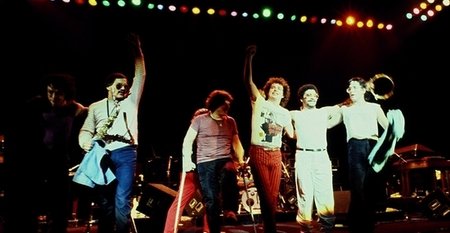
It also did the job Columbia had asked of it. Fahrenheit needed proof that Toto could still land a single after a line-up change, and I’ll Be Over You provided it, with Lukather’s other ballad from the album, Without Your Love, following it into the Top 40 at No. 38. Between them, the two songs re-established the band on American radio and carried the album through the Fahrenheit World Tour that autumn — the tour pictured above, with Jeff Porcaro behind the kit in Honolulu that November.
The song never really left. Fahrenheit itself went gold in 1994, and I’ll Be Over You stayed in Toto’s live repertoire for decades, Lukather still singing it, still attaching the same impossible conditions. That is the record’s quiet magic. Most breakup songs lie to you kindly and tell you the pain will end. This one tells the truth inside a lie — as soon as forever is through — and lets you sing along with both at once. Forty years on, nobody who hears that chorus believes the promise. Everybody understands it.
Leave a Reply