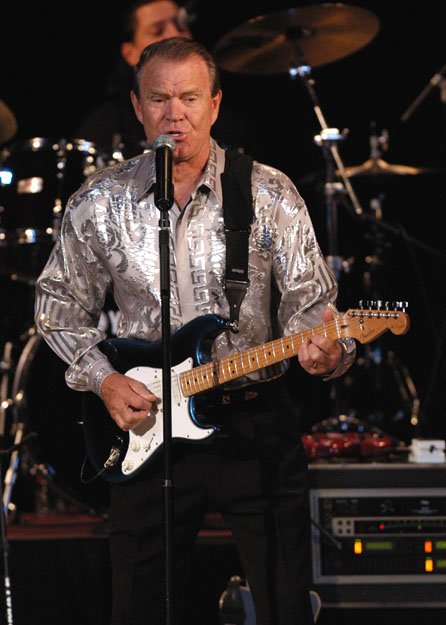
Ask people what they remember about Glen Campbell and they’ll tell you about the voice, the guitar, the rhinestones. But ask the people who knew him best — his children, his bandmates, the woman who stood beside him for thirty-five years — and they’ll tell you about something else: the rescue. Because twice in his life, Glen Campbell was drowning, and twice, love pulled him out.
The first time, it was music that saved him — the five-dollar guitar, the Wrecking Crew, the hits. The second time, it was a former Radio City Rockette named Kim Woollen, a blind date in 1981, and a faith he returned to when he had nothing left. This is the story of the heart behind the hits.
The Blind Date
By 1981, Glen Campbell’s personal life was a tabloid serial. Three marriages behind him — to Diane Kirk, Billie Jean Nunley, and Sarah Barg Davis — plus a wild, highly public romance with country star Tanya Tucker that had filled the gossip columns with stories of parties, fights, and reconciliations. He was drinking heavily. Cocaine had entered the picture. The man who sang about gentle times and Wichita linemen was living hard and falling fast.
Then a friend set him up on a blind date with Kimberly Woollen, a former Radio City Music Hall Rockette — a dancer, twenty-two years his junior, with no interest in the music business circus. It wasn’t love at first sight so much as recognition: here, finally, was someone who saw the man instead of the star. They married in 1982, and Kim Campbell would remain his wife until the day he died — thirty-five years, the longest and happiest chapter of his complicated romantic life.
“To the world, Glen was a star of TV and film, a legendary singer and guitarist,” Kim would write years later. “To me, Glen was my husband, my best friend, and the father of our three children.”
Hitting Bottom
The early years of the marriage were not easy. Campbell’s problems with alcohol and cocaine, which had begun in the seventies, didn’t magically disappear with a wedding ring. The eighties brought more tabloid drama, more binges, more close calls. By his own later admission, he was out of control — a man with everything to live for who seemed determined to throw it away.
The low point came in 2003, long after he’d supposedly cleaned up, when Campbell was arrested in Arizona for aggravated drunk driving and leaving the scene of an accident. He pleaded guilty and spent ten days in the Maricopa County jail — a sixty-seven-year-old legend in a jumpsuit, his mugshot on every news channel in America. It was humiliating. It was also, in a strange way, clarifying. There would be no more pretending.
Through all of it, Kim stayed. Not as an enabler — as an anchor. Campbell himself credited his fourth wife with helping him turn his life around, and the timeline backs him up: he stopped drinking and taking drugs in 1987, early in their marriage, and held onto his sobriety for the better part of two decades. Whatever demons chased Glen Campbell, Kim Woollen stood between him and them, and mostly, she won.
The Faith He Came Home To
Glen Campbell was raised in the Church of Christ in Billstown, Arkansas — a sharecropper’s son singing gospel hymns in the church choir, one of twelve children in a family where everybody played and sang. He’d drifted far from those roots during the fame years, but in the 1980s, he and Kim joined a Baptist church in Phoenix, Arizona, and began the slow walk back.
In a 2008 interview, Campbell revealed something that surprised many fans: he and Kim had been adherents of Messianic Judaism for two decades — a faith that blends Jewish tradition with belief in Jesus, practiced with the same earnestness Campbell brought to everything. It wasn’t a celebrity conversion or a publicity move. It was a man who had nearly destroyed himself looking for solid ground, and finding it in the oldest stories he knew.
You can hear that faith in his later music — in the gospel albums, in the quiet certainty of his final recordings. The boy who sang in the church choir never really left. He just took the long way home.
Three Kids on the Bus
Kim and Glen had three children together: Cal, Shannon, and Ashley, born in the eighties and raised largely out of the spotlight in Phoenix. They grew up with a father who was a legend and a mother who made sure they knew the man behind the legend — the one who taught them guitar chords at the kitchen table, who showed up to school events, who was, by all accounts, a warm and goofy dad.
Then, in 2010, something extraordinary happened. When Campbell announced his farewell tour after his Alzheimer’s diagnosis, he didn’t hire a band of session pros. He took his family. Cal, Shannon, and Ashley joined him onstage as part of his touring band — his children literally holding him up, musically and otherwise, through 151 concerts across North America and Europe. Night after night, as the disease stole his memory, his kids were there beside him, guiding him through the songs he’d taught them.
Ashley Campbell, the youngest, has carried the torch furthest. A gifted banjo player and singer-songwriter in her own right, she wrote “Remembering,” a heartbreaking song about watching her father disappear, and has become an advocate for Alzheimer’s awareness. The student had become the keeper of the flame.
Nine Children, One Complicated Family
The three children with Kim were the last of nine. Campbell fathered six sons and three daughters across his four marriages — a sprawling, complicated family tree with all the tensions you’d expect. His eldest children remembered the lean years and the wild years; his youngest knew the sober, settled man. Reconciling those two versions of their father hasn’t always been easy for the family, and the years after his death brought their share of disputes.
But on that farewell tour, for a little while, it all came together. The family band wasn’t just a gimmick — it was a statement. After a lifetime of fractured relationships and tabloid chaos, Glen Campbell was going out surrounded by the people who loved him most, making music the way he’d first learned it: with family, for family.
The Long Goodbye
In June 2011, at seventy-five, Glen Campbell announced in People magazine that he had been diagnosed with Alzheimer’s disease. Most stars would have retreated. Campbell did the opposite: he recorded “Ghost on the Canvas,” an album of new material, and announced a farewell tour — with his children in the band and a film crew following his every step.
The tour stretched to 151 shows, ending on November 30, 2012, in Napa, California. Night after night, audiences watched a man lose his memory in real time and keep singing anyway — forgetting lyrics, then finding them; getting lost, then being guided home by his children’s harmonies. It was heartbreaking and triumphant in equal measure, and it changed the public conversation about Alzheimer’s. The 2014 documentary “Glen Campbell: I’ll Be Me,” filmed on that tour, showed it all with unflinching honesty.
His final recording, “I’m Not Gonna Miss You” — written for the documentary — won a Grammy and was nominated for an Academy Award. It is one of the most devastating songs ever recorded: a man singing about the mercy of forgetting, while forgetting. After the tour, his friend and accompanist Carl Jackson guided him through sessions for one last studio album, “Adiós,” released in June 2017. Glen Campbell died two months later, on August 8, 2017, at a memory care facility in Nashville. He was eighty-one.
Kim was there for all of it — the diagnosis, the tour, the long decline. And she turned the grief into work: the I’ll Be Me Alzheimer’s Fund, and her own organization, CareLiving, dedicated to supporting the caregivers of Alzheimer’s patients. She had saved him once from addiction. She couldn’t save him from this. But she made sure no one would face it alone.
The Memoir
In June 2020, three years after Campbell’s death, Kim published “Gentle on My Mind: In Sickness and in Health with Glen Campbell” — a memoir of their thirty-five years together, titled, perfectly, after his breakthrough hit. It’s a love story, but an honest one: the addiction, the relapses, the Alzheimer’s, the long goodbye. She wrote it, she said, because she wanted people to know the man she knew — not the mugshot, not the punchline, but the husband, the father, the believer.
“As I celebrate Glen’s birthday today, my mind is flooded with memories of our 35 years together,” she wrote. It was the quiet coda to one of the great love stories in country music — not the fiery kind that burns out in the tabloids, but the steady kind that holds on through the worst and makes the best possible.
The Gospel Thread
The faith was always in the music, if you listened for it. Long before the Phoenix church and the Messianic congregation, there was the boy in the Church of Christ choir in Billstown, singing hymns with eleven brothers and sisters. In 1968, at the absolute peak of his fame, Campbell recorded “Oh Happy Day,” a gospel album — a superstar making a record of church songs because it was what he knew, what he was.
Gospel kept surfacing in his catalog across the decades: in the hymns he’d slip into concerts, in the quiet certainty of his phrasing on songs about grace and redemption. Listen to the way he sings about second chances — there’s a church in that voice. The rhinestone cowboy and the choir boy were never two different people. They were the same man, and the music knew it before he did.
When everything else fell away — the hits, the show, the memory itself — the hymns remained. On the farewell tour, between the standards, he’d sometimes drift toward the old gospel cadences, and the band would follow. It was muscle memory of the deepest kind: the first music he’d ever learned, the last music he’d ever lose.
The Heart Behind the Hits
Glen Campbell’s story is usually told as a career arc: the session ace, the superstar, the faded star, the comeback, the brave farewell. But the real arc is simpler and more human. A boy from nowhere learned to play guitar. The world gave him everything, and he nearly threw it away. Then a dancer from a blind date, a faith from his childhood, and three kids who learned his songs gave him a reason to hold on.
The rhinestones were costume. The voice was gift. But the man — the one who kept getting up, who kept believing, who stood on a Grammy stage at seventy-five with his memory going and sang anyway — that man was built by love. Kim’s love. His children’s love. And a faith that told him he was worth saving.
That’s the heart behind the hits. It was never really about the cowboy. It was about the man who finally found his way home.
Leave a Reply