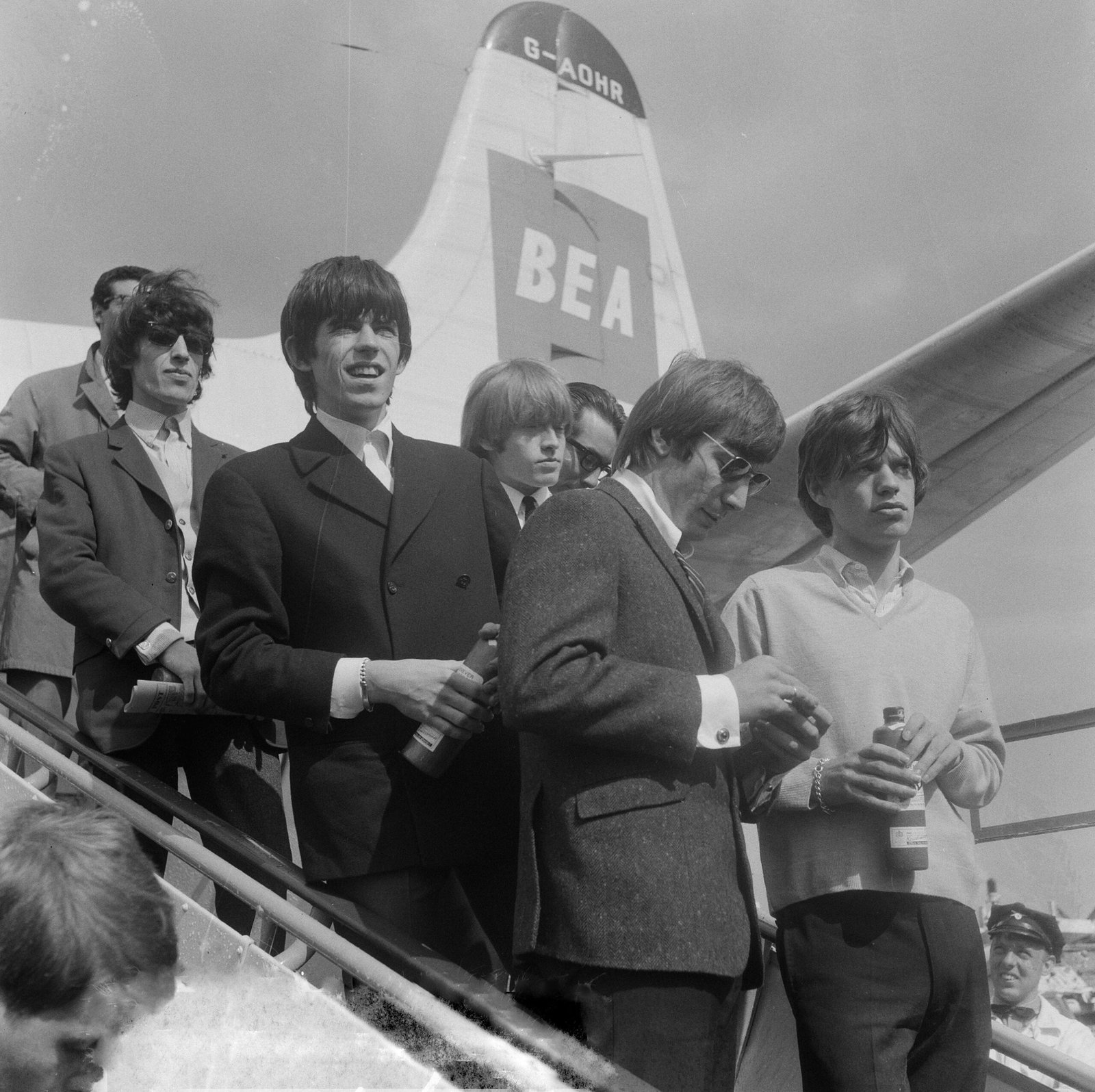
No band was supposed to last this long. The Rolling Stones were supposed to burn bright for a few years, the way pop bands did in the early sixties, and then fade into the variety-show circuit. Instead, they became something no one had ever seen before: a rock band that simply refused to stop. Six decades on, they are still filling stadiums, still anchored by the two men who met as teenagers on a railway platform with a shared love of American blues records.
But the legend was not built on longevity alone. It was built on nights like the one in May 1965 when the most famous guitar riff in history arrived in a dream, on a courtroom drama that turned them into outlaws, on the afternoon their founding member drowned in his own swimming pool, and on a December day in California when a free concert became a funeral for the sixties themselves. This is the story behind the story.
The Riff That Came in a Dream
In the early hours of May 7, 1965, Keith Richards woke up in a motel room in Clearwater, Florida, with a melody hammering in his head. Half asleep, he reached for the portable cassette recorder by his bed, picked up his acoustic guitar, and played a rough version of a riff, along with the words “I can’t get no satisfaction.” Then he fell back asleep and remembered nothing.
The next morning, he found the tape had run to its end. When he rewound it, he heard about two minutes of the riff, followed by forty minutes of his own snoring. He had, in his own telling, dropped the guitar pick somewhere in the middle of it. That sleepy fragment, captured on a little Philips machine, became “(I Can’t Get No) Satisfaction.”
Richards, remarkably, did not even want it released as a single. He thought the riff sounded like a horn line and had meant it as a placeholder. Mick Jagger wrote the verses a few days later by the hotel swimming pool. The band cut the song first at Chess Studios in Chicago on May 10, then finished it at RCA Studios in Hollywood on May 12, where Richards ran his guitar through a Gibson Maestro Fuzz-Tone pedal, a brand-new gadget that gave the riff its snarling, unmistakable bite. Manager Andrew Loog Oldham heard a number one. Richards heard a demo. Oldham was right: the single went to number one in America in July 1965 and transformed the Stones from just another British band into, in Jagger’s later phrase, a “huge, monster band.”
Two Teenagers and a Railway Platform
The partnership behind that riff began on October 17, 1961, on Platform 2 at Dartford railway station in Kent. Mick Jagger, carrying records by Chuck Berry and Muddy Waters under his arm, ran into Keith Richards, a childhood friend he had lost touch with years earlier. The records did the talking. Within months, they were jamming together with a slide guitarist named Brian Jones, who had placed an advertisement in Jazz News looking for musicians.
Jones was the one who named the band. When a journalist called asking for the group’s name, Jones spotted a Muddy Waters LP on the floor. One of the tracks was “Rollin’ Stone.” The band played its first show as “the Rollin’ Stones” on July 12, 1962, at the Marquee Club in London. By early 1963, with Charlie Watts on drums and Bill Wyman on bass, the classic lineup was set, and Jones was its undisputed leader, the blues purist who had assembled the whole thing.
Oldham, all of nineteen when he took over as manager, saw something else. Where the Beatles wore suits and smiled, he would sell the Stones as the nasty alternative: long hair, unsmiling faces, and headlines like “Would you let your daughter marry a Rolling Stone?” The image stuck so well that people still believe Oldham invented it from nothing. Wyman always insisted otherwise: the reputation came later, accidentally, and Oldham simply exploited it.
Redlands: The Night That Made Them Outlaws
On the evening of February 12, 1967, eighteen police officers arrived at Redlands, Keith Richards’ country house in West Sussex. Inside were Richards, Mick Jagger, Marianne Faithfull, art dealer Robert Fraser, and a handful of guests winding down from the day. The raid was the result of a tip-off, and many believed the band had been set up: the News of the World had reportedly tipped off the police, eager to make an example of rock stars.
Jagger was charged with possession of four amphetamine tablets. Richards was charged with allowing his house to be used for smoking cannabis. At their trial in Chichester that June, Jagger was sentenced to three months in prison and Richards to a full year. For a few days, it looked as though the biggest band in Britain might be finished.
Then the establishment surprised everyone. The Times published a famous editorial by William Rees-Mogg asking “Who breaks a butterfly upon a wheel?” arguing that Jagger was being punished for who he was rather than what he had done. On appeal, Richards’ conviction was overturned entirely, and Jagger’s prison sentence was replaced with probation. They had spent just one night behind bars. But something had changed: the Stones were no longer just a pop band. They were outlaws, and the public loved them for it.
The Founder Who Fell Apart
Brian Jones, the man who had founded the band and given it its name, did not survive the decade he helped create. As Jagger and Richards became one of the great songwriting partnerships in history, Jones drifted. Drug arrests piled up. His playing became unreliable. By 1969, he was barely present on the sessions for “Let It Bleed,” and with an American tour looming, one that Jones’ string of convictions would likely bar him from joining, the band made its decision.
On June 8, 1969, Jagger, Richards, and Charlie Watts drove to Jones’ home, Cotchford Farm in East Sussex, a house once owned by Winnie-the-Pooh author A. A. Milne, and told him he was out. Twenty-year-old Mick Taylor was named as his replacement. Jones issued a gracious statement about wanting to play his own kind of music.
Twenty-five days later, on the night of July 2 into July 3, Jones was found motionless at the bottom of his heated swimming pool. He was twenty-seven. The coroner recorded death by misadventure, noting the damage years of excess had done to his liver and heart. Rumors of foul play, including claims involving a builder working on the house, have swirled ever since, but the official verdict stands. Two days later, the Stones played a free concert in Hyde Park, already booked before his death, and dedicated it to their founder. Jagger read poetry. Hundreds of butterflies were released. It was farewell to the sixties’ first casualty among its own royalty.
Altamont: The Day the Dream Died
If Hyde Park was a farewell, Altamont was a funeral. On December 6, 1969, the Stones closed their American tour with a free concert at the Altamont Speedway outside Tracy, California, conceived as their answer to Woodstock. Some 300,000 people showed up. For security, the band hired the San Francisco chapter of the Hells Angels, reportedly paying them in beer.
It was a catastrophic decision. The Angels, armed with pool cues, beat fans indiscriminately. Jefferson Airplane’s Marty Balin was knocked unconscious. The Grateful Dead, seeing the violence, refused to play at all. During the Stones’ set, an eighteen-year-old named Meredith Hunter, high on amphetamines and carrying a revolver, clashed with the Angels near the stage. When he drew his gun, Angel Alan Passaro stabbed him repeatedly. Hunter died. The band, unaware a killing had happened yards away, played on to avoid a full riot.
The killing was captured on film by the Maysles brothers and became the chilling centerpiece of their documentary “Gimme Shelter.” Passaro was tried for murder and acquitted on self-defense grounds after jurors saw footage of Hunter drawing the gun. Three other people died at Altamont that day in separate accidents. The peace-and-love dream of the sixties, barely four months after Woodstock, was over. The Stones had wanted to give their fans a gift. Instead, they got a nightmare that would follow them for decades.
Exile: The Masterpiece Made in a Basement
Two years later, the band was running from the British tax authorities. Years of financial mismanagement had left them owing a fortune, and in the spring of 1971 they fled England as tax exiles, settling in the south of France. Richards rented Nellcote, a grand villa in Villefranche-sur-Mer, and its basement became the most famous makeshift studio in rock history.
There was no professional studio nearby, so the band parked its mobile recording truck outside and ran cables down into the basement: hot, cramped, and acoustically hopeless. Sessions stretched through the night, with musicians drifting in and out and Richards deep in heroin addiction. Jagger later complained he had to finish the record himself amid what he called the drunks and junkies. From that chaos came “Exile on Main St.,” released in May 1972, a sprawling double album now routinely ranked among the greatest records ever made. It was the sound of a band holding together by sheer will, recorded in a basement in a country they were hiding in.
The Glimmer Twins’ War
For all their survival, Jagger and Richards nearly destroyed the band themselves. In the mid-eighties, with the Stones on hiatus, Jagger launched a solo career and declared he had no interest in touring with the group. Richards was furious. What followed was the band’s own “World War III,” two years in which the Glimmer Twins, as they called their songwriting partnership, barely spoke. Richards recorded his solo album “Talk Is Cheap” in 1988 partly as a message: the Stones could exist without Jagger’s permission.
The truce held for decades, but Richards reopened old wounds in his 2010 memoir “Life,” in which he referred to Jagger as “Your Majesty” and by the nickname “Brenda,” and aired decades of grievances about Jagger’s ego and his small manhood. Jagger, with characteristic cool, said he found the personal passages “a bit upsetting” but refused a public feud. They toured together two years later anyway. As Richards put it, they are brothers: they fight, and they endure. Few brotherhoods have produced fourteen British number-one albums.
Still Standing
The decades that followed brought more changes than any band should survive: Mick Taylor quit in 1974, replaced by Ronnie Wood. Punk arrived and declared them dinosaurs; they answered with “Some Girls.” The eighties brought solo albums and a genuine fear that Jagger and Richards might never work together again. They always did.
Charlie Watts, the quiet drummer who had anchored everything since 1963, died in 2021. Bill Wyman had left in 1993. Yet the core endured. In 2023, the Stones released “Hackney Diamonds,” their first album of original material in eighteen years, and it went to number one in Britain, their fourteenth. They remain the highest-grossing live act of their era, a band that has now been together for more than sixty years.
Think about that the next time you hear those three sleepy notes from Clearwater. A riff dreamed by a half-conscious twenty-one-year-old became the opening line of a story that outlasted the sixties, survived Altamont, outlived its founder, and is still being written. No band was supposed to last this long. The Rolling Stones simply never got the message.
Leave a Reply