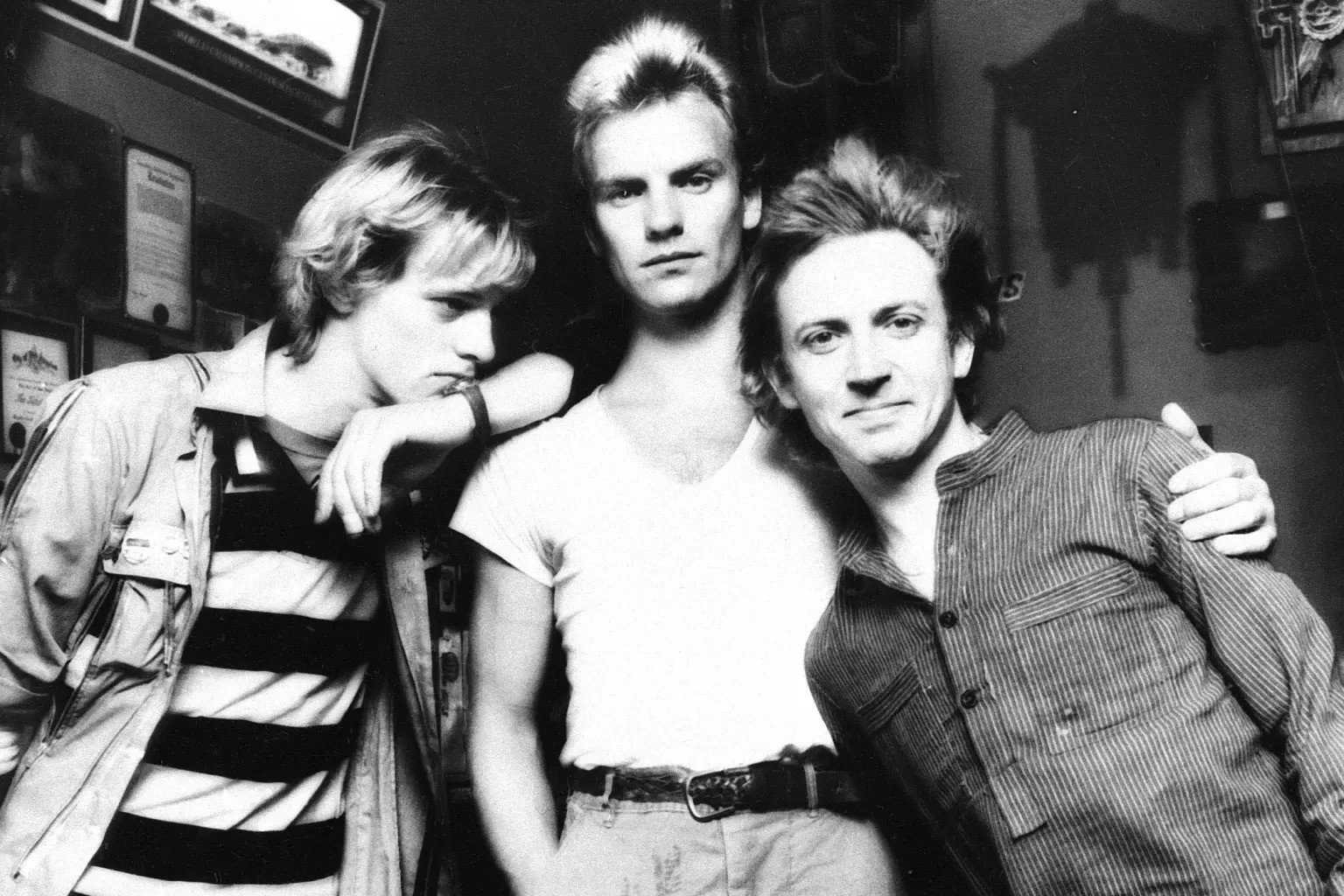
By the summer of 1980, The Police were the biggest new band in the world — and they were broke, exhausted, and not allowed to record in their own country. Britain’s tax laws had driven them into exile, their schedule was a meat grinder of tours and television, and they had exactly four weeks to make their third album before a world tour began. Sting, Stewart Copeland, and Andy Summers were barely sleeping, barely agreeing, and running on pure adrenaline. What they produced in that frantic month — “Zenyatta Mondatta” — contained two of the most famous songs of the decade and won them their first Grammy Awards. This is the story of a masterpiece made under impossible pressure.
Exile in Hilversum
The Police’s problem in 1980 was success itself. “Reggatta de Blanc” had made them stars, and British tax law meant that high earners who spent too many days in the UK faced punishing rates. Like the Rolling Stones before them, the band became tax exiles. They couldn’t record in Britain — so they decamped to Wisseloord Studios in Hilversum, in the Netherlands, a sleek modern facility outside Amsterdam.
They hired co-producer Nigel Gray, who had worked on their first two albums, for a fee of twenty-five thousand pounds — a huge sum for a band watching every penny, bringing the total recording budget to around thirty-five thousand. Gray knew the band’s chemistry and their quirks, and in the pressure-cooker of Hilversum he became the calm center — the man tasked with capturing lightning while the clock ran down. And they gave themselves four weeks. Not four leisurely weeks: four weeks interrupted by concert dates in Milton Keynes and Ireland, four weeks of relentless work while a massive world tour loomed on the horizon. The pressure was doubled by expectation — “Outlandos d’Amour” and “Reggatta de Blanc” had both been hits, and the whole world was waiting to see if the trio could do it a third time. The band has said they finished the album at four o’clock in the morning on the very day the tour began, then piled into cars and drove to Belgium for the first show — no rest, no celebration, just the road. It was, by every account, a madhouse. And somehow, out of that madhouse came magic.
“Don’t Stand So Close to Me”: The Teacher’s Confession
The album’s centerpiece — and the biggest single of the band’s career — came from Sting’s past. Before he was a rock star, Gordon Sumner was a schoolteacher in Newcastle, teaching English at St. Paul’s First School in Cramlington. “Don’t Stand So Close to Me” drew directly on that experience: the story of a young teacher overwhelmed by a schoolgirl’s crush, a tale of temptation and guilt told with literary flair. The lyric even invokes Vladimir Nabokov’s “Lolita,” framing the schoolgirl’s infatuation through one of literature’s most disturbing stories.
The music was as distinctive as the words. The song’s famous opening, built on a pulsing bass synthesizer, was unlike anything on the radio — and sharp-eared listeners can hear the click of the Roland CR-78 drum machine bleeding through the recording, a happy accident of the rushed sessions that became part of the track’s tense, ticking atmosphere. It was literary, rhythmic, and utterly distinctive. The public devoured it. “Don’t Stand So Close to Me” shot to number one in Britain, where it became the best-selling single of 1980, and reached the American Top 10. It won the band the Grammy for Best Rock Performance by a Duo or Group with Vocal — their first Grammy, earned by a song about a teacher who couldn’t keep his distance.
“De Do Do Do, De Da Da Da”: Nonsense With a Point
If “Don’t Stand So Close to Me” was literary, its follow-up single was deliberately the opposite. “De Do Do Do, De Da Da Da” — with its playground-chant title — was Sting’s sly commentary on the meaninglessness of pop lyrics themselves, a song about empty words built from empty words, daring the listener to find the depth beneath the chant. The joke was that a song complaining about vapid songwriting became a massive hit on the strength of its unforgettable chant: it reached number 5 in Britain and the American Top 10, and its insistent, reggae-inflected groove made it one of the most recognizable records of the era. Decades later, it remains the band’s most playfully subversive moment — a hit single that mocked hit singles.
The song also showcased what made The Police extraordinary: three musicians playing with almost telepathic precision, a chemistry forged in tiny clubs and now filling stadiums. Stewart Copeland’s drumming — all reggae-inflected bounce and punk energy — and Andy Summers’ shimmering, effects-laden guitar gave Sting’s pop instincts a rhythmic complexity no other hit machine could match. “De Do Do Do” sounded like nothing else on the radio, and that’s exactly why it worked.
The Political Turn
“Zenyatta Mondatta” was also the album where The Police got serious. “Driven to Tears,” written by Sting, was a blistering attack on global poverty and political indifference — a subject the reggae and punk scenes had been circling, now delivered with arena-sized force and one of Copeland’s most ferocious drum performances. “Bombs Away,” written by Copeland, confronted the Soviet invasion of Afghanistan, which had begun the previous year, with sardonic fury. These weren’t vague protest gestures; they were specific, angry, and current — the sound of the world’s biggest pop band deciding that fame without conscience was worthless.
This political edge would deepen on the band’s later records, but “Zenyatta Mondatta” was where it started — proof that the world’s biggest pop band was thinking about the world’s biggest problems. The album’s very title was a kind of statement: an invented portmanteau mashing together “Zen,” “Jomo Kenyatta” (the Kenyan leader), and the French word “monde” (world). It meant nothing and everything — a global, spiritual, political collage in a single made-up word, as if the band were announcing that their music no longer belonged to any one country, least of all the one whose tax laws had driven them out.
“Behind My Camel” and the Grammy Grudge
The album’s strangest story belongs to its most unlikely track. “Behind My Camel” was an instrumental composed by Andy Summers — the first Police song written solely by the guitarist, and a rare moment in the spotlight for the band’s quietest member. Sting reportedly hated it so much that he refused to play bass on it. Rather than fight, Summers simply played the bassline himself, laying down every note of the track alongside Copeland’s drums — guitar, bass, and composition all his.
The punchline is delicious: “Behind My Camel” went on to win the Grammy Award for Best Rock Instrumental Performance — beating out Sting’s own preferences and giving Summers a Grammy for the song his singer didn’t want to touch. It’s one of the great ironies in rock history, and a perfect illustration of the creative tensions that made The Police both brilliant and combustible. Three enormous talents, pulling in three directions, somehow producing music that sounded like one unstoppable force.
The Deep Cuts
Beyond the hits, “Zenyatta Mondatta” is packed with songs that reveal just how far The Police were stretching. “When the World Is Running Down, You Make the Best of What’s Still Around” — released as a single — was Sting at his most hypnotic, a looping, meditative groove built on repetition that anticipated the ambient-pop experiments of the decade to come. “Canary in a Coalmine” bounced along on a Caribbean lilt, its cheerful melody disguising lyrics about creeping anxiety. “Shadows in the Rain” was dark and jazzy, all menace and atmosphere. “Man in a Suitcase” and “Voices Inside My Head” showcased the band’s rhythmic telepathy — Copeland and Summers weaving around Sting’s bass like jazz musicians who’d wandered into a pop band.
These weren’t filler tracks. They were evidence of a band with more ideas than it knew what to do with, recording so fast that the ideas barely had time to cool before they were committed to tape. “Zenyatta Mondatta” rewards the curious listener: beneath the two giant singles lies an album of restless experimentation, the sound of three virtuosos pushing each other into uncharted territory, four weeks be damned. Fans who dig past the singles find the real Police — the band that could do anything, and knew it.
A Rushed Masterpiece
Here’s the remarkable thing: the band themselves were never happy with “Zenyatta Mondatta.” They felt it was rushed, undercooked, compromised by the insane schedule. They were so dissatisfied that in 1986, during the sessions for a planned sixth album that never materialized, they went back into the studio and re-recorded “Don’t Stand So Close to Me” and “De Do Do Do, De Da Da Da” entirely from scratch — slower, moodier, more “mature” versions that tried to capture what the band felt they’d missed in the 1980 rush. The re-recordings were eventually released, but they never displaced the originals in the public’s heart. The world had already decided: the rushed versions were the definitive ones.
But the public disagreed with the band’s verdict. “Zenyatta Mondatta” was released in early October 1980 and went straight to number one in Britain, reached number 5 in America, and was certified double platinum. It confirmed The Police as the biggest band of the new decade — a trio that could blend reggae, punk, pop, and jazz into something entirely their own, and the only band in the world that could make a four-week rush job sound like a coronation. The critics who called it rushed missed the point: the urgency is in the grooves. You can hear three musicians playing like the clock is ticking, because it was.
Pressure Makes Diamonds
“Zenyatta Mondatta” shouldn’t have worked. It was made by tax exiles in a foreign studio, in four frantic weeks, by a band that barely slept and barely agreed — three strong wills, one tiny studio, and a tour bus idling outside. The producer was hired for a fortune, the budget was tight, the clock was merciless. But pressure, in the right hands, makes diamonds. The album captured The Police at the exact moment they became the biggest band in the world — hungry enough to still be desperate, talented enough to make desperation sound like joy. Every time “Don’t Stand So Close to Me” comes on the radio, you’re hearing what four weeks of beautiful panic sounds like — three musicians at the top of their game, racing the clock and winning. And it sounds like 1980, forever and always — the sound of a band becoming legendary in real time.
Leave a Reply