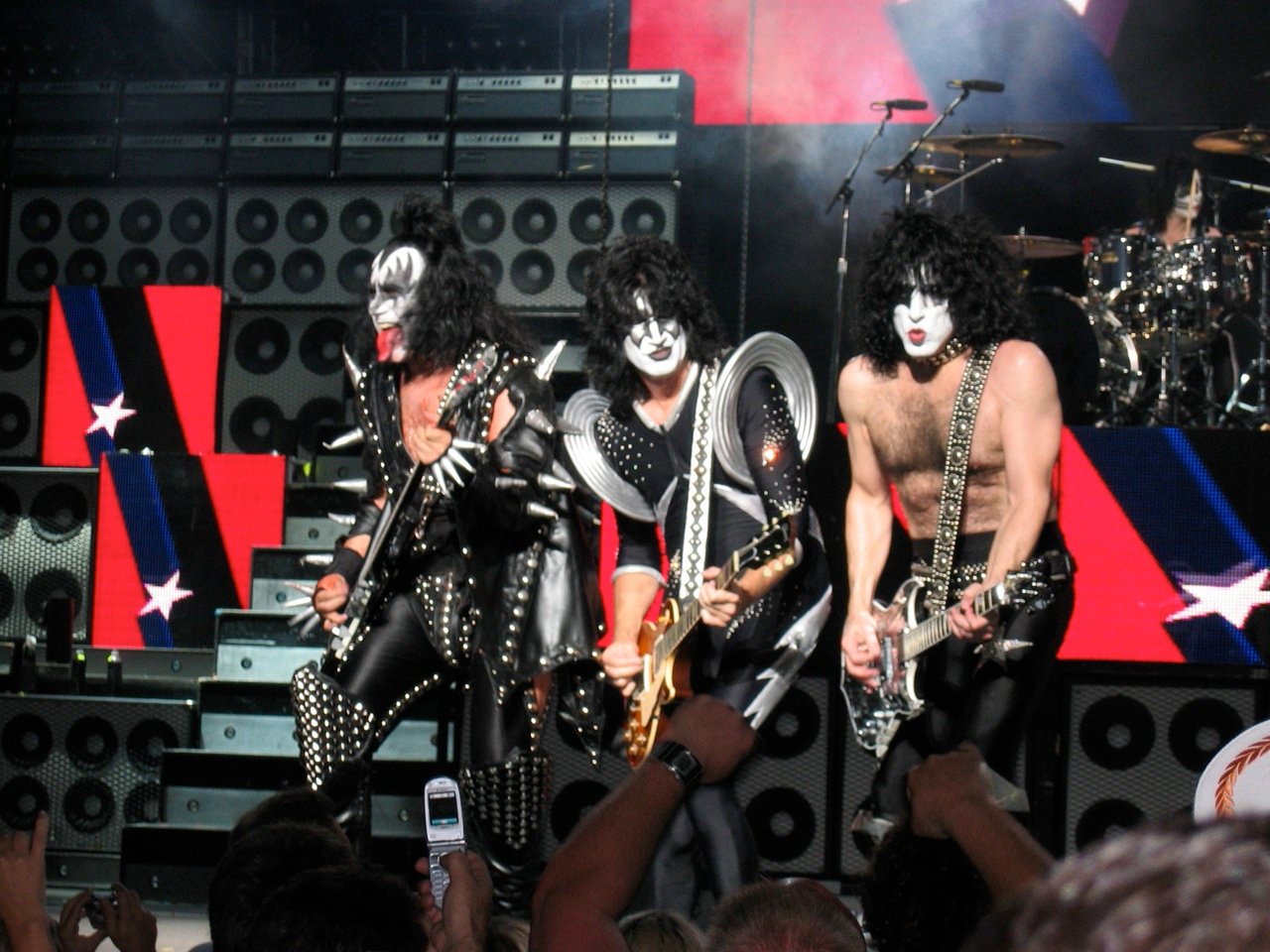
They are the most merchandised band in rock history — lunchboxes, pinball machines, coffins — but before the empire, KISS was four broke New Yorkers playing to empty rooms in face paint. Their story has everything: a fifty-dollar first gig, a frontman’s hair catching fire, fake blood made from breakfast ingredients, a ballad that became a hit by accident, and the disco song that nearly tore their army apart. This is KISS unmasked.
Fifty Dollars and a Dream
On January 30, 1973, KISS played its first show at a tiny club called the Coventry in Queens, New York. Fewer than ten people showed up. The band was paid fifty dollars. It was not an auspicious beginning for the self-proclaimed hottest band in the world.
The band had formed months earlier from the ashes of a failed New York group called Wicked Lester. Guitarist Paul Stanley and bassist Gene Simmons recruited drummer Peter Criss through a “Rolling Stone” classified ad, then found lead guitarist Ace Frehley through another. Frehley showed up to the audition wearing one red and one orange shoe and nearly electrocuted himself plugging in — but he could play, and that was enough.
It was Frehley who came up with the name and designed the now-famous lightning-bolt logo. The makeup came next: each member invented a persona — Simmons the fire-breathing Demon, Stanley the romantic Starchild, Frehley the Spaceman, Criss the Catman. In the glam-rock era of New York dolls and glitter, KISS bet everything on being larger, louder, and more theatrical than anyone else. For their first year, almost nobody noticed.
The Hair Fire
KISS’s early shows were gloriously chaotic, and the chaos was not always planned. On December 31, 1973, during a New Year’s Eve show, Gene Simmons’s signature fire-breathing act went wrong. Simmons would kneel at the front of the stage, tilt his head back, and blow a plume of kerosene-fueled flame toward the ceiling. That night, the fire caught his hair.
Simmons’s long black mane went up like a torch. Roadies rushed in as the Demon stood there, head ablaze, in front of a horrified audience. He escaped with minor burns and — in true Simmons fashion — finished the show. The incident became part of KISS lore, proof of the band’s commitment to the bit: the show must go on, even when the show is on fire.
It was not the last time the stage fought back. Over the years, Simmons would set off countless pyrotechnics inches from his face, Frehley would nearly electrocute himself on malfunctioning stage risers, and the band’s elaborate levitating drum kits and smoking guitars would malfunction in spectacular fashion. KISS concerts were part rock show, part stunt spectacular — and the stunts were real.
The Album That Saved the Label
Here is a fact that surprises even hardcore fans: KISS’s first three studio albums all flopped. “Kiss” (1974), “Hotter Than Hell” (1974), and “Dressed to Kill” (1975) sold poorly, and their label, Casablanca Records, was bleeding money. Founder Neil Bogart had bet the company on KISS, and the bet was failing.
What saved them was the realization that KISS was not a studio band — it was a live band. In the fall of 1975, Casablanca released “Alive!,” a double live album capturing the band’s bombastic concerts. It was a smash. The live version of “Rock and Roll All Nite” became KISS’s first Top 20 hit, the album went gold and then platinum, and it single-handedly rescued Casablanca from bankruptcy. The lesson was permanent: KISS would always be, first and foremost, a live experience. The makeup, the fire, the blood — it only made sense at full volume, in person.
The B-Side That Became a Hit
If “Alive!” proved KISS could rock, their next trick proved they could surprise. In 1976, the band released “Destroyer,” and its lead single was “Detroit Rock City,” a thundering anthem tailor-made for the KISS Army. Radio stations flipped the record over — and discovered “Beth” on the B-side.
“Beth” was the unlikeliest KISS song imaginable: a tender orchestral ballad sung by drummer Peter Criss, the Catman, complete with strings and not a power chord in sight. Criss had co-written it years earlier, and the band had recorded it almost as an afterthought. But America fell in love with it. “Beth” climbed to No. 7 on the Billboard Hot 100 — KISS’s biggest hit to that point — and won the People’s Choice Award for favorite new song. It became Criss’s signature, the song he would sing for the rest of his life.
The irony was delicious: the loudest band in America scored its biggest hit with its quietest song, sung by its drummer, hidden on the back of a single. KISS had accidentally proved they were more than a gimmick.
Blood, Sweat, and Breakfast Ingredients
By the late seventies, KISS was not just a band — it was a brand. The makeup personas had become iconic, and the stage show had escalated into full theater. Simmons’s fire-breathing was joined by his infamous blood-spitting: mid-show, the Demon would convulse, drool, and vomit great gouts of crimson blood over the front rows.
Fans assumed it was stage blood from a theatrical supply shop. The truth was more domestic. The recipe, as the band later revealed, was a kitchen-sink concoction: eggs, yogurt, red food coloring, and maple syrup. Yes — maple syrup. The Demon of rock and roll was spitting pancake topping. It looked horrifying under the stage lights, tasted terrible, and worked perfectly.
The merchandising machine was equally shameless and equally brilliant. At their peak, you could buy KISS lunchboxes, KISS makeup kits, KISS dolls, KISS comic books (famously printed, the band claimed, with ink mixed with their own blood), and eventually the KISS Kasket — a full-size coffin emblazoned with the band’s logo. Simmons, the son of a Holocaust survivor who had grown up poor in Israel and New York, never apologized for the commercialism. “We knew we were in the business of making money,” he said, in so many words, for decades. The KISS Army didn’t mind. They were too busy buying.
The Day KISS Became Four Bands
By 1978, KISS was at its commercial peak — platinum albums, sold-out tours in America and Japan, and a merchandising empire — and privately coming apart. Ace Frehley had told the others he wanted to quit. So manager Bill Aucoin and Casablanca chief Neil Bogart proposed a rescue plan of staggering audacity: all four members would release solo albums. On the same day.
On September 18, 1978, Paul Stanley, Gene Simmons, Ace Frehley, and Peter Criss each released a self-titled solo album — the first time in rock history that every member of a band had gone solo simultaneously. The records were designed as a matched set, with painted portraits of each member in full makeup and coordinated packaging. Every copy came with a poster, and the four posters fit together to form a single mural — a transparent ploy to get the KISS Army to buy all four.
None of the four appeared on anyone else’s record, and the music revealed four very different men. Stanley stayed closest to KISS-style hard rock. Criss leaned into R&B ballads. Simmons went eclectic, loading his album with guest stars and even covering “When You Wish Upon a Star” from Disney’s “Pinocchio.” And Frehley — the quiet Spaceman — stole the show. His cover of the Russ Ballard song “New York Groove” became the only Top 40 hit of the four, climbing to No. 13 on the Hot 100.
Stanley’s verdict, decades later in his memoir: the solo albums “turned out to be our next folly.” They didn’t save the band’s internal tensions — Frehley and Criss were both gone within a few years. But as a pure rock and roll stunt, nothing has ever topped it. Four albums, four egos, one day.
The Night They Went Disco
And then KISS committed what many fans considered the ultimate betrayal. In May 1979, riding high but sensing the shifting winds of pop culture, the band released “I Was Made for Lovin’ You” — a full-throated disco song, complete with four-on-the-floor beat and falsetto hooks. It was the lead single from “Dynasty,” their seventh studio album.
The backlash was immediate and vicious. Rolling Stone’s David Fricke warned that “the KISS Army is going to mutiny” when they heard the “disco-infected” track. Fans who had spent years treating disco as the enemy felt stabbed in the back. Years later, a curator of a museum exhibit about the infamous Disco Demolition Night of 1979 — when thousands of disco records were blown up in a Chicago stadium — suggested the song symbolized the moment KISS “jumped the shark.”
The story behind the song is pure Paul Stanley. He had been spending nights at New York’s legendary Studio 54 and decided, almost as a dare, to prove how easy it was to write a hit disco record. He co-wrote it with producer Vini Poncia and a young songwriter named Desmond Child. The sessions were tense: Poncia deemed Peter Criss’s drumming subpar — Criss was recovering from a serious 1978 car crash and struggling with substance abuse — and brought in session drummer Anton Fig to play on the album, though Criss still appeared on the cover and in the video.
Here is the punchline: the song was a massive hit. “I Was Made for Lovin’ You” reached No. 11 in America, went gold, and hit No. 1 in Canada, Australia, the Netherlands, and half a dozen other countries. It became a permanent concert staple — though the band rearranged it over the years to bury the disco elements. And the band itself never made peace with it: Simmons has called it his least favorite KISS song, and Frehley and Criss have said they dislike it too. Only Stanley defends it. The fans came around eventually. The KISS Army always does.
The Reunion That Broke Records
By the early nineties, KISS was running on fumes. The makeup had come off in 1983, the albums were selling modestly, and grunge had made their brand of bombast deeply unfashionable. Then came 1996 — and one of the most successful comebacks in rock history.
The original four members put the makeup back on, climbed into the platform boots, and launched a reunion tour that grossed $143.7 million, one of the highest-grossing tours of the decade. Fans who had grown up with the lunchboxes brought their own children. The Demon breathed fire again. The blood — eggs, yogurt, food coloring, maple syrup — flowed again. KISS had done what almost no band manages: they had become a nostalgia act without ever really going away.
They kept going for nearly three more decades, finally hanging up the platform boots with a farewell tour that ended at Madison Square Garden in December 2023. Fifty years after that fifty-dollar gig in Queens, KISS walked away as one of the best-selling bands of all time, with more than 100 million records sold.
The secret was never the music alone — though the anthems hold up. It was the understanding, from that very first night at the Coventry, that rock and roll is theater, and theater done with total commitment becomes something like religion. KISS didn’t just play for the KISS Army. They enlisted it, uniformed it, and marched it through five decades of fire, blood, and disco. Nobody else ever did it quite like that.
Leave a Reply