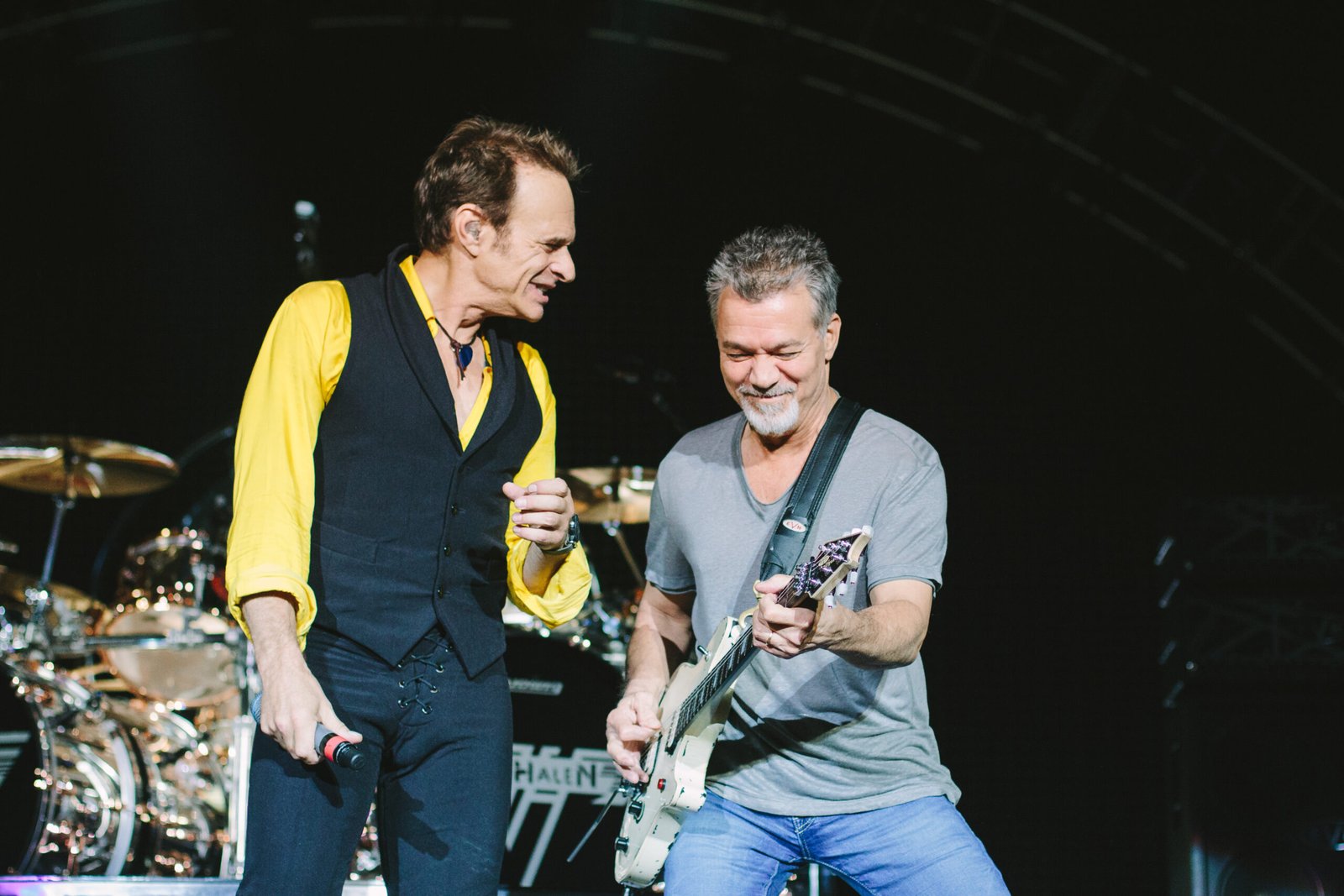
Van Halen didn’t just play rock and roll — they detonated it. In 1978, a band of California kids led by a soft-spoken guitar genius rewrote what the instrument could do, then spent the next four decades generating some of the wildest stories in music: a guitar built from spare parts, a prank call from Quincy Jones, a keyboard riff the singer hated, and a candy clause that turned out to be genius. This is Van Halen, unfiltered.
The Guitar That Cost Less Than Dinner
Every guitar hero has a signature instrument. Eddie Van Halen’s was a Frankenstein’s monster — literally. He called it “Frankenstein.” The world called it the Frankenstrat. And he built it himself, because the guitar he wanted didn’t exist.
The recipe was gloriously cheap. Around 1977, Eddie bought a factory-second Stratocaster-style body — rejected wood with a knot in it — for $50, and a maple neck for $80. He wanted the comfort and tremolo arm of a Fender but the thick, roaring power of a Gibson humbucker, so he chiseled out the body and dropped in a Gibson PAF pickup he had pulled from his old ES-335. To stop the pickup from squealing with feedback, he potted it himself in hot wax. One volume knob. That was it. No tone controls, no fancy switching. The entire experiment cost less than $150.
Eddie painted it white, added black stripes with masking tape, and played it on Van Halen’s debut album — the cover of which shows him mid-leap with the homemade guitar. He later added the famous red coat of paint and kept modifying it for decades, swapping necks the way other guitarists changed strings. He was famously secretive about his gear, deliberately misleading interviewers to throw copycat guitarists off the scent. But the truth was simple: the most influential guitar sound of a generation came from $130 worth of spare parts. A replica of the Frankenstrat now sits in the Smithsonian.
The Demo That Got Them Signed
Before the world knew Van Halen, Gene Simmons did. In 1976, the KISS bassist caught the young band at a club and was blown away. He financed a demo session for them — the so-called “Zero” demo — and flew the tapes back to New York to shop them around. Simmons even suggested the band change its name: he thought “Van Halen” sounded too stiff and proposed “Daddy Longlegs” instead. The band politely declined.
Simmons couldn’t get them a deal, but the demo made the rounds. Warner Bros. executive Mo Ostin eventually signed the band, pairing them with producer Ted Templeman. Their 1978 debut, “Van Halen,” exploded: it contained “Runnin’ with the Devil,” a pulverizing cover of the Kinks’ “You Really Got Me,” and “Eruption” — a 102-second instrumental that permanently changed electric guitar. Eddie’s two-handed tapping technique, showcased on “Eruption,” launched ten thousand imitators overnight and made him, at 23, the most talked-about guitarist on earth.
The Prank Call From Quincy Jones
In 1982, Eddie Van Halen got a phone call from Quincy Jones asking him to play a guitar solo on a Michael Jackson track. Eddie was sure it was a prank. “I went off on him,” he later recalled. “I went, ‘What do you want, you f-ing so-and-so!’” He hung up on Jones — by some accounts, four separate times — convinced one of his bandmates was winding him up. Jones had gotten Eddie’s number through Toto’s Steve Lukather, and it took repeated calls before Eddie agreed to at least meet at the studio the next day.
When he arrived, there was Quincy, there was Michael Jackson, there were the engineers. It was real. Jones told Eddie to do whatever he wanted. Eddie listened to “Beat It,” decided the arrangement needed work, and rearranged the middle section of the song on the spot. Then he recorded the solo — about twenty seconds of incandescent guitar — in under an hour. Engineers would later swear a speaker caught fire during the take.
As he was finishing, Jackson walked in. Eddie braced himself and confessed: “Look, I changed the middle section of your song.” He figured he’d either be thrown out by bodyguards or thanked. Jackson’s response: “Wow, thank you so much for having the passion to not just come in and blaze a solo, but to actually care about the song, and make it better.”
Eddie did it as a favor — he reportedly accepted nothing but the beer in the studio fridge — and insisted on two conditions: he would not be credited, and Jackson wouldn’t tell his bandmates. Van Halen had a rule against side projects. The original 1982 pressing of “Thriller” lists the soloist as a question mark. Eddie figured nobody would ever find out. As he later laughed: “Wrong! Big-time wrong. It ended up being Record of the Year.”
His favorite story came later, in a Tower Records in Sherman Oaks. “Beat It” was playing over the sound system, and Eddie overheard two kids in front of him saying, “Listen to this guy trying to sound like Eddie Van Halen.” He tapped one on the shoulder and said, “That IS me!”
The Keyboard Rebellion
Eddie Van Halen had been a classically trained pianist before he ever picked up a guitar, and by the early eighties he was itching to bring keyboards into Van Halen’s sound. He wrote a bright, ascending synth riff as early as 1981. Singer David Lee Roth and producer Ted Templeman hated the idea — keyboards, they felt, would make the band sound like they were selling out to pop trends. The riff sat on the shelf.
Eddie’s solution was to build his own recording studio, 5150, at his home. There, working alone with engineer Donn Landee in the middle of the night, he finally recorded the track properly. Templeman heard it and convinced Roth to at least try writing lyrics. Roth’s method was characteristically theatrical: he had roadie Larry Hostler drive him around Los Angeles in the back of his 1951 Mercury convertible, blasting the instrumental over and over. The night before, Roth had seen a TV news report about a man threatening to jump off a building — and imagined someone in the crowd yelling “go ahead and jump.” He turned that dark image into an invitation to seize life.
“Jump” was released in December 1983 as the lead single from the album “1984.” On February 25, 1984, it hit No. 1 on the Billboard Hot 100 — knocking Culture Club’s “Karma Chameleon” off the top — and stayed there for five weeks. It remains, to this day, Van Halen’s only No. 1 single. The irony was exquisite: the song the singer had resisted became the biggest hit of his career. The creative tension didn’t survive, though. Roth left the band in 1985, and “1984” was his last album with them.
The Brown M&Ms Clause
No Van Halen story is more famous — or more misunderstood — than the brown M&Ms. The band’s 1982 world tour contract rider ran to 53 pages of technical and hospitality demands. Buried in the middle, as Article 126, was this stipulation: “There will be no brown M&M’s in the backstage area, upon pain of forfeiture of the show, with full compensation.”
For years, it was held up as the ultimate example of rock star diva behavior. It was the opposite. Van Halen was the first band to take a truly massive arena production — nine eighteen-wheeler trucks of gear, where the standard was three — into small, third-tier markets. The staging was heavy, the power requirements were enormous, and the local crews had never handled anything like it. A single overlooked technical detail could be, in Roth’s words, “literally life-threatening.”
So the band planted a tripwire. As Roth explained in his autobiography, the rider was full of dense technical specs — “Article 148: There will be fifteen amperage voltage sockets at twenty-foot spaces, evenly providing nineteen amperes” — and right in the middle sat the candy clause. “When I would walk backstage, if I saw a brown M&M in that bowl — well, line-check the entire production. Guaranteed you’re going to arrive at a technical error. They didn’t read the contract.”
The system proved itself in Pueblo, Colorado, in 1980. Roth found brown M&Ms backstage and, true to form, trashed the dressing room. But the candy wasn’t the real problem: the venue had just installed a new floor that couldn’t support the weight of Van Halen’s staging. The promoters had ignored the weight requirements in the rider, just as they’d ignored the M&Ms. The staging sank through the floor, causing some $80,000 in damage. The brown M&M had done its job. As authors Chip and Dan Heath later wrote: “David Lee Roth was no diva; he was an operations master. In Van Halen’s world, a brown M&M was a tripwire.”
The Biggest Payday in Rock
At their peak, Van Halen commanded money that rewrote the record books. In 1983, the band headlined the US Festival in California for a fee of $1.5 million — at the time, a Guinness World Record for the highest-paid single appearance by a rock band. They played for hundreds of thousands of people in the desert heat, Roth in full ringmaster mode, Eddie grinning through a set of impossible guitar heroics. It was the sound of a band at the absolute top of the mountain, cashing the biggest check rock had ever written.
The Genius Who Never Stopped Building
Eddie Van Halen died on October 6, 2020, at 65, after a long battle with cancer. The tributes poured in from every corner of music — including a touching note from Quincy Jones, who remembered the kid who had hung up on him four times before changing pop history in an afternoon.
What Eddie left behind goes far beyond the tapping, the solos, and the $130 guitar. He left a way of thinking: that instruments are suggestions, not rules; that a rock band can play on a Michael Jackson record and make it better; that a candy bowl can be a safety system; that the sound in your head is worth building a studio to capture. Van Halen made six albums with David Lee Roth and four with Sammy Hagar, sold tens of millions of records, and never once played it safe.
Every guitarist who has ever tapped a fretboard with both hands is living in Eddie’s world. He built it himself — out of spare parts, spare afternoons, and a refusal to believe that anything was impossible. Just like that first guitar: $50 for the body, $80 for the neck, and a sound worth more than all the money in rock and roll.
Leave a Reply