I Feel Love: How Donna Summer Sang the Future Into Being
It was the summer of 1977, and the biggest pop song in Britain was a record that sounded like nothing on earth. No drums you could see, no bass guitar, no strings, no brass — just a pulse. A deep, hypnotic electronic heartbeat that throbbed at the center of a storm of synthetic arpeggios, while above it all a voice floated, breathy and ecstatic, repeating four words as if she were discovering them for the first time. When it came on the radio, DJs watched their telephones light up. Dancers didn’t stop dancing — they couldn’t. The pulse wouldn’t let them.
In Berlin that same summer, a man came running into a studio waving a copy of the single and shouting that he had heard the sound of the future. His name was Brian Eno, and he was making “Heroes” with David Bowie — two of the most sonically adventurous musicians alive. Even they were stunned. The record that had knocked them sideways was not by Kraftwerk, or Tangerine Dream, or some avant-garde electronic ensemble. It was by an American soul singer from Boston, a gospel choir girl turned disco diva, backed by machines. It was Donna Summer’s “I Feel Love,” and it would redraw the map of popular music so completely that, nearly fifty years later, we are still living in the world it invented. This is the story of how a track that was never meant to be a single became the sound of everything that came after.
The Girl from Boston
Donna Summer was born LaDonna Adrian Gaines on New Year’s Eve, 1948, in Boston, Massachusetts, the third of seven children in a devoutly Christian African American family. Her father was a butcher, her mother a schoolteacher, and the soundtrack of the house was the church — gospel music, choir rehearsal, the powerful voices of believers. Summer began singing in her church’s gospel choir as a young girl and made her performance debut at the age of ten, stepping in when a vocalist couldn’t perform. She never looked back.
By the late 1960s she had left the church circuit behind and was fronting a psychedelic rock band called Crow in Boston, a powerful gospel belter with a rocker’s attitude. Shortly before finishing high school, she moved to New York City, hungry for the stage. She auditioned for the Broadway production of the counterculture musical Hair — and didn’t get the part. But the producers were opening a production in Munich, West Germany, and they needed someone to play Sheila, the musical’s female lead. Against her parents’ initial reluctance, Summer took the role and crossed the Atlantic in 1968.
She never really came home. The Munich engagement stretched on, and she joined the Viennese production too, then returned to Germany, performing in other musicals, singing backup in studios, and doing part-time modeling. She married Austrian actor Helmuth Sommer and kept an Anglicized version of his surname as her stage name: Donna Summer. Munich in the early 1970s was a freewheeling, cosmopolitan city with a thriving studio scene, and Summer embedded herself in it — a session vocalist for hire, absorbing everything.
It was during a recording session for Three Dog Night at Munich’s Musicland Studios that she met the two men who would change her life: Giorgio Moroder, an Italian-born composer and producer with a fascination for electronic sound, and Pete Bellotte, a British songwriter and producer who had become Moroder’s creative partner. The trio forged a working partnership, and in 1974 their first fruits — the single “The Hostage” — became a hit across Western Europe. Summer’s debut album, Lady of the Night, followed. But nobody, least of all the three of them, was prepared for what happened the following summer.
Twenty-Two Orgasms
In the summer of 1975, Donna Summer walked into a session with an idea: the lyric “Love to love you, baby.” Moroder, who had been hunting for a way to develop the new disco sound rising out of America’s clubs, heard something in those five words. He wanted her to sing the song as a woman in the throes of passion — moaning, sighing, groaning orgasmically over the groove. Summer was reticent. She agreed to record it as a demo, something to shop to other artists.
What she did instead became legend. She pictured herself as Marilyn Monroe acting out a scene of sexual ecstasy, and she let loose: she had the engineers turn the lights down low and sang lying on her back on the studio floor, touching nothing but her knee, she later said — just thinking of her boyfriend to make the moans convincing. Moroder was astounded. He refused to let the performance be handed to anyone else. This was her record now.
Released in Europe under the simple title “Love to Love You,” it did modest business. But when the demo reached the hands of Neil Bogart, the president of America’s Casablanca Records, everything changed. Bogart played it at a party at his house, and the crowd wouldn’t let him take it off the turntable — he kept lifting the needle to play it again. According to Moroder’s own recollection, Bogart called him at 3 a.m. and demanded: make it longer. Moroder obliged, stretching the track to an unprecedented seventeen minutes, telling Donna to improvise more “sighs and moans” to fill the space, and filling an entire side of vinyl with one continuous, candlelit groove. Renamed “Love to Love You Baby,” it was issued by Casablanca in November 1975 — and Summer was signed.
The record was a sensation and a scandal. It climbed to number two on the Billboard Hot 100 in early 1976 and topped the dance charts. Time magazine published a piece counting 22 simulated orgasms in the song and dubbed Summer “the First Lady of Love.” The BBC banned it. Radio stations across America refused it. And none of it mattered — the clubs had already decided. In a reversal of the usual hit-making process, it was the DJs and dancers — the underground gay and Black club scene — who made “Love to Love You Baby” a phenomenon, proving the power of the dancefloor to drive pop culture. Disco now had its first true diva. But the trio in Munich already had their eyes on something far more radical.
A Concept Album About Time
By 1976, Summer, Moroder and Bellotte were one of the most reliable hit factories in Europe, and they wanted to make a statement. Their plan for Summer’s fifth album was a concept: I Remember Yesterday would be a journey through the decades of popular song, with each track evoking a different era — 1940s big band swing on the title track, girl-group drama in the Spector vein, a Motown-styled number — moving forward through the years. The album would close with a final track that represented the future: a song that sounded like nothing from the past at all.
That final track would be “I Feel Love,” and it would be the last song recorded for the album. Moroder had a clear vision for how to make the future audible. “I did it by only using synthesizers,” he later explained, “because I thought it was the instrument that would be used in the future — be the instrument of the future.” He was a self-described fan of electronic music who had already experimented with synthesizers on his records, including his 1972 hit “Son of My Father” — which, when covered by Chicory Tip, became one of the first British number ones to feature a synthesizer. Now he wanted to go further: an entire record built almost entirely out of machines, with a real voice floating above it. Nobody had ever tried that on a pop record before.
The audacity of the idea is hard to overstate. Disco in 1976 was the music of orchestras — lush string sections, blaring horns, gospel choirs, congas and timbales. Moroder proposed the opposite: strip all of it away and build a dance track from oscillators, sequencers and white noise. As Bellotte later told Sound on Sound, the team understood exactly what they were attempting, and they attacked it with the excitement of explorers. “Once this was done and Giorgio had laid the basic track down — we’d use other Moogs later on, including the Minimoog, but nothing ever had the strength of that particular bass, which is like a giant’s hammer on a wall — every other synthesized sound locked in absolutely solidly with the original tempo. We had entered another world!”
The Moog at Musicland
The sessions took place at Musicland Studios in Munich in early 1977, built around an unlikely guest star: a Moog Modular 3P, one of the large early-model modular synthesizers, which Moroder borrowed from the German classical composer Eberhard Schoener. Schoener had been something of a Moog pioneer, and Moroder — who already had experience with the original Moog instruments — contacted him about using the machine. The massive, unwieldy instrument, which one account compared to a small TARDIS, was hauled into Musicland, and with it came Schoener’s assistant, Robby Wedel. Wedel would prove to be the unsung hero of the track.
At the time, the sequencer on the Moog had no external clock sync the way later instruments would. Wedel showed Moroder and Bellotte how to synchronize the song’s various parts around an internal click track — a technique so novel that, Bellotte later said, even Moog founder Bob Moog was reportedly unaware the instrument could do it. The procedure was painstaking. First, the team recorded a reference pulse on track 16 of the 16-track tape recorder. From that pulse they locked in the Moog, so that every subsequent pass was perfectly synchronized. The various parts were programmed on the Moog’s sequencer, note by note, before the melody was even written — Moroder composed the backing track and the bassline first, an unusual inversion of the normal songwriting process, then introduced variety by altering the key at regular intervals and layering Summer’s vocals on top.
The Moog was a temperamental beast. It went out of tune quickly — within 20 or 30 seconds — so the team had to record the bassline in short bursts, retuning the instrument between each one, then stitching the passes together. To create the hi-hat sound, they took white noise generated by the Moog and processed it with an envelope, chopping it into the machine-gun tick that drives the track. A similar sculpted-white-noise treatment became the snare. There was, however, one sound the Moog simply couldn’t deliver to their satisfaction: the kick drum. The deep, metronomic thump that anchors the entire record came not from a machine but from a human being — Keith Forsey, Moroder and Bellotte’s regular London-born session drummer, who laid down seven minutes of four-on-the-floor thump on a real drum kit. Aside from Summer’s vocals, Forsey’s kick is the only element of the song not played by a machine.
The final stroke of genius was in the mixing. Each note of the sequenced bassline was doubled by a delay effect: the unmodified note plays through the left channel and the slightly delayed repetition through the right, creating a flickering, strobe-like effect — a sensation of the pulse spinning in space. The whole backing track, according to Bellotte, was recorded in just two or three hours. It had the purity of something done fast and the precision of something done by hand, because in 1977, before MIDI, before digital sequencers, there was no other way to do it.
One Take, Ten Minutes, Head Voice
Then came the voice. Pete Bellotte wrote the lyric — a marvel of simplicity, essentially four words and their variations: “It’s so good, it’s so good, it’s so good, it’s so good / I feel love, I feel love.” Where “Love to Love You Baby” had been all earthly sensuality, “I Feel Love” was something more abstract: a woman dissolving into pure sensation, desire rendered as circuitry.
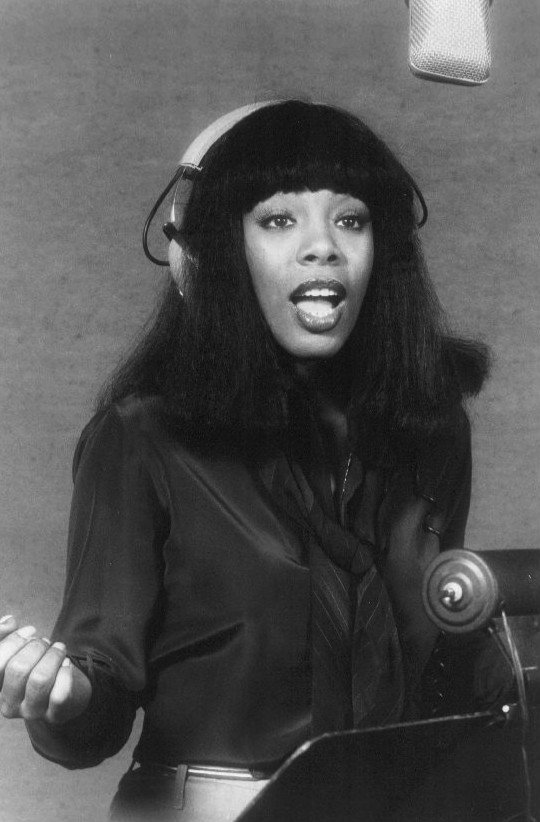
What happened next is one of the great stories in pop. Before she recorded, Summer had been in discussions with her astrologer — and about her new love interest, Bruce Sudano of the blue-eyed soul act Brooklyn Dreams, the man she would eventually marry. Perhaps the stars were aligned, because she was in an unusual state of mind. And when she stepped up to the microphone, she did something no one expected: instead of the deep, gospel-trained chest voice that dominated disco, she sang in a light, floating head voice — breathy, weightless, otherworldly. Against the most mechanical backing track ever committed to tape, she sang like a human spirit hovering just above the machinery.
She did it in one take. Moroder later told Record Mirror: “Donna finished in 10 minutes. Neither of us thought it would be as big as it’s been.” The understatement is delicious. The track that would invent electronic dance music was, to its creators, just an album closer — a conceptual coda to a nostalgia record, a piece of studio experimentation made for fun. They had aimed for the future and hit it so precisely that they didn’t even realize where they’d landed.
What makes the vocal performance so enduring is its paradox. The lyric is almost childlike in its simplicity — “I feel love” — but Summer sings it like someone describing a new element on the periodic table. There is no winking, no camp, no diva excess. She sounds genuinely transported, as if the machines had opened a window onto something she couldn’t see but could feel. Decades of house and techno vocalists would try to copy that feeling. None of them would quite get there.
The Machine Behind the Machine
It is one of the great ironies of pop history that the most futuristic American dance record of 1977 was made in Munich, West Germany, by an Italian and an Englishman, with a singer from Boston. But Musicland Studios in the 1970s was the unlikely capital of the electronic underground, and Giorgio Moroder and Pete Bellotte were its princes. The studio, which the two producers essentially ran as their workshop, had already generated a string of disco hits, including “Love to Love You Baby.” They had a house crew of session musicians — and they had Keith Forsey.
Forsey was a London-born drummer who had become the heartbeat of the Munich sound. It was his four-on-the-floor kick on a real drum kit that gave “I Feel Love” its human pulse — the only non-machine, non-voice element in the entire record. He was more than a session player; he was Moroder’s rhythmic conscience, the man who kept the machines honest. The same year, Forsey played with Moroder’s own side project, the Munich Machine, whose single “Get On The Funk Train” was a racing near-hit. The Munich sound was funk filtered through European electronics: relentless, precise, and engineered for dancefloors thousands of miles away.
Moroder himself was no overnight sensation. He had been chasing the electronic future for years before “I Feel Love.” He was an early adopter of sequencers and a believer, years ahead of the industry, that synthesizers were not novelties but the instruments of the music to come. “Son of My Father,” his 1972 single, became — via Chicory Tip’s cover — one of the first British number ones to feature a synthesizer. By the time he borrowed Eberhard Schoener’s Moog, he had spent half a decade learning how to make machines sing. “I Feel Love” was not a lucky accident. It was the sound of a man who had been preparing for this record for years, finally finding the right singer, the right song, and the right machine at the same moment.
And it mattered that the singer was Donna Summer. The song’s credits list her as a co-writer alongside Moroder and Bellotte, and it is her presence that keeps the record from being a mere technical exercise. A lesser vocalist would have fought the machines or been swallowed by them. Summer did something rarer: she floated above them, humanizing the circuitry without softening it. The pulse is Moroder’s; the feeling is hers. That is why the record belongs to her as much as to him — and why, when people talk about “I Feel Love,” they talk about Donna Summer first.
The Sound of the Future
The single that nobody expected arrived quietly. “I Feel Love” was first issued in May 1977 as the B-side of the album’s ballad single, “Can’t We Just Sit Down (And Talk It Over)” — the afterthought of an afterthought. But the clubs heard it first. DJs who flipped the record over found themselves holding the most alien object to ever hit a dancefloor, and they played it. Two months later, on July 2, 1977, the sides were flipped and “I Feel Love” was reissued as an A-side in its own right. What happened next was a detonation.
But the most famous testimony to the record’s power came not from the charts but from a studio in Berlin. In the summer of 1977, David Bowie was in Germany recording “Heroes,” the second album of his Berlin trilogy, with Brian Eno — the former Roxy Music synthesizer visionary — as his collaborator. These were two men at the cutting edge of rock’s electronic frontier, inventing the sound of the decade to come. And when they first heard “I Feel Love,” they were knocked flat.
Bowie told the story repeatedly, most notably in the liner notes to his Sound + Vision box set in 1989. Biographer David Buckley recounts it in his Kraftwerk biography Publikation: “One day in Berlin,” says Bowie, “Eno came running in and said, ‘I have heard the sound of the future.’ He puts on ‘I Feel Love,’ by Donna Summer. He said, ‘This is it, look no further. This single is going to change the sound of club music for the next 15 years.’ Which was more or less right.”
It was more or less right in the way that great prophecies are — right in spirit, wrong only in scale. Eno predicted fifteen years; the record has been reshaping club music for nearly fifty. The image is worth savoring: the most avant-garde minds in rock racing into a studio waving a disco single, because they’d heard the future and it had a four-on-the-floor kick and a sequenced bassline. Buckley described the track as sounding “as if Kraftwerk had gone potty and recruited a bona fide American soul singer.” It was the collision everyone thought impossible: the coldest machines and the warmest voice, fused into something entirely new.
Number One Everywhere
The charts confirmed what Eno had heard. In the United Kingdom, “I Feel Love” reached the top of the singles chart in July 1977 and stayed there for four weeks — an eternity for a record that strange. Across Europe it was unstoppable: number one in Australia, Austria, Belgium, France, Italy and the Netherlands, number three in Germany and Italy, top ten in Canada, Ireland, New Zealand, Norway, South Africa, Sweden and Switzerland.
America took a little longer to catch up — the record climbed the Billboard Hot 100 through the autumn and peaked at number six for the week of November 12, 1977, becoming Summer’s first US top-ten single. It reached number nine on the Soul Singles chart. Both the single and I Remember Yesterday went gold. The album itself reached number three in Britain — Summer’s only top-ten studio album there — stuck behind immovable competition from Johnny Mathis and the A Star Is Born soundtrack.
The record kept returning. The 1982 remix reached number 21 in Britain; the 1995 remix went all the way back to number nine on the US dance charts and number eight in the UK. Between its original release and its remixes, “I Feel Love” sold the better part of a million physical singles in Britain alone — enough to make it one of the best-selling singles of all time there. A single that had been recorded as a conceptual album closer had become, through sheer force of its strangeness, one of the defining records of the decade.
The Children of the Pulse
No record in pop history has a more crowded family tree. “I Feel Love” became the first well-known disco song with a completely synthesized backing track, and almost immediately, the machines started multiplying. The pulsing octave bassline, the staccato hi-hats, the four-on-the-floor thump — they became the genetic code of everything that followed. The song is routinely credited with laying the foundations for electronic dance music, and the Financial Times named it one of the most influential records ever made.
The first generation of descendants were the synth-pop bands and the Hi-NRG producers who took the record’s machine-pulse and ran with it. The Human League, Blondie, Kylie Minogue — all have cited the track’s influence. In Britain in 1985, Bronski Beat — the synth-pop trio of Jimmy Somerville, Steve Bronski and Larry Steinbachek — teamed up with Marc Almond to record a version of “I Feel Love.” The full version was actually a medley that also folded in snippets of “Love to Love You Baby” and John Leyton’s “Johnny Remember Me.” It was a huge success, reaching number three in the UK, equalling the chart achievement of their own “Smalltown Boy,” and was memorably described by one critic as “the gayest record ever made.”
In the late 1980s and early 1990s, the record’s second life began in the warehouses and clubs of Chicago and Detroit. Historians describe Detroit techno as the result of melding the synthpop of Kraftwerk, Giorgio Moroder and Yellow Magic Orchestra with African American styles like house, electro and funk — the Belleville Three, Juan Atkins, Derrick May and Kevin Saunderson, fusing European electronics with the four-on-the-floor aesthetic “I Feel Love” had pioneered. The record’s echo is audible in house, garage, Hi-NRG and techno alike; as one retrospective put it, Summer’s ethereal vocal created a template for the future of club mixes, and the bedrock of genres like house and garage. It has been covered by acts including Bronski Beat, the techno band Messiah and Sam Smith, and in 2022 Beyoncé sampled it on “Summer Renaissance” from her album Renaissance — the pulse, undiminished, underpinning a new generation’s dancefloor.
Perhaps the loveliest tribute is the one from Phil Hartnoll of Orbital, the British electronic duo. He was thirteen in the summer of 1977, a punk kid, when he heard “I Feel Love” on John Peel’s Radio 1 show. The record rewired something in him. Two decades later, he was making electronic dance music himself — the direct descendant of the sound that had ambushed him as a teenager. That’s how “I Feel Love” worked: it didn’t just influence musicians. It recruited them.
The Future Keeps Arriving
In 2011, the Library of Congress added “I Feel Love” to the National Recording Registry, selecting it as “culturally, historically, or aesthetically important” — one of just 25 recordings chosen that year, and the first of the disco-era records to be preserved as an American treasure. In 2024, the recording was inducted into the Grammy Hall of Fame, belated recognition that the most futuristic record of 1977 had outlasted almost everything made that year.
Donna Summer herself never made another record quite like it — no one could have, and she didn’t need to. She went on to become the only artist to have three consecutive double albums reach number one, the Queen of Disco who survived the death of disco and kept singing for four more decades until her death in 2012. Giorgio Moroder went on to score Midnight Express, Flashdance and Top Gun, winning Oscars, and to be rediscovered as a pioneer by generations of electronic musicians who tracked his Munich work like archaeologists. Pete Bellotte’s “giant’s hammer on a wall” bassline became the most imitated eight bars in dance music history.
But the deeper story is the one Brian Eno understood in that Berlin studio in the summer of 1977. “I Feel Love” is not just a great record; it is a proof of concept that never expired. It proved that machines could swing, that the future could be felt in the body, that a gospel choir girl from Boston could sing over circuitry and make it sound like church. Every time a DJ drops a track built from nothing but sequencers and a voice — every time a producer programs a bassline that pulses like a second heartbeat, every time a dancefloor moves as one to a rhythm that no human hands could play — the future that record promised arrives again.
Eno said it would change the sound of club music for the next fifteen years. He was wrong only about the number. It has been forty-eight years, and the pulse hasn’t stopped. Some records sound dated. “I Feel Love” still sounds like it arrived from tomorrow — which, of course, is exactly where it was made.
Leave a Reply