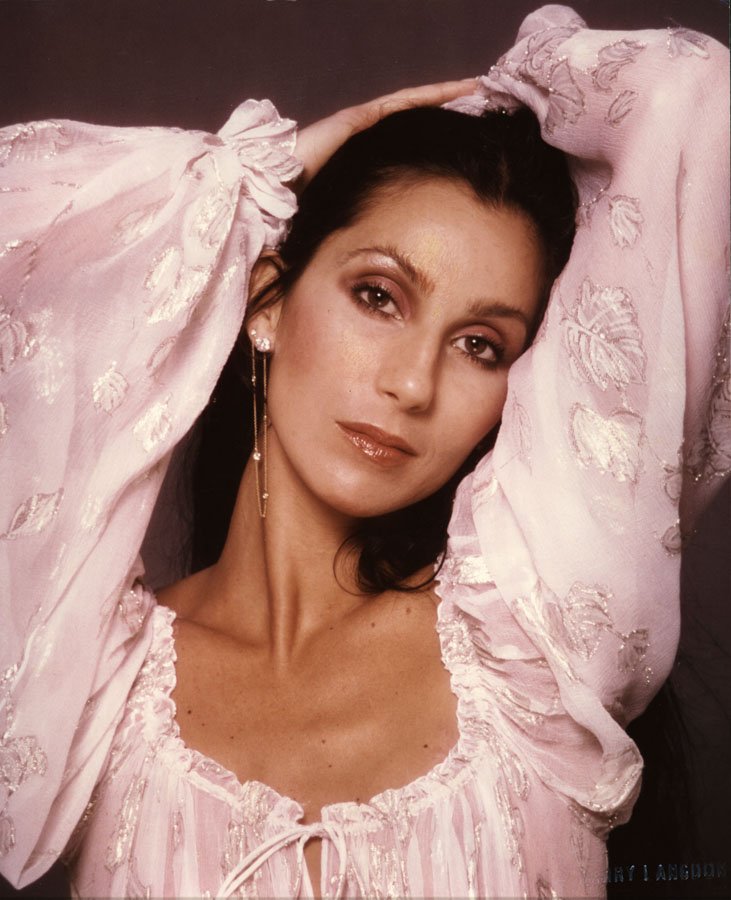
Believe: How Cher Turned a Rejected Demo and a Late-Night Studio Accident Into the Biggest Hit of Her Life
In January 1998, Cher flew from London to Los Angeles to bury her ex-husband. Sonny Bono — the man who had been her husband, her singing partner, and the architect of her fame since she was sixteen — had been killed in a skiing accident in the mountains of Aspen. At his funeral in Palm Springs, Cher stood at the pulpit and delivered the eulogy through tears. She called him “the most unforgettable character” she had ever met. By the spring, she would host a CBS tribute special, Sonny and Me: Cher Remembers, and accept a posthumous star for the two of them on the Hollywood Walk of Fame. At fifty-one, she had been a star for more than three decades. By every law of pop music, her chart-topping days were supposed to be over.
Less than a year later, she released the biggest single of her entire career — a song built on a demo nobody wanted, powered by a vocal effect nobody had dared to use, that sold more than ten million copies, topped the charts in twenty-three countries, made her the oldest woman ever to hit number one in America, and permanently rewired the sound of pop music. By the spring of 1998, she was back in London, working with two British producers half her age in a studio she would later describe as a dungeon, recording an album she would dedicate to the man she had just buried. This is the story of “Believe.”
The Long Road to Nowhere
To understand how miraculous “Believe” was, you have to appreciate how many times Cher had already reinvented herself — and how thoroughly the music business had written her off by the mid-nineties.
She rose to fame in 1965 as one half of the folk-rock duo Sonny & Cher, whose “I Got You Babe” topped the Billboard Hot 100 that August and became the sound of a generation. After the duo’s television fame faded, Cher rebuilt herself as a solo star with a string of dramatic, story-driven chart-toppers: “Gypsys, Tramps & Thieves” in 1971, “Half-Breed” in 1973, and “Dark Lady” in 1974 — all number one on the Billboard Hot 100. Then came the seventies’ disco years, the end of her marriage, and a period when the hits dried up.
The eighties brought yet another Cher. She walked away from music to act — earning an Academy Award nomination for Best Supporting Actress for Silkwood (1983), then winning the Academy Award for Best Actress for the romantic comedy Moonstruck at the 60th Annual Academy Awards in April 1988. At the same time, she relaunched herself as a rock singer, scoring platinum albums and hit singles including “I Found Someone” and, in 1989, “If I Could Turn Back Time,” the Diane Warren-written anthem whose battleship music video became one of the defining images of the decade.
Her gift for survival was already the stuff of legend. After the Sonny & Cher television empire collapsed and their marriage ended in divorce in 1975, Cher had tried disco — scoring a gold-certified 1979 hit with “Take Me Home,” which peaked at number eight on the Billboard Hot 100, her first top ten single in five years. Then she walked away from music almost entirely to study acting, earning critical raves for her Broadway debut in 1982’s Come Back to the 5 & Dime, Jimmy Dean, Jimmy Dean. When she returned to records in 1987 with the self-titled Cher album, the rock establishment scoffed — until “I Found Someone” proved she could belt with the best of them, and Heart of Stone went triple platinum in America two years later. Reinvention wasn’t a strategy for Cher. It was a reflex.
But the nineties were less kind. The decade was dominated for Cher by acting — she made her directing debut with If These Walls Could Talk — while her recording career stalled. Her 1995 album It’s a Man’s World was poorly received, and her label’s executives in London were losing faith that she could still sell records. Rob Dickins, the chairman of Warner Music UK, had an idea: Cher should make a dance album. It was, by her own later admission, not a direction she was eager to take. She had reportedly argued that dance music wasn’t conducive to “real songs.” But the commercial logic was hard to fight. The Euro-dance sound was sweeping Britain, and artists like Gina G had shown that a big-voiced woman over electronic beats could move serious units.
Cher was fifty-one years old, grieving her first husband, and being asked to start over in a genre she didn’t trust, in a country she didn’t live in, with producers half her age that she had never met. She said yes anyway. It is the first of many decisions in this story that only looks brave in retrospect.
The Demo Nobody Wanted
The song that would save her had been unwanted for years.
Its origins go back to 1991, when singer Mark Scott and songwriter Brian Higgins created an original demo of “Believe” for Warner Records, co-produced by Nick Van Eede and Kevin MacMichael of the band Cutting Crew — who were reportedly paid a bottle of whisky between them for the session. From there, Higgins shopped the song around. He offered the demo to the English indie-dance band Saint Etienne, who turned it down. The song then landed at Warner’s offices in a new version, credited to Higgins, Matthew Gray, Stuart McLennen, and Timothy Powell — and sat there for months. Along the way, the demo had been passed to several major artists through Higgins before it eventually found its way to Cher in 1997. But even then it circulated at Warner as an unwanted demo: a chorus in search of a song, waiting for someone stubborn enough to finish it. Producer Mark Taylor would later say of it: “Everyone loved the chorus but not the rest of the song.”
Dickins, meanwhile, was scouting for material for Cher’s new record. The story goes that Dickins happened to walk down a corridor at Warner’s London office and bumped into Higgins, who was there to talk about another project. Dickins asked if he’d submit songs for the Cher album. Three days later, a tape with sixteen of Higgins’s songs arrived. The ninth song was “Believe.” Dickins later recalled his reaction: “Cher could do this chorus, especially the lyrics, with her private life the way it is. She’s gone through all these things.”
He was right about the chorus. The verses, everyone agreed, were a mess. Dickins first asked Higgins to finish the song himself. “About a week later he comes in with the finished song and it’s terrible,” Dickins later recalled. “I’ve got this great chorus and this terrible song.” Higgins handed the song over, admitting he was probably too close to it. So Dickins sent the stray song to Metro Productions — the songwriting and production house run by Taylor and Brian Rawling out of a studio complex called Dreamhouse in Kingston upon Thames, a suburb west of London. Two of Metro’s writers, Steve Torch and Paul Barry, were handed the job of building a complete song around that orphaned chorus. Dickins’s patience wore thin as the rewrites piled up. “What is wrong with all you people?” he reportedly demanded. “I’ve got a hit chorus and none of you can write a song.”
Eventually, Torch and Barry delivered a version that Dickins and Cher were happy with. As released, “Believe” carries six songwriting credits: Brian Higgins, Stuart McLennen, Paul Barry, Steven Torch, Matthew Gray, and Timothy Powell. There is a seventh name missing from the credits — Cher’s own. Finding the second verse too self-pitying, she rewrote it on the spot during the sessions. In a December 2000 BBC radio interview she explained: “I wrote part of Believe — the second verse. The first verse was this woman who was sad that this guy was going, and the second verse was saying the same thing, so I changed it on the spot!” She never asked for an official credit. In a 2023 interview with The Guardian, she admitted she regretted the decision: “I should have asked for a writing credit. I was so stupid!”
The Little Dungeon of a Place
Cher’s sessions at Dreamhouse began in the summer of 1998. She had come to London intending to record one song — “Dov’è l’amore,” a track written by Paul Barry and Mark Taylor that Dickins had found for her. But Dickins had a larger plan: once she was there, the Metro team ended up producing the bulk of the album, six tracks in all, including “Believe.”
By the standards of a woman who had recorded with Phil Spector’s wall of sound and rock’s biggest names, Dreamhouse was a shock. Cher later remembered the studio as “this little dungeon of a place, the smallest studio I’ve ever been in in my life.” It was a three-studio complex in Kingston, Surrey, running on Mackie consoles in every room. Even Dickins had second thoughts when he visited: he walked in to find Cher sitting on a horrible sofa in a horrible room and wondered what on earth he had gotten them into.
What the room lacked in glamour it made up for in ingenuity. The track was assembled with Cubase on an early Power Macintosh G3, using synthesizers including a Clavia Nord Rack and an Oberheim Matrix 1000. Cher’s vocals were captured on three TASCAM DA-88 digital audio recorders through a Neumann U67 microphone. She spent six weeks working at the studio — and Taylor, for all his studio confidence, was terrified. “The first day was incredibly nerve-racking,” he admitted later. “I thought she might think our setup was a bit small, and that she would turn out to be a bit ‘Hollywood.’”
She wasn’t. The Sound on Sound account of the sessions describes a professional who dug in, argued her way through the recording process — “We argued the whole way through,” she later said of it — and shaped the record with them. But the most consequential moment of those six weeks wasn’t a vocal performance. It was something Taylor did to a vocal after she had sung it — alone, late at night, with a piece of software barely a year old.
The Accident That Rewired Pop
Auto-Tune had been released in 1997 by the company Antares. It was designed to be invisible: a corrective tool that gently nudged flat or sharp notes into place, a digital safety net for imperfect singers. Used properly, no listener should ever have known it was there. Its inventor, Dr. Andy Hildebrand, was a geophysicist who had spent his career using seismic algorithms to help oil companies find drilling sites — he left Exxon’s research world to study music composition, realized the same math could detect vocal pitch, and unveiled Auto-Tune at the 1997 NAMM show. (The Recording Academy would eventually honor him with a Technical Grammy in 2023.) Nobody who built the tool imagined what Taylor was about to do with it.
Taylor, tinkering with Cher’s vocal late one night, did something the software’s designers had never intended. He pushed the pitch-correction speed — the “retune” setting — all the way to zero, its most extreme value. Instead of smoothing the transitions between notes, the software snapped Cher’s voice from pitch to pitch in unnaturally rapid steps, stripping out the portamento — the natural slide of the human voice between notes — and leaving behind a crystalline, stuttering, faintly robotic warble. On lines like “I can’t break through,” her famous contralto seemed to shatter into digital glass and reassemble itself mid-word.
Taylor knew immediately that it was extraordinary. He also knew it might be career suicide. Playing the processed vocal for Cher, he said later, was “the most nerve-wracking part of the project.” He had no idea how a legend would react to hearing her voice turned into something half-machine.
She loved it. Cher insisted the effect stay — and when executives at Warner heard the finished mix and wanted the robotic vocal removed, she shut the conversation down with words that have become part of pop legend. As recounted by journalist Neil Strauss in The New York Times, and repeated in Cher’s Wikipedia biography, her answer to the label’s request to strip the effect was: “You can change it over my dead body.” The label backed down. The effect stayed.
The producers, keen to protect their trade secret, spent months telling journalists the sound came from a vocoder pedal — the recently released Digitech Talker. It wasn’t until later that the truth emerged: “Believe” was the first commercial recording to feature the audible side effects of Antares Auto-Tune used as a deliberate creative effect. The software’s own manual would eventually name the zero-speed setting “the Cher effect.” Within a decade, that once-shocking sound was simply what pop radio sounded like — from T-Pain and Lil Wayne to Daft Punk and the Black Eyed Peas, an entire generation of artists built careers on the setting Cher had refused to surrender. According to Pitchfork, a remarkable 99 percent of all contemporary pop music now uses Auto-Tune in some form. A world of singers learned to sing through the machine because one woman, at fifty-two, heard the machine and recognized herself in it.
There is a particular irony in this that deserves a moment. A fifty-two-year-old woman, in a business that discards women for aging, had just smuggled a machine’s voice onto the radio — and used it to sing about a woman who refuses to break. The artificiality wasn’t a cover for weakness. It was armor.
Twenty-Three Countries, One Voice
“Believe” was released as the lead single on October 19, 1998, three days before the album of the same name arrived on October 22. The album — Cher’s twenty-second studio record — was dedicated to Sonny Bono, the man whose death had hung over its making.
Britain heard it first, and Britain went mad for it. “Believe” debuted at number one on the UK Singles Chart — Cher’s first single ever to enter the chart at the top — and stayed there for seven consecutive weeks, dominating the run-up to the holiday season. (The Christmas-week crown itself went to the Spice Girls’ “Goodbye,” their third consecutive festive chart-topper — a footnote Cher could surely live with.) According to the Official Charts Company, “Believe” was the UK’s best-selling single of 1998, shifting more than 1.5 million copies that year and over 1.8 million in total. It became the highest-selling single by a female artist in British chart history, and in 2014 it became the first single by a solo female artist to be certified triple platinum in the UK.
America took longer to catch on, but when it did, the numbers were historic. The song entered the Billboard Hot 100’s Top 40 in January 1999, and on March 13, 1999, it reached number one, where it stayed for four weeks. Consider what that meant. Cher was fifty-two years and nine months old — the oldest woman ever to top the Billboard Hot 100, a record that earned her a place in the Guinness Book of World Records and that stood for decades. Her previous number one, “Dark Lady,” had been twenty-five years earlier — the longest gap between chart-toppers ever recorded for a solo artist at the time. And her first Hot 100 number one, “I Got You Babe” with Sonny Bono back in the summer of 1965, was now thirty-three years and seven months behind her — the longest span between first and last number-one hits in the chart’s history, beating a record held by former Beatle George Harrison.
Billboard would crown “Believe” the best-performing single of 1999 on both the Hot 100 and the Hot Dance Club Play charts. It spent twenty-one weeks atop Billboard’s Hot Dance Singles Sales chart and was still in the Top 10 a full year after release. Worldwide, it reached number one in twenty-three countries — the roll call ran from the United States and the United Kingdom through Canada, Ireland, Australia, New Zealand, France, Germany, Spain, Italy, Scandinavia, and beyond — and sold more than ten million copies, making it one of the best-selling singles of all time and the biggest-selling recording of Cher’s entire career.
The year 1999 belonged to her in ways that went beyond sales. On January 31, she sang the national anthem at Super Bowl XXXIII. She co-headlined the TV special VH1 Divas Live ’99, which drew 19.4 million viewers and became the highest-rated program in VH1’s history at the time. Billboard named her the top dance artist of 1999. A woman whom the industry had been gently nudging toward the oldies circuit was suddenly the most contemporary-sounding artist on the radio.
An Album Built Around a Miracle
The album that carried the single had been assembled around it almost by accident. Taylor and Rawling had been hired to produce a single track; they ended up shaping six of the album’s songs, effectively defining its sound. The record also drew on heavyweight dance talent: New York house legend Junior Vasquez and producer Todd Terry each contributed tracks — though not without drama. Vasquez had originally been sent “Dov’è l’amore” to produce in New York, but when he sent his version back across the Atlantic, Dickins rejected it and handed the track to Taylor and Rawling instead.
The rest of the record was a patchwork worthy of the era. Longtime Cher collaborator Diane Warren wrote “Takin’ Back My Heart.” Cher covered Amy Grant’s “The Power” and Betsy Cook’s “Love Is the Groove,” and even slipped in a remixed version of her own 1988 single “We All Sleep Alone.” The follow-up single, “Strong Enough” — written by Taylor and Paul Barry and sporting the same distorted-vocal disco thump — was released in February 1999 and became another international hit, confirming that “Believe” was no fluke. The parent album climbed to number four on the Billboard 200.
The Coronation
The final validation arrived in early 2000 at the 42nd Annual Grammy Awards. “Believe” was nominated for Record of the Year and won Best Dance Recording. It was Cher’s first Grammy — a staggering fact for a woman who had been famous since the mid-sixties and whose only previous Grammy recognition had been a Best New Artist nomination alongside Sonny Bono in 1966. Accepting the award, she had completed a circle that no one in the industry had believed could be drawn: from folk-rock teenager to disco queen to Oscar-winning actress to rock belter to, at fifty-two, dance-pop pioneer.
The trophies piled up well beyond that one night. The parent album picked up a Grammy nomination for Best Pop Vocal Album, and remixer Peter Rauhofer won Best Remixer of the Year for his Club 69 reworking of the track. “Believe” also cleaned up at the International Dance Music Awards and the Ivor Novellos, and took Best International Hit at the Danish Grammys. In the end, the song that Warner’s own executives had wanted to “fix” was the most decorated record of Cher’s career.
The success of the single carried the album with it. Believe reached number four on the Billboard 200 and sold in the millions worldwide. And then Cher did what she had always done at the peak of a wave: she took it on the road. The Do You Believe? Tour — also known as the Believe Tour — ran from June 1999 to March 2000, originally scheduled to end that December but extended by popular demand. It played 121 shows across Europe and North America, with opening acts including Cyndi Lauper, Wild Orchid, Michael McDonald, Julio Iglesias Jr., and, in Europe, Belinda Carlisle. It sold out in every American city it visited, drew a global audience of more than 1.5 million people, and grossed well over a hundred million dollars. The August 1999 performance at the MGM Grand in Las Vegas was filmed for the HBO special Cher: Live in Concert, which became the network’s highest-rated original program of the 1998–99 season.
For a generation of young fans, this was their first Cher — not the variety-show host their parents watched, not the Oscar winner, not the rock chick of the battleship video, but a shimmering dance-floor commander in a blond wig, closing every show with a song that sounded like the future. She had done it again: become someone new without ever ceasing to be herself. And the industry noticed the template: as Grammy.com observed in its 25th-anniversary retrospective, “Believe” went on to inspire a whole wave of established divas to follow her onto the dance floor.
Why “Believe” Endures
Listen to “Believe” now, nearly three decades on, and the first thing that strikes you is how little it has dated — not because the production sounds modern, but because it sounds like nothing else ever quite managed to copy. The imitators sanded down the effect into a generic sheen. The original still has edges. Cher’s voice, that unmistakable contralto, fights its way through the digital processing rather than dissolving into it. You can hear a human being inside the machine, and that tension is the whole point.
The song’s lyric, too, has proven more durable than anyone had a right to expect from a dance single. It is, at its heart, a breakup song that refuses to be a victim’s song — and that transformation is Cher’s own contribution, the rewritten second verse, the narrator who decides in real time that she will not be sad in two verses running. “Do you believe in life after love?” is a question the singer spends the song answering for herself: yes, if you insist on it hard enough. After Sonny’s death, after a stalled career, after being told at fifty-one that she should make a dance record in a tiny studio in Surrey, Cher answered it with her life.
“Believe” never left her set list. It closed the Do You Believe? Tour every night, and it has anchored every Cher tour since — from the three-year Farewell Tour to the Las Vegas residency to the Here We Go Again Tour, where she still performs it as the final encore, decades after a record label wanted the strange sound scrubbed from the record. The song the industry once asked her to humanize became the sound she walks off stage to, night after night.
That is the deeper reason “Believe” belongs in the story of popular music, beyond the charts and the Grammys and the Guinness records. Every few years, the industry discovers an older woman and acts surprised that she can still matter. Cher has been making that discovery embarrassing for six decades. She was the folk-rock girl, the variety-show queen, the disco diva, the Oscar winner, the rock chick — and then, when all of those costumes were supposed to be in storage, she put on a new one and had the biggest hit of her life with a vocal effect that scared her own record label. She remains, with Barbra Streisand, one of only two Best Actress Oscar winners ever to top the Billboard Hot 100 — a statistic that captures her singularity better than any superlative: nobody else has lived both of those lives, let alone thirty-three years apart.
The demo nobody wanted. The studio nobody respected. The software nobody had misused. The singer everybody had counted out. “Believe” was built from rejections — and then, in the most literal way possible, it made the whole world believe. Some comebacks are about returning to form. This one was about inventing a form nobody had seen before, at an age when the industry says invention is over. Cher heard the future in a late-night studio accident, looked the suits in the eye, and told them they’d take that sound out of her song over her dead body. Twenty-five years later, pop music is still living inside the world she refused to give up. She believed when nobody else did — and in the end, the whole world followed.
Leave a Reply