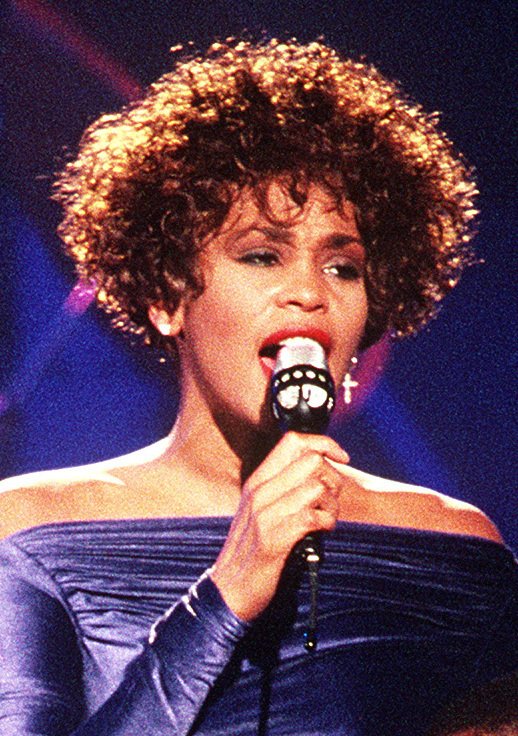
On 27 January 1991, at Tampa Stadium in Florida, Whitney Houston walked onto a football field in a white tracksuit and sang the American national anthem before Super Bowl XXV. She sang for a little over two minutes. The performance that followed is widely regarded as the greatest rendition of “The Star-Spangled Banner” ever given at a sporting event, and it has been replayed, imitated, and discussed ever since. It was not just a beautiful piece of singing, although it was certainly that. It was a performance that arrived at a moment of national anxiety, during the first days of a war, and that gave a country looking for something to hold on to a voice that sounded, for two minutes, both powerful and tender, both patriotic and deeply personal.
To understand why that performance mattered so much, it helps to remember the context. The Super Bowl, the championship game of American football, is the most watched television event in the United States, and in 1991 it took on an additional significance because of the Persian Gulf War. The United States had launched Operation Desert Storm on 17 January 1991, just ten days before the game, and the country was tense, uncertain, and, in many households, frightened for family members serving in the Gulf. Security at Tampa Stadium was at its highest level, with barricades, searches, closed airspace, and military aircraft patrolling overhead. The game itself, between the New York Giants and the Buffalo Bills, was almost secondary to the atmosphere surrounding it. The national anthem, in that setting, was not a formality. It was a moment when the entire country would be listening, and when the singer would be, for two minutes, the voice of a nation at war.
Houston was, by 1991, one of the most famous singers in the world. Born in Newark, New Jersey, in 1963, into a musical family — her mother was the gospel singer Cissy Houston, her cousin was Dionne Warwick, and her godmother was Aretha Franklin — she had grown up singing in church and had become, in the 1980s, a pop superstar with a voice of extraordinary range and control. Her debut album in 1985 and her follow-up in 1987 had produced a string of number one singles, and she was known for a vocal style that combined gospel power with pop precision. She was also, at 27, at the height of her vocal powers, with a voice that could move from a whisper to a full-throated climax without ever losing control.
How the arrangement was made
The arrangement that Houston sang in Tampa was not the traditional arrangement of the anthem. It had been created specifically for the occasion by her musical director, Rickey Minor, and the arranger and conductor John Clayton, with Houston herself credited for the vocal arrangement. The most important change was a shift in time signature, from the anthem’s traditional three-beat waltz time to a four-beat common time. That change, which sounds technical, had a profound effect on how the song felt. It slowed the tempo down, gave Houston more space to breathe within each phrase, and allowed her to shape the melody with the kind of phrasing that gospel singers use to make a familiar song sound new.
Houston had been inspired, in part, by Marvin Gaye’s celebrated rendition of the anthem at the 1983 NBA All-Star Game, which had also slowed the song down and given it a soulful, gospel-inflected feel. Houston’s version went further. She lowered the key, she took her time with the opening phrases, and she built the performance gradually, from a quiet, almost intimate beginning to a climax that seemed to fill the stadium. The Florida Orchestra, conducted by Jahja Ling, provided the accompaniment, and the arrangement’s jazz and gospel harmonies gave the familiar melody a warmth and a richness that the traditional military-band arrangement does not have.
The recording that the television audience heard was, famously, not entirely live in the conventional sense. For reasons of broadcast safety and stadium acoustics — including the noise of fighter jets flying overhead — Houston had pre-recorded her vocal in a studio session, reportedly in a single take, and on the day she sang live into a microphone that was not carrying the broadcast sound, while the stadium and television audiences heard the pre-recorded version. That fact, which became public later, led to some controversy, with some commentators arguing that the performance was therefore not genuine. Houston’s defenders, and most listeners, took a different view: the vocal that was heard was Houston’s own, recorded by her, in her own arrangement, and the performance on the field — her presence, her phrasing, her emotion — was real. The pre-recording was a practical decision, made by the NFL and by Houston’s team, to ensure that a moment of national significance would not be ruined by technical problems. It does not diminish the singing, which remains, by any measure, extraordinary.
Watch: Whitney Houston — “The Star-Spangled Banner” at Super Bowl XXV, 1991
The performance itself
When Houston took the field on 27 January, she was wearing a white tracksuit with red and blue accents and a white headband, a look that was both athletic and patriotic without being a costume. She stood in the centre of the field, with the Florida Orchestra behind her, and she sang with a stillness that was striking. She did not gesture extravagantly, she did not move around the field, and she did not try to upstage the song. She simply stood and sang, and the stadium, with more than seventy thousand people in it, fell silent.
The performance builds with remarkable control. The opening phrase, “O say can you see,” is sung quietly, almost conversationally, as if Houston is inviting the listener to look. As the song progresses, her voice grows in power and in warmth, and by the time she reaches the climax — the long, sustained notes on the words “free” and “brave” — she is singing at full power, with a clarity and a control that few singers could match. The final phrase, delivered with a flourish that seems to hang in the air, was followed by a flyover of fighter jets from a nearby air base, a moment of theatre that the NFL had planned and that, in the context of the war, felt both stirring and sobering.
The television audience in the United States was reported at 115 million people, with a worldwide audience far larger, and the response was immediate. In the days that followed, Houston’s anthem was played on radio stations across America, and Arista Records released it as a charity single, with proceeds going to soldiers and their families involved in the Gulf War. The single became the first and only recording of the national anthem to reach the American Billboard Hot 100 chart, where it peaked in the Top 20 and remained on the chart for eleven weeks. It was re-released after the attacks of September 2001, when it reached an even higher chart position, and it has remained, ever since, the standard against which all other Super Bowl anthem performances are measured.
Why it endured
It is worth asking why this particular performance, of a song that is sung at every American sporting event, has endured in a way that no other has. Part of the answer is technical. Houston’s vocal is, quite simply, one of the great recorded performances in popular music, a demonstration of breath control, pitch, phrasing, and emotional intelligence that vocal coaches still study. The arrangement, with its slowed tempo and its gospel harmonies, allows the listener to hear the anthem’s melody as if for the first time, to notice its leaps and its difficulties, and to appreciate how hard it is to sing well.
Part of the answer is also historical. The performance arrived at a moment when America needed a unifying cultural moment, and Houston, as a Black woman singing the national anthem at a time when the country was at war, embodied a particular kind of American patriotism: inclusive, emotional, and rooted in the gospel tradition that had shaped so much of American music. The image of Houston, in a white tracksuit, singing with her eyes closed and her hand over her heart, became an icon of the era, and it has been replayed at moments of national crisis ever since, most notably after September 2001.
There is also a more personal reason. Houston’s later life was marked by well-documented struggles with addiction and with the pressures of fame, and she died in February 2012 at the age of 48. The Super Bowl performance, from a time when her voice was at its peak and her career was at its height, has become, for many listeners, a reminder of what she was capable of at her best. It is a performance without irony, without artifice, and without the complications that would later cloud her public image. It is simply a great singer, singing a difficult song, beautifully, at a moment when it mattered.
Listen to Houston’s anthem today, and it is easy to be moved by it, even if you have no particular attachment to American football or to the national anthem itself. The performance works as music first, and as patriotism second, because Houston treats the song as a piece of music to be interpreted, not as a ritual to be endured. She finds the emotion in the melody, she shapes it with patience, and she delivers it with a conviction that makes the listener believe, for two minutes, in the ideals the song is supposed to represent. That is why, more than thirty years later, Whitney Houston’s Super Bowl anthem remains the standard, and why it is still, for many people, the first performance they think of when they think of her voice.
The Super Bowl performance also had a lasting effect on how the anthem itself is sung at sporting events. Before 1991, most anthem performances at major events followed a fairly standard pattern: a singer, accompanied by a band or orchestra, delivering the song in a straightforward, respectful manner, with little personal interpretation. After Houston, singers began to approach the anthem as a piece of music to be interpreted, with personal phrasing, gospel inflections, and dramatic builds, and audiences began to expect a performance rather than a formality. That shift has produced both memorable performances and, occasionally, controversial ones, when a singer’s interpretation has been seen as too idiosyncratic or too showy. Houston’s version remains the benchmark precisely because it balances interpretation and respect: it is unmistakably personal, yet it never loses sight of the song itself, and it never makes the singer more important than the anthem.
Houston’s performance also became a touchstone in discussions of American identity in the 1990s and beyond. At a time when debates about race, patriotism, and belonging were intensifying, the image of a Black gospel-trained singer delivering the national anthem with such authority offered a powerful counter to narrower definitions of American identity. It suggested, without needing to say so explicitly, that American patriotism could be expressed through gospel music, through soul music, and through the voice of a young Black woman from New Jersey, as legitimately as through any other tradition. That suggestion, made in two minutes on a football field, has resonated far beyond sports, and it is part of why the performance is still invoked in conversations about what it means to be American.
Two details about the recording itself help explain why the performance has lasted. First, according to Houston’s musical director Rickey Minor, the studio vocal that America heard on the day was recorded in a single take. Minor later recalled that Houston arrived at the session straight from screen tests, had barely heard the arrangement, listened to it once, and sang it through. Whether or not one take tells the whole story of the production, the account fits what listeners hear in the recording: a vocal that sounds decided, not assembled, with each phrase landing exactly where the arrangement needs it. Second, the arrangement itself, credited to John Clayton with Minor, did much of the emotional work before Houston sang a note. By slowing the anthem and giving it a gospel-influenced pulse, it created the space in which her voice could build gradually, from a near-conversational opening to the ringing final phrase, rather than forcing her to start at full power. The combination, a patient arrangement and a vocalist who knew how to pace herself inside it, is why the recording still sounds deliberate rather than dated.
The afterlife of the single confirms that judgement. Released as a charity single in February 1991, it reached the American Top 20 at the time, an extraordinary result for a national anthem. A decade later, after the attacks of September 2001, it was released again and climbed higher, reaching number six on the Billboard Hot 100. Few recordings are asked to carry a nation’s mood twice, in two different crises, and fewer still manage it. That the same performance could serve both moments, without being re-recorded or reworked, says something about how completely Houston and her collaborators had understood the assignment in January 1991: not to decorate the anthem, but to sing it as if every word mattered, slowly enough for a worried country to hear them.
Sources / further reading
- Wikipedia, “The Star Spangled Banner (Whitney Houston recording)” — on the 27 January 1991 Tampa performance, the Florida Orchestra, the arrangement by John Clayton and Rickey Minor, and the single’s chart history.
- Sports Business Journal, “Whitney Houston’s anthem for the ages” — on the NFL’s planning, the pre-recorded vocal, the security context of the Gulf War, and the single’s charity release.
- Pro Football Network, “Top 5 Greatest National Anthem Performances in Super Bowl History” — on the 3/4 to 4/4 arrangement change, the single’s chart peaks in 1991 and 2001, and the performance’s enduring reputation.
Image: Wendy Wei via Pexels, free licence.
Leave a Reply