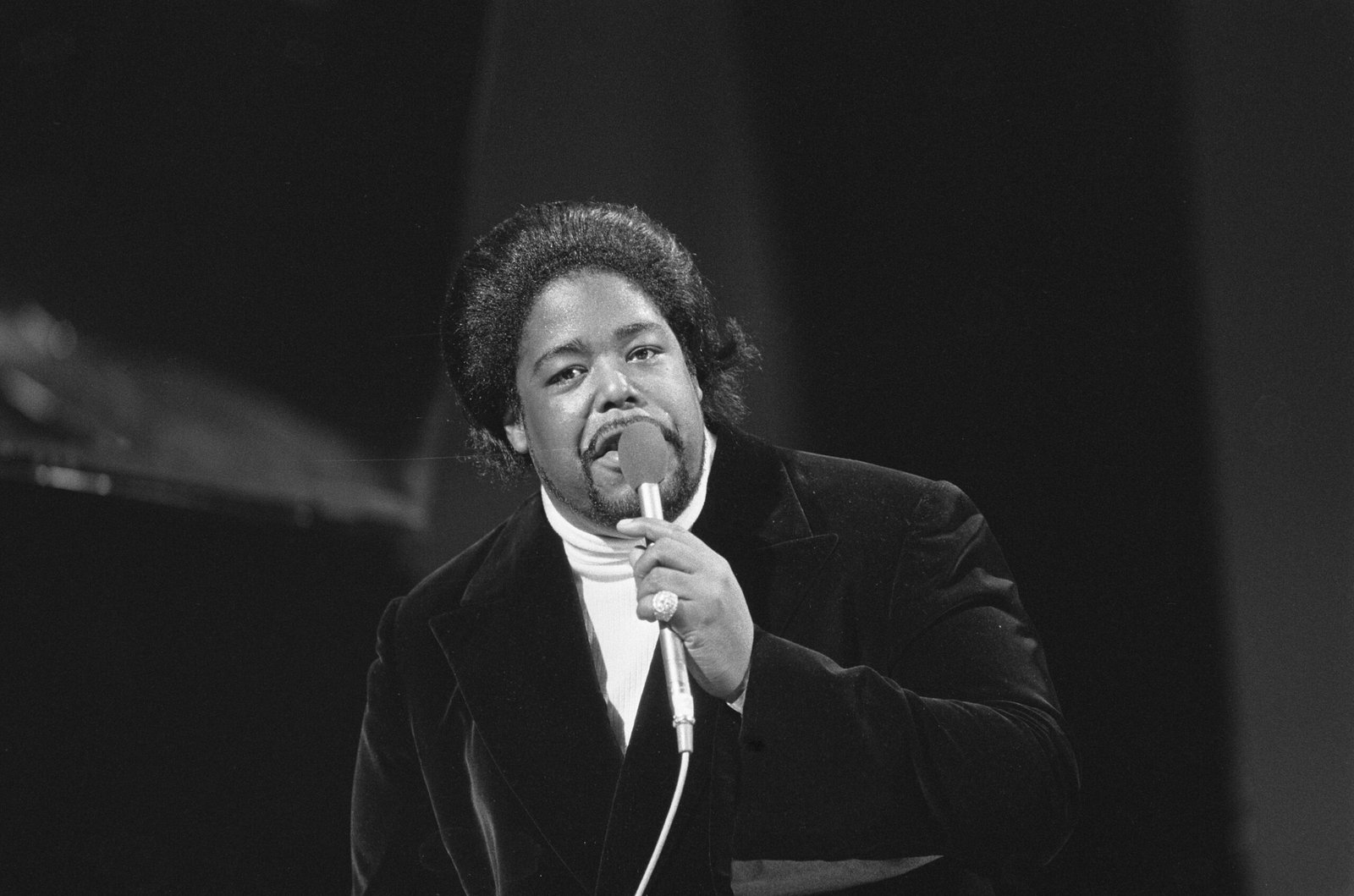
Barry White was the most self-contained hitmaker in soul music. He wrote his songs, produced his records, arranged the strings, conducted the orchestra, and then stepped to the microphone to rumble over the top of it all. Which makes the biggest record of his late-seventies comeback a genuine oddity: he didn’t write it. In August 1977, with his commercial crown visibly slipping, White released a song handed to him by two writers in his orbit, Ekundayo Paris and Nelson Pigford. He turned it into his longest-running number one on the R&B chart — and, though nobody knew it at the time, the last great pop crossover of his career.
The song was It’s Ecstasy When You Lay Down Next to Me, and its story is really two stories: how a borrowed song rescued the Maestro at the exact moment the disco era he helped invent was starting to move on without him, and how that same groove came back, twenty-three years later, to top the British charts all over again.
A Crown Beginning to Slip
Between 1973 and 1975, Barry White had seemed untouchable. His Love Unlimited Orchestra took the instrumental Love’s Theme to number one, Can’t Get Enough of Your Love, Babe topped the pop chart, and You’re the First, the Last, My Everything missed the summit by a single place. Album followed gold album. Then, quietly, the numbers began to slide.
Let the Music Play, released in January 1976, peaked at a respectable but reduced No. 42 on the pop album chart. Its follow-up, Is This Whatcha Wont?, released that November, was the real warning sign. It stalled at No. 125 on the Billboard 200 and No. 25 on the R&B albums chart — the first Barry White album ever to miss the R&B top ten. Its singles, Don’t Make Me Wait Too Long and I’m Qualified to Satisfy You, peaked at No. 20 and No. 25 on the R&B singles chart, making it his first album to produce no top-ten single at all.
The problem was not that White had lost his touch. The problem was that the music business had caught up with it. Disco, the sound White’s orchestral soul had done so much to create, was now an industry unto itself, full of younger producers working faster and cheaper. The Maestro needed a record that reminded everyone who had built the blueprint.
The Song He Didn’t Write
Almost every Barry White hit carried one writing credit: Barry White. But for his seventh studio album, White reached outside his own pen. It’s Ecstasy When You Lay Down Next to Me was written by Ekundayo Paris and Nelson Pigford, songwriters working within White’s circle, and what they brought him was a slow-burning seduction song with a title that functioned as its own advertisement.
White may not have written it, but he unmistakably made it. He produced the record himself and arranged it, which in the White universe meant everything that mattered. Out came the full machinery: the Love Unlimited Orchestra’s sweeping strings, a rhythm section locked into a deep, unhurried funk groove, the sighing backing voices — and, up front, the device nobody could imitate, White’s spoken-word seduction. Before he sang a note, he talked, low and intimate, the way he had since I’m Gonna Love You Just a Little More Baby. The talking was never decoration. It was the signature, and on It’s Ecstasy it turned somebody else’s composition into a Barry White record within seconds.
The album version ran nearly seven minutes, a full-length seduction suite built for the hi-fi and the dance floor alike. For the single, the performance was edited down to about three and a half minutes and released in August 1977 as the lead single from the album Barry White Sings for Someone You Love, which arrived on August 30. The B-side was I Never Thought I’d Fall in Love with You.
Five Weeks at Number One
The single’s chart run was a slow burn worthy of the song itself. It entered the Billboard Hot 100 on August 20, 1977, way down at No. 86, and climbed for months. On the R&B chart, there was nothing slow about it: through October, It’s Ecstasy When You Lay Down Next to Me sat at number one for five consecutive weeks, becoming the longest-running R&B chart-topper of White’s entire career — longer than Can’t Get Enough, longer than I’m Gonna Love You Just a Little More Baby, longer than any of them.
On the pop chart, it spent two weeks at No. 4 in November. The only thing between Barry White and another number one that autumn was one of the most immovable blockbusters of the decade: Debby Boone’s You Light Up My Life, which was in the middle of a then-record ten-week reign at the top. The song also reached No. 5 on Billboard’s disco chart, proof that White could still command the dance floor he had helped build, while in Britain it managed a modest No. 40 — a footnote that would become ironic later.
The album rode the single back to the summit. Barry White Sings for Someone You Love topped the R&B albums chart, White’s first number one there since 1975 and his fifth overall, and reached No. 8 on the Billboard 200, his best pop showing since Can’t Get Enough had hit number one in 1974. It went platinum, and it kept giving: Playing Your Game, Baby climbed to No. 8 on the R&B chart, and Oh, What a Night for Dancing reached No. 24 on the pop chart in early 1978. After the alarming slump of Is This Whatcha Wont?, the comeback was complete.
The Last Great Crossover
What nobody could have known in the autumn of 1977 was that It’s Ecstasy When You Lay Down Next to Me was a farewell as well as a comeback. It was White’s sixth top-ten hit on the Hot 100 — and his last. He would place records on the R&B chart for years to come, and he would enjoy a full-scale renaissance in the 1990s, but the pop top ten never opened its doors to him again.
That gives the record a particular poignancy in his catalogue. It is the final statement of the imperial-phase Barry White: the orchestra at full stretch, the groove at its deepest, the voice at its most confident, deployed — for once — in the service of another writer’s song. The most self-sufficient man in soul bowed out of the pop elite with a hit he had been given rather than one he had made from nothing, and it made no difference at all. The song is remembered, unmistakably, as his.
The Groove That Wouldn’t Die
Most disco-era hits lived out their days on oldies radio. This one went back to work. In 2000, British pop star Robbie Williams and his songwriting partner Guy Chambers, working with producers Kelvin Andrews and Danny Spencer, built Williams’ new single around the strings and groove of It’s Ecstasy When You Lay Down Next to Me. The result was Rock DJ, released on July 31, 2000, as the lead single from the album Sing When You’re Winning.
Rock DJ became Williams’ third UK number one and one of the biggest British singles of the year, its notorious video — in which Williams strips down to a dancing skeleton — winning British Video of the Year at the 2001 Brit Awards, where the song itself was named British Single of the Year. And there, in the writing credits of a millennial pop smash, sat two names from 1977: Nelson Pigford and Ekundayo Paris, collecting co-writer royalties on a number one record twenty-three years after Barry White turned their composition into a classic.
It is the perfect ending to the song’s story. It’s Ecstasy When You Lay Down Next to Me began as an act of trust — the great auteur of soul handing his voice to somebody else’s material at the moment he most needed a hit. It saved his crown in 1977, held the R&B chart longer than any record he ever made, and then, a generation later, it seduced an entirely new audience that had never heard Barry White’s name attached to it. The Maestro always insisted the secret was in the groove. On this record, the groove outlived everything.
Leave a Reply