Voice, Guitar, and Truth: How a Dying Bob Marley Wrote “Redemption Song”
On the night of September 23, 1980, at the Stanley Theatre in Pittsburgh, Pennsylvania, a thin and visibly weary Bob Marley walked to the front of the stage, sat down on a stool, and did something he had almost never done in his career. He sent the band away. Alone, with only an acoustic guitar, he played the last song of the night — a song most of the audience had never heard, the closing track of his new album “Uprising.” He sang it the way a man testifies: “Won’t you help to sing these songs of freedom? ‘Cause all I ever have are redemption songs.”
Two days earlier, Marley had collapsed while jogging in New York’s Central Park. The blackout, doctors would soon confirm, had been caused by a tumor in his brain. The cancer that had started under his toenail three years before had spread to his lungs, his liver, and his brain. He had, by some accounts, been given weeks to live. He played anyway. The Pittsburgh show would be the last concert of his life. “Redemption Song” would be the last song he ever performed in public — and, released as a single the following month, the last single released in his lifetime.
It is the starkest recording Bob Marley ever made: no drums, no bass, no horns, no harmonies — just his voice and his guitar, three minutes and forty-seven seconds, in the key of G. After a career built on the full, rolling power of the Wailers, after anthems that filled stadiums, Marley stripped everything away until only the essential remained. The words he sang weren’t entirely his own; the most famous lines had been spoken forty-three years earlier by Marcus Garvey in a drafty hall in Nova Scotia. But the reckoning in them — with slavery, with mortality, with what a man leaves behind — was Marley’s alone. This is the story of “Redemption Song”: the wound, the prophet’s words, and the dying man who turned them into a farewell.
The Wound Under the Toenail
The beginning of the end announced itself as something trivial. In 1977 — the year after the attempt on his life in Kingston, the year of the “Exodus” album recorded in London exile — Bob Marley injured his foot playing football, the game he loved with a passion that matched his music. Beneath the nail of his right big toe, a dark spot appeared. He assumed it was a bruise from the injury, the kind of thing an athlete ignores. It wasn’t a bruise.
In July 1977, doctors examined the lesion and delivered the diagnosis: melanoma — and not just any melanoma, but acral lentiginous melanoma, a rare and aggressive form of skin cancer that grows on the palms, the soles, and under the nails. The recommended treatment was stark: amputate the toe, and with it, the cancer’s foothold. Marley refused. His Rastafarian faith taught that the body is a temple that must not be altered or cut — “the body is the temple,” as the belief holds — and amputation was, to him, unthinkable. The doctors removed the nail and the nail bed instead, a compromise, and Marley went back to work as if the matter were settled.
It wasn’t settled. The cancer was already moving, invisibly, through his body. For the next three years, Marley did what he had always done: he recorded, he toured, he preached. He made “Kaya” in 1978. He made “Survival” in 1979. He played the Amandla Festival. He filled his days with music and his nights with the company of friends and family, and he told almost no one how much pain he was in. Rita Marley would later say he was already suffering badly while he wrote the song that would become his farewell — that “Redemption Song” was where he confronted his own mortality, privately, before he confronted it publicly.
There is a particular cruelty in the timeline. The melanoma might have been curable if it had been caught early and treated aggressively — if the toe had come off in 1977. Instead, the disease metastasized with a slowness that must have felt, to Marley, like a reprieve, and then with a suddenness that felt like an ambush. By the time he collapsed in Central Park in September 1980, the cancer had colonized his lungs, his liver, and his brain. The spot under the toenail had become a map of his dying. But before any of that — before the collapse, before the final tour, before the world knew — there was the song, written circa 1979, while the diagnosis hung over him like weather.
Garvey’s Words
The most quoted lines in “Redemption Song” were not written by Bob Marley. They were spoken in October 1937, in Menelik Hall in Sydney, Nova Scotia, by Marcus Garvey — the Jamaican-born Pan-Africanist whose philosophy of Black nationalism and empowerment had provided the ideological foundation of the Rastafari movement itself.
Garvey was near the end of his own road by then, a diminished figure living in London, touring the remnants of his movement. The address he gave that night was later published under the title “The Work That Has Been Done” in his magazine, the Black Man. And in it, he said the words that would outlive him by nearly a century: “We are going to emancipate ourselves from mental slavery because whilst others might free the body, none but ourselves can free the mind.” He went on: “Mind is your only ruler, sovereign. The man who is not able to develop and use his mind is bound to be the slave of the other man who uses his mind.”
Marley folded Garvey’s sentence almost word for word into his chorus: “Emancipate yourselves from mental slavery, none but ourselves can free our minds.” He had been carrying Garvey with him for years — reciting the prophet’s words in public, steeped in a movement that regarded Garvey as a forerunner of Haile Selassie himself. And the song’s title, too, reaches back to Garvey: his 1923 book, “The Philosophy and Opinions of Marcus Garvey,” opens with a dedication to the members of the Universal Negro Improvement Association “in the cause of African redemption.” It is widely believed that Marley took the song’s name from that dedication — from the Garveyist goal of redemption itself.
Consider what Marley was doing. He was taking a political speech from 1937 — a call for mental emancipation delivered to a fading movement in a Canadian mining town — and setting it to a folk melody, in the voice of a dying man, at the end of the twentieth century. He wasn’t borrowing a slogan. He was completing a circuit: Garvey’s words about freeing the mind, carried across four decades, landing in the mouth of a Jamaican singer who was running out of time and knew it. The past wasn’t past. It was instructions.
The Prophet He Carried
To understand why Garvey’s words were in Marley’s mouth, you have to understand what Garvey was to Marley. Marcus Garvey — born in St. Ann’s Bay, Jamaica, in 1887 — was the founder of the Universal Negro Improvement Association and the great prophet of Pan-Africanism, the man who taught that Black people must look to Africa, build their own institutions, and free their own minds. By the time Marley was born in 1945, Garvey had been dead five years. But in Jamaica, Garvey’s ideas had taken on a second life: they became one of the ideological foundations of the Rastafari movement, which revered Garvey as a forerunner — the John the Baptist to Haile Selassie’s messiah, the man who had prophesied “look to Africa, when a Black king shall be crowned.”
Marley didn’t just admire Garvey; he carried him. He had been reciting Garvey’s words in public for years — quoting the prophet on stage, weaving the philosophy into interviews and lyrics alike. The dedication in Garvey’s 1923 book, “The Philosophy and Opinions of Marcus Garvey” — “to the true and loyal members of the Universal Negro Improvement Association in the cause of African redemption” — named the very goal Marley set for his music. When Marley titled his song “Redemption Song,” he was planting his flag in Garvey’s cause, in the language Garvey himself had consecrated more than half a century earlier.
This is what makes the borrowing so much more than a quotation. Garvey’s 1937 speech was delivered to a fading movement in a Canadian mining town, by a man near the end of his road. Marley’s song was written by a man near the end of his own road, carrying a terminal diagnosis. The words passed from one dying prophet to another across forty-three years — from Menelik Hall to Tuff Gong Studios — and each man, in his final chapter, was saying the same thing: the body can be chained, but the mind is yours to free. Garvey gave Marley the sentence. Marley gave it a melody, and in doing so, gave it immortality.
The Song Arrives
“Redemption Song” was written circa 1979 — the year of the “Survival” album, the year Marley was touring the world as reggae’s undisputed king, the year almost nobody outside his inner circle knew he was dying. Think about that dissonance for a moment. On stage, he was incandescent: the dreadlocks flying, the Wailers locked into those rolling grooves, tens of thousands of people moving as one body. Off stage, he was a man in his mid-thirties living with a terminal diagnosis, in pain that he hid with the discipline of a man who had been performing since childhood.
Rita Marley’s recollection is the key that unlocks the song: he was already suffering while he wrote it, and the song is where he dealt with his own mortality. You can hear that reckoning in every line. The opening verse reaches back to the slave ships — “Old pirates, yes, they rob I / Sold I to the merchant ships” — and then pivots, without warning, to the present tense of the mind: “But my hand was made strong / By the hand of the Almighty.” The song moves between history and eternity the way dying people do, the past suddenly vivid, the future suddenly narrow, the present reduced to what matters.
What makes “Redemption Song” different from everything else Marley wrote is what it leaves out. There is no Babylon to burn here, no political program, no call to arms. The revolution it proposes is interior: free your mind, and the rest will follow. It’s the most personal song he ever wrote and the most universal — a dying man’s advice to the living, which is also, not coincidentally, the oldest kind of song there is. He had spent his career speaking for a movement. Now he was speaking for himself, and it turned out the two were the same.
Uprising
Between January and April 1980, Marley and the Wailers recorded the album that would become “Uprising” at Tuff Gong Studios in Kingston, Jamaica, with Marley and Island Records founder Chris Blackwell sharing production duties. It was the band’s twelfth studio album, and it would be the last released in Marley’s lifetime. Island put it out on June 10, 1980 — and on the very day it reached the shops, Marley and the Wailers were in Munich, opening for Fleetwood Mac before 69,000 people at the Reitstadion. The machine was still running at full speed. The body inside it was failing.
“Uprising” is, by most accounts, a deeply spiritual record — hymns to Jah, meditations on the conflict between the sacred and the secular, the sound of a man sorting his accounts. And then, at the very end, after all the full-band fire, comes the departure: “Redemption Song,” the closing track, three minutes and forty-seven seconds long, in the key of G, produced by Marley himself. Unlike almost every other track he ever recorded, it is strictly a solo acoustic performance — Marley’s voice and his acoustic guitar, no accompaniment whatsoever. No drums. No bass. No I Threes on harmony. Just the man and the instrument, the way he must have first played it alone in a room, working out whether the song was true.
The placement is everything. Albums are arguments, and the last track is the conclusion. After an entire career of building bigger sounds — after the Wailers’ wall of rhythm, after the stadium years — Marley chose to end his final album with the smallest sound he could make. It’s as if he were stripping away everything that stood between him and the listener: the band, the groove, the production, the persona. What’s left is what was always there underneath — the voice, the guitar, and the truth. The folk form was deliberate, too; the song’s architecture echoes the great acoustic protest songs, the tradition of a lone singer with a guitar telling the unvarnished thing. Marley, the reggae revolutionary, was reaching past reggae to something older and more elemental.
The album’s other single, “Could You Be Loved,” was the hit — bright, danceable, destined for the dance floor. “Redemption Song” was something else: not a single at first, not a bid for the charts, just the last word on the record. It would become a single soon enough. But in June 1980, it was simply the end of the album — and, though no one knew it yet, the end of something much larger.
The Folk Song in a Reggae Catalog
Musically, “Redemption Song” is an act of renunciation — and the details matter. The recording runs three minutes and forty-seven seconds, in the key of G, and it is, as every account agrees, strictly a solo acoustic performance: Marley’s voice and his guitar, with no accompaniment of any kind. No drums, no bass, no keyboards, no backing vocals. Marley produced it himself. In a catalog built on the communal thunder of the Wailers — on bass lines you feel in your chest and harmonies stacked like bricks — the bareness is shocking. It’s the sound of a man walking away from everything he knew how to do, toward the one thing he had to do.
The form he chose was folk — the oldest protest-song architecture there is, the tradition of the lone singer with a guitar telling the unvarnished truth. Critics have long noted the echo of Bob Dylan’s songcraft in its bones: the plainspoken verses, the moral weight carried lightly on a simple chord progression, the sense that the song could have been written a hundred years ago or yesterday. For Marley, the reggae revolutionary, to reach past reggae to folk was itself a statement. Reggae was the sound of the movement; folk was the sound of the individual conscience. And this was, finally, an individual song — not the Wailers’ song, not Jamaica’s song, not the movement’s song, but one man’s.
There’s a discipline in the simplicity. Every reggae singer of Marley’s stature knew how to fill a track — how to let the groove carry a weak line, how to hide behind the band’s power. “Redemption Song” permits no hiding. The guitar part is almost rudimentary, a fingerpicked pattern that leaves enormous space around the vocal, and into that space Marley pours everything: the history of the slave ships, Garvey’s philosophy, his own dying. The spareness isn’t a lack of arrangement. It’s the arrangement — the decision that nothing should stand between the words and the listener, because the words were running out of time.
The Collapse
The Uprising tour was supposed to be a triumph — Marley’s biggest American run yet, the victory lap of a man at the peak of his powers. The band opened the American leg at the Hynes Auditorium in Boston on September 16, 1980, and then came the centerpiece: two nights at Madison Square Garden, September 19 and 20, co-headlining with the Commodores. It was a strange pairing on paper — Lionel Richie’s smooth soul machine alongside Marley’s righteous fire — but the New York Times reviewer, by all accounts, was left in no doubt about who had won the night. Marley was, that weekend, untouchable.
The next day, he went for a jog in Central Park. What happened there is now part of the legend, and the facts are stark enough without embellishment. On September 21, 1980, Marley suffered a seizure and collapsed on the path. He was rushed to the hospital, and the examination revealed the cause of the blackout: a tumor in his brain. Further tests — including work at New York’s Memorial Sloan Kettering Cancer Center — confirmed what the collapse had announced: the melanoma that had begun under his toenail in 1977 had metastasized throughout his body, spreading to his lungs, his liver, and his brain. One physician at Sloan Kettering reportedly remarked that Marley had an unprecedented amount of cancer. The prognosis was measured in weeks.
He had a show in two days. The tour — the crew, the dates, the fans, the machine — was already in motion. And Marley, thin and weak and carrying a death sentence in his charts, made the decision that defines him as surely as any song: he would play.
Pittsburgh
On September 23, 1980 — two days after the collapse — Bob Marley walked onto the stage of the Stanley Theatre in Pittsburgh, Pennsylvania. The rest of the tour would be cancelled after this night; everyone around him knew the American run was over. But for one more evening, the show went on. Marley gave everything he had left, and then, at the end of the night, he did the thing he had almost never done: he sat down alone, with an acoustic guitar, and sang “Redemption Song.”
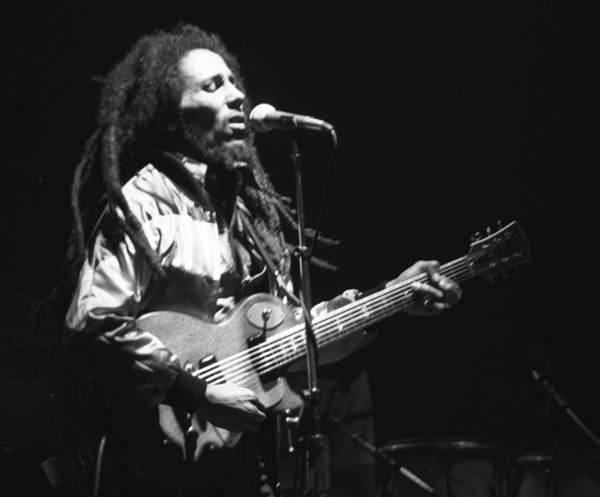
Picture it. The full band has played its last full set. The lights narrow. A dying man on a stool, his famous dreadlocks already thinning under the weight of illness and treatment, his voice carrying what one account called a haunting resonance — melancholy and hope in the same breath. He plays the song the way it was recorded: no accompaniment, no safety net, just the folk-simple guitar figure and the words. “Emancipate yourselves from mental slavery.” “Won’t you help to sing these songs of freedom?” The audience at the Stanley that night didn’t know what they were witnessing. Almost no one in that room knew he was dying. They were watching a man give his final testimony, and they thought it was just a beautiful encore.
It was the last song Bob Marley ever performed in public. The tour was cancelled. The machine stopped. What remained was the reckoning — with doctors, with treatments, with the few months he had left — and the song, already recorded, already released on “Uprising,” waiting for the world to understand what it was.
The Last Single
“Redemption Song” was issued as a single in October 1980 — October 7, by the record books — the last single released while Bob Marley was still alive. There’s a terrible poignancy in the timing. The single went out into the world as its singer was disappearing from it: no tour to support it, no performances, no interviews, just the record — the voice and the guitar — making its own way. It didn’t need him. That was the point he had been making all along: none but ourselves can free our minds. The song was now on its own, and it would do the work.
Marley, meanwhile, was fighting. After the Pittsburgh show, he sought treatment at specialist clinics — in New York, in Miami, in Mexico — and then, as the conventional options ran out, he turned to the clinic of Dr. Josef Issels in Rottach-Egern, Bavaria, Germany, for an experimental naturopathic approach to his cancer. He spent months there, through the winter and into the spring of 1981, while the disease continued its advance. His body weakened; even the dreadlocks, the crown he had worn his whole adult life, became a burden. He fought for eight months past a prognosis of weeks — eight months of borrowed time, spent in the stubborn, disciplined way he had spent everything.
The Long Goodbye
What followed Pittsburgh was eight months of borrowed time — eight months past a prognosis measured in weeks, fought with the same discipline Marley had brought to everything. He sought treatment wherever hope was offered: at Memorial Sloan Kettering in New York, where he underwent radiation therapy to try to reduce the tumors in his lungs and liver; at specialist clinics in Miami and Mexico; and finally, when the conventional options were exhausted, at the clinic of Dr. Josef Issels in Rottach-Egern, Bavaria, Germany, where he pursued an experimental naturopathic approach through the winter of 1980 and into the spring of 1981.
It didn’t work, and those around him watched the strongest man they knew diminish. His body weakened steadily; even his dreadlocks — the crown he had worn for his entire adult life, the visible sign of his covenant — became a physical burden. But he kept fighting, in his way, on his terms. The man who had refused to let surgeons take his toe in 1977 was not going to surrender quietly now. He had spent his career singing about freedom; he spent his final months practicing it, choosing his own path through the dying the way he had chosen everything else.
In May 1981, he decided to go home. He boarded a flight from Germany bound for Jamaica — for his country, for rest, for whatever remained. His condition deteriorated in the air. The plane made an emergency landing in Miami, and Marley was taken to Cedars of Lebanon Hospital. On May 11, 1981, at the age of 36, Bob Marley died — eleven months after “Uprising” reached the shops, less than eight months after that night in Pittsburgh. Jamaica gave him a state funeral on May 21, combining Ethiopian Orthodox and Rastafari tradition, for a man who belonged to both and to neither, entirely.
The Song That Outlived Him
“Redemption Song” did what Marley asked of it: it went on singing. In 2004, Rolling Stone placed it at number 66 on its list of the 500 Greatest Songs of All Time — one of the highest positions ever given to a recording made by a single voice and a single guitar. The Jamaican poet and dub artist Mutabaruka has called it the most influential song in Jamaican history. It has been covered, quoted, and carried into protests and classrooms and churches on every continent, the way Garvey’s words were carried before it — from a hall in Nova Scotia in 1937, to a studio in Kingston in 1980, to everywhere.
The song’s power is inseparable from the circumstances of its making, and that is both its glory and its ache. We can’t hear it now without hearing the dying man in it — without knowing that the voice asking us to sing songs of freedom belonged to someone who had only months to live, that the guitar was played by hands already marked by the disease that would kill him. But that knowledge doesn’t diminish the song; it completes it. “Redemption Song” is not a performance of wisdom. It’s the thing itself: a man facing the end, refusing despair, and leaving instructions.
Marley once sang, in that final chorus, “all I ever have are redemption songs” — as if apologizing for the poverty of the offering, as if a guitar and the truth were not enough. He was wrong, and the decades have proven it. The stadiums are empty now. The tours are over. The Wailers’ great rolling grooves belong to history. What remains, what always remains, is the smallest sound he ever made: a voice, a guitar, and a question first asked by Marcus Garvey in 1937 and answered by Bob Marley in 1980. Emancipate yourselves from mental slavery. None but ourselves can free our minds. He sang it dying, so that we might hear it living.
Leave a Reply