Written in Rage: The Night Ann Wilson Turned a Sleazy Insult into “Barracuda”
It starts with a guitar riff that sounds like a horse at full gallop — a chugging, muted-string charge that erupts, stops dead, erupts again. Then a voice, raw and furious, spits out the opening line: “So this ain’t the end, I saw you again today.” From the first seconds of “Barracuda,” you can hear that this is not a song written for fun. It is a song written for revenge.
This is the story of how one of the greatest hard-rock anthems of the seventies was born out of one of the ugliest moments in the music business — a sleazy publicity stunt, a backstage insult, and a night in a hotel room when Ann Wilson of Heart sat down with a pen and let her rage do the writing.
The Sisters Who Wouldn’t Play the Game
To understand “Barracuda,” you have to understand what Heart was up against in 1976. The band, fronted by sisters Ann and Nancy Wilson, had come roaring out of the Pacific Northwest with their debut album, Dreamboat Annie. Released in Canada in September 1975 and in the United States the following year, the record was a slow-burning phenomenon. “Magic Man” climbed to number 9 on the Billboard Hot 100, “Crazy on You” reached number 35, and the album itself peaked at number 7 on the Billboard 200, eventually selling more than a million copies.
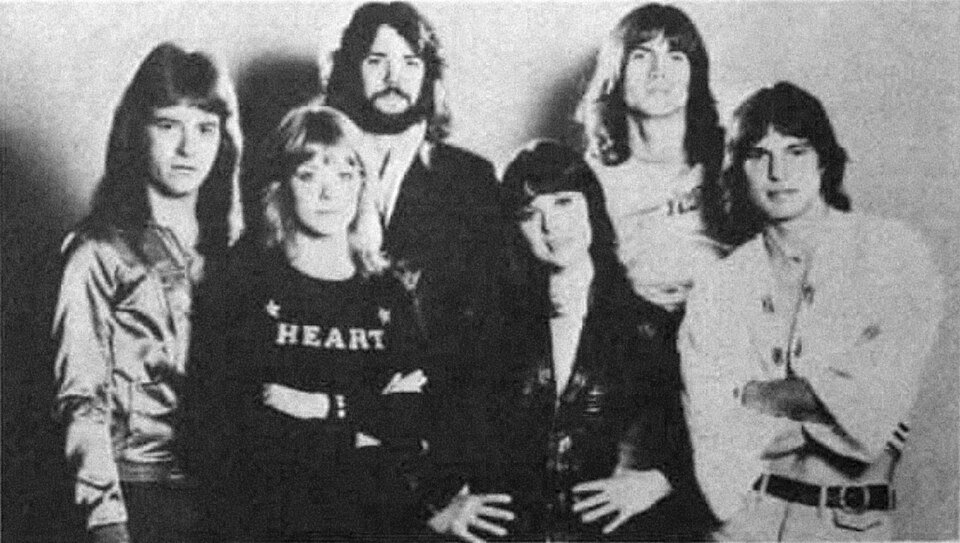
Heart was that rarest of seventies things: a hard-rock band fronted by women who played their own instruments, wrote their own songs, and refused to be anyone’s decoration. Ann Wilson had one of the most powerful voices in rock — a full-throated instrument that could wail like Robert Plant and ache like a blues singer in the same verse. Her younger sister Nancy was a guitarist of genuine ferocity, whose acoustic intro to “Crazy on You” remains one of the most dazzling displays of fingerpicking in rock history. Together with lead guitarist Roger Fisher, guitarist and keyboardist Howard Leese, bassist Steve Fossen, and drummer Michael Derosier, they had built a sound that mixed folk delicacy with Led Zeppelin thunder.
But success in the seventies music business came with a price, and for two young women in a rock band, the price was being treated as a novelty. Radio programmers didn’t know what to do with them. Interviewers asked about their clothes instead of their chords. And their record label, the small Canadian outfit Mushroom Records, had decided that the best way to sell Heart was not the music at all — it was the sisters.
Two Sisters, Two Fishers
The Wilson sisters hadn’t planned on becoming a rock band at all — certainly not in Canada. Ann Wilson, born June 19, 1950, in San Diego, grew up with her younger sister Nancy in a musical, peripatetic family — their father was a Marine Corps officer — before the family settled in the Seattle suburbs. After graduating from Sammamish High School in Bellevue, Washington, Ann sang with several Seattle bar bands until she answered a local ad: a band founded by guitarist Roger Fisher and bassist Steve Fossen, then calling itself White Heart or Hocus Pocus depending on the week, needed a lead singer. Ann auditioned. She was hired on the spot.
Then came Mike Fisher — Roger’s older brother, a Vietnam-era draft dodger who had slipped out of a rear window when his home was raided and escaped to Vancouver, British Columbia. On a clandestine visit back across the border to see the band play, Mike met Ann. It was, as Nancy later put it, the moment “she and Michael fell in love.” Ann followed Mike back to Vancouver, where they lived together on a hippie commune. One by one, the rest of the band followed — Steve Fossen finished college, Roger crossed the border — and the group set up shop in Canada, with Mike as their manager.
Ann’s song “Magic Man,” Heart’s first big hit, is about Mike Fisher and the beginning of that relationship — written by a young woman who had run off to another country for love and wasn’t about to apologize for it.
Nancy, meanwhile, had stayed behind to finish high school and then college, where she majored in art and German literature and played solo gigs around Seattle. In 1974 she quit college, moved to Vancouver, and joined the band — which was then renamed Heart. It didn’t take long for the second Fisher brother to fall for the second Wilson sister: Nancy and Roger Fisher became a couple, and Roger liked to call the arrangement “the Heart Partnership” — two couples, one band, everything intertwined.
With producer Mike Flicker, the band recorded its debut album, Dreamboat Annie, at Can-Base Studios in Vancouver (later renamed Mushroom Studios). By 1975, the classic lineup was set: Ann on lead vocals and flute, Nancy on rhythm guitar and vocals, Roger Fisher on lead guitar, Howard Leese on guitar and keyboards, Steve Fossen on bass, and Michael Derosier — who joined as the full-time drummer — behind the kit. It was this band, bound together by blood, love, and volume, that Mushroom Records would try to tear apart.
The Sleaziest Ad in Rock History
In 1977, Mushroom Records took out a full-page advertisement in Rolling Stone magazine. It was designed as a spoof of the National Enquirer, and it featured a photograph of Ann and Nancy Wilson, bare-shouldered and back to back — an outtake from the Dreamboat Annie cover sessions. The caption read: “It was only our first time!”
The implication was unmistakable and entirely fabricated: that the Wilson sisters were lesbian lovers, and that buying a Heart record was buying a ticket to that fantasy. It was, as Ann Wilson would later tell Rolling Stone, “a funny, badass sales technique” to the Mushroom executives — but to her and Nancy, raised by a feminist mother, it felt like a violation.
“That pissed us off. It went against everything we were trying to initiate, trying to invent — and the fact that our first time in [Rolling Stone] had that lascivious implication,” Ann told the magazine nearly forty years later. “For [this promoter] to imagine us together in an incestuous lesbian relationship — the sleaze factor really dawned on me in that moment.”
The ad didn’t just offend the sisters. It poisoned the well. Once the rumor was in circulation, every sleazy corner of the industry felt licensed to repeat it, each retelling more vulgar than the last.
“How’s Your Lover?”
The breaking point came on the road. According to the Wall Street Journal’s “Anatomy of a Song” feature, pieced together from interviews with the band in May 2019, the key incident happened on October 15, 1976, in East Lansing, Michigan, where Heart was opening for Bob Seger and the Silver Bullet Band. Other accounts place a similar encounter in Detroit. The details vary slightly; the sting of it does not.
After the show, at the after-party, a record promotion man — described in one account as “a real sleazeball with a satin jacket” — approached Ann Wilson and asked, with a smirk, “How’s your lover?”
Ann assumed he was asking about her boyfriend, Mike Fisher — Roger Fisher’s brother, who was Heart’s manager and sound engineer. She pointed toward him. The promoter’s smirk widened. “No,” he said. “Your sister.”
Ann Wilson has told the story more than once, and her fury has never cooled. In an interview with Dan Rather, she recalled: “Some really sleazy guy came up to me and implied to me that he was really turned on by the fact that me and Nance were lesbian ancestral lovers. That just really got him going in his fantasy, yeah. That made me so mad because I love my sister. Suddenly, my mother’s face, you know, came right up saying, ‘Don’t get into show business. It’s so tacky, full of sleazy people that are going to misunderstand you.’”
She thought her mother was right. “It made me really angry, especially because I felt that they had attacked [Nancy’s] honor,” Ann said. “So, I went and wrote the words to ‘Barracuda.’ I just think, if I would have had a gun, I might have reacted differently to the guy. But thank goodness I didn’t.”
She didn’t have a gun. She had something better: a pen, a hotel room, and a voice that could strip paint.
The Night the Lyrics Wrote Themselves
Ann stormed away from the party, rode the elevator up to her hotel room, and did what songwriters do when the world gives them something unforgivable — she wrote it down. And then she kept writing.
“I had never written lyrics so quickly,” she later wrote in Kicking and Dreaming, the memoir she co-wrote with Nancy. “We didn’t even know the meaning of the word ‘misogyny’ at the time, but we felt it loud and clear, and reacted with anger.”
The lyrics that poured out that night were not a love song and not a breakup song. They were an indictment — of the promoter, of the label, of an entire industry that looked at two brilliant musicians and saw only bodies to market. “You lying so low in the weeds / Bet you gonna ambush me,” Ann wrote, and the image is perfect: the music business as a swamp, its predators hiding in the reeds. “The real thing don’t do the trick, no / You better make up something quick / You gonna burn, burn, burn, burn, burn it to the wick / Ohh, barra-barracuda.”
And then the bridge, the strangest and most poetic passage in the song, which Ann and Nancy worked out together: “‘Sell me, sell you,’ the porpoise said / Dive down deep now to save my head, you / I think that you got the blues too.” It reads like a fever dream, but the meaning is clear enough — everybody in this business is for sale, everybody is drowning, and the only honest thing left is the blues.
It’s worth pausing on what the “barracuda” actually is, because the song has been misunderstood for decades by listeners who assume it’s about a bad boyfriend or a predatory woman. The Wilson sisters settled the question themselves in 2008, in the statement they issued about the song’s political misuse: “‘Barracuda’ was written in the late ’70s as a scathing rant against the soulless, corporate nature of the music business, particularly for women. The ‘barracuda’ represented the business.” The fish is the industry — sleek, smiling, circling, with teeth. Every “you” in the lyric is aimed at the men who ran it: the label executives who placed the ad, the promoter with the smirk, the whole machinery that looked at two musicians and saw meat.
Musically, the song is as cunning as its lyrics. Ann noted in her memoir that “Barracuda” has “a crazy bar-of-five” — an odd rhythmic hiccup buried in the gallop that makes the song lurch unexpectedly. “If you were dancing to it, it suddenly shifted, and you had your good foot in the air.” It’s a small compositional act of aggression, a tripwire in the groove — the musical equivalent of the lyrical sucker punch. Nothing about this song sits still or behaves. That was the point.
“Those lyrics were written by my true nature, in true rage,” Ann told Rolling Stone in a 2018 interview, connecting the song to the #MeToo movement. “It went on in 1977, and it still goes on now.”
Nancy came back to the hotel that night and found her sister mid-eruption. Her anger mixed with Ann’s. She supplied melodies and helped shape the bridge. The song, in that hotel room, was essentially born whole — lyrics, melody, and fury in a single sitting.
A Riff Is Born at Soundcheck
But “Barracuda” needed a musical body to carry those words, and that body had been born separately, weeks earlier, in the most unglamorous place imaginable: a soundcheck.
Roger Fisher, Heart’s lead guitarist, and drummer Michael Derosier had a habit of arriving early and jamming while the crew set up the gear. “We’d get down, shred, while they were setting up the gear,” Fisher recalled. “We were locked in that gallop mode.” What they were playing was a chugging, muted-string riff — part Buddy Holly’s “Peggy Sue,” part the theme from the TV western Bonanza — a rhythm that surged forward like a racehorse and then stopped on a dime.
Mike Fisher, Roger’s brother and the band’s manager, happened to be listening. “That’s a pretty good riff,” he said. “You should make a song around that.” Somebody hit record on a cassette player, and the gallop was captured — a seed waiting for the right soil.
The seed had roots, too. In March 2019, Nancy Wilson told the music interview show Gear Factor that the riff owed a debt to a band Heart had toured with in Europe: Nazareth, the Scottish hard-rockers who had scored a hit covering Joni Mitchell’s “This Flight Tonight” in 1973. “We’d been opening for a band called Nazareth in Europe,” Nancy said, “and Nazareth had a hit with a Joni Mitchell song that they covered called ‘This Flight Tonight’ that had kind of that riff. So we kind of borrowed that. And we made it into ‘Barracuda.’”
Borrowed is the polite word. Nancy admitted the Nazareth guys were not thrilled. “We saw the guys from Nazareth later, and they were pissed. ‘You took our riff!’” she laughed. “But that’s kind of what everybody does. You borrow from what you love, and then you make it your own.”
Drummer Michael Derosier confirmed the influence in the Wall Street Journal interviews, citing the feel of Nazareth’s cover as an inspiration for his own galloping beat. And in Kicking and Dreaming, Ann tells the story of Nazareth’s guitarist Manny Charlton cornering the band in their dressing room after a show and “gently, but tersely” suggesting they had ripped off the gallop. Ann’s reply was magnificent: she told Charlton they were “channeling Led Zeppelin,” who had stolen it from Joan Baez’s “Babe, I’m Gonna Leave You,” who had taken it from the bluesmen, who had taken it from “drummers in Kenya, who had taken it from gypsies, who had learned it from Adam. And Adam got it from Lilith. She got it from the horses.” That, she wrote, shut him up.
In the spring of 1977, the pieces came together. Ann’s hotel-room lyrics met Fisher and Derosier’s soundcheck gallop, Nancy added her melodies and the bridge, and “Barracuda” — credited to all four — became a song.
The “Alien Attack”
Recording “Barracuda” was its own adventure. The band cut the track in the spring of 1977 at Kaye-Smith Studios in Seattle with producer Mike Flicker, the man who had produced all of Heart’s early records. Flicker understood the band’s twin engines — Ann’s voice and the guitars — and he knew how to capture both at full roar.
The most famous moment of the session was a complete accident, courtesy of Roger Fisher’s restless experimentation. Fisher had been playing with feedback and effects, and at one point during the session he leaned over his amplifier with a flanger engaged. His guitar cord brushed against the amp, and the rig produced a bizarre, warbling, otherworldly wail.
Fisher, being Fisher, didn’t apologize — he got excited. He pulled the plug out of his guitar entirely and held the metal end of the cord next to the amplifier’s tubes, coaxing out a sustained oscillation — a sound like a theremin possessed by a demon. “Record this,” he told Flicker. They stopped and started the tape several times to catch the cycle in just the right place. When Flicker asked what they should call the effect, Fisher grinned: “Alien Attack.”
If you listen to “Barracuda” today, you can hear it — that strange, swooping electronic cry that surfaces in the song’s final stretch, like something from a science-fiction film invading a rock record. It was a brilliant accident, “exactly the kind of inventiveness that only a non-linear player like Roger could pull off,” as Ann later wrote. “You could never ever do something like that today with ProTools.”
Every element of the recording crackles with intent. Derosier’s drums drive the gallop relentlessly. Fisher’s riff chugs and stops and chugs again, each stop punctuated by ringing tremolo harmonics he devised for the track. Nancy’s rhythm guitar thickens the attack. And over it all, Ann sings like a woman who has decided that the only appropriate response to being degraded is to be undeniable.
Two Labels, One War
“Barracuda” was recorded in the middle of open warfare. Heart’s relationship with Mushroom Records had collapsed completely — over money, over the contract, and, not least, over that Rolling Stone ad. Producer Mike Flicker later said that Mushroom was so unreasonable in the contract negotiations that the band decided to abandon the album they had been working on, scrapped it, and signed with the newly formed Portrait Records, a CBS subsidiary, to make a fresh record instead.
Mushroom did not take this quietly. The label tried to block the release of the new album and rushed out its own version of the abandoned record — an unfinished collection called Magazine — in early 1977, just before Portrait could release Heart’s new LP. It was a scorched-earth move: if Mushroom couldn’t keep the band, it would flood the market with a half-finished Heart album to undercut them.
The courts got involved. A Seattle court forced Mushroom to recall Magazine so that Heart could remix the tracks and add new vocals, and the album was eventually re-released in 1978, peaking at number 17 on the charts. But the damage to the relationship was permanent. Mushroom Records, the little Canadian label that had discovered Heart, folded in 1980 — a footnote in the story of a band it had tried, and failed, to own.
Through all of this, Heart kept recording. The new album for Portrait was called Little Queen, and its lead single — the song Ann Wilson had written in a fury in a hotel room — was “Barracuda.”
The Record That Bit Back
“Barracuda” was released as a single in May 1977, with “Cry to Me” on the B-side. The album Little Queen followed on May 14, 1977. And then the barracuda went hunting.
The single climbed the Billboard Hot 100 through the summer, reaching number 11 in the week of September 3, 1977, and spending twenty weeks on the chart. It was Heart’s second Top 20 entry in the United States, and it hit number 2 in Canada and number 8 in Germany. Little Queen rode the single’s wake to number 9 on the Billboard 200, becoming the band’s second million-selling album — it would eventually be certified triple platinum.
The Wilson sisters, meanwhile, got the last laugh on Mushroom in the most public way possible. In July 1977, Ann and Nancy appeared on the cover of Rolling Stone — this time not as the butt of a sleazy ad, but as the subjects of a cover story, bona fide rock stars. In that very issue, the sisters cited the infamous advertisement as a key reason for their decision to leave Mushroom Records. The magazine that had once been the vehicle for their humiliation was now the stage for their triumph.
There is a particular sweetness in that reversal. The label had tried to sell the sisters as a dirty joke. The sisters answered with a song so ferocious, so undeniable, that it became the hit Mushroom had wanted all along — except it belonged to Portrait, to Heart, and to the two women the label had tried to exploit. “Barracuda” wasn’t just a hit record. It was a repossession.
What the Barracuda Cost
“Barracuda” made Heart immortal, but the era it came from didn’t survive. The tangled romances that had powered the band — the “Heart Partnership” of the Wilson sisters and the Fisher brothers — unraveled within two years of the song’s release. In the fall of 1979, after the band’s 77-city tour behind the double-platinum Dog and Butterfly, Roger Fisher was voted out of the band by the other members. Within a month, his brother Mike — Ann’s partner of nearly a decade, the man she had followed to Canada, the “Magic Man” himself — was gone too. Both couples broke up. The family that had made the music was over.
It would be easy to read “Barracuda” as the beginning of that end — the moment the outside world’s poison got inside the band. But the Wilson sisters refused to let it be an ending. Nancy and longtime guitarist Howard Leese filled the guitar void, their childhood friend Sue Ennis began helping with songwriting, and Heart kept going: through the lean early eighties, through the massive mid-eighties comeback with “These Dreams” and “Alone,” through decades of tours that turned them into one of the most enduring hard-rock bands in history.
And then, in 2013, came the vindication. On April 18, 2013, Heart was inducted into the Rock and Roll Hall of Fame, and the original six members — Ann, Nancy, Roger Fisher, Steve Fossen, Howard Leese, and Michael Derosier — reunited on stage for the first time in thirty-four years to play the songs they had made as young people in Canada. They were inducted by Chris Cornell, the Seattle grunge icon who told the audience what heroes and role models Ann and Nancy Wilson had been to him and to every musician who came out of the Pacific Northwest after them. Roger Fisher, the man whose soundcheck gallop had started it all, stood shoulder to shoulder with the sisters whose honor he had once watched Ann defend with a pen. Whatever had broken between them, the music had outlasted it.
The Song That Wouldn’t Die
Nearly fifty years later, “Barracuda” has outlived everyone who tried to use it and everything it was written against. VH1 named it the 34th-best hard rock song of all time in 2009. It has appeared on compilation after compilation — Greatest Hits/Live, The Essential Heart, Strange Euphoria — and on live albums spanning four decades. Its riff is taught in guitar shops, its opening bars are instantly recognizable to three generations of rock fans, and Ann Wilson still sings it with her fist in the air.
But the song’s afterlife has also carried an irony the Wilson sisters never asked for. In 2008, “Barracuda” was blasted across the floor of the Republican National Convention as vice-presidential nominee Sarah Palin took the stage. Palin had been nicknamed “Sarah Barracuda” as a high school basketball star in Alaska, and the McCain campaign decided her theme song had chosen itself.
The Wilson sisters were appalled. “Sarah Palin’s views and values in NO WAY represent us as American women,” Ann and Nancy said in a statement. “The song ‘Barracuda’ was written in the late ’70s as a scathing rant against the soulless, corporate nature of the music business, particularly for women. While Heart did not and would not authorize the use of their song at the RNC, there’s irony in Republican strategists’ choice to make use of it there.”
Their representatives, Universal Music Publishing and Sony BMG, sent the McCain-Palin campaign a cease-and-desist notice. The campaign had secured performance rights through ASCAP, which limited what the band could do — but the Wilsons made their position unmistakable. A song written as a woman’s furious “no” to exploitation was not going to be repurposed as a campaign’s “yes” without a fight.
The deeper legacy of “Barracuda,” though, isn’t political. It’s personal, and it belongs to every woman who has ever been underestimated, talked over, or turned into someone else’s joke. When Ann Wilson told Rolling Stone in 2018 that the song’s lyrics were “written by my true nature, in true rage,” she added: “I hope that that song will come in handy now when women are thinking about what they want to do and not do.” Four decades after a sleazy promoter asked about her “lover,” the song was still doing its work — still handy, still furious, still true.
That’s the real story of “Barracuda.” Not a song about a fish, and not a song about a breakup. It’s a song about what happens when you try to humiliate the wrong woman — when you mistake a singer for a product, a sister for a scandal, and rage for something you can control. Mushroom Records wanted a gimmick. What it got was an anthem. Ann Wilson went up to her hotel room that night with nothing but anger and a pen, and she came back down with one of the most enduring battle cries in rock history. The barracuda, it turns out, bites back.
Leave a Reply