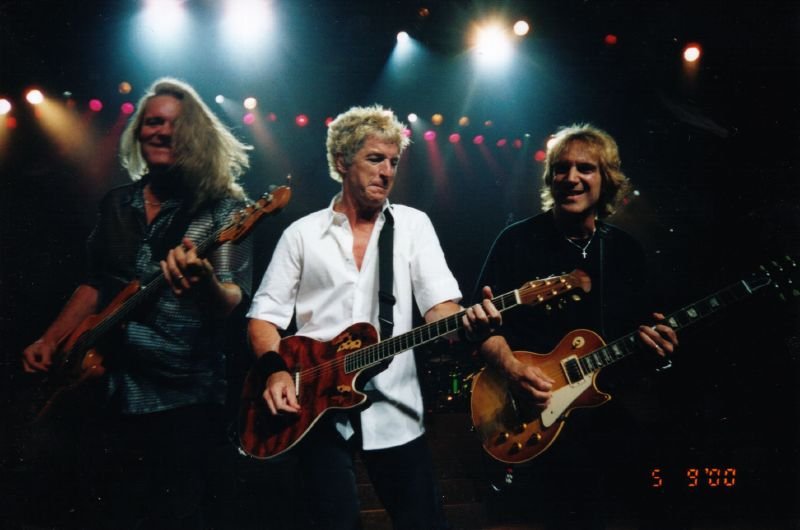
The Wedding Song That Wasn’t: How Kevin Cronin’s Heartbreak Wrote REO Speedwagon’s “Keep On Loving You”
It is one of the most-played wedding songs in American history. Couples have chosen it for their first dance for four decades. They sway to it, they cry to it, they call it “their song.” And Kevin Cronin, the man who wrote it, has spent years gently suggesting that maybe — just maybe — they should listen to the verses.
Because “Keep On Loving You” is not a love song. It’s a song about finding out the woman you love has been unfaithful — and deciding, in the wreckage, to stay anyway. Cronin wrote it in the middle of a long night, alone at a piano, after learning that his wife had cheated on him before they were even married. The verses are an accusation. The chorus is a verdict. And the whole thing became the biggest hit REO Speedwagon ever had — the power ballad that defined a genre, the first number one for a band that had been grinding for thirteen years, and the centerpiece of an album that sat at number one for fifteen weeks and became the best-selling record of 1981.
This is the story of how heartbreak, a cranked-up Les Paul, and a song nobody wanted to record turned a blue-collar bar band from Illinois into the biggest rock act in America — and how a piano ballad written in the wreckage of a marriage became the definitive power ballad of the 1980s.
Thirteen Years in the Trenches
To feel the full weight of “Keep On Loving You,” you have to know how long REO Speedwagon waited for it — and how many singers, bass players, and false starts those thirteen years contained.
The band formed in 1967 in Champaign, Illinois, after keyboardist Neal Doughty and drummer Alan Gratzer met as students at the University of Illinois. Doughty spotted the name — the REO Speed Wagon, a 1915 flatbed truck built by the REO Motor Truck Company of Ransom Eli Olds — in a History of Transportation class and thought it would make a good band name. They started as a campus cover band, bashing through the Doors and Cream for fraternity crowds, and became the town’s leading act. Epic Records signed them in 1971.
What followed was nearly a decade of churn. The band changed lead vocalists three times across its first three albums. Terry Luttrell sang on the 1971 debut and left in early 1972; Gary Richrath — the Peoria guitarist who’d joined in 1970 and become the band’s musical engine — found his replacement through the Musicians’ Referral Service of Chicago, where a flyer advertised a young Evanston singer-guitarist named Kevin Cronin. At his audition, Cronin sang Elton John’s “Holiday Inn” and got the gig. He recorded one album, 1972’s R.E.O./T.W.O., then fell out with Richrath over musical direction during the sessions for Ridin’ the Storm Out and left; Mike Murphy was drafted in to finish the vocals. Cronin went off on his own — his solo path even included opening slots for the Eagles, Linda Ronstadt, and Frank Zappa — before approaching Richrath, reconciling, and returning for good in 1976. Bassist Bruce Hall, a Champaign native, joined in 1977, completing the classic lineup: Cronin, Richrath, Doughty, Hall, and Gratzer.
By 1980, they’d released eight studio albums. They had a loyal following and a reputation as a ferocious live act — their 1977 live album You Get What You Play For had convinced Epic of their concert power. They had platinum records: 1978’s You Can Tune a Piano, but You Can’t Tuna Fish had gone platinum. What they didn’t have was a genuine hit single. “Ridin’ the Storm Out” (in its live version) had scraped to number 94 in 1977. “Time for Me to Fly” had reached number 56 in 1978. They had never cracked the top 50 of the Billboard Hot 100. For a band that could fill arenas in the Midwest, national pop stardom kept slipping through their fingers.
The album they were making in 1980 was supposed to change that — though nobody, least of all the band, expected it to change things quite the way it did. The record was called Hi Infidelity, a pun on “high fidelity” that turned out to be brutally literal. Without quite planning it, REO Speedwagon was writing a concept album about cheating. Cronin was living through the collapse of his marriage. Doughty’s wife had left him for another man — his pain became “In Your Letter.” Guitarist Gary Richrath was writing about rumors of infidelity in “Take It on the Run.” The whole band was pouring thirteen years of touring fatigue and relationship wreckage into the music.
And in the middle of it all, Cronin was carrying the heaviest secret: he’d discovered his wife had been unfaithful before they married.
The Long Night
“It was a heartfelt little song I wrote in the middle of a long night,” Cronin later recalled, “which came to life the next afternoon. It was truly a miracle.” In a 2017 interview, he described the song’s arrival with the bemusement of a man still surprised by it decades later: he’d woken up in the night with three simple piano chords looping in his head, and by morning they had become a song. He crafted it alone, at the piano — and when he brought it to the band, his bandmates weren’t sold. It was too soft, too vulnerable, too far from the hard-rock roots of a band built on Gary Richrath’s guitar.
He brought it to rehearsal the way you’d carry something fragile. He sat down at the piano — an instrument he rarely touched in front of the band — and played a slow, aching ballad. The room’s verdict was swift: this was not an REO Speedwagon song. This was a folk singer’s lament, and they were a Midwestern hard-rock outfit built around Gary Richrath’s guitar. Cronin answered that he was the band’s main songwriter, so it was one, and that turning it into one was their job.
He had a reason to dig in. The verses he’d written were closer to an indictment than a valentine. “You should have seen by the look in my eyes, baby, there was something missing.” He tells her she should have read it in his face. He compares her to a snake lying still in the grass. He says he knows about the other men. It’s raw, specific, furious — the sound of a man who has just learned the truth and is still deciding what to do with it.
And then the chorus arrives. Not as a feeling, but as a decision: he is staying. He will keep on loving her.
Cronin has been candid about what that decision meant — and what it cost. “It’s funny, because a lot of people over the years have told me how they played that song at their wedding and it was the first dance at their wedding, or it’s ‘their song’ with their boyfriend or girlfriend,” he said in an interview with Songfacts. “My first thought is always, ‘Wait. Did you listen to the verses of the song?!’”
He wrote it, he explained, after finding out his wife had cheated on him. The song, he said, “is a yin-yang thing, where there is obviously trouble in paradise in the verses, but I always believed that people are capable of changing, and that if your life runs into a tough spot, it doesn’t mean that you necessarily have to run from it. You can also look it in the eye, and if there is enough worthwhile in the relationship to keep it going, then you give it all you’ve got, and that’s what I did. Even in giving it all I got, at some point, we realized that it just wasn’t going to work. So when I wrote that line, I meant it. I tried my best, but it just didn’t happen.”
The marriage ended in divorce. The song outlived it by decades.
The Les Paul That Saved It
Cronin kept playing the ballad at rehearsal, session after session, refusing to let it die. The band stayed unimpressed — until the chorus. “Up until that point the band had been totally uninterested in what I was playing,” Cronin recalled in an interview with American Songwriter, “but when Gary Richrath heard the chorus, he plugged one of his vintage Les Pauls into a Marshall double-stack, and cranked up the volume.”
Cronin’s first thought was that Richrath was trying to drown him out. His second thought was that this was exactly what the song had been missing. He leapt up from the piano bench. The folk ballad suddenly had a rock spine — Richrath’s huge, soaring guitar chords lifting the chorus into the stratosphere while Cronin’s piano and vocal carried the wounded verses. That collision — tenderness and thunder — became the template for the eighties power ballad. “When you first write a song, you have no idea where that song will go,” Cronin said. “I had no idea that ‘Keep On Loving You’ would take us on such a wild ride.” He’s still riding it. Four decades later, the song remains REO Speedwagon’s signature — the one the crowd waits for, the one that still gets the lighters (or the phone screens) in the air. Cronin still sings it every night, still plays those three piano chords, still means the chorus. The marriage it was written about is long over. The decision it describes — to look the worst in the eye and keep on loving anyway — turned out to be bigger than any one relationship. It became the band’s epitaph and its anthem, the three minutes that explain why thirteen years of bar-band grinding was worth it. A song about the end of a marriage became the beginning of everything. Thirteen years of waiting, one night of honesty, and a chorus the whole world could sing — that’s the whole story, and it’s enough. Cronin looked infidelity in the eye and chose, for a while, to keep on loving anyway. He meant it. He tried his best. It didn’t work. But the trying — set to three piano chords and a Les Paul — became immortal. That’s the final paradox of “Keep On Loving You”: a song about a failed decision that succeeded beyond any songwriter’s wildest dreams.
The band cut it that way for Hi Infidelity, with Cronin, Richrath, and Kevin Beamish co-producing. Neal Doughty played Hammond organ. The backing vocals featured session aces Tom Kelly and Richard Page — the kind of pristine West Coast harmony stack that made the chorus sound like it was echoing off canyon walls.
The Sessions
The Hi Infidelity sessions, in retrospect, have the feel of a band working without a safety net and not knowing it. The album was cut in 1980 with the band co-producing alongside engineer Kevin Beamish — Cronin and Richrath, the two poles of REO’s personality, sharing the boards. It was an unusual arrangement, and it worked because the material demanded honesty over polish. These weren’t songs being constructed; they were being confessed.
The sonic details tell the story. Doughty’s Hammond organ — the instrument he’d been playing since the Champaign fraternity days — gives the record its warmth, grounding even the glossiest choruses in something earthy and Midwestern. Kelly and Page, the session singers on “Keep On Loving You,” were the secret weapon of West Coast rock harmony; their stacked backing vocals on the chorus are what make it sound enormous, a wall of voices lifting Cronin’s lead into the rafters. And Richrath’s guitar — the vintage Les Paul through the Marshall double-stack — is the album’s other lead voice, answering Cronin’s piano the way it had in that rehearsal room.
What nobody in the studio knew was that they were making the biggest album of 1981. By Cronin’s later account, the band had no sense of the scale of what was coming — they were just trying to make a record honest enough to match what they were living through. The infidelity theme wasn’t a concept imposed from above; it was the air they were breathing. Cronin’s collapsing marriage, Doughty’s wife leaving him, the rumors swirling around Richrath — the album is a group diary, set to power chords. That’s why it connected: millions of listeners in 1981 were living through their own versions of the same stories, and here was a band saying the quiet parts out loud.
Epic Records was no more convinced than the band had been. By Cronin’s account, the label didn’t think the track was strong enough to be a single, and the group had to argue for it — Cronin says he had to fight tooth and nail with the label’s A&R team just to get it released as a single. It’s a familiar story in rock history — the label hearing the weirdest thing in the pile and missing it completely — but the REO version has a particular sting, because the band had been right about so little for so long. Thirteen years, eight albums, countless bar gigs and station-wagon miles, and the hit was the song the professionals wanted to bury. The song the A&R men couldn’t hear became the song the whole country couldn’t stop hearing. Epic finally relented. “Keep On Loving You” was released as a single on November 4, 1980, a little over two weeks before the album arrived on November 21. The label’s hesitation became part of the legend: nobody wanted this song, and everybody needed it.
Number One
What happened next rewrote the band’s history in permanent ink.
“Keep On Loving You” climbed the Hot 100 through the winter and, on March 21, 1981, reached number one — knocking Eddie Rabbitt’s “I Love a Rainy Night” off the top spot. It spent one week at the summit and was certified gold by the RIAA on March 4, just as it was peaking. It was the band’s first number one, their first top-10, their first top-50 — the single that finally, after thirteen years, made REO Speedwagon a pop act.
The album went further. Hi Infidelity hit number one on the Billboard 200 on February 21, 1981, taking over from John Lennon and Yoko Ono’s Double Fantasy, and stayed there for fifteen weeks — fifteen non-consecutive weeks at the top, a run that finally ended in late June. Only a handful of rock albums in history have spent that long at number one. It was named Billboard’s top album of 1981, the biggest-selling LP of the year, and it stayed on the Billboard 200 for 101 weeks — unprecedented for an American rock band at the time. The RIAA certified it Diamond in 2017 for ten million copies sold in the United States. Four of its singles reached the Top 40: “Keep On Loving You” at number one, Richrath’s “Take It on the Run” at number five, “In Your Letter” at number 20, and “Don’t Let Him Go” at number 24.
Fifteen Weeks
Stop and consider what fifteen weeks at number one meant in 1981. This was not the streaming era, when albums drift on and off the summit. This was the era of physical records, of kids saving allowance money, of a single LP dominating the culture for an entire season. Hi Infidelity took the top spot in February — displacing a Lennon album released in the wake of his murder, no less — and held it, on and off, into the summer. It outlasted every challenger. It was the highest-selling rock LP of 1981, and when Epic reissued it for its 30th anniversary in 2011, the label’s own accounting credited it with close to ten million US sales — a figure the RIAA made official with its Diamond certification in 2017.
The album’s dominance was a team effort, and the singles tell the story of a band firing on every cylinder. “Take It on the Run,” Richrath’s song about rumors of infidelity, peaked at number five in May 1981 — the guitarist’s biggest songwriting hit, and proof that the album’s confessional streak ran through the whole band, not just its frontman. “In Your Letter,” born from Doughty’s wife leaving him for another man, reached number 20. “Don’t Let Him Go” hit number 24. Four Top 40 singles from one record — from a band that, a year earlier, had never cracked the Top 50 with anything.
And at the center of it all, the song that started as three piano chords in the middle of the night. “Keep On Loving You” wasn’t just the album’s lead single. It was its thesis statement: the wounded verse, the soaring chorus, the decision to stay. Every other song on Hi Infidelity is, in some way, a variation on that theme — betrayal, rumor, heartbreak, perseverance. Cronin’s ballad just said it first, and said it biggest.
The success had a visual component, too — and it was gloriously low-rent. The video for “Keep On Loving You,” directed by Bruce Gowers, was shot in a single day alongside three other REO videos — four clips in one marathon shoot, on a budget that showed. It featured Cronin pouring his heart out to a sultry psychiatrist, in a setup Cronin himself later called hilariously cheap — he joked that it made the band look like “even bigger dorks than we were.” There were no yachts, no mansions, no cinematic pretensions: just five Midwestern rock musicians in a room, acting out a heartbreak ballad for a camera.
But the timing was perfect: the clip was among the first videos to air when MTV launched in August 1981, and the channel’s heavy rotation kept the song — and the album — alive for months. Consider the luck of it. MTV debuted on August 1, 1981; Hi Infidelity, released the previous November, was still a chart monster, and REO Speedwagon held the number-one album spot as the new medium hit the airwaves. The band got in on the ground floor of the video age almost by accident — the cheap psychiatrist video, shot in a day, became one of the defining images of MTV’s first year. The channel’s endless replays kept Hi Infidelity glued to the top of the charts long after a normal album cycle would have faded, and introduced the band to an audience that had never bought a rock record in a store. The dorks, it turned out, were exactly what the new medium needed: sincere, unpolished, and utterly themselves.
The Price of Honesty
There is a coda to the Hi Infidelity story that the wedding DJs never mention. The album that made REO Speedwagon superstars also marked the beginning of the tensions that would eventually tear the classic lineup apart — particularly between Cronin and Richrath, the two men whose collision had created the band’s biggest hit. The guitarist who’d saved “Keep On Loving You” by plugging in his Les Paul left the band in 1989, undone by his tensions with Cronin; drummer Alan Gratzer had retired the year before. Success didn’t resolve the fault lines; it gilded them. Doughty, Cronin, and Hall carried on, but the band that made Hi Infidelity — the five men in the room when the Marshall stack roared to life — never played together again.
Cronin himself has said that writing those songs was his way of processing the pain in real time — not trying to write hits, but trying, as he put it in one interview, to not lose his mind. The whole of Hi Infidelity is a document of people turning their private wreckage into choruses the whole country could sing. That’s why it sold ten million copies. Not because it was calculated, but because it wasn’t. The most commercial album of 1981 was also the most confessional — a record about infidelity, written by men living through it, that accidentally invented the sound of the decade.
The Ballad That Ate the Eighties
It’s hard to overstate what “Keep On Loving You” did for rock music as a form. The power ballad existed before 1980 — but this song codified it: the wounded, piano-led verse giving way to the arena-shaking guitar chorus, the intimate confession exploding into communal catharsis. Every band that followed the formula through the eighties — Journey, Foreigner, Whitesnake, Bon Jovi — was walking a road REO Speedwagon paved in a Champaign rehearsal room when a guitarist plugged in a Les Paul to drown out his singer.
Consider the architecture. The verses are Cronin alone — piano, voice, accusation. “You should have seen by the look in my eyes, baby, there was something missing.” It’s a man talking to one woman in an empty room. Then the chorus, and Richrath’s guitar doesn’t just accompany the vocal — it answers it, argues with it, lifts it. The private becomes public. The confession becomes an anthem. That dynamic — whisper to roar, verse to chorus, wound to scar — became the single most imitated structure in eighties rock. When you hear it in “Faithfully” or “I Want to Know What Love Is” or “Every Rose Has Its Thorn,” you’re hearing the ghost of a rehearsal room in Illinois, a singer at a piano, and a Les Paul through a Marshall stack.
And the wedding-song irony has never faded — if anything, it’s deepened. Cronin still hears from couples who made it their first dance. He still thinks the same thing: did you listen to the verses? But maybe the couples know something he doesn’t. Maybe they’ve heard the verses — the snakes in the grass, the look in his eyes, the other men — and chosen the chorus anyway. Maybe that’s what the song is actually about: not the infidelity, but the decision. Not the wound, but what you do after. A wedding song about choosing to stay, sung by a man who tried and failed, might be the most honest wedding song ever written. The couples swaying to it aren’t misunderstanding the song. They’re completing it — supplying the happy ending Cronin couldn’t give himself, one first dance at a time.
But the song worked. Thirteen years of bar-band grinding, one long night at a piano, one cranked-up Marshall stack — and a blue-collar band from Illinois had the biggest album in America. “Keep On Loving You” didn’t just give REO Speedwagon their first number one. It gave the eighties its signature sound: heartbreak, turned all the way up.
The Decision
What endures about “Keep On Loving You,” finally, isn’t the chart run or the Diamond certification or the fifteen weeks. It’s the decision at the song’s center — and how rare it is in pop music. Most love songs are about falling in love or falling out of it. This one is about the moment in between: the terrible, clear-eyed instant when you know the worst and choose anyway. Cronin didn’t write a fantasy. He wrote a verdict, delivered by a man who’d seen the evidence.
He’s been honest about what the verdict cost. “That song is a yin-yang thing,” he said — trouble in the verses, faith in the chorus. “I always believed that people are capable of changing, and that if your life runs into a tough spot, it doesn’t mean that you necessarily have to run from it. You can also look it in the eye, and if there is enough worthwhile in the relationship to keep it going, then you give it all you’ve got, and that’s what I did.” He gave it all he got. It wasn’t enough. The marriage ended. But the song — the record of a man trying his best in the worst moment — outlived the marriage by decades and will outlive everyone who made it.
That’s why the wedding couples aren’t wrong, even if they haven’t listened to the verses. They’re not hearing a simple love song. They’re hearing a man who looked at the hardest truth love can show you and decided to stay — for a while, with everything he had. Every marriage is, in the end, that decision, made over and over. Cronin just wrote it down first, in the middle of a long night, at a piano he barely played — and then his guitarist plugged in a Les Paul, and the whole world sang along.
Leave a Reply