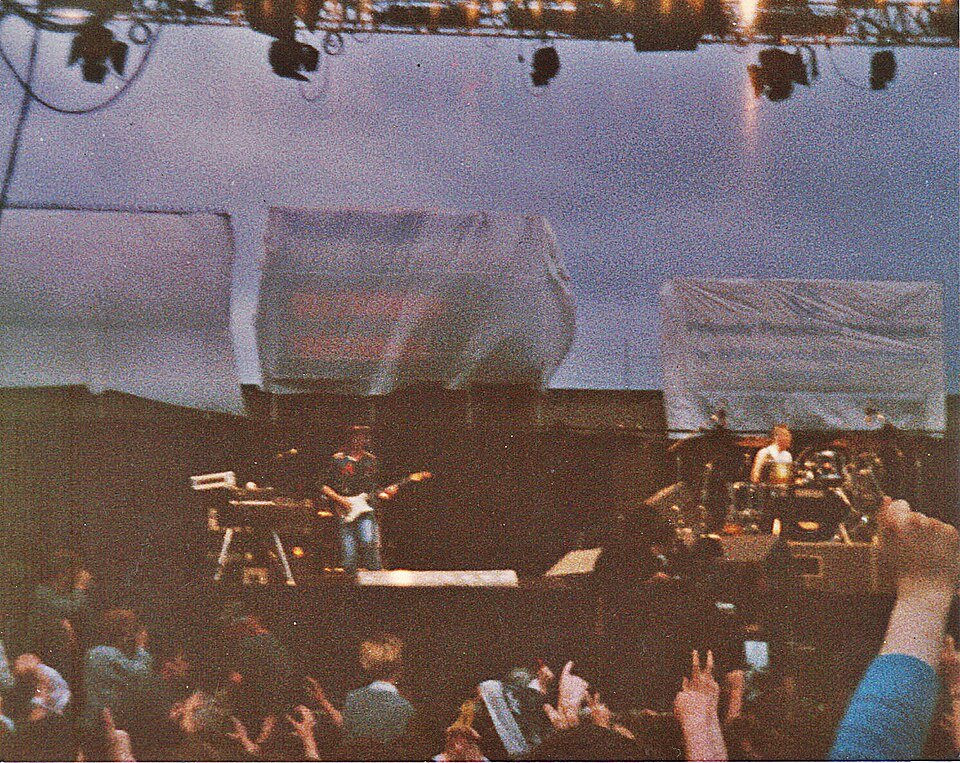
With or Without You: The Song U2 Almost Threw Away — and the Guitar That Played Itself
In the winter of 1986, the biggest rock band in the world was stuck. U2 had spent months in a Georgian mansion outside Dublin, trying to make the album that would define them. They had the songs — or they thought they did. They had Brian Eno and Daniel Lanois, the most adventurous producers alive, pushing them toward something unprecedented. And they had one song that wouldn’t cooperate: a troubled love ballad that the band had been wrestling with for over a year, through dozens of arrangements, without finding the one that worked.
They were ready to abandon it. Bono, the singer, didn’t want to let it go, but even he couldn’t make the pieces fit. The Edge, the guitarist, had tried everything. The rhythm section had tried everything. The producers had tried everything. The song was a beautiful problem with no solution.
Then a package arrived from Canada. Inside was a prototype guitar built by an inventor named Michael Brook — an instrument that could sustain notes forever, a guitar that, in the Edge’s words, “played itself.” The Edge plugged it in, played two takes, and put it down. That was it. The problem was solved. The song was “With or Without You.” It became U2’s first American number one, the song that made The Joshua Tree the biggest album on earth, and one of the most beloved ballads in rock history.
This is the story of a song that almost didn’t exist, and the strange instrument that saved it.
Dublin, 1976
U2 began, famously, with a note on a school bulletin board. In September 1976, Larry Mullen Jr., then a fourteen-year-old drummer, posted a notice at Mount Temple Comprehensive School in Dublin seeking musicians for a band. Among those who showed up to his kitchen: Paul Hewson, a charismatic sixteen-year-old who would become Bono; David Evans, a quiet guitarist who would become the Edge; his brother Dik Evans; and Adam Clayton, who could barely play bass but had the right attitude.
They were terrible. By their own cheerful admission, they were one of the worst bands in Dublin. But they had something that couldn’t be taught: conviction. Bono, even at sixteen, performed like the fate of the world depended on it. The Edge, even then, was searching for sounds nobody had heard. They practiced relentlessly, played every pub and parish hall that would have them, and slowly — very slowly — got good.
By 1980, they had a record deal with Island Records and a debut album, Boy, produced by Steve Lillywhite. October (1981) and War (1983) followed, each bigger than the last. War gave them “Sunday Bloody Sunday” and “New Year’s Day” — political anthems that made them the conscience of rock. The Unforgettable Fire (1984), produced by Eno and Lanois, was their first experiment with atmosphere, and its tour made them arena stars in America.
But they weren’t the band yet. They were a big band with big ambitions and a sense that their best work was ahead of them. The Joshua Tree was supposed to be the album that proved it.
The Demo
“With or Without You” began, unglamorously, as a demo recorded in late 1985. U2 had just come off The Unforgettable Fire tour — the tour that had made them arena stars in America — and they were looking for the next step. The band had bought a house for drummer Larry Mullen Jr., and they used it to review new material, jamming through ideas to see what stuck.
The early version of the song was built on a Yamaha drum machine beat — a mechanical pulse that the band looped while the Edge worked out a chord pattern. Adam Clayton, the bassist, played a short-scale Ibanez bass part: simple, insistent, grounding. It was a sketch, not a song — a groove in search of a meaning. The band recorded it at STS Studios in Dublin, one of several permutations they tried, and filed it away. STS was the band’s own facility, a place where they could experiment without the clock running — and “With or Without You” needed that freedom, because it was going to take a very long time to become itself.
What the demo had was atmosphere. What it lacked was a reason to exist. U2 in 1985 was a band of big gestures — The Unforgettable Fire had been expansive, political, anthemic. A quiet love song didn’t obviously fit. But Bono heard something in the chord pattern, something personal, and he wouldn’t let it go.
The lyric came from a complicated place. In 1986, Bono traveled to the Côte d’Azur in the south of France, and there, away from the band, he confronted the central tension of his life: the conflict between his existence as a touring rock musician — always leaving, always moving, always belonging to the crowd — and his existence as a husband and domestic man. He was married to Ali Hewson, his childhood sweetheart, and the marriage was real and deep. But the road was real too. “With or Without You” is, on its surface, a love song. Underneath, it’s a song about the impossibility of being in two places at once — about loving someone and leaving them, over and over, and wondering whether the love can survive the leaving.
Bono’s first draft of the lyrics wasn’t good enough. The band told him so — a mark of how U2 worked, with a bluntness that would have destroyed lesser bands. In most groups, telling the singer his words aren’t working is a declaration of war. In U2, it was Tuesday. They had been together since they were teenagers; they had earned the right to be honest. According to the album’s assistant engineer Dave Meegan, Bono went away and rewrote them completely. What he came back with, Meegan said, was “absolutely stunning.” It was, in Meegan’s words, “a critical moment… it’s what forced ‘With or Without You’ to happen.”
Eno and Lanois
Brian Eno and Daniel Lanois were the strangest and most inspired production choice U2 ever made. Eno had been the keyboardist in Roxy Music before leaving to invent ambient music — albums like Music for Airports that treated sound as environment rather than statement. He had produced Talking Heads and David Bowie’s Berlin trilogy. His philosophy was oblique: he used a deck of cards called “Oblique Strategies” to force musicians out of their habits (“Honor thy error as a hidden intention,” one card read). He believed that the best music came not from executing a plan but from creating conditions where accidents could happen.
Lanois was Eno’s complement: a French-Canadian producer, engineer, and multi-instrumentalist who understood the craft of recording at a molecular level. Where Eno thought in concepts, Lanois thought in sounds — in microphone placement, in tape saturation, in the exact reverb that makes a guitar sound like a cathedral. Together, they had produced The Unforgettable Fire, and U2 trusted them completely.
For The Joshua Tree, Eno and Lanois pushed the band toward America — not the America of MTV, but the mythic America of deserts, highways, and broken promises. The album’s imagery, from the title (a twisted tree in the Mojave Desert, photographed by Anton Corbijn) to the songs (“Where the Streets Have No Name,” “I Still Haven’t Found What I’m Looking For,” “Bullet the Blue Sky”), was a love letter to an idea of America that the band knew was partly illusion. “With or Without You” was the album’s emotional core: the personal song amid the political ones, the quiet heart of a loud record.
Danesmoate House
The Joshua Tree sessions began in earnest in 1986 at Danesmoate House, a Georgian mansion in Rathfarnham, on the outskirts of Dublin. Eno and Lanois had chosen it deliberately: they wanted the band out of the sterile environment of a commercial studio, in a place with atmosphere, history, and room to experiment. The house became a laboratory. Rooms were converted into recording spaces. The band lived and worked in the same place, blurring the line between life and music.
Eno and Lanois were an unusual production team. Eno, the former Roxy Music keyboardist turned ambient music pioneer, thought in terms of textures and accidents — he believed the best music came from setting up conditions and letting strange things happen. Lanois, the Canadian producer and musician, was more hands-on, a craftsman who understood both the technical and the emotional sides of recording. Together, they pushed U2 away from the straightforward rock of their early albums and toward something more atmospheric, more ambiguous, more big.
“With or Without You” was their hardest case. Under Eno and Lanois’s direction, the band tried everything: the Edge pursued ambient guitar textures, Clayton turned up his bass, Mullen experimented with an electronically enhanced drum kit. They recorded version after version. And still, the song wouldn’t cohere. The band considered abandoning it entirely. Bono resisted — he believed in the song the way he’d believed in the lyric — but even he was running out of arguments.
What the song needed, though nobody knew it yet, was a sound that didn’t exist in any of their amplifiers. It needed the Infinite Guitar.
Gavin Friday
One of the unsung heroes of “With or Without You” is Gavin Friday — Bono’s childhood friend from Dublin, the former frontman of the Virgin Prunes, and one of the few people who could tell Bono when he was wrong. Friday had been present at the creation of U2; he understood the band’s dynamics from the inside, and he had no stake in flattering them.
When the Joshua Tree sessions stalled on “With or Without You,” it was Friday who intervened. He listened to the various failed arrangements, talked with Bono about what the song was trying to be, and helped rearrange the track — injecting, as the histories put it, “a renewed sense of belief.” Friday’s contribution is hard to quantify, which is why it’s often overlooked. He didn’t play an instrument on the record. He didn’t produce it. What he did was simpler and rarer: he reminded a stuck band why they cared about the song in the first place.
Every great band needs a Gavin Friday — someone outside the machinery who can hear the song underneath the struggle. U2 was lucky to have one. Many bands aren’t, and their best songs die in the studio, abandoned for lack of someone to say: keep going, you’re close.
The Instrument That Played Itself
Michael Brook was a Canadian guitarist, inventor, and producer who had been working on a strange device: a guitar with infinite sustain. The principle was related to the E-Bow, a handheld device that vibrates guitar strings magnetically, but Brook’s invention went further — it allowed a full range of transitions from zero to infinite sustain, creating notes that could bloom and hold forever, like a violin or a human voice.
The Edge had described the instrument to Guitar Player magazine in 1985, calling it “a guitar that plays itself.” When the prototype arrived at Danesmoate House, nobody knew what to expect. Daniel Lanois later described the scene: the Edge and Lanois had been working on the chord pattern in the control room, with the Yamaha beatbox keeping time, when the package arrived. They unpacked it, followed Brook’s intricate setup instructions, and the Edge plugged in.
What happened next is the stuff of studio legend. The Edge played the part — a simple, sustained figure that floated over the chord pattern like light through a window. Lanois asked him to do another take. He did. Then he put the guitar down. “That was it,” Lanois said. “It was not labored over; we were just fascinated with this new device of Michael’s. The part never changed. The two tracks he initially played made it to the finish line.”
Two takes. No overdubs, no rethinking, no laboring. The part that had eluded the band for a year arrived in minutes, played on an instrument that had arrived that morning. The Edge ran it through his live rig — a Vox AC30 amplifier and, probably, a Korg SDD-3000 digital delay pedal — and the sound was otherworldly: sustained, shimmering, endless.
Bono and his friend Gavin Friday were in the control room when the Edge played the part in the live room. Hearing the Infinite Guitar blend with the backing track, they immediately understood what had happened. Lanois remembered saying, “That sounded pretty cool,” and then, listening back: “Jesus, it’s better than I thought.” The band considers the recording one of the breakthrough moments of the entire Joshua Tree sessions — the moment when, amid fears they had run out of ideas, a new idea arrived from nowhere and changed everything.
Michael Brook
Michael Brook himself deserves a moment. The Canadian guitarist and inventor who built the Infinite Guitar was not a rock star — he was a tinkerer, an artist working at the intersection of music and technology. He had developed the instrument out of a fascination with sustain: the idea that a guitar note, instead of decaying, could bloom and hold indefinitely, like a bowed string or a human voice held on a single breath.
The Infinite Guitar was a finicky, temperamental device. The Edge later joked that it would have failed even the most basic safety regulations — his guitar technician occasionally received electric shocks from it while preparing it for performances. It was a prototype in the truest sense: brilliant, unstable, barely controllable. Which is perhaps why it worked so perfectly for “With or Without You.” The song needed something uncontrollable, something the band couldn’t overthink. The Infinite Guitar couldn’t be overthought. It could barely be operated.
Brook went on to a distinguished career as a film composer and producer, but the Infinite Guitar remains his most famous invention — a device that changed one song and, through that song, changed rock guitar. Every sustained, shimmering guitar part in the decades since owes something to that package arriving at Danesmoate House in the winter of 1986.
The Building Blocks
With the Edge’s part in place, the rest of the song assembled itself. Adam Clayton’s bassline — gentle but insistent, the song’s anchor — gave the ethereal guitars something to hold onto. Larry Mullen Jr. added his drum part later, combined with the original session’s machine beats, creating a hybrid rhythm that was both human and mechanical. Eno contributed drum programming and synthesizer textures. The “building blocks,” as Lanois called them, were complete.
But the song still needed mixing, and the mixing became its own drama. In December 1986, U2 brought in Steve Lillywhite — the producer who had worked on their first three albums — to mix several tracks, including “With or Without You.” Lillywhite was a straightforward rock mixer; Eno and Lanois were texture obsessives. The three men had different ideas about what the song should be.
The most famous moment came when Eno walked into the mixing room while Lillywhite and engineer Mark Wallis were working. Eno announced he wanted to change the introduction. Wallis later recalled: “It was kind of awe-inspiring because he said, ‘Right, send this guitar through those ten effects over there and send that guitar through those ten effects over there and then feed them back to each other.’” What had been a traditional rhythm guitar, bass, and drums introduction suddenly became “something quite otherworldly and spiritual.” Wallis called it “visionary.” The sound of the song, he said, started to tell you where it was going before the lyric arrived.
“With or Without You” was, by all accounts, the most debated song Lillywhite worked on — Eno, Lanois, and Lillywhite each pulling in different directions. But the tension produced something none of them could have made alone: a rock ballad that sounded like it came from another planet.
The Joshua Tree
“With or Without You” didn’t just make The Joshua Tree — The Joshua Tree made “With or Without You” make sense. The album, released on March 9, 1987, was a coherent world: eleven songs about America, faith, doubt, and longing, sequenced like a journey. “Where the Streets Have No Name” opened with its shimmering, searching guitar. “I Still Haven’t Found What I’m Looking For” was gospel-tinged yearning. “Bullet the Blue Sky” was fury. And “With or Without You,” track three, was the wound at the center — the personal song that made the political ones human.
The album debuted at number one in the UK and number one in America — U2’s first American chart-topper. It sold 25 million copies worldwide. It won the Grammy Award for Album of the Year in 1988. Time magazine put U2 on its cover, calling them “Rock’s Hottest Ticket.” They were twenty-six years old, and they were the biggest band in the world.
But the album’s success created its own crisis. How do you follow The Joshua Tree? U2’s answer — the Rattle and Hum album and film (1988), an earnest exploration of American roots music — was received as overreaching, and the band spent the next few years in the wilderness, rethinking everything. They emerged in 1991 with Achtung Baby, a complete reinvention: ironic, electronic, European. The band that made “With or Without You” deliberately destroyed itself and built something new. It’s one of the bravest moves in rock history — and it worked.
Through all the reinventions, “With or Without You” remained. It’s the one song U2 has never been able to leave behind, the one the audience demands, the one that defines them even as they’ve spent decades trying to outrun the definition.
The Single Nobody Wanted to Release
Even with the record finished, the band’s team wasn’t sure about “With or Without You” as a single. Paul McGuinness, U2’s manager — the shrewd Dubliner who had guided the band from pubs to arenas — thought the song sounded too odd for radio. It was long, it was atmospheric, it built too slowly. Radio wanted hooks in the first ten seconds. “With or Without You” took its time.
McGuinness was eventually convinced, and Island Records gave the single a tightly controlled premiere — a strategy to build anticipation. In the days before streaming, a single’s launch was choreography: service it to radio on a specific date, control the first plays, build the story. Island serviced “With or Without You” to radio with unusual care, betting that the song’s strangeness would be its strength — that listeners, hearing something they’d never heard before, would lean in rather than tune out. It was a gamble. McGuinness’s instincts about radio were usually right. This time, the song was righter. “With or Without You” was released on March 16, 1987, as the lead single from The Joshua Tree. It debuted on the Billboard Hot 100 at number 64 in the chart week of March 21, 1987. Then it started climbing.
Three weeks at number one. U2’s first American chart-topper. The song also hit number one in Canada and went Top 10 around the world. The Joshua Tree became the biggest album of 1987 — and, arguably, the biggest rock album of the decade. It won the Grammy for Album of the Year. U2, the earnest Irish band that had started in a Dublin kitchen in 1976, was now the biggest band on earth.
The Sound That Echoed
The influence of “With or Without You” on rock guitar is hard to overstate. Before it, the Edge was known for his rhythmic, delay-driven style — the chiming arpeggios of “I Will Follow” and “Sunday Bloody Sunday.” After it, he became the master of atmosphere, the guitarist who could fill a stadium with a single sustained note. A generation of players — from the shoegazers of the early nineties to the worship-rock guitarists of the 2000s to the indie bands of today — learned their craft studying what the Edge did on this song.
But the influence goes deeper than technique. “With or Without You” proved that a rock ballad didn’t have to follow the power-ballad formula — quiet verse, loud chorus, guitar solo, key change. It could be patient. It could build so slowly you barely noticed it building. It could trust the listener to stay. In an era of three-minute singles designed for MTV, U2 made a four-minute-and-fifty-three-second meditation and took it to number one. It was a rebuke to everything the industry thought it knew about hits — and the industry, to its credit, listened.
The Coda
The ending of “With or Without You” — the “oh-oh-oh” coda that builds and builds until Bono is practically wailing — has become one of the great communal moments in rock. In concert, it’s the part where the stadium takes over, where seventy thousand voices join Bono’s in a wordless cry that means everything and nothing. It’s not a lyric. It’s a feeling, given sound.
What’s remarkable is that the coda was there from the beginning — it was part of what made the song work, the release after the tension of the verses. The verses of “With or Without You” are restrained, almost whispered: “See the stone set in your eyes / See the thorn twist in your side.” The pre-chorus lifts: “And you give yourself away.” And then the chorus — “With or without you” — opens the floodgates. The coda is the flood.
In the studio, Bono sang it like a man exorcising something. Live, he sings it like a man sharing something. The difference is the audience. A song about the impossibility of being in two places becomes, in concert, a song about everybody being in the same place — together, singing, for four minutes, as if the distance didn’t exist.
The Song That Stayed
“With or Without You” never left. It became the emotional centerpiece of U2’s live shows — the song where Bono pulls a girl from the audience, where the stadium lights go down, where seventy thousand people sing the “oh-oh-oh” coda like a prayer. The Edge’s Infinite Guitar part, once a studio accident, became one of the most imitated guitar sounds in rock. Every guitarist who ever bought a delay pedal and tried to make it shimmer was chasing Danesmoate House.
The song’s meaning has deepened with time. What began as Bono’s meditation on the conflict between the road and home has become, for millions of listeners, a song about every impossible love — every relationship stretched between presence and absence, every heart split between two places. The lyric’s ambiguity is its power. “With or without you” — it’s not a statement. It’s a question that never gets answered.
And the lesson of the recording endures too. U2 almost threw the song away. They had every reason to: it didn’t work, it took too long, the arrangements kept failing. What saved it wasn’t effort but openness — the willingness to try a strange instrument from Canada, to let an accident become the foundation, to trust that the song knew what it needed better than the band did. It’s a lesson that applies far beyond music: the things we almost abandon are sometimes the things that matter most. The difference between a forgotten demo and a timeless song can be as small as a package arriving in the mail on the right day.
The Edge played two takes and put the guitar down. Sometimes that’s all it takes. Sometimes the song is just waiting for the right sound to arrive in the mail.
With or without you, indeed. U2 chose with — and the world is louder, stranger, and more beautiful for it. Some songs are hits. A few are landmarks. This one is a place people go — and, once they’ve truly been there, they never really leave it at all.
Leave a Reply