“Might As Well Jump”: How Eddie Van Halen’s Synthesizer Broke Up the Biggest Band in America
In 1983, the greatest guitar player alive built a recording studio in his backyard and started playing keyboards. That sentence, on its face, sounds like the beginning of a joke. In the world of Van Halen, it was the beginning of the end.
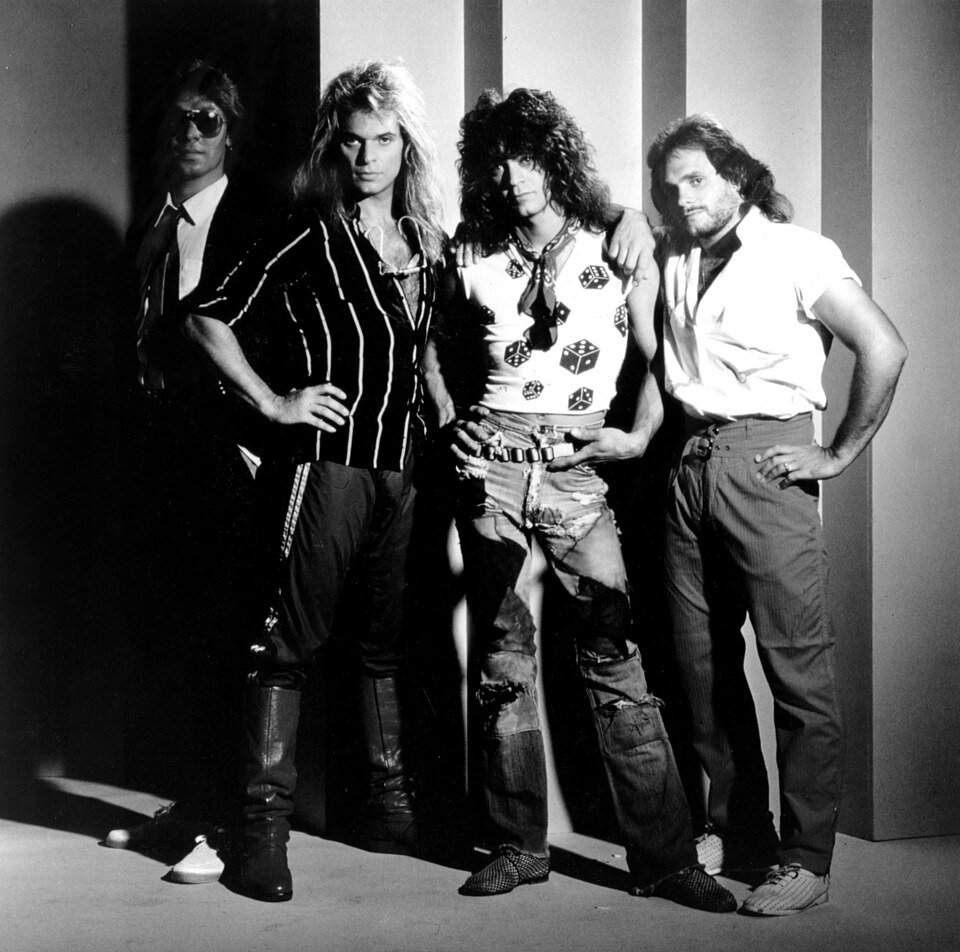
Eddie Van Halen had spent five years establishing himself as the most innovative rock guitarist since Jimi Hendrix. His two-handed tapping, his tone, his sheer joy in the instrument — it had all made Van Halen, the band he formed with his brother Alex, singer David Lee Roth, and bassist Michael Anthony, into one of the biggest acts in America. They were a guitar band. That was the whole point. Guitars, loud and glorious, with Eddie’s Frankenstrat leading the charge.
But Eddie was bored. And restless. And increasingly frustrated with a singer and a producer who, in his view, kept telling him what Van Halen was allowed to be. So he did what geniuses do when they’re frustrated: he built himself a room where nobody could tell him no, and he started twisting knobs on a synthesizer until it sounded right.
The result was “Jump” — a song driven by an Oberheim OB-Xa synthesizer instead of a guitar, the biggest hit Van Halen ever had, and the wedge that split the band in half. It spent five weeks at number one. It made Van Halen superstars on a scale they’d never imagined. And within two years of its release, David Lee Roth was gone.
This is the story of a riff nobody wanted, a lyric written in the back of a Mercury convertible, and the most successful act of creative disobedience in rock history.
Pasadena
The Van Halen brothers didn’t come from nowhere. Edward and Alex Van Halen were born in the Netherlands — Eddie in Amsterdam in 1955, Alex in 1954 — and immigrated with their family to Pasadena, California, in 1962. Their father, Jan Van Halen, was a professional musician, a clarinet and saxophone player who gigged around Los Angeles to support the family. Their mother, Eugenia, was Indonesian-Dutch. The boys grew up in a working-class immigrant household where music was both a livelihood and a discipline.
Here’s the detail that explains everything about Eddie Van Halen: he was trained as a classical pianist. Both brothers studied piano as children, and Eddie won classical piano competitions — he has said he never learned to read music well, playing instead by ear and by watching. That classical foundation, absorbed before he ever touched a guitar, shaped his entire approach to the instrument. The two-handed tapping technique that made him famous? It’s essentially a piano technique applied to a guitar fretboard. The harmonic sophistication of his solos, the way he thought in terms of composition rather than just riffs — it all came from those childhood years at the keyboard.
So when Eddie sat down at a synthesizer at 5150 in 1983, he wasn’t a guitarist dabbling in keyboards. He was a keyboard player returning home. The Oberheim OB-Xa wasn’t foreign territory; it was the instrument he’d started on, electrified and modernized. “Jump” makes perfect sense when you know this. It wasn’t Eddie abandoning his identity. It was Eddie reclaiming the first half of it.
The brothers formed their first bands in Pasadena in the early seventies, playing backyard parties and high school dances. David Lee Roth joined in 1974 — the story goes that the brothers kept renting Roth’s PA system for their gigs, and eventually decided it would be cheaper to just put him in the band. Michael Anthony, the bassist with the heavenly high harmonies, completed the lineup. They ground it out in the LA club scene — Gazzarri’s, the Starwood, the Whisky — building a following so fervent that Warner Bros. came calling. Their 1978 debut, produced by Ted Templeman, turned them into stars overnight. Van Halen II (1979), Women and Children First (1980), Fair Warning (1981), Diver Down (1982) — each one bigger, each one pushing the tension a little further.
The Riff in the Drawer
Eddie Van Halen wrote the synthesizer riff for “Jump” around 1981 — maybe earlier; he later said he’d had the arrangement in his head for several years. It was a simple, rolling, impossibly catchy figure, the kind of melody that sounds obvious only after someone has written it. Eddie played it for the band. The band said no.
David Lee Roth, in particular, wanted nothing to do with it. Roth’s vision of Van Halen was pure and non-negotiable: guitars, swagger, party anthems. Synthesizers were for new wave bands, for Europeans in thin ties, for everything Van Halen wasn’t. In Roth’s telling — confirmed in his memoir Crazy From the Heat — he simply preferred Eddie’s guitar work and didn’t see why the band needed keyboards. Eddie, in a 1995 Rolling Stone cover story, put it more bluntly: Roth had rejected the synth riff for at least two years before agreeing to write lyrics to it.
Producer Ted Templeman, who had guided all of Van Halen’s albums, sided with Roth. Templeman was a brilliant rock producer — he understood guitars, vocals, and the alchemy of a great band playing live in a room. Keyboards made him nervous. After the concessions Eddie had made on Diver Down (1982), an album heavy on cover songs that left the guitarist dissatisfied, the creative tension in the band was becoming unbearable. Eddie felt managed. He felt contained. He felt, in a word, unheard.
So he stopped asking for permission.
Ted Templeman and the Machine
Ted Templeman deserves more than a supporting role in this story. He was one of the great rock producers of the seventies — the man behind the Doobie Brothers, Little Feat, and all of Van Halen’s Roth-era albums. He had discovered Van Halen playing at the Starwood in Hollywood and convinced Warner Bros. to sign them. He understood the band’s chemistry intuitively: Eddie’s genius, Roth’s showmanship, Alex’s thunder, Michael Anthony’s harmonies. His production style was straightforward — capture the band live, keep it raw, don’t overthink.
But Templeman was also, by 1983, part of the problem as Eddie saw it. He represented the old way: the producer as authority figure, the studio as a place where the band came to execute someone else’s vision. Eddie’s frustration after Diver Down was real. That album had been rushed, heavy on covers — “(Oh) Pretty Woman,” “Dancing in the Street,” “Where Have All the Good Times Gone!” — and Eddie felt it was a step backward, a concession to Roth’s commercial instincts and Templeman’s caution.
The irony is that Templeman was right about a lot of things, and Eddie knew it. Templeman’s account of the “Jump” session — “Donn and Ed put the track down alone in the middle of the night. We recut it once in one take for sonic reasons. Dave wrote the lyrics that afternoon in the backseat of his Mercury convertible. We finished all vocals that afternoon and mixed it that evening” — is the testimony of a professional who recognized magic when he heard it, even if it arrived on an instrument he distrusted. Templeman didn’t love the synthesizer. He loved the song. There’s a difference, and it’s the difference between a good producer and a great one.
5150
In 1983, Eddie built his own studio. He put it in his backyard at his home in the Hollywood Hills, and he named it 5150 — the California police code for an involuntary psychiatric hold, the designation for someone deemed a danger to themselves or others. The name was a joke, but like all of Eddie’s jokes, it had a point. He was telling the world exactly how he felt: crazy enough to lock up, or crazy like a fox.
The studio was built with Donn Landee, the band’s longtime engineer, who would later co-produce the 5150 and OU812 albums. While the boards and tape machines were being installed, Eddie started fiddling with synthesizers to pass the time. Templeman later recalled the scene: “There were no presets. He would just twist off until it sounded right.”
This was Eddie’s method in everything. He had built his famous Frankenstrat guitar himself, cobbling together parts and painting it with Schwinn bicycle paint. He had invented two-handed tapping by watching Jimmy Page and thinking, what if both hands? Now he was approaching the synthesizer the same way — not as a keyboard player, which he wasn’t, but as a tinkerer, an inventor, a man who believed any instrument would yield its secrets if you twisted the knobs long enough.
The first thing he did at 5150, by his own account, was “Jump.” He recorded the synthesizer track himself, alone, in the middle of the night, with Landee engineering. Roth and Templeman, Eddie told Rolling Stone, didn’t like it. His response became legendary: “Take it or leave it. I was getting sick of their ideas of what was commercial.”
It was a declaration of independence, played on an Oberheim. And it worked — not just as a song, but as a statement of intent that the whole music industry would hear.
The Backseat Lyric
To his credit, Ted Templeman didn’t give up. Whatever his reservations about synthesizers, he was still the producer, and he still believed in the song underneath the keyboards. In 1983, he asked Roth to take another listen to Eddie’s unused idea — the riff that had been sitting in the drawer for two years.
What happened next is one of the great songwriting stories in rock. Roth got into the back of his 1951 Mercury convertible — his beloved chopped hot rod, a car as much a part of his persona as the spandex and the grin — with the band’s roadie Larry Hostler driving, and listened to the track on repeat as they cruised. He needed a lyric. And he found it in the last place anyone would look: the evening news.
The night before, Roth had watched a television news report about a man threatening to commit suicide by jumping off a high building. As the man waffled on the ledge, Roth imagined the crowd below — and imagined someone shouting, “Go ahead and jump.” It was a dark, strange, very Roth-like inspiration: taking something bleak and flipping it into something ecstatic.
But Roth didn’t write a song about suicide. He wrote the words as an invitation — to love, to risk, to leap. “Might as well jump,” the chorus says, and in Roth’s hands it becomes a philosophy: life is short, the ledge is high, you might as well go for it. He later told Musician magazine that Hostler was “probably the most responsible for how it came out” — the roadie had bounced the idea around with him in the car, and the lyric took shape in that moving, unlikely writing room.
Roth also dedicated the song to Benny Urquidez, the martial artist under whom he was studying — a detail that tells you everything about Roth in 1983: rock star, frontman, and serious student of kickboxing, writing lyrics in the back of a hot rod about jumping.
Templeman remembers the session with the clarity of a man who witnessed something rare: “Dave wrote the lyrics that afternoon in the backseat of his Mercury convertible. We finished all vocals that afternoon and mixed it that evening.” One afternoon. One evening. The biggest hit of Van Halen’s career, written and recorded in a day. In an industry where albums take years and singles take months, “Jump” was a reminder of how rock and roll is supposed to work: a great idea, a deadline, and the courage to trust your instincts.
The Solo
Let’s talk about the guitar solo in “Jump,” because it deserves its own moment. After two minutes of synthesizer-driven pop, Eddie Van Halen picks up his guitar and plays one of the most joyful solos in rock history — a burst of melody and technique that reminds everyone in the room who they’re listening to. He later called it his favorite solo he ever wrote, and it’s easy to hear why. It’s not a display of virtuosity for its own sake, though the virtuosity is staggering. It’s a solo that sings — that carries the song’s euphoria forward instead of interrupting it.
The solo was spliced together from multiple takes, a common studio practice that Eddie usually avoided — he preferred to play live, in the moment. But “Jump” was a studio construction from the start, built layer by layer at 5150 in the middle of the night. The solo had to match the precision of the synthesizer track, and Eddie, the great improviser, disciplined himself into building it piece by piece. The result is a paradox: the most carefully assembled moment on the record sounds like the most spontaneous.
There’s a metaphor in there for Eddie’s whole career. The man who made spontaneity look easy was, in fact, one of the most meticulous musicians who ever lived. He just hid the work.
The Sound of the Future
“Jump” doesn’t sound like anything Van Halen had done before, and that was precisely its power. The Oberheim OB-Xa synthesizer riff — bright, rolling, anthemic — opens the song and never really leaves. It’s one of the most recognizable introductions in popular music, as iconic in its way as the opening of “Smoke on the Water” or “Back in Black.” But it’s not a guitar. For a band whose entire identity was built on Eddie Van Halen’s guitar, that was revolutionary.
Except — and this is the part people forget — the guitar is still there. After the synth-driven verses and chorus, Eddie unleashes a guitar solo that he himself called his favorite solo he ever wrote. It was spliced together from multiple takes, a studio construction, but it burns with the same fire as everything he played. The message of “Jump,” musically, is that Eddie didn’t abandon the guitar. He expanded. He was saying: I can do this too, and I can do it better than the people who do only this.
The song was released on December 21, 1983, as the lead single from the album 1984. The album followed on January 9, 1984. “Jump” went to number one on the Billboard Hot 100 and stayed there for five weeks — Van Halen’s first and only American chart-topper. The album reached number 2 on the Billboard 200, held off the top spot only by Michael Jackson’s Thriller, and became the band’s best-selling record.
Eddie had been right. The synthesizer wasn’t the death of Van Halen. It was the making of them — commercially, at least.
The Video Fight
If the recording of “Jump” was a triumph, the music video was a war. MTV was now the most powerful force in popular music, and every major single needed a video. Roth, who understood visual spectacle better than anyone in rock, had strong ideas. He wanted the “Jump” video to intercut performance footage with scenes of himself living the rock-star life — driving his chopped Mercury, carousing, being Diamond Dave in all his glory.
Producer Robert Lombard, who was overseeing the video, thought this was a terrible idea. He believed the song was strong enough to carry a straight performance video, and that Roth’s intercut footage would dilute its impact. In a move of breathtaking audacity, Lombard took the rough cut to Eddie and Alex Van Halen’s house in Coldwater Canyon — bypassing Roth entirely — and made his case. “Guys, I’m taking a stand here,” he told them. “If you put in this crazy footage, the video isn’t gonna have the impact it should have.”
Eddie and Alex agreed. The final video, directed by Roth with the band’s longtime collaborator Pete Angelus, was a straightforward performance piece — the band on stage, shot from multiple angles, with Roth waving a large red flag during the synthesizer solo. It was nominated for three MTV Video Music Awards and won Best Stage Performance. Lombard was fired. But he had been right about the video, and everyone knew it.
The footage Roth had shot for “Jump” — the Mercury, the mayhem — later surfaced in the video for “Panama,” the album’s third single. It was a consolation prize, and an unsatisfying one.
The whole episode captures something essential about Van Halen in 1984: a band at the absolute peak of its powers, tearing itself apart over questions that success should have answered. They had the biggest single in the country. They had the biggest album of their career. And they were fighting about a music video. It seems absurd in retrospect, but creative partnerships often break at the moment of greatest triumph — when there’s finally enough at stake to fight over, and when each member starts to believe the success proves their vision was the right one. Eddie believed “Jump” proved he didn’t need Roth’s permission. Roth believed his lyric proved the song needed him. They were both right, which is why they couldn’t stay together.
1984: The Album
“Jump” was the lead single, but 1984 the album was the full statement — and it showed both sides of the band’s creative divide. Alongside the keyboard-driven “Jump” and “I’ll Wait” (co-written with Michael McDonald of the Doobie Brothers, another Templeman connection), there were pure guitar anthems: “Panama,” with its roaring riff and Roth’s engine-revving vocals; “Hot for Teacher,” with Alex Van Halen’s thunderous double-bass drumming and one of Eddie’s most ferocious solos; “Drop Dead Legs,” a deep cut that guitarists still study.
The album was a compromise, and like all great compromises, it satisfied nobody completely and everybody partially. Eddie got his synthesizers. Roth got his rockers. Templeman got his hit. The public got one of the defining albums of the eighties. 1984 reached number 2 on the Billboard 200 — blocked from the top only by Thriller, which was occupying the culture the way a weather system occupies the sky — and it stayed on the charts for over a year. It produced four singles. It made Van Halen, briefly, the biggest rock band in the world.
The 1984 tour was a triumph and a pressure cooker. The band played to packed arenas, with a stage show that matched their ambition. But backstage, the rift was widening. Roth was increasingly focused on his solo career — the Crazy From the Heat EP, with its unlikely hit cover of “California Girls,” suggested he could survive without the band. Eddie was increasingly focused on 5150, on writing and recording on his own terms. They were sharing stages but living in different worlds.
The Split
“Jump” was where the drama really started, Lombard later said. And he was right. The success of the song didn’t heal the rift in Van Halen; it deepened it. Eddie had proven he didn’t need Roth’s permission to have a hit. Roth had proven he could write a lyric for anything, even a synthesizer riff he’d resisted for two years. They had made their masterpiece together and learned, in the process, that they no longer trusted each other.
In 1985, Roth left to pursue a solo career. His EP Crazy From the Heat — recorded while he was still technically in Van Halen — had been a hit, and he believed he could make it on his own. “The band as you know it is over,” Eddie said in August 1985. It was the end of an era.
The standard story is that Roth quit. The real story, as Eddie told it in that 1995 Rolling Stone interview, is more complicated: the split was about control, about the studio, about who got to decide what Van Halen sounded like. “Jump” was the battlefield. Eddie built 5150 to escape Roth and Templeman’s influence. “The first thing I did up here was ‘Jump,’” he said, “and they didn’t like it.”
Van Halen went on, of course. Sammy Hagar replaced Roth, and the band had a massively successful second act — four consecutive number-one albums, beginning with 5150 (1986), named for Eddie’s studio, the room where the revolution had started. The Hagar era had a different sound — more polished, more mainstream, less dangerous — and a different chemistry. Hagar was a team player where Roth had been a solo act in a band. The music was successful, but it was never quite as electric as what had come before. You can’t replace lightning; you can only build a very good lightning rod.
Roth, for his part, had a successful solo career — Eat ‘Em and Smile (1986) was a genuine hit, powered by the guitar wizardry of Steve Vai — but he never again reached the heights of Van Halen. The two camps feuded publicly for years, reconciled for a disastrous 1996 MTV appearance, feuded again, and eventually reunited for tours in 2007 and beyond that reminded everyone what the original magic had been. The 2007-2008 reunion tour, with Eddie’s son Wolfgang on bass replacing Michael Anthony, was one of the highest-grossing tours of the year. The old songs still worked. “Jump” still brought the house down.
The Oberheim and the Aftermath
The Oberheim OB-Xa that Eddie used on “Jump” deserves a footnote in history. It was a polyphonic analog synthesizer, one of the great instruments of the early eighties — the same family of keyboards that powered Prince’s “1999” and countless new wave records. Eddie didn’t play it like a keyboardist. He played it like a guitarist who had found a new kind of guitar: riff-based, rhythmic, aggressive. The “Jump” riff isn’t a pad or a texture. It’s a hook, constructed with the same instinct for melody that made his guitar riffs unforgettable.
The success of “Jump” changed the synthesizer’s place in rock. After 1984, it was no longer career suicide for a guitar band to use keyboards. Def Leppard, Bon Jovi, Europe — the whole second wave of eighties hard rock built on the permission “Jump” had granted. Eddie hadn’t just made a hit. He’d moved the boundary of what rock was allowed to be.
And the song itself? It never went away. “Jump” has been played at every sporting event in America, in a thousand movies and commercials, at weddings and graduations and political rallies. It’s one of those songs that has passed from music into atmosphere — you don’t listen to it so much as you live inside it for four minutes. Children who have never heard of Van Halen know the riff. It belongs to everyone now.
Eddie Van Halen died on October 6, 2020, at the age of sixty-five, after a long battle with cancer. The tributes poured in from every corner of music, and they all said the same thing: he changed what the guitar could do. But “Jump” remains his strangest and most revealing achievement — the moment the world’s greatest guitarist proved he didn’t need the guitar at all. Think about the arc: a classical piano student from Pasadena becomes the most imitated guitarist alive, gets bored, builds a studio in his backyard, teaches himself synthesizer in the middle of the night, writes a riff his singer rejects for two years, and then watches it become the biggest hit of his life. Every step of that story is about refusing to stay in the box other people built for you.
He built a studio in his backyard. He twisted the knobs until it sounded right. He told the biggest band in America to take it or leave it. They took it. And for five weeks in 1984, the sound of the future was a synthesizer riff that nobody had wanted, written by a man who played it in the middle of the night, alone, because he was done asking for permission.
Might as well jump.
Leave a Reply