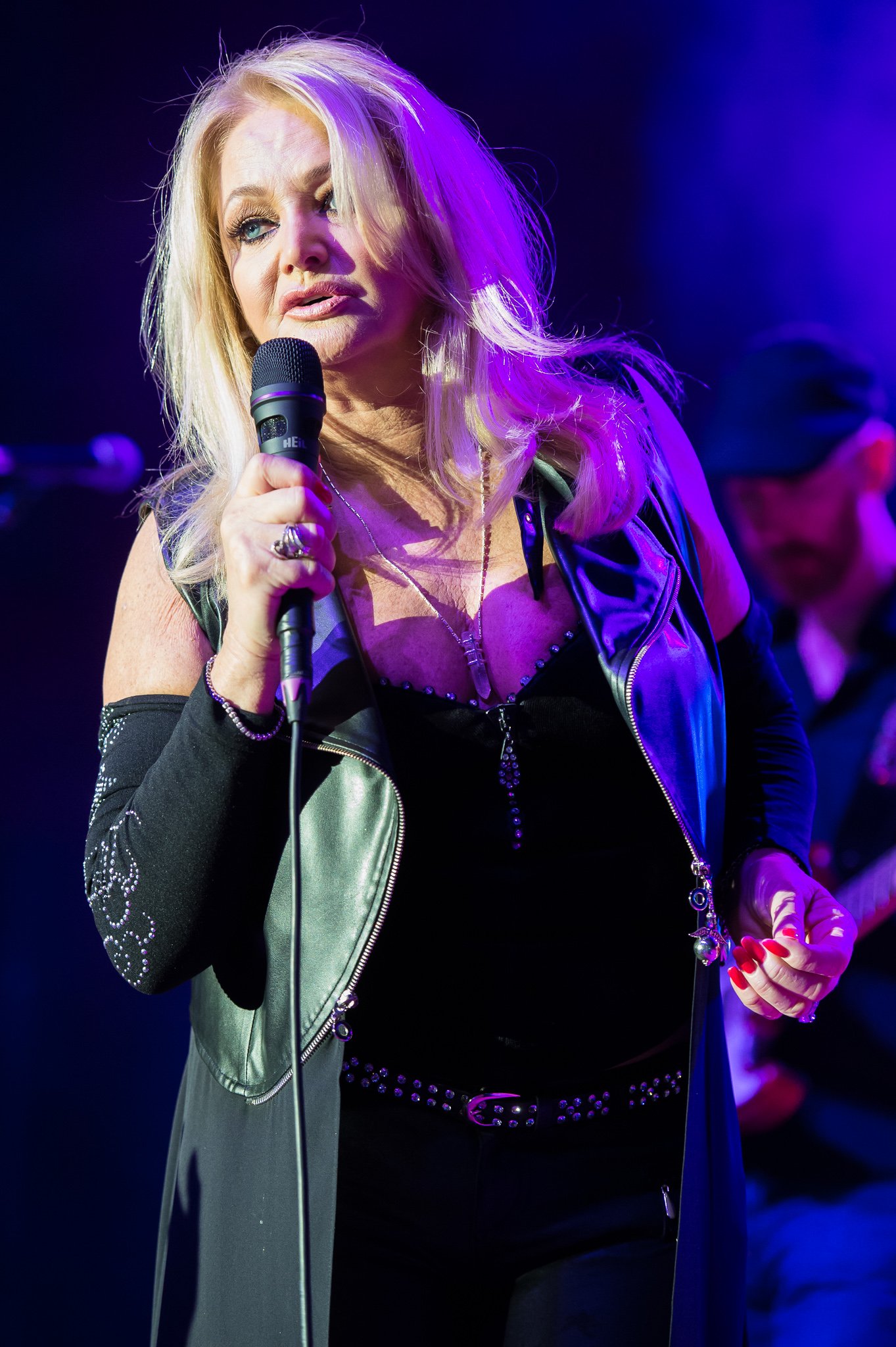
Some songs are written for the radio. Holding Out for a Hero was written for a game of chicken played on tractors, by two teenagers, in a film about a town that had outlawed dancing. That it became one of the most durable anthems of the 1980s — a song that has since rescued scenes in everything from Shrek 2 to a thousand talent-show finales — is down to a perfect collision: a screenwriter who thought in choruses, a composer who thought in cathedrals, and a Welsh singer with a voice like a distress flare.
Bonnie Tyler had just conquered the world once. In 1983, Total Eclipse of the Heart had spent four weeks at number one in America and made her, almost overnight, the queen of the power ballad. The man behind it was Jim Steinman, Meat Loaf’s songwriter and producer, a maximalist who believed a pop song should feel like the end of the world. When Hollywood came calling for Tyler’s next move, she had one condition — and it shaped everything that followed.
A Condition, and a Screenwriter
Paramount Pictures wanted Tyler for the soundtrack of Footloose, its film about Ren McCormack, a city teenager who lands in a small town where rock music and dancing are banned. Tyler agreed to sing — but only if Steinman could be involved. It was a shrewd condition. Steinman was her producer at CBS, the architect of her new sound, and the one man certain to build a song as large as her voice.
The film’s screenwriter, Dean Pitchford, had co-written every song on the soundtrack, pairing his lyrics with a different composer for each track. For the hero number, he went to Steinman. Pitchford’s lyric opened with a question pitched somewhere between a prayer and a personal ad: where have all the good men gone, and where are all the gods? It demanded a streetwise Hercules, a white knight, a man larger than life. Steinman, who never in his life undersold anything, heard it as an invitation to go bigger still.
Built From a Ghost of Steinman’s Past
Steinman’s music arrived with a secret. The galloping piano figure and surging harmonies of Holding Out for a Hero were adapted from Stark Raving Love, a track on his own 1981 solo album Bad for Good — an album largely built from songs intended for Meat Loaf. Recycling was Steinman’s lifelong method: no idea was ever wasted, only reborn at a larger scale. What had been an album track in 1981 became, in Tyler’s hands, a runaway train.
Before recording, Tyler was flown to Paramount’s studios in Los Angeles and shown the film’s rushes so she could feel the scene the song had to power. She later recalled sitting in a small screening room watching the tractor chicken sequence: Kevin Bacon’s Ren and his rival Chuck racing toward each other, Chuck bailing out first — and Ren nearly dragged to disaster because his shoelace had caught on a pedal. It was absurd, dangerous and pure adrenaline, and it told her exactly how to sing the record: like somebody’s life depended on the next ten seconds.
The sessions ran from September to December 1983 at the Power Station in New York, where Total Eclipse of the Heart had been built, with Steinman producing and John Jansen as associate producer. The template was familiar — pounding piano, martial drums, choir-like backing vocals, everything at maximum — but the tempo was new. Total Eclipse had been a slow burn; Hero is a cavalry charge, four and a half minutes of forward motion with Tyler riding the arrangement like a woman who has no intention of being rescued quietly.
Context mattered, too. Pitchford had designed the Footloose soundtrack as a portfolio of specialists — Kenny Loggins for the title song’s joy, other writers for romance and rebellion — and he reserved the film’s most mythic assignment for Steinman. The scene in question was the story in miniature: two boys too proud to back down, a foolish contest that suddenly turns deadly, and a hero who survives not by being strongest but by hanging on when his shoelace betrays him. Pitchford’s lyric went looking for a streetwise Hercules; Steinman’s music supplied the thunder of Olympus; and Tyler’s vocal — rasping, straining, utterly unsentimental — kept the whole confection honest. Gods, in her delivery, sound like something a tired waitress in a small town might pray for at the end of a shift. That collision of the mythic and the mundane is the record’s engine, and it is why the song has never belonged to the film alone.
The Hit That Arrived Late
Footloose opened in February 1984 and its soundtrack became a phenomenon, topping the album chart for weeks. But amid the title track’s stampede, Holding Out for a Hero was the slow starter. Released as a single, it peaked at a modest number 34 on the Billboard Hot 100, and in Britain it managed a single week at number 96 before disappearing. By any normal accounting, that was the end of its story.
It wasn’t. Tyler’s label reissued the song in September 1985, and this time everything connected. Tyler, who was in New York recording her next Steinman album, Secret Dreams and Forbidden Fire, had no idea the reissue had even happened until CBS phoned and invited her onto Top of the Pops — she took the first plane home. The single shot to number two in the UK, held off the top only by David Bowie and Mick Jagger’s Live Aid charity cover Dancing in the Street, and reached number one in Ireland. A song written for a film scene had needed nearly two years to find its chart position, and it got there just as the film itself was becoming a generational touchstone.
The video, filmed in California with scenes at the Grand Canyon, dressed Tyler as a Western heroine pleading for rescue while cameras swooped around her — close enough, she later joked, that a helicopter nearly blew her off the canyon’s edge. In 1986 the song closed her album Secret Dreams and Forbidden Fire, formally taking its place as the second pillar of the Tyler–Steinman partnership.
It is worth pausing on what Tyler herself brought to the recording, beyond obedience to Steinman’s blueprint. Producers built ever larger arrangements around her precisely because the voice could not be drowned: the harder the piano galloped, the harder she pushed back, until the record became a contest between singer and orchestra that the singer, somehow, wins. That quality — desperation with perfect pitch — is what separated her from every other big-voiced balladeer of the decade.
The Song Hollywood Can’t Quit
What happened next is the rarest thing in pop: the song became a permanent piece of cinematic vocabulary. To play Holding Out for a Hero over a montage is to tell the audience, instantly, that someone ordinary is about to attempt something impossible. Jennifer Saunders’ Fairy Godmother hijacked it for the finale of Shrek 2 in 2004, introducing Tyler’s anthem to an entire generation of children. Games, adverts, trailers and television dramas have reached for it ever since — whenever a scene needs courage at full volume, this is the song in the drawer.
The industry recognition caught up eventually. The single climbed the British certifications step by step — silver in 2004, gold in 2019, and platinum in 2021, marking more than 600,000 UK sales and streams for a record that had once stalled at number 96 there. Tyler re-recorded it several times across her career, but no version has ever displaced the original: Steinman’s thunder, Pitchford’s myth-making lyric, and that voice, arriving like the cavalry it describes.
There is a pleasing symmetry in how it happened. A singer who insisted on bringing her own producer. A composer who rescued the music from his own back catalogue. A screenwriter who understood that a tractor race needed a Greek myth. And a hit that refused to keep to the film’s timetable, arriving late, at number two, and then simply never leaving. Bonnie Tyler spent the song holding out for a hero. The song, in the end, made her one.
Leave a Reply