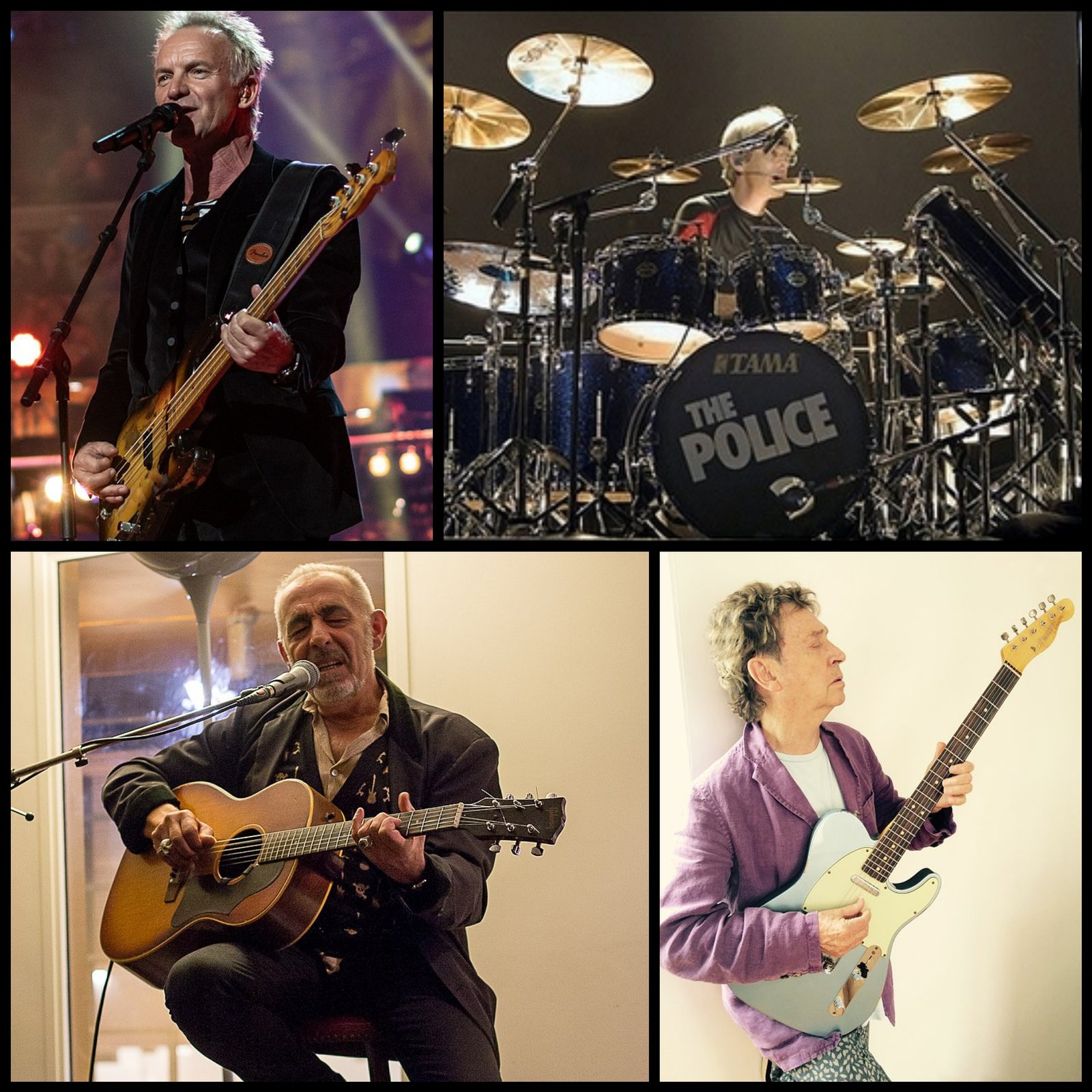
Three musicians, one enormous tour, and a band coming apart
In the summer of 1983, The Police were the biggest band in the world. Their fifth album had just been released, its lead single was on its way to becoming the biggest hit of the year, and they were about to embark on a world tour that would play to stadiums and arenas on several continents. Audiences saw three musicians at the height of their powers: a bassist and singer who wrote songs that sounded like pop and like literature at the same time, a guitarist who could make a few notes sound like a whole orchestra, and a drummer whose playing was as distinctive as any singer’s voice.
What audiences did not see, or saw only in glimpses, was that the band were breaking up even as they became more successful. The tour that made them the biggest band in the world was also their last tour as a working band for more than two decades. It is a story about how success can make a band’s internal tensions worse rather than better, and about how three musicians who made extraordinary music together found it harder and harder to be in the same room.
The Police before Synchronicity
The Police had formed in London in 1977, around Sting, a former teacher from Newcastle who played bass and sang, Stewart Copeland, an American-born drummer raised partly in the Middle East, and Andy Summers, an older guitarist who had played in 1960s bands. Their early sound drew on punk, reggae, and pop, and they built a following through constant touring and through a series of singles that showed Sting’s songwriting gift and the band’s unusual instrumental chemistry.
What made The Police distinctive was that they sounded like a trio, not like a larger band with parts missing. Summers’s guitar did not merely play chords. It created textures, using effects and space in a way that made three instruments sound like many more. Copeland’s drumming was busy, inventive, and instantly recognisable, with rhythms that drew on reggae, jazz, and rock at once. Sting’s bass and voice held the centre, with melodies that were both catchy and literate.
By the early 1980s the band had a run of successful albums and singles, and they were moving from clubs and theatres to arenas. Their fourth album, Ghost in the Machine, showed a darker, more keyboard-led sound, and it suggested that the band were ready for a larger, more ambitious record. That record would be Synchronicity.
Making Synchronicity
Synchronicity, released in June 1983, was recorded in Montserrat, in the Caribbean, a location chosen partly for its isolation and partly for its studios. Recording in Montserrat did not make the band’s tensions disappear. If anything, isolation made them more visible. The three musicians worked increasingly separately, recording their parts at different times, and the album was assembled from performances that were not always made in the same room at the same time.
That working method shows, in a good way, in the finished record. Synchronicity sounds spacious and layered, with songs that range from the famous single about watching and obsession to more experimental tracks about psychology, dreams, and synchronicity itself, a concept Sting had taken from the writings of Carl Jung. The album’s title and themes reflect Sting’s growing interest in literature and psychology, and its songs are more ambitious, lyrically, than the band’s earlier singles.
The album’s lead single became the band’s biggest hit and the biggest hit of 1983 in the United States, where it spent eight weeks at number one. Its success was not without irony. Many listeners heard it as a love song, and it was played at weddings and on romantic radio dedications, even though its lyric is, on closer reading, about obsession and surveillance rather than romance. Sting himself has noted that misunderstanding over the years, and it has become part of the song’s story: a song about watching someone, mistaken for a song about loving them.
The album as a whole became a massive commercial success, reaching number one in several countries and becoming the band’s best-selling record. It also won Grammy Awards, including for the lead single. By the time the band set out on tour, they were not merely successful. They were, for a year, the most successful rock band in the world.
The Synchronicity tour
The Synchronicity tour, which ran from 1983 into early 1984, took the band to North America, Europe, Australia, and elsewhere, playing stadiums and large arenas. The shows were spectacular in the best sense: three musicians, with minimal additional staging, playing songs that filled large spaces through sheer musical skill. Summers’s guitar textures, Copeland’s drumming, and Sting’s voice and bass were enough to fill a stadium, and audiences responded with an enthusiasm that matched the band’s chart success.
But touring at that scale is exhausting, and it is particularly exhausting for a band whose members are barely speaking to each other off stage. The Police’s tensions were not new. Sting, Copeland, and Summers had always been strong personalities with different musical ideas, and their creative disagreements had, in earlier years, produced better music. By 1983, however, those disagreements had hardened into personal distance. The band travelled separately, socialised separately, and, according to later accounts, communicated on stage more easily than they did off it.
That distance did not, for the most part, show in the performances. The band played with precision and power, and audiences left the shows feeling they had seen a great band at its peak. That is part of the tour’s poignancy. The Police on the Synchronicity tour sounded like a band at its peak, and in musical terms they were. In personal terms, they were at the end.
The tour’s final shows, in early 1984, are often described as the band’s last performances as a working group for many years. The band did not announce a formal break-up at the time in the way some bands do. They simply stopped, drifted into solo projects, and did not make another album together. Sting became a hugely successful solo artist. Copeland worked in film music and other projects. Summers continued to record and tour. The Police, as a band, went quiet.
Why the band broke up
There is no single reason The Police broke up, and it is a mistake to look for one. Bands break up for a combination of reasons: creative differences, personal fatigue, the pressure of success, and the simple fact that three people who were once young and hungry are no longer in the same place in their lives. In The Police’s case, all of those factors were present.
Sting, as the band’s principal songwriter, increasingly wanted to explore musical territory that did not fit a three-piece rock band. Copeland and Summers, as musicians of great skill and strong ideas, increasingly wanted more space for their own contributions. Success made those differences harder to resolve, because each member had the financial freedom to pursue solo work and did not need the band in the way they once had. Touring at stadium scale made it harder still, because it left little time or energy for the slow, patient work of writing together.
It is also worth noting that The Police never had the kind of long, settled partnership that some bands have. They were, from the start, a band of strong individuals who happened to make extraordinary music together. That individuality was their strength on record, and it was also, eventually, the reason they could not continue. A band that is built on tension can make great music from that tension, but only for so long.
Reunion, and what it proved
More than two decades later, in 2007, The Police reunited for a world tour. The reunion tour was a commercial success, and it showed that audiences still loved the band’s songs and still wanted to hear them played by the original three musicians. It also showed, more quietly, that the band’s music had outlived their break-up. Songs from the Synchronicity tour sounded as strong in 2007 as they had in 1983, and new, younger audiences discovered them alongside older fans.
The reunion did not lead to a new album, and the band have not recorded together since. That fact is, in its own way, fitting. The Police’s story is not a story about a band that broke up and then fixed itself. It is a story about a band that made extraordinary music for a short period, broke up at the height of its success, and then, years later, reminded audiences why that music mattered. The reunion proved that the songs were bigger than the break-up, which is perhaps the best outcome a broken-up band can hope for.
Listening again
If you listen to Synchronicity again, try listening to it as a trio record first. Notice how little is actually on the record: three instruments, a voice, and space. Then listen to it as a stadium record, and notice how that trio sound fills a large space without needing a large band. That combination — intimacy and scale, tension and beauty — is what made The Police special, and it is why the Synchronicity tour, even as the band were breaking up, sounded like a band at its peak.
What remains
The Police’s Synchronicity tour endures as a paradox: the biggest tour of their career, and their last as a working band for more than twenty years. It shows a band making its best music at the moment when it could no longer stay together, and it reminds us that success does not always save a band. Sometimes it simply makes the reasons for breaking up clearer. The songs, however, survived, and they still fill stadiums, whether played by the original band or sung by audiences on their own.
Three players, three different musical worlds
Part of what made The Police so distinctive, and part of what eventually made them difficult to sustain, was that each member brought a different musical world into the band. Copeland’s drumming drew on reggae, on the Middle Eastern music he had heard growing up, and on a punk-era energy that valued inventiveness over steadiness. Summers’s guitar drew on jazz, on 1960s rock, and on a love of texture and space that made his playing sound orchestral even when he played only a few notes. Sting’s writing drew on literature, on jazz, on pop melody, and on a bass player’s sense of groove.
When those worlds met, the result was a band that sounded like no other trio. A reggae-inflected drum pattern, a jazz-inflected guitar texture, and a pop melody could coexist in a single song without sounding forced, because each musician trusted the others to hold their part of the sound. That trust was the band’s creative engine. It allowed Sting to write songs that were more ambitious than a typical rock song, because he knew Summers and Copeland would find ways to make them work as trio performances, not merely as songs with accompaniment.
That same diversity, however, meant that each member had strong ideas about where the band should go next, and those ideas did not always align. A drummer who loves reggae and a guitarist who loves jazz will not always agree with a songwriter who wants to explore psychology and literature. In earlier years, those disagreements produced better records. By 1983, with stadium tours, solo ambitions, and personal fatigue added to the mix, they produced distance. The band’s diversity was both its genius and, eventually, its limit.
The Synchronicity tour is therefore best remembered not as a failure, but as a peak that could not be sustained — a final year in which three very different musicians played, for the last time in their prime, as one band. Three musicians, each with a different musical world, made a record and a tour that brought those worlds together for a final, brilliant year, and the music they made in that year has outlasted the tensions that ended it.
Sources / further reading
- Published histories of The Police, Synchronicity, and the 1983–84 Synchronicity tour
- Published chart histories for The Police and Synchronicity
- YouTube, “The Police — Every Breath You Take (Official Music Video)”, video ID OMOGaugKpzs
Image credit: Image: Brett Sayles via Pexels, free licence (thematic concert image, not a photograph of The Police)
Leave a Reply