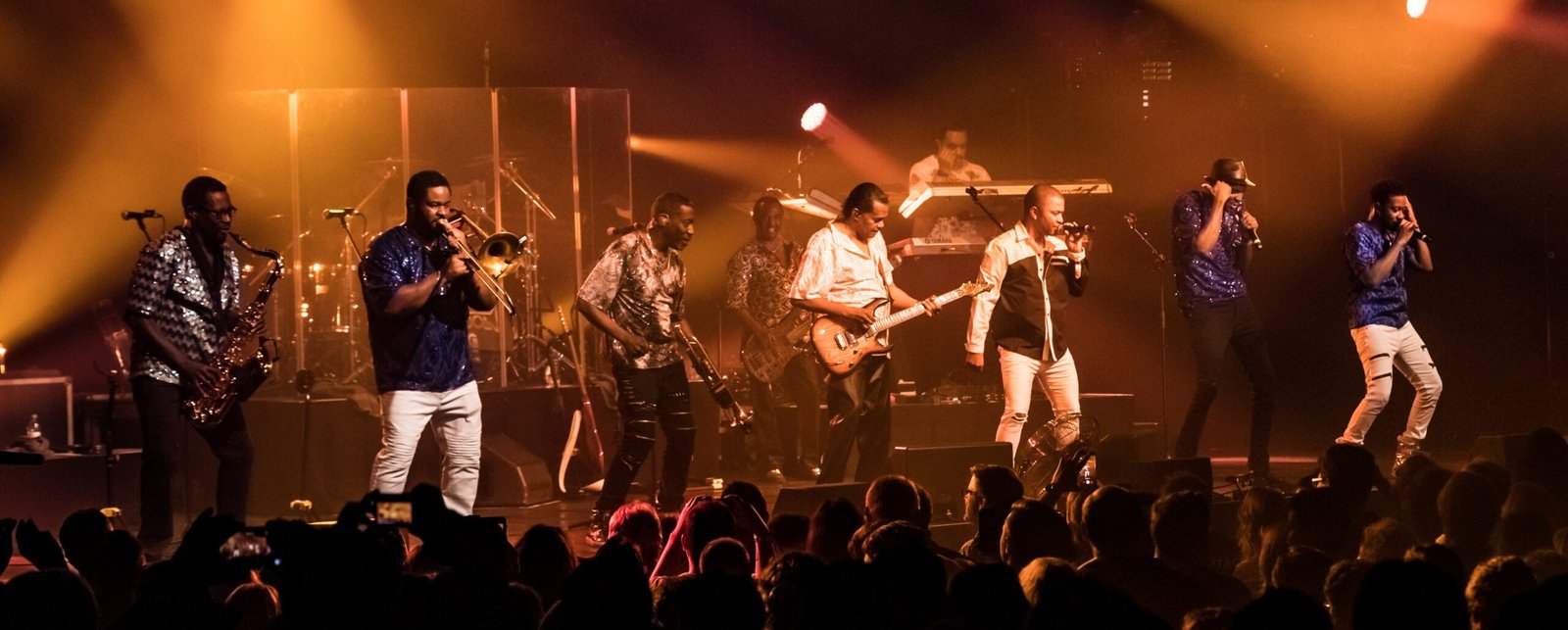
They are the band behind the two songs that get played at nearly every wedding, graduation, and championship celebration on the planet. Yet for most of their early career, Kool & the Gang couldn’t sing a note, couldn’t get arrested, and were named after a case of mistaken identity with James Brown’s band. Before the glittering suits and the global anthems, they were seven teenagers from Jersey City who learned their craft in the shadow of jazz royalty — one of them the godson of Thelonious Monk himself. This is the story of how a scrappy instrumental jazz outfit survived a near-fatal slump, bet everything on a schoolteacher with a smooth voice, and accidentally wrote the most-played party song in history on a tour bus.
The Godson of Thelonious Monk
Robert Bell did not grow up dreaming of disco. Born in Youngstown, Ohio, he moved with his family to Jersey City, New Jersey, where his father Bobby and his uncle Tommy were boxers. The family lived in the same apartment building as Thelonious Monk, the eccentric piano genius of bebop, who took such a shine to young Robert that he became his godfather. Miles Davis would drop by the building too — not to talk music, but because he fancied himself a boxer and wanted to train with the Bell men.
Robert, who gave himself the nickname “Kool” as a way of navigating the street gangs of his new neighborhood, played bass. His younger brother Ronald played keyboards and trumpet. Along with five school friends from Lincoln High School — Robert “Spike” Mickens on trumpet, Dennis “Dee Tee” Thomas on saxophone, Ricky West on keyboards, George “Funky” Brown on drums, and Charles Smith on guitar — they formed an instrumental jazz and soul group in 1964 and called themselves the Jazziacs.
They were serious musicians from the start. Their first gigs were opening a weekly jazz night at a local theater, and they occasionally shared stages with heavyweights like McCoy Tyner, Pharoah Sanders, and Leon Thomas — legends who treated the teenagers as peers. They played Motown covers as the backing band for Soul Town, a small Jersey City outfit modeled on Motown. But watching a show by Willie Feaster and the Mighty Magnificents changed everything. As Robert later recalled, the performance blew them away: if they wanted to be in show business, they couldn’t just stand there and play. They needed a show.
A Name They Almost Didn’t Get to Keep
The band cycled through names like the Soul Town Band and the New Dimensions before landing, in 1967, on a regular gig at the Blue Note Lounge in Jersey. One night the emcee introduced them as Kool & the Flames. The crowd loved it. Their manager, Gene Redd, did not — he warned them that James Brown’s backing band, the Famous Flames, would not take kindly to the confusion. So they swapped one word and became Kool & the Gang.
Redd signed them to his new independent label, De-Lite Records, and produced their debut album, the all-instrumental “Kool and the Gang,” released in 1969. It barely scraped the R&B chart. Worse, the band had a problem no one had told them about: people now expected them to sing. Robert later admitted they sounded “real ragged” with lyrics at first. Bit by bit, gig by gig, they learned how to sing as they went along — a crash course in vocals that would, a decade later, become the foundation of their empire.
Funk’s Golden Moment — and the Crash
By 1973, the band had reinvented itself as a harder, funkier, tighter unit, and the gamble paid off spectacularly. Their fourth album, “Wild and Peaceful,” spawned “Funky Stuff,” “Jungle Boogie,” and “Hollywood Swinging” — the last two cracking the US Top 10 and each selling over a million copies. It was their breakthrough to a white audience, and for a glorious stretch they were one of the funkiest bands in America. “Summer Madness,” a dreamy instrumental from 1974’s “Light of Worlds,” found immortality in the film “Rocky,” and “Open Sesame” landed on the “Saturday Night Fever” soundtrack.
Then came the crash. By the mid-1970s, the band drifted — adding female vocalists, string sections, and disco gloss on albums like “Open Sesame,” “The Force,” and “Everybody’s Dancin’.” The public hated it. One review of “Everybody’s Dancin’” ran under the headline “Kool and the Gang have gone bland,” with the critic declaring they had “joined the disco lemmings” and lost their edge. Robert later confessed they had gotten “too fancy and over-creative” and strayed from the basic Kool & the Gang sound. Gigs dried up. The band that had once shared bills with jazz legends was working “just off and on,” wondering if the party was over.
The Schoolteacher Who Saved the Band
Salvation arrived from two directions at once. First, at the suggestion of promoter Dick Griffey — the man who founded SOLAR Records — the band did something it had resisted for years: it hired a dedicated lead vocalist. The choice was James “J.T.” Taylor, a smooth-voiced singer from South Carolina who had been working as a schoolteacher and singing in local groups around Hackensack, New Jersey. Some members resisted; the female session singers they’d been using weren’t thrilled either. But Taylor brought something the band had never had: warmth. As he later put it, vocals added a new dimension to the songs — especially ballads, which the group had always avoided because nobody in the band could sing them properly.
Second, the band entered a four-album partnership with Brazilian producer, arranger, and jazz-funk star Eumir Deodato. Deodato steered them toward mainstream pop and dance music built on irresistible hooks and chorus lines. Their first choice of producer, incredibly, had been Stevie Wonder — who was simply too busy. Deodato proved to be the perfect second choice.
The first fruit of the new era, “Ladies’ Night” (1979), was their biggest album since the beginning, powered by the title track and “Too Hot.” In January 1980 it was certified platinum for a million US sales — the band’s first platinum album ever. They followed it with “Something Special” and “As One,” completing the four-album Deodato run before deciding they had taken that polished direction as far as it could go and choosing to produce themselves again. But it was the follow-up that changed everything.
“Celebration”: An Anthem Written on a Tour Bus
“Celebration” began life as a throwaway lyric in “Ladies’ Night” — the line “come on, let’s all celebrate.” Robert Bell heard an international anthem hiding inside it. The band developed the song on a tour bus after attending the American Music Awards, with all eight members plus Deodato earning songwriting credits.
Released in October 1980 as the lead single from “Celebrate!,” it became the band’s first and only single to reach No. 1 on the Billboard Hot 100. It was the kind of song that transcended music: it soundtracked the 1980 World Series, the 1981 Super Bowl, the 1981 NBA Finals, and the return of the American hostages from Iran. Decades later it would be inducted into the Grammy Hall of Fame and selected for the Library of Congress’s National Recording Registry — the official archive of recordings deemed culturally and historically significant.
The hits kept coming: “Get Down on It,” “Joanna” — declared the most-played pop song of 1984 — and the “Emergency” album, which sold over two million copies and made Kool & the Gang the only group in 1985 to land four Top 20 singles from a single album. They had gone from “gone bland” to untouchable in under five years.
Wembley, Band Aid, and the Top of the World
At the peak of their powers, the band found itself at the center of pop history’s biggest moments. In June 1984, they took time off from recording “Emergency” to play a sold-out Wembley Stadium concert organized by Elton John. That November, while visiting their label’s London offices, they were in the room when Bob Geldof arrived to pitch his idea for a multi-artist charity single. Kool & the Gang signed on to “Do They Know It’s Christmas?” — the Band Aid record that defined an era of pop conscience and became one of the best-selling singles of all time.
The accolades piled up: two Grammy Awards, seven American Music Awards, a star on the Hollywood Walk of Fame, induction into the Vocal Group Hall of Fame and the New Jersey Hall of Fame, and in 2018, induction into the Songwriters Hall of Fame. They toured the world, opened for Van Halen in 2012, and celebrated their fiftieth anniversary with a world tour in 2014. Through it all, Robert “Kool” Bell kept the machine running, preferring to hire consultants project by project rather than surrender control to full-time management — the band owned its business as fiercely as it owned its sound.
The Last of the Original Gang
Success, though, could not stop time. Taylor eventually departed to pursue a solo career, and the 1990s and 2000s brought a slower, steadier rhythm of touring and recording. Then came the losses. Ronald Bell — the band’s primary composer and producer, the architect of so many of those hits, who had gone by the name Khalis Bayyan — died suddenly in September 2020 at 68. Less than a year later, in August 2021, founding saxophonist Dennis “Dee Tee” Thomas — the band’s onstage master of ceremonies, the man who styled their clothes, and the father of actress Michelle Thomas — died peacefully in his sleep at 70, just weeks after playing the Hollywood Bowl. In November 2023, drummer George “Funky” Brown lost his battle with lung cancer at 74.
Today, Robert “Kool” Bell is the last surviving member of the original lineup, still carrying the band into its seventh decade. The 2023 album “People Just Wanna Have Fun,” released for the band’s sixtieth anniversary, featured some of the final studio work of Ronald and Dennis. In October 2024, Kool & the Gang was inducted into the Rock & Roll Hall of Fame — six decades after seven school friends picked up their instruments in Jersey City, and a fitting crown for a group that has sold more than 70 million albums worldwide.
From the godson of Thelonious Monk to the kings of the wedding dance floor, theirs is one of the great American comebacks in popular music: a band that lost its way, found its voice in a schoolteacher, and wrote the song the whole world sings when it has something to celebrate. Not bad for a group that started out unable to sing at all.
Leave a Reply