
The Everly Brothers were Don Everly, born Isaac Donald Everly on 1 February 1937 in Brownie, Kentucky, and Phil Everly, born Phillip Everly on 19 January 1939 in Chicago, Illinois, two brothers who, as children, sang with their parents on the radio, and who, as young men, became the most influential harmony duo in the history of rock and roll. Their voices, blended in close harmony — Don singing the lower part, Phil singing a third above him — created a sound that was, at the same time, sweet and melancholic, country and pop, intimate and commercial, and that sound became a model for generations of singers, from the Beatles to Simon and Garfunkel to the Beach Boys. Their career, which began in the mid-1950s and continued, with interruptions, for more than fifty years, included some of the great songs of the early rock era: “Bye Bye Love” in 1957, “Wake Up Little Susie” in 1957, “All I Have to Do Is Dream” in 1958, “Bird Dog” in 1958, “Cathy’s Clown” in 1960, and many others. But their story is not only a story of hits; it is a story of brothers, of a family act that became a pop phenomenon, of a harmony that was, in a literal sense, a blood relationship, and of a partnership that, for all its beauty, was also marked by tension, separation, and, in the end, reconciliation.
Don and Phil Everly grew up in a musical family. Their father, Ike Everly, was a coal miner and a talented guitarist who played in a style that influenced later country guitarists, and their mother, Margaret, sang. As children, Don and Phil performed with their parents on a radio show in Iowa, the “Everly Family Show”, singing country songs, gospel songs, and popular songs, and learning, from an early age, how to harmonise, how to blend, and how to perform for an audience. That early training mattered, because close harmony is not a skill that can be learned quickly; it requires years of singing together, of learning each other’s breathing, phrasing, and pitch, until two voices sound like one voice with two parts. Don and Phil had that training, and they had something else besides: they were brothers, and their voices, which were similar in timbre, blended in a way that unrelated singers rarely achieve. When they sang together, the harmony did not sound like two people singing; it sounded like a single, richer voice, with a depth and a warmth that a solo singer could not produce.
Nashville, Cadence, and the First Hits
In the mid-1950s, Don and Phil moved to Nashville, Tennessee, then as now the centre of country music, and they began to work as songwriters, writing songs for other artists and trying, themselves, to get a recording contract. They were signed, in 1957, to Cadence Records, a small label run by Archie Bleyer, and their first major hit, “Bye Bye Love”, written by Felice and Boudleaux Bryant, a husband-and-wife songwriting team who would become the Everlys’ most important collaborators, reached number two on the pop chart and number one on the country chart, a crossover success that was, at the time, still unusual. The record’s sound — acoustic guitars, a steady beat, and the brothers’ close harmony — was new, and it was influential, because it showed that country-influenced music, sung in harmony, could be a pop hit, and that a duo, rather than a solo singer or a large group, could be a major commercial force.
“Bye Bye Love” was followed, later in 1957, by “Wake Up Little Susie”, also written by the Bryants, a song that became the Everlys’ first number-one pop hit and one of the most famous songs of the early rock era. The song tells, in a light-hearted way, the story of a boy and a girl who fall asleep at a drive-in movie, wake up late, and worry about what their parents and friends will think. The lyric, which is, by modern standards, innocent — the couple have done nothing more than fall asleep — was, at the time, considered suggestive by some radio stations, and the record was banned by some stations in Boston and elsewhere, a ban that, as often happens, only increased its popularity. The record’s success was not due to controversy alone; it was due, above all, to the singing. Don and Phil sang “Wake Up Little Susie” with a bright, energetic harmony, with a rhythmic drive that made the song danceable, and with a sense of fun that made it instantly appealing to teenagers. It was a perfect pop record, in the sense that it was short, catchy, and memorable, and it established the Everlys as stars.
The hits continued through the late 1950s and into the early 1960s, with the Bryants writing many of them and with the Everlys’ harmony becoming, increasingly, a trademark. “All I Have to Do Is Dream”, released in 1958, was a slow, dreamy ballad, sung with a tenderness that showed a different side of the brothers, and it reached number one in both the United States and Britain, becoming one of the best-selling records of the year. “Bird Dog”, also in 1958, was a fast, playful number about a boy who steals another boy’s girl, sung with a humour and a rhythmic bounce that made it a favourite with young audiences. “Devoted to You”, “Problems”, and “Til I Kissed You” followed, each showing a different facet of the brothers’ style, from ballad to up-tempo rocker, and each, in its way, a demonstration of how versatile close harmony could be. By 1960, the Everlys had moved to Warner Bros. Records, where they recorded “Cathy’s Clown”, written by Don, which became their biggest-selling single, reaching number one in both the United States and Britain, and “Let It Be Me”, a ballad that showed their harmony at its most beautiful.
The Harmony Itself: How It Worked
It is worth pausing to describe, in plain terms, what made the Everly harmony so distinctive, because it is easy to hear it and to enjoy it without understanding why it works. Close harmony, as the Everlys practised it, involves two voices singing notes that are close together — usually a third apart — so that the harmony is tight, warm, and, to the ear, almost like a single voice with a rich texture. Don, the older brother, sang the lower part, which was usually the melody, and Phil, the younger brother, sang the higher part, a third above Don, which added brightness and lift to the sound. The result was a harmony that was, at the same time, simple and sophisticated: simple, because it used only two voices and a small interval; sophisticated, because the two voices had to be perfectly in tune, perfectly in time, and perfectly matched in tone, or the harmony would sound sour. Don and Phil, who had sung together since childhood, achieved that matching to a degree that few other duos have matched, and their records, even today, sound remarkably clean and precise.
That precision was not accidental; it was the result of years of practice, of singing together in a family act, of learning each other’s habits, and of a musical instinct that, in both brothers, was highly developed. Don, who was the more dominant personality and the more prolific songwriter, often led the harmony, while Phil, who was quieter and, by many accounts, the more naturally gifted singer, provided the higher part with a sweetness that balanced Don’s earthier tone. The combination — Don’s warmth and Phil’s brightness — gave the Everlys a sound that was both grounded and airborne, both country and pop, both intimate and commercial. Later harmony groups, from the Beatles, who covered Everly songs and who, in their early years, sang in a similar close harmony, to Simon and Garfunkel, who cited the Everlys as a major influence, to the Beach Boys, whose harmonies, while more complex, owe a debt to the Everlys’ example, have all, in different ways, built on what Don and Phil did.
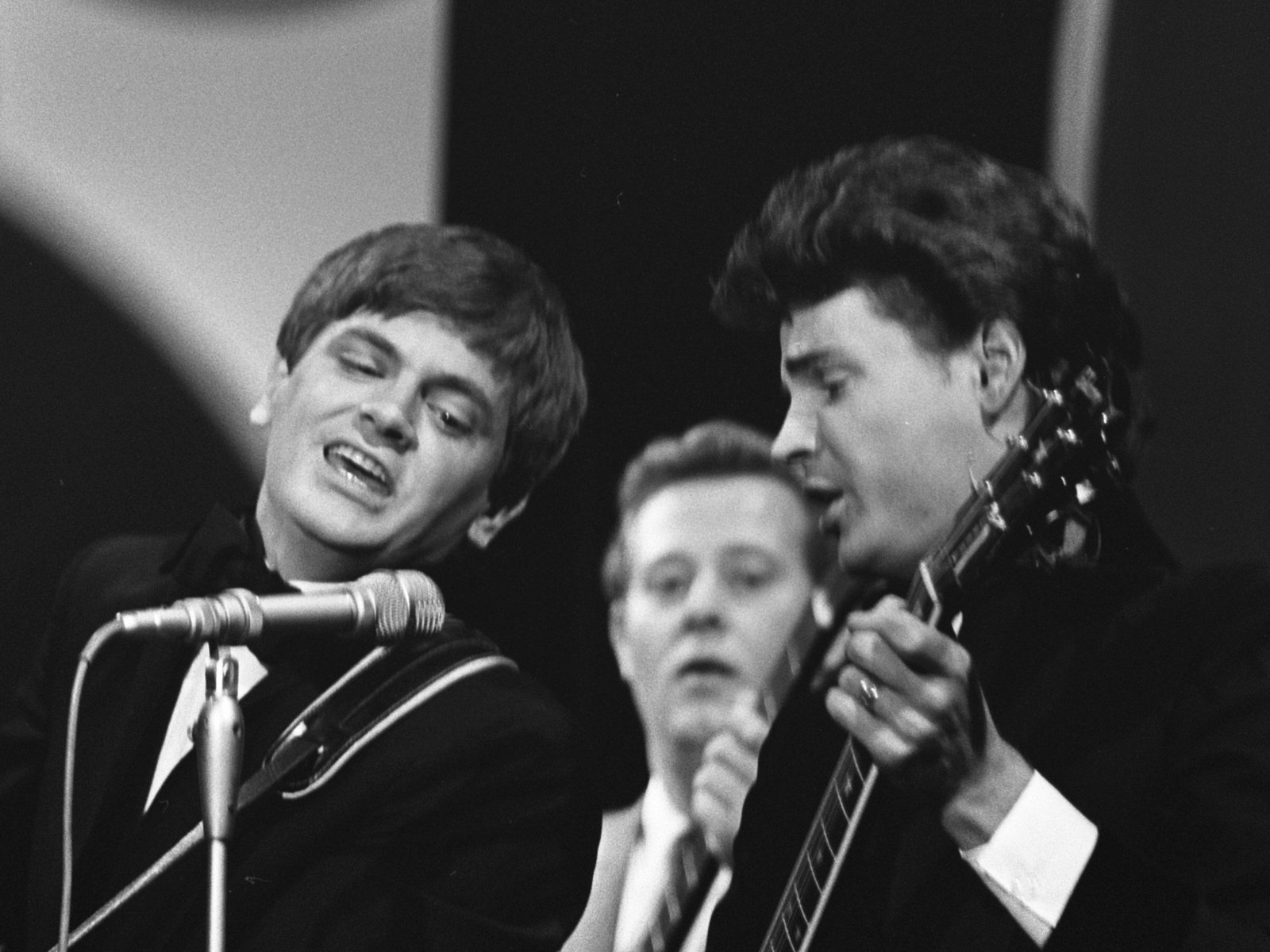
The Everlys’ guitar playing also deserves mention. Don played a Gibson J-200 acoustic guitar, and Phil played a similar instrument, and their guitar work, which was rhythmic and melodic at the same time, provided the foundation for their harmonies. They were not virtuoso guitarists in the manner of a jazz player, but they were excellent rhythm guitarists, and their playing, like their singing, was tight, clean, and perfectly matched. In live performance, they often played acoustic guitars, standing close together, singing into a single microphone or into two microphones placed close together, so that their voices blended naturally, without electronic assistance. That live sound — two brothers, two guitars, two voices, close together — became an image of the Everlys that has endured, and it remains, for many listeners, the quintessential image of close harmony in popular music.
Breakup, Solo Years, and Reunion
By the mid-1960s, the Everlys’ commercial fortunes had declined, as musical fashions changed and as new groups, many of whom had learned from the Everlys, took their place. The Beatles, the British Invasion, and the rise of folk-rock and psychedelia all contributed to a market in which a close-harmony duo from the 1950s seemed, to many young listeners, old-fashioned. The brothers themselves, who had worked together since childhood, were also growing apart, personally and musically. Don wanted to explore different styles, Phil wanted to pursue his own songwriting, and the pressures of a long partnership, combined with the stresses of touring, recording, and family life, began to tell. In 1973, after a performance at Knott’s Berry Farm in California, Phil smashed his guitar and walked off stage, and Don announced, on stage, that the Everly Brothers were finished. The breakup, which was painful and public, lasted for ten years, during which both brothers pursued solo careers, with mixed success, and during which the question of whether they would ever sing together again became a matter of speculation among fans.
The reunion, when it came in 1983, was a major event. Don and Phil reunited for a concert at the Royal Albert Hall in London, a concert that was recorded and released as an album, and that showed, to the surprise of some and the delight of many, that their harmony had survived the separation intact. They continued to perform together, intermittently, for the next two decades, recording new albums, including “EB 84”, produced by Dave Edmunds, and touring, often to audiences who had grown up with their records and who greeted them with affection and nostalgia. They were inducted into the Rock and Roll Hall of Fame in its first class in 1986, alongside Chuck Berry, Little Richard, Elvis Presley, and others, and they received, in their later years, the recognition that their early work deserved, including a Grammy Lifetime Achievement Award in 1997. Phil died on 4 January 2014, at the age of seventy-four, from complications of chronic obstructive pulmonary disease, and Don died on 21 August 2021, at the age of eighty-four. Their deaths, seven years apart, marked the end of one of the great partnerships in popular music, a partnership that had begun in childhood, on a radio show in Iowa, and that had lasted, with a ten-year interruption, for more than half a century.
To listen to the Everlys today is to hear a sound that is, in a sense, timeless, because it is based not on fashion but on the human voice, on the blend of two voices that, by birth and by practice, fit together perfectly. Their songs — “Bye Bye Love”, “Wake Up Little Susie”, “All I Have to Do Is Dream”, “Cathy’s Clown” — are still played, still covered, and still recognised, not because they were hits in their day, although they were, but because they are well made, well sung, and, in their harmony, beautiful in a way that transcends their era. They showed that two voices, singing close together, could be as powerful as a whole orchestra, and that a song, sung by brothers, could sound like a single voice, speaking directly to the listener. That is the Everlys’ legacy, and it is why, more than sixty years after “Wake Up Little Susie”, their harmony still wakes listeners up, still makes them smile, and still reminds them of what popular music, at its best, can be: two people, singing together, in perfect tune.
Sources / further reading
- Reference entries on the Everly Brothers (Don, 1937–2021; Phil, 1939–2014), Ike Everly, Cadence Records, Archie Bleyer, and Felice and Boudleaux Bryant.
- Rock and Roll Hall of Fame: The Everly Brothers, inducted 1986, first class; Grammy Lifetime Achievement Award, 1997.
- Contemporary chart accounts for “Bye Bye Love”, “Wake Up Little Susie” (1957, first pop number one), “All I Have to Do Is Dream” (1958), and “Cathy’s Clown” (1960, Warner Bros.).
- Accounts of the 1973 Knott’s Berry Farm breakup and the 1983 Royal Albert Hall reunion.
Image credit: Image: Thibault Trillet via Pexels, free licence (thematic singer with guitar and bass, not a photograph of the Everly Brothers).
Leave a Reply