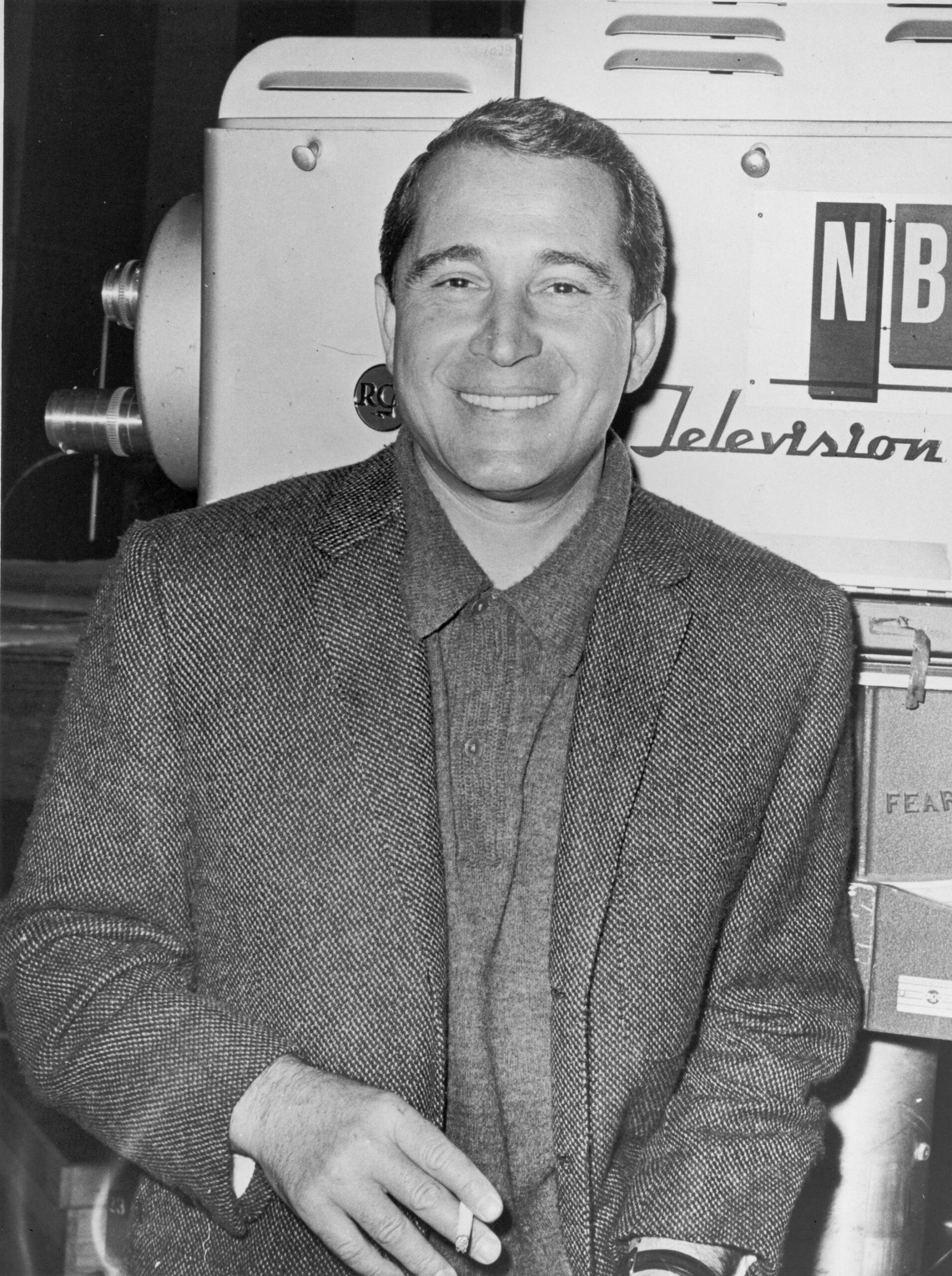

Perry Como was born Pierino Ronald Como on 18 May 1912, in Canonsburg, Pennsylvania, a coal town south-west of Pittsburgh, the seventh of thirteen children of Italian immigrants. His father worked in the steel mills, and the family, like many immigrant families of the time, lived close to the edge of poverty. Como’s first trade was not music but barbering. He opened his own barber shop in Canonsburg as a teenager, and he later liked to say that the shop taught him how to talk to people, how to listen, and how to be at ease with strangers — skills that would serve him, unexpectedly, on television. He sang in church and in local groups, and his voice, a warm baritone with an easy, unforced quality, attracted attention. In 1933 he joined the Ted Weems orchestra as a singer, touring and recording with the band, and learning the discipline of a working musician: night after night, town after town, with no room for temperament.
In 1943 Como signed with RCA Victor, a relationship that would last for forty-four years, an extraordinary run of loyalty in an industry built on short contracts. His first hits came quickly: “Till the End of Time” (1945), based on Chopin’s Polonaise, went to number one, and a string of ballads followed — “Prisoner of Love” (1946), “Surrender” (1946), “Chi-Baba, Chi-Baba” (1947). Como’s style was the opposite of showy. He did not belt, he did not swoop, he did not try to overwhelm a song. He sang it as if he were speaking to one person, quietly, in a room, and the microphone, which had made the crooner possible, was his natural instrument. Bing Crosby, the dominant popular singer of the era, was a model, but Como was softer, less jazzy, more intimate. Where Crosby swung, Como soothed. Where Sinatra, a decade younger, would bring drama and edge to a ballad, Como brought calm. That calm became his trademark, and, in time, his joke: critics called him “Mr. Nice Guy” and “the Relaxed One,” and Como, who had a dry sense of humour, accepted the labels with a smile.
From radio to the living room
Como’s move to television was, in retrospect, inevitable, because television needed exactly what he offered: a performer who did not seem to be performing. His radio show, The Chesterfield Supper Club, which began in 1944, had already made him a household voice. When television arrived, Como adapted without apparent effort. The Perry Como Show ran, in various forms, from 1948 to 1963, and The Kraft Music Hall, which he hosted from 1959 to 1967, became one of the most popular variety shows in America. The format was simple: Como sang, introduced guests, chatted briefly, and sang again. There were no elaborate production numbers, no frantic comedy, no sense of a star working hard to impress. Como wore a cardigan sweater, sat on a stool or stood by a piano, and sang as if the audience were guests in his home. The cardigan became famous in itself, a symbol of a kind of unpretentious stardom that television, in its early years, rewarded. Viewers trusted him because he did not seem to want anything from them except their company for an hour.
That trust was not an accident. Como was, by all accounts, genuinely unpretentious. He lived quietly, married his childhood sweetheart, Roselle Belline, in 1933, and stayed married to her for sixty-five years, until her death in 1998. He raised three children, played golf, went to church, and avoided the nightclub world that consumed many singers of his generation. He did not drink heavily, did not chase headlines, and did not cultivate a glamorous image. When he won Emmy Awards — five in total, including awards for Best Male Singer and for his show — he accepted them with the same low-key grace he brought to a song. The contrast with the more turbulent lives of his contemporaries was part of his appeal, but it was also, for a time, a problem for his reputation. Critics who valued drama and innovation sometimes dismissed Como as bland, as a singer for people who did not really like music. That judgement, which Como bore without complaint, missed the difficulty of what he did. Singing simply, without tricks, and making it sound effortless, is one of the hardest things in popular music, and Como did it for half a century.
Catch a Falling Star and the first gold record
Como’s catalogue is full of records that, taken one by one, seem modest, but taken together, amount to one of the great careers in American popular song. “Catch a Falling Star,” recorded in 1957, is a good example. Written by Paul Vance and Lee Pockriss, the song is a gentle, lilting ballad, and Como’s version, with its easy swing and its unhurried vocal, became a hit. It also became a piece of music-industry history: it was the first single ever to be certified gold by the Recording Industry Association of America, when the RIAA introduced its gold-record certification in 1958. The award recognised sales of a million copies, and it marked a moment when the record business began to measure success in a formal, public way. That the first gold single should belong to Perry Como, the least boastful star in the business, seemed fitting to many observers, and Como himself treated the honour with characteristic understatement.
Other records tell the same story of quiet durability. “It’s Impossible,” recorded in 1970, was an English version of the Mexican song “Somos Novios,” written by Armando Manzanero, with lyrics by Sid Wayne. Como’s version reached the top ten on the Hot 100 and number one on the Easy Listening chart, and it introduced him to a younger audience that had grown up with rock and roll but still recognised a beautiful melody when it heard one. “And I Love You So,” recorded in 1973, written by Don McLean, became another late-career standard, and Como’s version is still the one many listeners think of first, ahead of McLean’s own. “Magic Moments” (1957), written by Burt Bacharach and Hal David, and “Round and Round” (1957) were further hits that showed Como’s ability to sing contemporary material without changing his style. He did not chase trends. He waited for good songs, sang them plainly, and let the songs do the work.
The long television years
The television years deserve a closer look, because they are where Como’s influence was greatest and least understood. In the 1950s and 1960s, television variety shows were the main way American families encountered popular music, and the host of such a show was, in effect, a curator. Como used that role with taste. His guests included singers, dancers, comedians, and classical musicians, and he introduced them with a warmth that made the show feel like a gathering rather than a competition. He was also, crucially, a singer who could sing with anyone, in any style, without making it about himself. Duets with guests were a regular feature, and Como’s gift in a duet was to listen, to blend, and to let the other singer shine. That generosity, which sounds simple, is rare among stars, and it made his show a place where younger singers wanted to appear.
Como also pioneered, without making a fuss about it, a style of television performance that later hosts would copy: the informal, living-room manner, the cardigan, the stool, the sense that the camera had simply dropped in on a rehearsal. Before Como, television singers often performed as if they were on a stage, projecting to a theatre audience. Como performed as if he were in the viewer’s home, and the viewer, sitting at home, felt addressed directly. That intimacy, which seems natural now, was a discovery, and it depended on Como’s barber-shop training in talking to strangers as if they were friends. He never raised his voice on television, never hurried a song, and never seemed anxious about ratings. The ratings, for a long time, took care of themselves, because audiences, faced with a choice between excitement and company, often chose company.
The later years and the quiet farewell
Como’s television career wound down in the late 1960s, as variety shows gave way to other formats, but his recording career continued, and he remained a concert draw, particularly in Britain and Ireland, where his audience was fiercely loyal. He recorded Christmas albums that became seasonal standards — his Christmas shows and records, with their mix of sacred and popular songs, were a staple of American December for decades — and he continued to tour, often with his family, until the late 1990s. He received a Kennedy Center Honor in 1987, and a Grammy Lifetime Achievement Award was among the honours that recognised a career that had, by then, spanned six decades. He died on 12 May 2001, at the age of eighty-eight, at his home in Jupiter, Florida, six days before his eighty-ninth birthday, and a few years after the death of his wife. The obituaries called him, as they always had, the relaxed crooner, Mr. Nice Guy, the man in the cardigan, and they meant it as praise.
There is a temptation to treat Como as a figure from a simpler time, and to leave him there. That would be a mistake, because the simplicity was the achievement. In an industry that rewards novelty, volume, and self-promotion, Como built a career on steadiness, taste, and kindness, and he sustained it longer than almost any of his contemporaries. He sang love songs without irony, Christmas songs without sentimentality, and popular songs without condescension, and he did it in a voice that never seemed to strain. Listeners who grew up with him remember not a single great performance but a presence: a man on a television screen, in a cardigan, singing as if he had all the time in the world, and making the viewer feel that they did too. That presence is why Perry Como, the barber from Canonsburg who became the most trusted voice in American living rooms, still matters, and why his records, played today, still sound less like history than like company.
Christmas, and the songs that marked the year
Como’s Christmas records deserve a section of their own, because for many American families they were the sound of December. He recorded “Home for the Holidays” in 1954, a song written by Robert Allen and Al Stillman, and it became a seasonal standard, played on radio every December for decades, and still played today. He recorded Christmas albums, hosted Christmas television specials, and sang carols and popular Christmas songs with the same calm, unhurried manner he brought to everything else. The Christmas specials, in particular, became a ritual: families gathered to watch Como, in a sweater, by a fire or a tree, singing songs that marked the season without turning it into a spectacle. In an era when Christmas television became louder and more elaborate, Como’s specials remained quiet, and audiences loved them for it. The specials were also, notably, family affairs: Como’s wife and children sometimes appeared, and the tone was that of a home, not a studio.
That domestic quality was not a marketing invention. Como’s home life, by all accounts, was genuinely quiet and stable, and he protected it. He did not live in Hollywood or New York full-time, preferring his homes in Florida and in New York State, and he did not cultivate the nightlife that many stars of his generation treated as part of the job. He played golf, a game he loved and played well — he was a keen golfer who played in celebrity tournaments — and he spent time with his family, his church, and his friends from Canonsburg. When he was asked, as he often was, about the secret of his long marriage and his long career, he answered with the same simplicity he brought to a song: he liked his work, he liked his home, and he saw no reason to make either complicated. That answer, which sounds like a platitude, was in fact a philosophy, and it explains why Como, unlike many of his contemporaries, did not burn out, break down, or become bitter. He sang, he went home, and he sang again the next day, for fifty years.
Como’s influence on later singers is quieter than Sinatra’s or Crosby’s, but it is real. Singers who value phrasing over power, intimacy over drama, and steadiness over novelty — from Andy Williams, who followed a similar path, to the many easy-listening and adult-contemporary singers of the 1970s and beyond — owe something to Como’s example. He showed that a singer could be a star without being a spectacle, that a television show could be a gathering rather than a contest, and that a career could be built on trust rather than on shock. In an age of louder, faster, and more self-conscious stardom, that example looks, if anything, more valuable than it did in Como’s own time. The cardigan, the stool, and the quiet voice were not a lack of ambition. They were a choice, made early and kept for a lifetime, and they are why Perry Como is still remembered not as a relic but as a presence.
Sources
- Perry Como biography, Country Music Hall of Fame and Grammy Awards records
- Recording Industry Association of America, gold-record certification history for “Catch a Falling Star” (1958)
- Emmy Awards records for The Perry Como Show and Kraft Music Hall
- Kennedy Center Honors records, 1987
- Contemporary profiles and obituaries of Perry Como (2001)
- RCA Victor recording history for Perry Como, 1943–1987
Image credit: Vintage NBC microphone, CC0, Daderot, via Wikimedia Commons (thematic image, not a photograph of Perry Como).
Leave a Reply