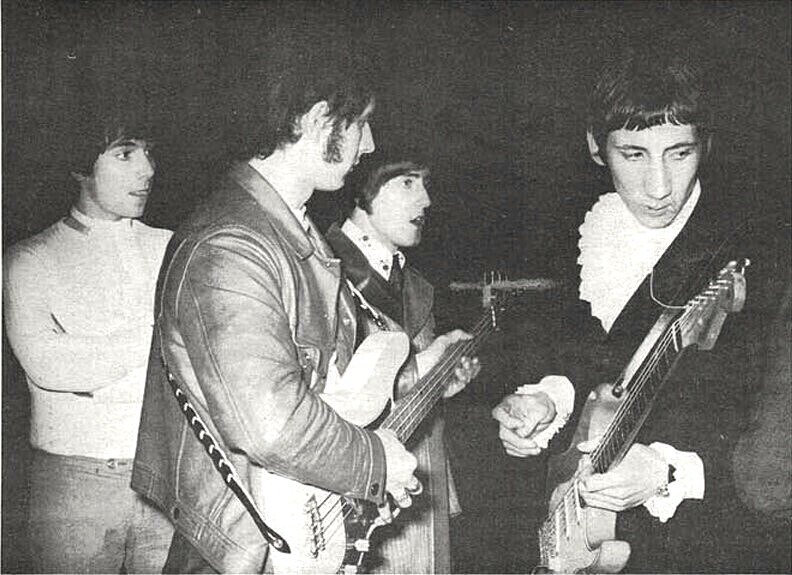
People try to put us down — just because we get around. It is the most famous opening gambit in British rock, and it very nearly never happened. When Pete Townshend wrote My Generation in 1965, he was twenty years old, and by his own later account he was lost: a gangly art student turned guitarist who had no idea where he fitted into the world, only a burning certainty that the world was not going to make room for him. The song he wrote about that feeling started life as a slow blues, was rejected by almost everyone who heard it, and was rescued by an accident in the studio — a lead singer who had never rehearsed it and could not hear himself sing. The accident became the hook. The hook became an anthem. And the anthem became the defining statement of a generation that rock music had only just learned to speak for.
This is how My Generation was made: slowly, reluctantly, and then, in one inspired afternoon at IBC Studios in London, all at once.
A Blues Song Nobody Wanted
Townshend — who later said he wrote the song on a train — began with something far removed from the finished record. The earliest versions of My Generation were slow, brooding talking-blues pieces, modelled in part on the Mose Allison style the band would soon cover outright in Young Man Blues, and echoing John Lee Hooker’s Stuttering Blues. Townshend made demo after demo through the middle of 1965, reshaping the lyric and the tempo, and the song kept growing faster and angrier. One widely told story holds that part of his fury came from a very specific insult: the Queen Mother, passing through Belgravia on her daily drive, was said to have taken offence at Townshend’s 1935 Packard hearse parked on the street and had it towed away. Whether or not the tale is literally true, Townshend liked telling it, because it captured exactly what the song was about — the old world clearing the young out of its way.
The band, remarkably, did not want to know. Co-manager Chris Stamp heard the potential immediately and spent, by his own account, at least two months persuading Roger Daltrey and the others that the song was worth recording. Daltrey was unenthusiastic; the song sat awkwardly between blues and pop, and nothing about it resembled the R&B covers the band had built its live reputation on. An early attempt at cutting it in August 1965, at the City of London Studios, came to nothing. The song survived because Stamp would not let it die, and because manager Kit Lambert had one crucial idea: speed it up. Played fast, the lyric stopped sounding like a complaint and started sounding like a confrontation.
October 13, 1965: The Happy Accident
The definitive session took place on October 13, 1965, at IBC Studios, with producer Shel Talmy behind the desk. Talmy — the American who had already given the Kinks their raw, distorted sound — recorded the Who the way they played live: loud, fast, and pushing against the edges of the equipment. A few run-throughs were attempted in straightforward fashion. Then came the stutter.
Daltrey had not rehearsed the song properly, and in the studio he could not hear his own voice through the monitors. As he fought to fit Townshend’s dense, tongue-twisting lyric to the racing music, his delivery fractured into a stop-start snarl: people try to put us d-down. It sounded like a young mod on amphetamines, tripping over his own fury — which, Lambert immediately recognised, was precisely the point. He urged Daltrey to lean into it, to stutter more. Talmy, delighted, called it one of those happy accidents and insisted it stay. The implication hovering over every f-f-fade away — a swear word the band never quite sang — gave the record a danger that radio could feel but could not quite ban.
Around that vocal, the band built something genuinely new. John Entwistle, who had broken strings on his Danelectro bass and been forced onto a Fender Jazz Bass, played what became one of the first featured bass solos on a pop record — not accompaniment but a lead voice, trading blows with the vocal. The song keeps ratcheting upward, modulating through a staircase of keys toward C, while Keith Moon’s drumming grows steadily more unhinged and Townshend’s guitar dissolves into feedback at the close. Session pianist Nicky Hopkins adds rolling colour underneath. In under three minutes, the record manages to sound like a band fighting itself — which, everyone involved would cheerfully admit, was not far from the truth.
Banned, Then Number Two
Brunswick released My Generation in the United Kingdom on October 29, 1965 — backed, fittingly, with the band’s version of James Brown’s Shout and Shimmy, though American buyers got Townshend’s Out in the Street on the flip instead — and promptly ran into trouble: the BBC initially refused to play it, on the grounds that the stutter might offend listeners who stammered. The refusal did not survive contact with the public. Demand forced the corporation to reverse itself, and the single climbed to No. 2 on the UK chart — kept from the summit only by the Seekers’ The Carnival Is Over — becoming the Who’s highest-charting British single. In America, where Decca released it a few weeks later, it stalled at No. 74, an early sign of how long the band’s conquest of the United States would take. The song lent its name to the Who’s debut album, released that December, and its most quoted line — hope I die before I get old — instantly became the most cited lyric of the decade.
It is worth pausing on how radical the record sounded in the Britain of late 1965. Pop singles were not supposed to have bass solos. They were not supposed to end in feedback and wreckage. They were certainly not supposed to feature a singer who sounded as though he could barely control himself. My Generation broke all three rules in under three minutes, and it did so a full decade before punk — which is why, when punk arrived, its architects queued up to cite the Who as godfathers. The record did not just express teenage frustration; it invented a grammar for it, one built out of volume, sarcasm, and the refusal to enunciate politely. Every singer who has ever spat a lyric through clenched teeth is, knowingly or not, working in Daltrey’s shadow.
The Line That Followed Them Forever
No band has ever been more thoroughly haunted by one sentence. Townshend spent decades explaining, qualifying, and occasionally regretting the line, pointing out that it was never a literal death wish but a refusal to grow old in spirit — to become the kind of person who puts the young down. The irony, of course, is that the Who grew old performing it: My Generation stayed in their set for the rest of their career, stretching out in concert — the version on Live at Leeds is a fourteen-minute epic that absorbs whole other songs — while its studio original was canonised. Rolling Stone placed it eleventh on its list of the 500 Greatest Songs of All Time, and it was inducted into the Grammy Hall of Fame.
What endures, though, is not the ranking but the record’s construction: a masterpiece assembled from rejection and malfunction. The songwriter thought nobody understood him. The singer thought the song was not worth rehearsing. The stutter was a man struggling to hear himself. The bass solo was a substitute instrument. The BBC thought it was offensive. Every single thing that went wrong with My Generation turned out to be the thing that made it immortal — the sound of four young men who could not get the words out fast enough, and in failing, said everything.
Leave a Reply