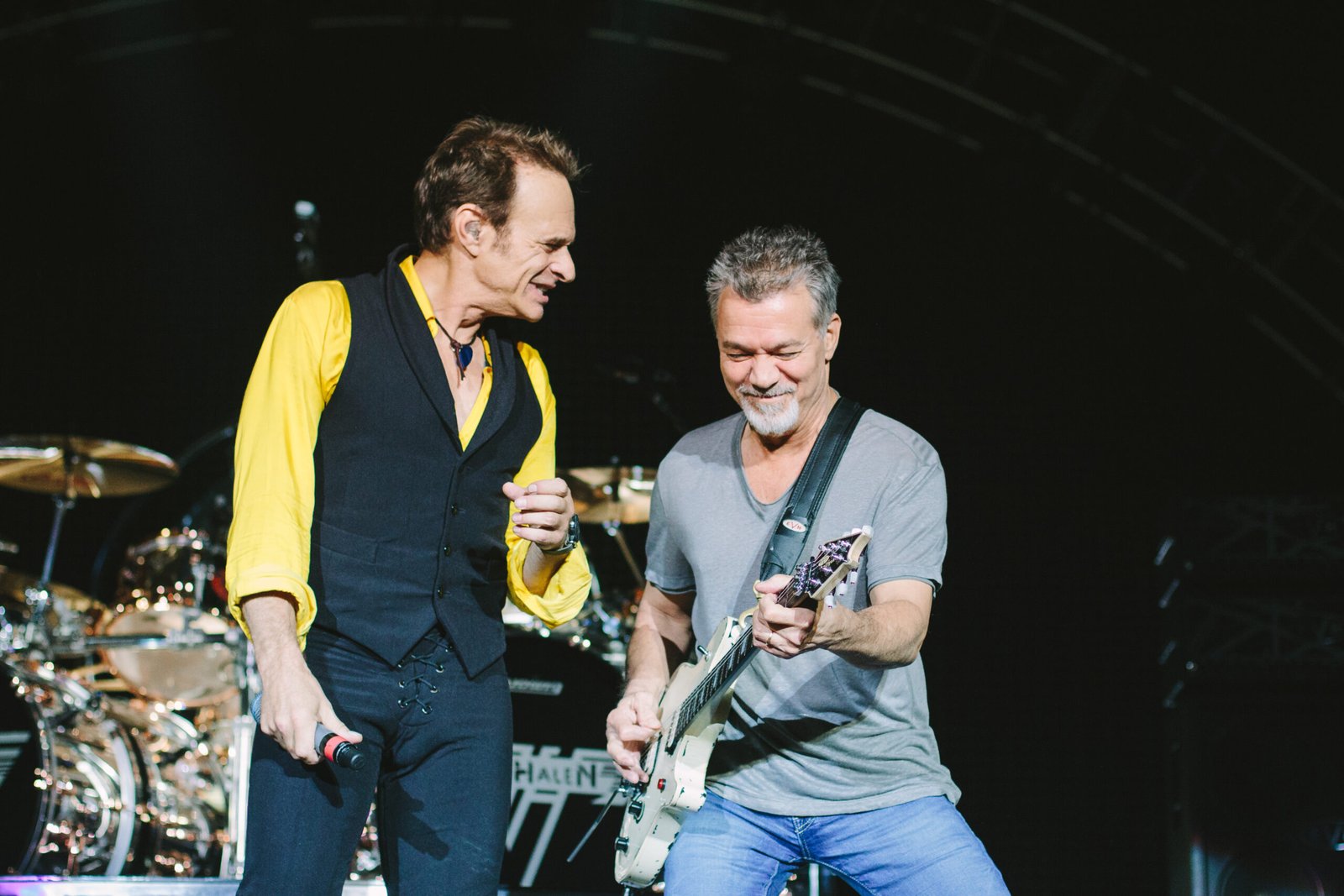
A reporter once accused David Lee Roth of singing about only three things: women, partying, and fast cars. Roth, who rarely let an insult pass without an answer, did something nobody expected — he checked the charge against his own catalogue. Women? Certainly. Partying? Guilty, happily. But fast cars, he realized, he had never actually written about at all. The accusation was meant as a put-down. Roth decided to treat it as a songwriting assignment.
The result was Panama, three and a half minutes of pure forward motion that became one of the signature records on 1984, the biggest album of Van Halen’s career. Despite its title, the song has nothing to do with the country in Central America. Its chorus rides one of Eddie Van Halen’s most famous riffs, and its quiet middle section features, quite literally, a Lamborghini — because when this band needed the sound of a fast car, they did not reach for a sound-effects library. They backed a real one up to the studio door.
The Accusation
Roth explained the song’s origins years later in an interview with Howard Stern. On a trip to Las Vegas, he had watched a race car compete under the name “Panama Express,” and the name lodged in his head — the way names do for singers who are always listening for something that scans. The word had personal resonance, too: Panama was also the name of Roth’s own Opel Kadett, a car he was fond enough of to turn into a piece of wall sculpture after its driving days were done.
So when the reporter’s jibe landed — that David Lee Roth only ever sang about women, partying, and fast cars — the missing third of the list bothered him precisely because it was wrong. He had the title sitting in his notebook and two-thirds of a reputation to defend. What he wrote was a lyric loaded with his trademark double meanings, in which the car and the woman blur into a single object of pursuit: a “model citizen” with “zero discipline” who is running a little hot under the hood. Roth never pretended the song was only about an automobile. But it was, at last, a genuine car song — written, perversely, to prove that he could write one.
Eddie Aims at AC/DC
If the words were Roth’s answer to a critic, the music was Eddie Van Halen answering a different challenge: his own band’s reputation for excess. Eddie later said that with Panama he was deliberately chasing the straightforward, three-chord directness of AC/DC — no synthesizer, no ornament, just a riff that hits like a door slamming. Coming on the same album as Jump, all keyboards and pop sheen, Panama was the proof that the guitar band was still in the building.
The track was recorded in 1983 at 5150 Studios, the facility Eddie had built at his home in Studio City, Los Angeles — the room that finally gave him control over Van Halen’s sound. Ted Templeman, the producer who had discovered the band and shaped every one of their albums, was back behind the desk, with Donn Landee engineering. It would be Templeman’s last album with the group, and the sessions themselves marked a quiet transfer of power: for the first time, Van Halen were working on the guitarist’s turf, on the guitarist’s schedule. The friction that arrangement created would eventually tear the band apart. On Panama, though, all it created was focus. The arrangement is a model of economy: Alex Van Halen’s drums swing as much as they pound, Michael Anthony’s bass and stratospheric backing vocals fill the choruses, and Eddie’s guitar does the rest — a grinding, revving figure that sounds less played than ignited. Credited to all four members, Panama distilled everything the band did best into a single track with no wasted motion.
A Lamborghini Joins the Band
The song’s most famous passage arrives in the middle, when the band drops away and Roth drops into a half-whispered aside: “I can barely see the road from the heat comin’ off of it.” Behind him, low and guttural, an engine idles and growls. It is not a studio effect. It is Eddie Van Halen’s own 1972 Lamborghini Miura S, backed up to the studio so that microphones could be attached to its exhaust pipes, with Eddie working the throttle while the tape rolled.
It was the perfect Van Halen gesture — extravagance and practicality at the same time. The band that had once recorded car horns in a parking lot for Runnin’ with the Devil now had a supercar on the session, credited in everything but name. Roth plays the moment for all it is worth, leaning into the double meaning as he reaches down “between my legs” to “ease the seat back,” and then the band slams back in for the final choruses with the engine still snarling underneath. The bridge turned a very good hard rock song into an unforgettable one, and it did it with a piece of recording that could not be faked: a V12, recorded at the source, by the man who owned it.
The Summer of 1984
1984 was released on January 9, 1984, and spent five weeks at number two on the Billboard 200, held off the top only by Michael Jackson’s Thriller. It went on to become one of the two best-selling albums of the band’s career, eventually certified diamond in the United States — a remarkable result for a record made in a home studio amid open warfare over what Van Halen was supposed to sound like. Panama followed Jump and I’ll Wait as the album’s third single, released in the United States on June 18, 1984. Where the first two singles had leaned on Eddie’s synthesizer, Panama was a guitar record, and the band’s core audience embraced it as a homecoming. It peaked at number 13 on the Billboard Hot 100 that August and climbed to number two on the Mainstream Rock chart.
The video, directed by Pete Angelus, mixed live footage shot at the Spectrum in Philadelphia with scenes of the band clowning in Roth’s own heavily customized 1951 Mercury Eight convertible — the frontman’s beloved hot rod standing in for a drag racer, an Opel, and a Lamborghini all at once. It captured the band at the exact peak of their powers: the biggest rock act in America, apparently having the time of their lives.
Nobody in the film looks like men about to split up. But Panama would prove to be the final Top 20 hit of the David Lee Roth era; within a year of its chart peak, Roth was gone, and the original Van Halen was over.
The Song That Outlived the Lineup
Most bands bury the songs of a departed singer. Van Halen did the opposite. Panama stayed in the set when Sammy Hagar took over the microphone, stayed through every subsequent incarnation of the band, and was waiting, center stage, when Roth finally returned in 2007. Few songs cross a feud like that; this one did, because it belonged less to any singer than to the band’s whole identity — the riff, the swing, the grin. Rolling Stone has called it the perfect distillation of the Van Halen sound in just three minutes and thirty seconds, and its afterlife keeps proving the point, from its prominent place in the racing game Gran Turismo 4 to decades of classic-rock radio.
That timing has given the song a second meaning as a bookend — the last great blast of the classic lineup, a band firing on every cylinder it had. Roth wrote it to correct a reporter’s mistake. He ended up writing his era’s farewell without knowing it: a song about speed, recorded with a sports car, in the studio his guitarist built to be free.
Leave a Reply