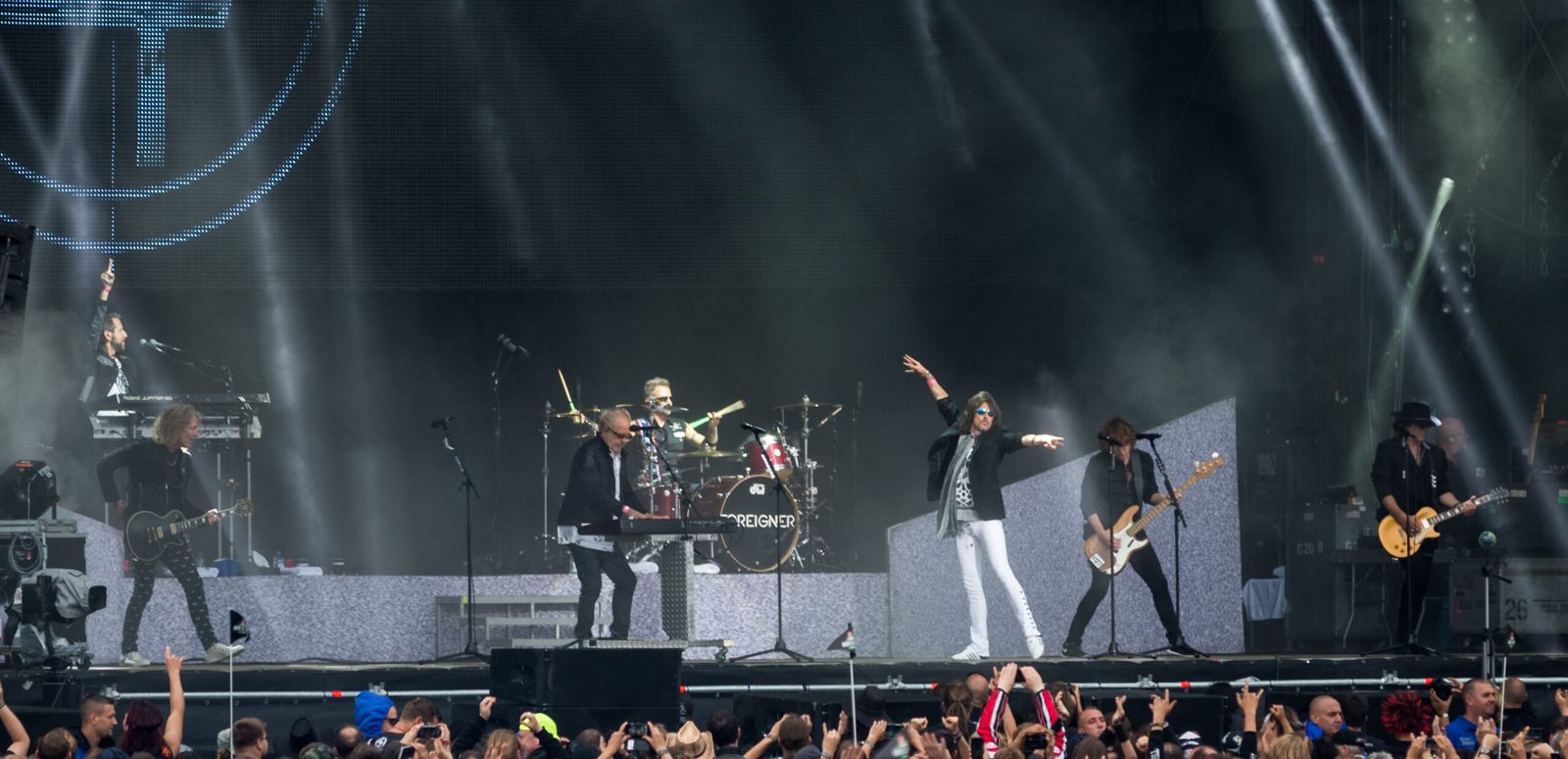
Some songs are laboured over for months. Cold as Ice was written because another song failed. In late 1976, Foreigner were deep into recording their debut album in New York when producer Gary Lyons delivered his verdict on one of the tracks planned for the record: it simply did not fit. The band — a new, untested Anglo-American outfit built around guitarist Mick Jones and singer Lou Gramm — suddenly had a hole in their first album and very little time to fill it. Jones went home, sat down at his piano, and by the time he stood up again he had the riff, the title and the bones of the song that would become one of Foreigner’s signature records.
It is a fitting origin for a band that always thrived on pressure. Foreigner had been assembled in 1976 from musicians with impressive pasts and uncertain futures: Jones, a Brit who had played with Spooky Tooth; multi-instrumentalist Ian McDonald, a founding member of King Crimson; and Gramm, a Rochester singer Jones had spotted fronting a band called Black Sheep. Atlantic Records was giving them their shot. What they needed, urgently, was one more song.
The Song That Wasn’t Supposed to Exist
The track Cold as Ice replaced was, McDonald later believed, a song called Take Me to Your Leader. Lyons heard what the band had planned and told them it wasn’t right for the album. Many debut bands would have argued, or patched the gap with something from the reject pile. Jones instead treated it as a writing assignment with an overnight deadline.
“I went home after Gary said this, sat down at my piano and out came the riff for Cold as Ice,” Jones recalled. “And the rest of the song flowed from there.” The piano figure he found — insistent, pounding, almost accusatory — became the song’s backbone and its instant hook, the first thing any listener hears. It was also a personal milestone: Jones has said it was the first song he ever wrote and recorded on the piano, an instrument he approached as a guitarist feeling his way. He brought it back to the band completed with Gramm, whose name shares the writing credit, and the verdict was immediate. “When I got back, they played me Cold as Ice and it worked for me,” Lyons said. “So we went into Atlantic Studios one night to cut it.”
Minus Twenty in New York
The lyric Jones hung on that riff was a character study rather than a confession. Its subject, he explained, was “the stereotypical cold-hearted, bad girl — the sort of woman Joan Crawford would play in a film.” The woman in the song sacrifices everything, and everyone, for money; the singer warns her that one day she will pay the price. Jones insisted it wasn’t aimed at anyone specific — though he conceded, with a grin, that “there was one girl at school that dumped me, so maybe that trauma stayed with me over the years and subconsciously filtered in.”
Then there was the weather. “The other contributing factor,” Jones said, “was that it was about minus 20 degrees in New York at the time we were writing it, which may have fed into the atmosphere.” The cold was not a metaphor. It was literally the coldest stretch of a brutal New York winter, and the song absorbed it — in the title, in the frostbitten piano, in Gramm’s controlled, furious vocal, a man trying to reason with someone who feels nothing at all.
One Night at Atlantic Studios
The recording itself became part of the legend. The band cut the track at Atlantic Studios in a single night session, with Lyons and John Sinclair producing, and Jones on piano alongside his guitar. McDonald remembered that he and Lyons stayed in the studio all night working on the vocals — layering Gramm’s lead against the band’s harmonies until the record had its haunting, stacked sound. The single version would later add subtle horns and strings, giving the chill a strange lushness, but the core of the record was made in that one overnight push.
“When we got out of the studio we discovered that a blizzard had been raging,” McDonald recalled. “Everywhere was covered in snow, and we heard on the radio that it had been the coldest night in New York on record! Somehow that seemed to be a good omen for the song.” The band walked out into a frozen city holding a song called Cold as Ice. It is hard to invent a better omen than that.
The finished track ran just over three minutes: piano riff, chanted backing vocals with their almost operatic swell, Gramm riding the top of it all, Al Greenwood’s keyboards and Orchestron thickening the air, and drummer Dennis Elliott driving underneath. Billboard heard “a haunting feel” and a “surrealistic chilling effect”; Cash Box praised “the controlled fury of Lou Gramm’s lead vocal.” Critic Dave Marsh wrote that the songwriting on Cold as Ice and its predecessor placed Jones “among the better English hard-rock writers.”
Jones has rated it as one of his eleven favourite Foreigner songs, and his reasoning goes back to that first night at the piano: it was where he discovered he could write on an instrument he barely played. The riff — really a left-hand accusation as much as a melody — gave the young band something none of their guitar-driven material had: a sound you could identify within two seconds, in a car, on a cheap radio, through a shop doorway. Bands spend careers hunting for two seconds like that. Foreigner found theirs because they had to.
From B-Side to Top Ten
Here is the detail that still amazes Jones’s admirers: when Foreigner’s first single, Feels Like the First Time, was released in the spring of 1977, some versions of the 45 carried Cold as Ice on the B-side. The song that had been written in a panic to save the album was initially treated as filler for the flip of a single.
Radio and the public corrected the oversight. Released as a single in its own right in July 1977, with the album track I Need You on the B-side, Cold as Ice climbed to No. 6 on the Billboard Hot 100, out-charting in America almost everything else on the debut album and helping turn Foreigner into one of the great debut albums of the arena-rock era. It travelled, too: No. 9 in Canada, No. 13 in the Netherlands, Top 40 in Australia — the first proof that the band’s name was a promise the charts intended to keep them to. In Britain, where the band’s success came more slowly, it reached No. 24 the following year. It has since been certified gold in the United States.
For the band, it also set a template. Foreigner’s biggest records would often balance muscle against melody — hard guitars against keyboards and piano, Gramm’s raw voice against polished harmonies — and Cold as Ice was where that balance was first struck, in a single night, under deadline.
The Chill That Never Thawed
Most emergency songs disappear once the emergency passes. Cold as Ice never did. Within a year of release it was already seeping into pop culture: a March 1978 Saturday Night Live broadcast used it as the soundtrack to a notoriously grisly sketch introduced by host Christopher Lee with a warning that it was “not for the squeamish.” Jones himself has ranked it among his eleven favourite Foreigner songs.
Its second life came through sampling. In 2000, Brooklyn hip-hop duo M.O.P. built their own Cold as Ice around the song’s piano figure, carrying Jones’s overnight riff to an audience that had never heard of Foreigner. Rapper B.o.B interpolated it a decade later. In 2019, the song turned up in the third season of Stranger Things, soundtracking Eleven’s decision to break up with Mike — a new generation meeting the cold-hearted girl for the first time.
That is the strange afterlife of Cold as Ice: a song written to fill a gap, in the middle of the night, in the middle of a blizzard, by a band nobody knew yet. It was supposed to be the track that completed an album. Instead it became one of the tracks that defined a band — proof that sometimes the best thing a producer can tell you is that your song isn’t good enough, provided you go home angry, sit down at a piano, and let the weather do the rest.
Leave a Reply