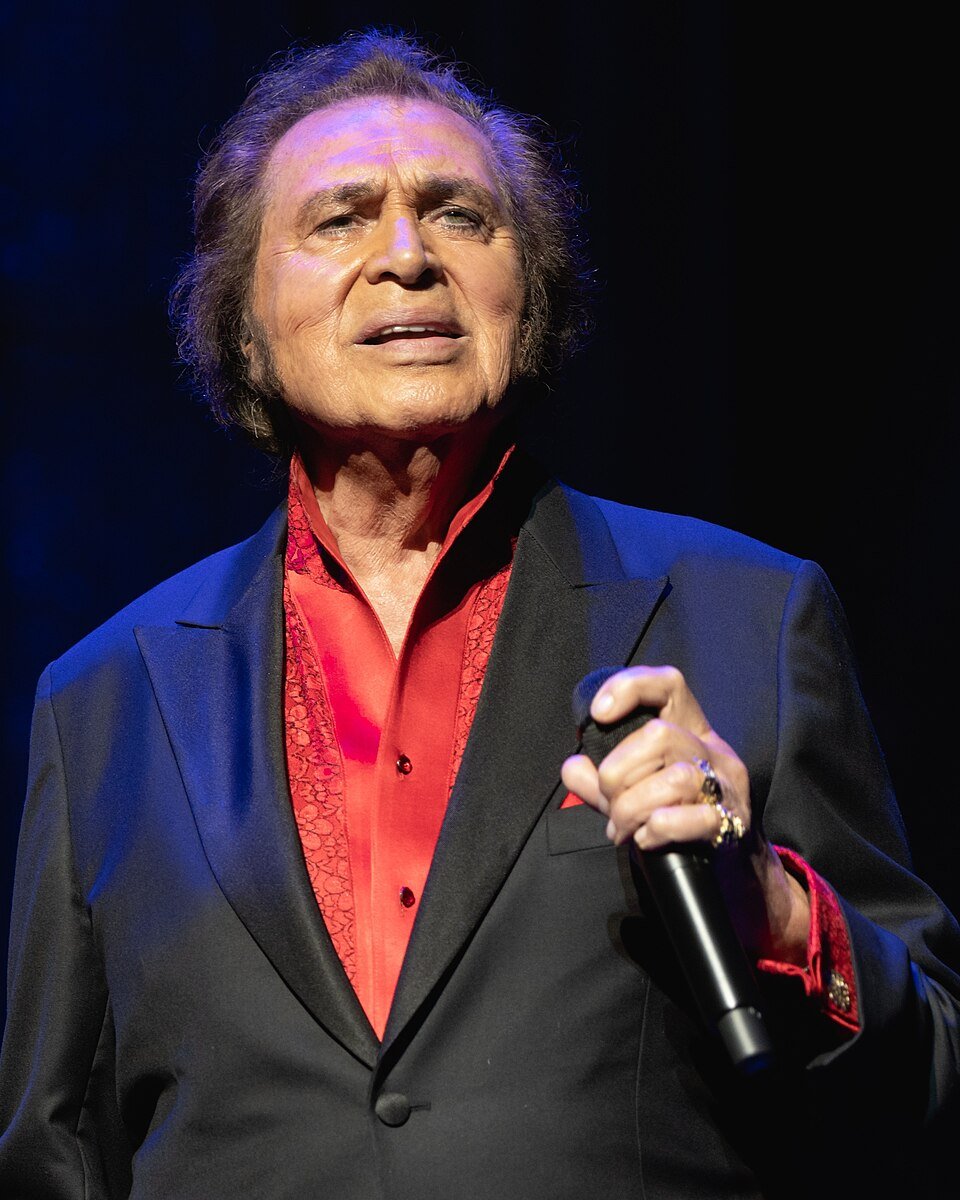
It is the simplest question a lover can ask, and Engelbert Humperdinck built one of the longest-lived numbers in his repertoire out of asking it three times in a row: when, when, when? Quando Quando Quando began life as an Italian bossa nova at the Sanremo Music Festival in 1962, travelled to America in the voice of Pat Boone, and then, in 1968, landed in the hands of a British balladeer who understood exactly what to do with a song about sweet, smiling impatience. Engelbert did not shout the question. He crooned it, swayed with it, and turned it into an invitation — one his audiences are still happily accepting, and singing back at him, more than half a century later.
A Question Asked Three Times at Sanremo
The song was written for the 1962 Sanremo Music Festival, then as now the great shop window of Italian popular music. The music was by Tony Renis, a Milan-born singer and composer still in his early twenties, and the words were by Alberto Testa, one of Italy’s most prolific lyricists. Under the festival’s old rules, each competing song was performed in two different versions, and Quando quando quando was presented by Renis himself and by the smooth-voiced Emilio Pericoli. It placed only fourth on the night — but Sanremo juries have never had the last word. Once released, the song climbed to the top of the Italian Musica e dischi singles chart, and its lilting bossa nova rhythm carried it far beyond Italy’s borders.
The lyric is a small masterpiece of longing disguised as good manners. The singer asks his beloved to tell him when she will come — dimmi quando tu verrai — and to name the year, the day and the hour when she might finally kiss him. Every moment of waiting is sweet, he insists, because when she does kiss him she will promise they will never part. It is less a demand than a dance: three little words, repeated like a heartbeat, over a rhythm borrowed from Brazil and polished for the Italian Riviera.

Crossing the Atlantic, One Word at a Time
America heard the song almost immediately. In 1962 Pat Boone recorded it, opening in Italian before slipping into English, and took it into the Billboard Hot 100, where it reached number 95. Boone is sometimes described as the man who wrote the English words, but the English lyric is credited to the veteran American songwriter Ervin Drake; the confusion probably lingers because Boone — whose full name was Charles Eugene Boone — turns up as “Charles Boone” in the writing credits on some later releases of the song, alongside Renis and Testa.
Whoever held the pen, the adaptation made one inspired decision: it kept a single Italian word. In almost every English-language version, everything is translated except quando itself. “Tell me when will you be mine? Tell me quando, quando, quando” — the foreign word became the hook, exotic enough to feel romantic and simple enough for anyone, anywhere, to sing on first hearing. That one retained word is a large part of why the song travelled so well, and why, six years later, it was still waiting for the singer who would make it his own.
Engelbert Finds His Question
By 1968 Engelbert Humperdinck was two years into one of the most remarkable runs in British pop, a velvet-voiced romantic whose records sold in the millions on both sides of the Atlantic. For his third album, A Man Without Love, released that year, he and producer Peter Sullivan assembled a programme of big, continental-flavoured ballads — and tucked in among them, closing the first side, sat the little Sanremo bossa nova. On Quando Quando Quando, the musical direction was by Johnny Harris, and the arrangement keeps the song’s Latin sway but dresses it for Engelbert’s world: warm strings, a gently swinging rhythm section, and that unhurried baritone floating over the top.
What Engelbert brought to the song was restraint. Where the Italian originals sparkle, he smoulders. He sings the opening question almost conversationally — tell me when will you be mine — and lets the triple quando roll off his tongue like a smile he is trying not to show. The desperation in the lyric never surfaces; in his hands, waiting sounds like a pleasure in itself. The album reached number 3 in Britain and went gold in America, and while its title track took the single honours, Quando Quando Quando quietly became one of the most requested and best-loved tracks in his catalogue — his own official website still lists it among his most popular songs of all time.

The Chart Hit That Arrived Thirty-One Years Late
Here is the strangest part of the story. Engelbert’s 1968 recording, for all its later fame, was never a major hit single in its own era. Its day on the British chart came a full thirty-one years later. In the late 1990s Engelbert cheerfully reinvented himself for the dancefloor with The Dance Album, revisiting his best-known songs in new dance versions shaped by remixers Chris Cox and Barry Harris, the team known as Thunderpuss. A dance version of Quando Quando Quando was released into that moment — and in the UK chart dated 30 January 1999, there it was: Engelbert Humperdinck, back in the Top 40 at number 40, with a song he had first recorded when he was thirty-two. Few records can claim a chart peak separated from their recording by three decades, three musical eras and one bossa nova.
Built for the Stage
Television and the record racks kept the song warm in the meantime. When Decca compiled His Greatest Hits in 1974, at the end of Engelbert’s contract with the label, Quando Quando Quando was placed second in the running order — ahead of almost every one of his genuine hit singles — and the album spent three weeks at number one in Britain. The compilers clearly understood what the concert crowds already knew: chart positions were not the only measure of a song’s place in his story.
If the chart story is odd, the stage story is simple: this song was made to be performed. Engelbert was already featuring it on American television within a year of the album, performing it on The Hollywood Palace on 25 October 1969, and it settled into his live act for good. It is easy to see why. The tempo lets him move — reviewers have long noted the hip-swinging charm he brings to it — and the chorus is a ready-made piece of audience participation: a question the crowd can answer by singing it straight back. Concert accounts across the decades describe the same scene, from a 2018 show in Westbury, New York, where he picked up the pace with the song mid-set, to a December 2025 performance in New Brunswick, New Jersey, where, with Engelbert approaching ninety, the audience was still singing along on “Tell me when will you be mine” while he danced about the stage. A song about waiting had become the moment in the show where nobody has to wait at all.
The Question That Never Got Answered
The song’s wider afterlife kept pace. Filmgoers heard it in 1980 in The Blues Brothers, drifting from a deserted hotel lounge where Jake and Elwood find five of their old bandmates playing it as the Murph and the Magic Tones. In 2005 Michael Bublé revived it as a duet with Nelly Furtado, and in 2009 Fergie and will.i.am reworked it for the musical film Nine. Engelbert’s own recording found a new generation when it appeared in Netflix’s The Umbrella Academy — a placement he himself mentioned with evident delight in interviews — and his official YouTube channel eventually gave the 1968 track its own lyric video, which has been viewed millions of times.
That is the real answer to the song’s question. Quando — when? For Tony Renis and Alberto Testa, when was a Sanremo stage in 1962. For Pat Boone, it was the same year, in another language. For Engelbert Humperdinck, it turned out to be 1968, and 1969, and 1999, and every concert stage since. He never did get a date, a day or an hour out of the song. He got something better: a question his audiences never tire of asking with him.
Leave a Reply