
In 1962, Etta James was best known as a singer of other people’s heartbreak, wrapped in strings. Her signature record, At Last, had made her the voice of elegant longing, and her label, Chess Records, was content to keep her in ballads. Then, on a single drawn from her self-titled third album, she opened her mouth and testified. Something’s Got a Hold on Me is built like a sermon and sung like a possession: a young woman stands up in front of the congregation to announce that something has seized her — and the something, scandalously, is not the spirit. It is a man. In two minutes and forty-eight seconds, Etta James smuggled the fire of the Black church into secular rhythm and blues, and she did it with a song she had written herself.
She was twenty-four years old, and she had been singing professionally for nearly a decade. But this was the record where the church girl and the blues woman stopped taking turns and became the same person.
A Testimony That Slipped Out of Church
Jamesetta Hawkins grew up in Los Angeles singing in the choir of St. Paul Baptist Church, under the direction of Professor James Earle Hines, whose Echoes of Eden choir was famous across the city’s gospel circuit. She learned there how a testimony works: the believer rises, half-speaking and half-singing, and tells the congregation what the Lord has done. Something’s Got a Hold on Me, which James wrote with Leroy Kirkland and Pearl Woods, follows that form exactly — “let me tell you ’bout a thing,” she begins, like a witness called forward — before swerving into secular territory. The thing that has a hold on her makes her walk like she wants to run and talk in a lover’s language; the rhythm section answers her like a congregation, with handclaps and shouts.
Kirkland, a veteran arranger who had worked with rhythm-and-blues acts through the fifties, and Woods, a songwriter in the Chess orbit, helped James shape the song, but its authority is hers. Where the ballads had asked her to be smooth, this number asked her to preach. Her voice spans nearly two octaves across the performance, from a low confiding growl up to the famous cry on the chorus — the sound of a singer who has found the exact place where gospel ecstasy and romantic surrender become indistinguishable, which is, of course, the joke and the genius of the song.
Chess Cuts Her Loose
The road to that shout ran through five hectic years. James had been discovered as a teenager by bandleader Johnny Otis, cut the risqué Roll It Henry — cleaned up for radio as The Wallflower — with the Peaches in 1955, and toured the chitlin’ circuit while still underage. Leonard Chess signed her to his Chicago label in 1960 and set about remaking her as a sophisticated ballad singer: All I Could Do Was Cry, then Trust in Me, then At Last in 1961, each one plusher than the last. The strategy worked — she became a star of the supper-club circuit — but it muffled the singer who had grown up shouting in a Baptist choir and hollering on Otis’s stage. Something’s Got a Hold on Me was the moment the muffling stopped, and it is no coincidence that it arrived on a song she had written herself: nobody at Chess was going to hand their ballad singer a record this unbuttoned, so she brought her own.
Chess released the record in 1962 as the third single from the album Etta James, on its Argo subsidiary, with production credited to Leonard and Phil Chess alongside Ralph Bass. The B-side was Waiting for Charlie to Come Home. The follow-up single, Stop the Wedding, kept one foot in the ballad camp — which makes Something’s Got a Hold on Me stand out all the more as the album’s unruly heart. The contrast with her recent hits was deliberate and dramatic. At Last and Trust in Me had floated James’s voice over Riley Hampton’s orchestral arrangements; Something’s Got a Hold on Me strips all of that away for a hard little R&B band, handclaps and a groove built to move a dancefloor and a church aisle at the same time.
The public responded to the shout. The single climbed to number four on Billboard’s Hot R&B Sides chart and crossed over to number 37 on the Hot 100 — a remarkable showing for a record this raw, on a pop chart still dominated by teen idols and girl groups. It announced that James was not merely a balladeer with a blues past but a rhythm-and-blues singer who could carry a record on the force of her voice alone. In the studio discography of a singer often handed material by others, it also stands as proof of her own pen: the biggest shout of her career is one she co-wrote.

The Night Nashville Proved It
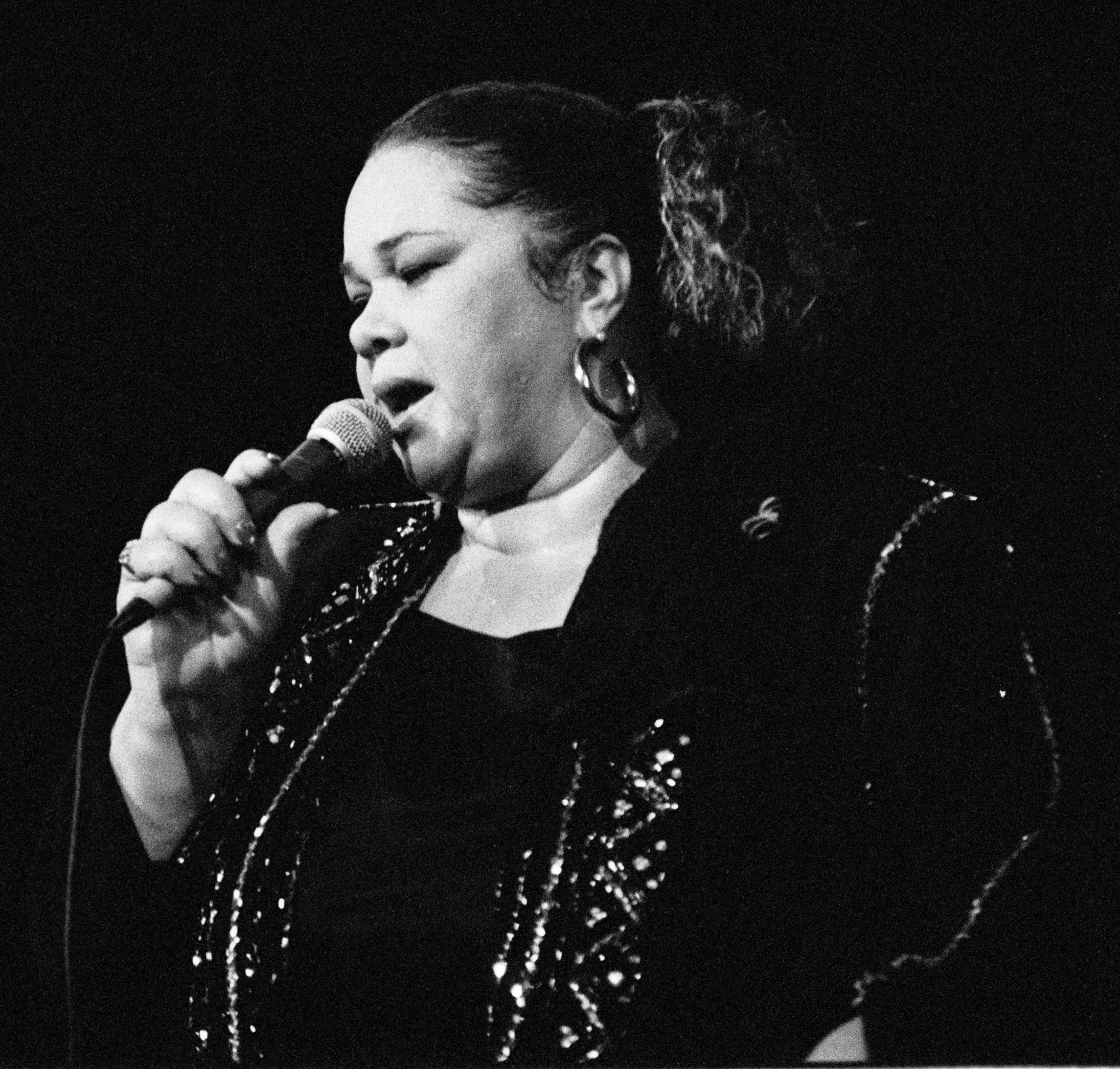
If the studio record is a testimony, the live version is a revival. On 27 September 1963, James performed at the New Era Club in Nashville, and Chess recorded the show for her first live album, Etta James Rocks the House. In front of a whooping club crowd, Something’s Got a Hold on Me stretches and ignites; James works the room like a preacher who knows exactly when to let the congregation answer. The album, released in 1964, became a landmark of live R&B recording, and its version of the song is the one history kept. She was still performing it a quarter-century later: at an all-star concert led by B.B. King at the Ebony Theater in Los Angeles in 1987, James tore through the song with King himself on guitar, a performance preserved on the album and home video A Night of Blistering Blues.
The Hook That Wouldn’t Die
Most 1962 singles are period pieces. This one kept being reborn. Christina Aguilera sang it in the 2010 film Burlesque, choosing it as her character’s first show-stopper, and it opens the 2021 film CODA, which went on to win the Academy Award for Best Picture. Beth Hart and Joe Bonamassa cut a ferocious version for their 2011 album Don’t Explain.
But the song’s most astonishing afterlife came through sampling, and through that Nashville recording. Producers had mined it since 1991; in 2006 the electronic artist Pretty Lights built his track Finally Moving around James’s voice. Then, in 2011, two of the biggest dance records on the planet arrived within months of each other, both built on her cry of “sometimes I get a good feeling” lifted from the Rocks the House performance: Avicii’s Levels, which became a global anthem, and Flo Rida’s Good Feeling, which took the same hook into the American top five. A twenty-four-year-old church-trained singer, recorded live in a Nashville club in 1963, had become the voice of twenty-first-century dance music — her name often unmentioned, her voice unmistakable.
When James died in January 2012, five days short of her seventy-fourth birthday, both Avicii and Flo Rida publicly paid tribute to the woman whose voice had carried their hits — a surreal and fitting honour for a singer who had been famous, forgotten and famous again more times than she could count. Her catalogue sales surged by 378 per cent in a matter of days, Billboard reported, as a new generation went looking for the source of the sound. The old Argo single has since earned a Silver certification in Britain on streaming-era sales alone.
James herself had kept the song at the centre of her act for five decades, from the New Era Club in 1963 to her induction into the Rock and Roll Hall of Fame in 1993 and beyond. Every singer who has covered it since — Aguilera, Beth Hart, a Swedish DJ with a laptop — has been chasing the same thing she captured in 1962: the precise second when testifying about heaven and testifying about a lover become the same act. Something had a hold on her. It has never entirely let go of anyone else, either.
Leave a Reply