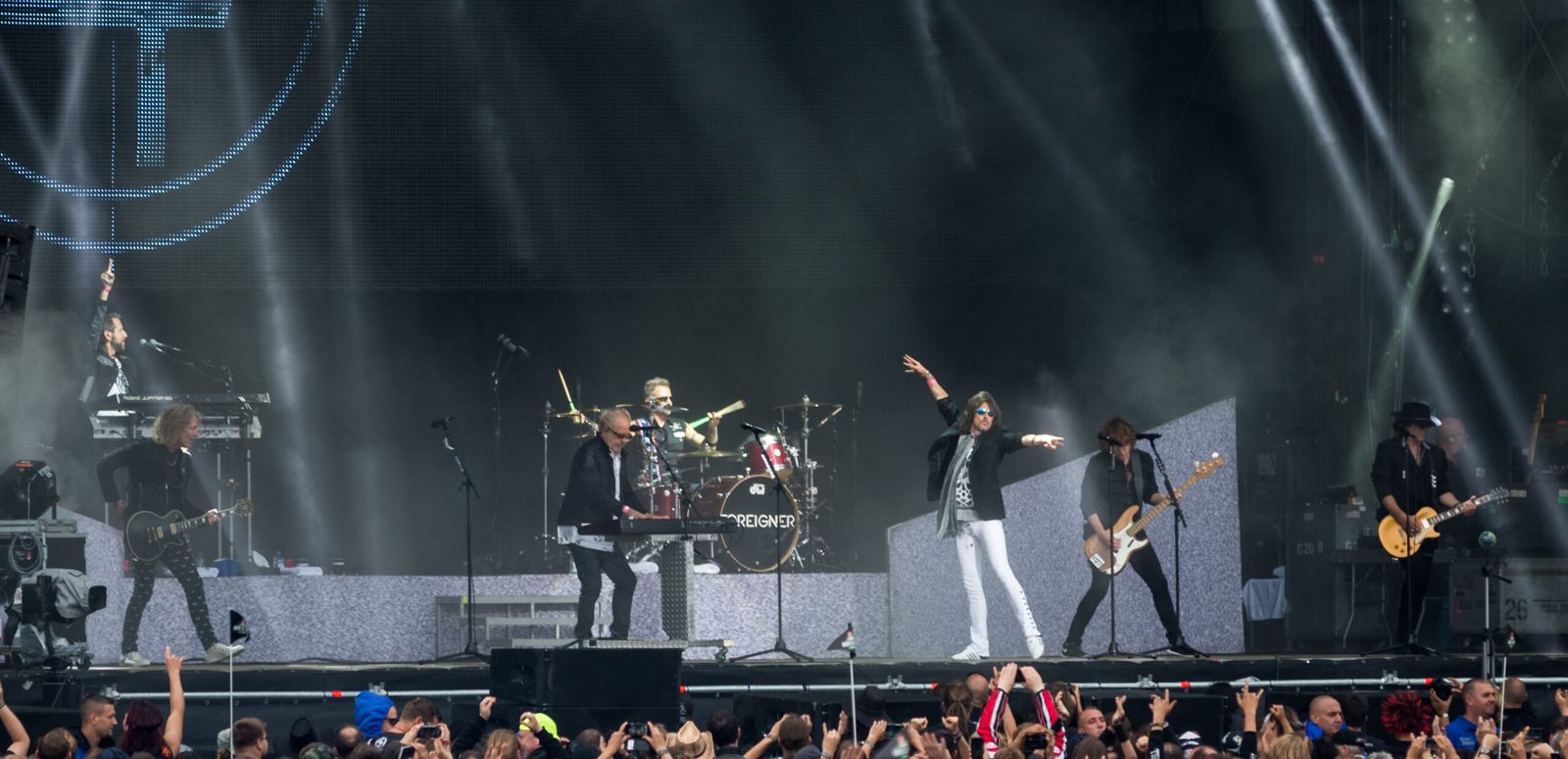
In March 1977, a band nobody had heard of released its first single, and within four months that single had climbed to No. 4 in America and announced one of the defining arena-rock acts of the next decade. Yet a year earlier, Feels Like the First Time had been the centrepiece of a demo tape that every major record label in the business — including the one that eventually released it — had listened to and refused. Foreigner did not merely survive those rejections. The band exists, in a sense, because of the song that caused them.
The strangest part of the story is that the song came first — before the band, before the name, before the deal. Mick Jones wrote it alone in New York, while he was still assembling the group that would record it. It served as the audition piece that won Foreigner its singer, the calling card that won it a contract, and, finally, the opening track of a debut album that sold five million copies in the United States alone. This is the story of how one song about starting over became the start of everything.
A Song Written Before the Band Existed
Mick Jones arrived at his own band the long way round. The guitarist from Portsmouth had written songs for Johnny Hallyday in Paris in the 1960s and spent the early 1970s in Spooky Tooth, a respected British band that never quite converted respect into success. In 1976 he relocated to New York, played briefly around the scene, and made a decision: this time he would build the group around his own songs, and he would write those songs first.
“I started writing by myself,” Jones recalled. “Before I knew it, I had two or three songs, and I wondered what to do with them. One of those songs was ‘Feels Like the First Time.’” The lyric explains itself once you know the circumstances. Jones was starting again in every department — a new country, a new band taking shape, a new chapter in his private life — and the song takes the oldest subject in pop, falling in love, and treats it as an experience so total that it wipes the past clean. It is sung by a man who has been hurt before and is astonished to feel none of it. Renewal was not just the song’s theme. It was its author’s situation, set to a riff.
The Audition Song
Jones rehearsed his new material with keyboard player Al Greenwood, and Greenwood remembered the day the song arrived. Jones turned to him and said he had something; he picked up a guitar and played Feels Like the First Time. Greenwood’s verdict, delivered decades later, was simple: “Okay, now I think we’ve got something here.”
What the band still lacked was a singer. Jones had kept the voice of Lou Gramm in his head from Black Sheep, the Rochester singer’s earlier band, and Gramm was tracked down and flown to New York to audition. The audition set list tells you how highly Jones rated his new songs: Gramm sang Feels Like the First Time, At War with the World, Woman, Oh Woman and Take Me to Your Leader — four Jones originals, most of them unheard by anyone outside the rehearsal room. He got the job on the strength of them.
The completed line-up had a symmetry that gave the band its name. Jones, multi-instrumentalist Ian McDonald — a founding member of King Crimson — and drummer Dennis Elliott were English; Gramm, Greenwood and bassist Ed Gagliardi were American. Three and three. As the band liked to explain, wherever they travelled, half of them would be foreigners. Working briefly under the name Trigger, the sextet cut a demo of the audition songs, with Feels Like the First Time at its head, and went looking for a record deal.

The Demo Every Label Refused
They did not find one — not at first. Gramm has never forgotten the routine: “We brought that demo tape to every label and they all rejected us.” Atlantic Records, the home of Led Zeppelin and the Rolling Stones, passed along with everybody else. The rejections dragged on long enough that the band came close to dissolving before it had played a note in public.
The rescue came from manager Bud Prager, who was convinced Atlantic was the right home and refused to take the first no for an answer. Prager carried the tape back up to the label, where this time it reached John Kalodner, an A&R executive with a celebrated ear for exactly this kind of radio-ready rock. Kalodner heard a hit where others had heard a risk, championed the band inside the building, and persuaded Atlantic president Jerry Greenberg — who had already passed on the same tape once — to reconsider. In 1976, Foreigner signed. The song that no label wanted became the property of the label that had turned it down twice over.
Cutting It at Atlantic
The debut album was recorded late in 1976 at the Hit Factory and Atlantic Recording Studios in New York, produced by John Sinclair and Gary Lyons in collaboration with Jones and McDonald. Feels Like the First Time was given the place of honour: track one, side one, the first thing the world would hear. The record they built around Gramm’s tenor still sounds like a manifesto — a bright keyboard figure over a stomping beat, Jones’s guitar answering the vocal, everything compressed into three minutes and fifty seconds of forward motion.
Even then, the band nearly talked itself out of its own sound. A first mix of the album, made at Sarm Studios in London, dissatisfied them, and the record was remixed at Atlantic Studios in New York by Jones, McDonald and engineer Jimmy Douglass, emerging drier, harder and closer to the demo’s directness. The album, titled simply Foreigner, was released on 8 March 1977, with Feels Like the First Time lifted as the lead single the same month, backed by another of the demo songs, Woman, Oh Woman.
No. 4, First Time Out
The single climbed through the spring and peaked at No. 4 on the Billboard Hot 100, an extraordinary result for a debut release by a band with no name recognition at all. The album matched it, reaching No. 4 on the Billboard 200, sitting in the Top 20 for a year and eventually selling five million copies in America. Two more singles followed it into the charts, Cold as Ice and Long, Long Way from Home, but it was the first song that defined the formula: immaculate construction, a chorus built for arenas, and a singer who could sound both bruised and triumphant in the same line.
Critics sometimes dismissed Foreigner as calculating, as though writing songs this effective were a kind of cheating. The demo story rather undermines the charge. These were not focus-grouped products; they were songs a guitarist wrote alone because his life was starting over, which the entire industry declined, and which the public then adopted so completely that the band built around them played stadiums for a decade.

The Song That Would Not Go Away
Feels Like the First Time never really left. It opened the debut album, opened countless concerts, lent its title to a latter-day Foreigner package, and turned up in films from Pitch Perfect — where it anchors the riff-off medley — to Magic Mike. In 2013, Jones and Gramm stood together to be inducted into the Songwriters Hall of Fame, a reconciliation sealed, fittingly, by the catalogue that began with the song Gramm sang at his audition.
There is a final symmetry. A song about the shock of beginning again — about love arriving as though nothing had ever gone wrong before — was itself begun again and again: written for no band, rejected by every label, remixed when it displeased its makers. Each time, it survived. Foreigner’s whole career can be read as the long echo of a single conviction Mick Jones had in an empty rehearsal room in 1976: that this song, heard properly, could start something. He was right. It still sounds like the first time.
Leave a Reply