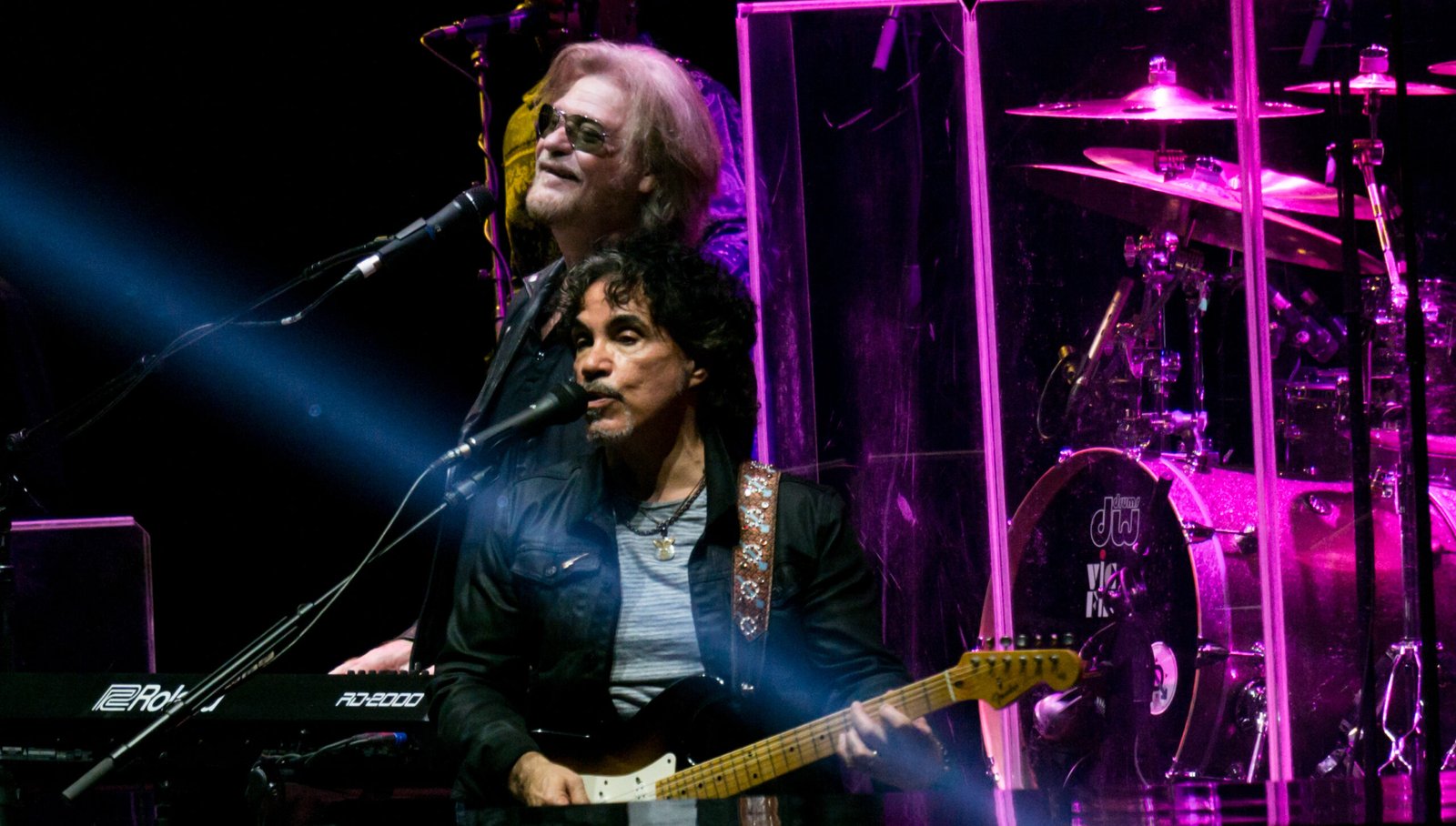
The band had gone home. It was one night in March 1981 at Electric Lady Studios in Greenwich Village, New York, and after a long day working on their tenth album, Private Eyes, Daryl Hall and John Oates were the last musicians left in the room, along with engineer and co-producer Neil Kernon and a floor full of instruments still switched on. Hall sat down at a Korg organ that happened to be there, flipped a Roland CompuRhythm drum machine to its Rock 1 preset, and played the first bass line that came into his head. Kernon heard what he was doing and quietly turned on the tape machine. “Good thing,” Hall later said, “because I’m the kind of person who will come up with an idea and forget it.” Within about ten minutes the chords had fallen into place, and a phrase that had been knocking around Hall’s head for almost a year — “I can’t go for that, no can do” — had found its groove. Nobody in the room knew it yet, but they had just sketched a record that would top the pop, R&B and dance charts at once, lend its pulse to Billie Jean, and become one of the most sampled songs of its era.
Ten Minutes at the Korg Organ
Hall did not write I Can’t Go for That (No Can Do) so much as catch it. The CompuRhythm — a Roland CR-78, the early programmable drum box the duo normally used just to keep tempos — offered only a handful of preset patterns, and Rock 1 was the plainest of them. Against its dry, ticking pulse, Hall worked out a springy, left-hand bass line on the organ, using whatever sound happened to be dialled in, while Kernon miked both the organ and the machine. The chords, including the song’s answering “B” section, came together in roughly ten minutes. Then Hall heard a guitar part in his head and sang the idea to Oates, who was sitting in the control booth. Oates plugged his 1958 Stratocaster straight into the mixing board and, experimenting with a muted, plucking attack, found the record’s clipped, percussive riff on the spot. Hall sang a rough guide vocal — part melody, part gibberish — added a bell track, and the three men called it a night. “I basically wrote the song on the spot,” Hall recalled. “It was being recorded as I was thinking of it.”
The words arrived the next day. Hall sat down with Sara Allen, his partner and frequent collaborator, and the two of them fleshed out the lyric around the phrase he had been carrying for months; Hall has said he wrote most of the words, with Allen contributing ideas, and the finished song carries a three-way writing credit for Hall, Oates and Allen. It was a fitting way to work on the Private Eyes sessions, which ran at Electric Lady from March to June 1981 with the duo producing themselves alongside Kernon.
A Refusal Aimed at the Music Business
Almost everyone who heard the finished record assumed it was about a lover drawing a line: I’ll do almost anything you want, but not that. Hall and Oates let them think it, but the refusal was aimed somewhere else entirely. “Most people think the song is about a relationship, and it is — but one with the music industry,” Hall explained. “I felt very manipulated at the time, by management and the record business. Like a pawn. ‘I can’t go for that — no can do.’ That was something I said a lot.” Oates has made the same point for years: the song is about not being pushed around by big labels, managers and agents, and about staying true to yourself creatively. The disguise was deliberate: written as a lover’s ultimatum, a complaint about contracts became something any listener could aim at anyone asking for one compromise too many.

Keeping the Machine
What makes the record radical, even now, is how little is on it. The team did try replacing the drum machine with real drums, but Kernon found the result too heavy-handed: it lost what he called its sensuality, its slinky feel. So the CR-78 stayed, and everything else was arranged around the space it left. On top of the machine pulse and Hall’s organ bass came Oates’s muted guitar, Hall’s synthesizers, light percussion overdubs to put a human feel back over the programming, the duo’s lush, triple-tracked backing vocals, and a sinuous saxophone break from Charles DeChant, the band’s longtime saxophonist. The whole performance fitted onto a single roll of two-inch tape. The album version runs five minutes and nine seconds, stretching out like a club record; the single was trimmed to three minutes and forty-five seconds, with another Private Eyes track, Unguarded Minute, on the B-side. Among the first American hits built openly around a drum machine, it pointed directly at the sound of the coming decade: skeletal, synthetic and soulful all at once.

Number One on Pop, Soul and Dance
RCA released Private Eyes on 1 September 1981, and I Can’t Go for That (No Can Do) followed as the album’s second single, backed by a simple performance video that put Hall, Oates and DeChant in front of the cameras. The single entered the Billboard Hot 100 at No. 59 in the week of 14 November 1981 — the highest debut of that week — and then climbed for eleven weeks. On 30 January 1982 it reached No. 1, ending the ten-week reign of Olivia Newton-John’s Physical. It had already been certified gold by the RIAA on 7 January, and it spent six weeks atop the Radio & Records airplay chart.
The pop crown was only part of it. Driven by heavy play on urban contemporary radio, the single also reached No. 1 on Billboard’s Hot Soul Singles chart and No. 1 on the Hot Dance Club Play chart — making it, remarkably, the only record of 1982 to top both the Hot 100 and the soul chart, a rare feat for a white act. Hall, raised on Philadelphia soul, savoured that one most: learning the news, he wrote in his diary, “I’m the head soul brother in the U.S. Where to now?” Abroad, it became the duo’s first British Top 10 single, peaking at No. 8, and reached No. 2 in Canada and No. 5 in New Zealand. VH1 later ranked it No. 6 on its list of the 100 greatest songs of the eighties.
The Night Michael Jackson Said Thank You
In January 1985, Hall joined dozens of stars at the We Are the World session, the USA for Africa charity recording. There, away from the managers and minders, Michael Jackson came over to talk. As Hall has retold it many times since: “I got talking to Michael Jackson and he said, ‘I hope you don’t mind. I stole the groove from I Can’t Go for That for my song Billie Jean.’” Hall’s answer has become part of pop folklore: “Oh Michael, what do I care? You did it very differently.” By Hall’s account, he also told Jackson that he had lifted the bass line from another song himself — borrowing, he shrugged, is “something we all do.” It is hard to think of a greater compliment: the defining groove of the Thriller era began life as a ten-minute improvisation over a preset drum pattern, in an empty studio, after everyone else had gone home.
Say No Go: The Groove Learns to Rap
Hip-hop heard the same possibilities Jackson had. In 1989, De La Soul built their anti-drug single Say No Go — from their landmark album 3 Feet High and Rising — directly on the Hall & Oates record, flipping its hook into a warning about crack cocaine: where Hall sang “no can do,” De La Soul answered “say no go.” Hall has said he felt gratitude rather than grievance: De La Soul were the first to sample a Hall & Oates song, and he was flattered. They were far from the last. Simply Red built their 2003 hit Sunrise around the track, and The xx drew on it for On Hold in 2016. Oates has called it one of the most sampled songs in their catalogue — “maybe ever, for all we know.”
That afterlife suits the song. I Can’t Go for That (No Can Do) began as an accident its writer might have forgotten by morning, was kept deliberately lean when every instinct of the era said to pile more on, and carried a lyric whose real target — the business itself — stayed hidden in plain sight. A preset rhythm, an organ bass line, a muted guitar and a phrase Hall could not stop saying: sometimes ten minutes in an empty studio is all a classic needs.
Leave a Reply