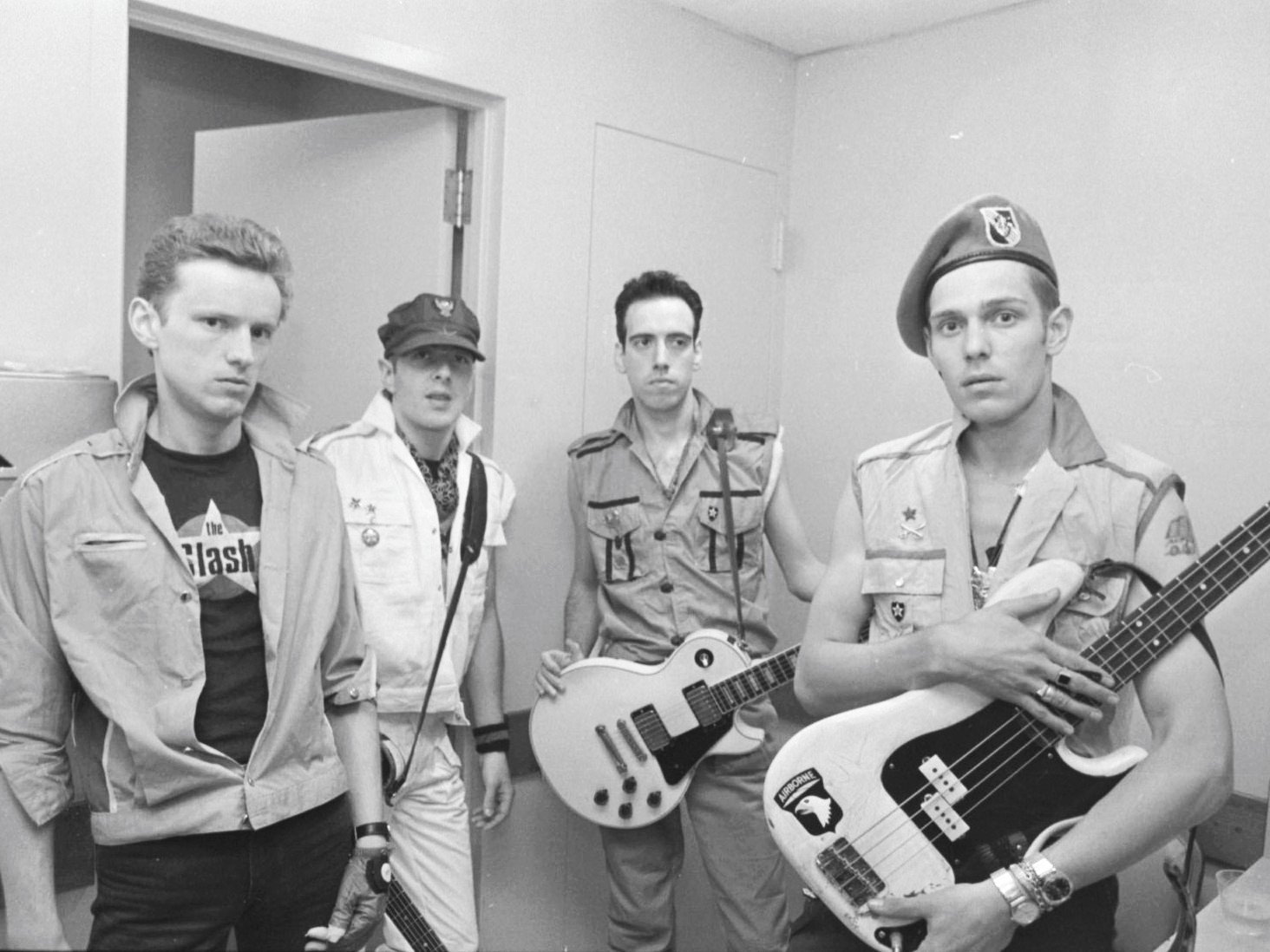
They were billed as “The Only Band That Matters,” and for a furious, brilliant stretch of the late 1970s and early 1980s, it was hard to argue. The Clash took the raw snarl of punk and stretched it until it held reggae, rockabilly, funk, jazz, and hip-hop. But behind the anthems was a band held together by chewing gum and conviction — a band whose greatest album was produced by a man swinging a ladder around a recording studio, whose frontman once vanished to run a marathon in Paris, and whose ending was so bitter that the two men at its heart never truly made peace. This is the story most fans never heard.
A Diplomat’s Son Walks Into a Squat
Joe Strummer was born John Graham Mellor in Ankara, Turkey, the son of a British diplomat whose postings dragged the family across the globe. It was about as far from punk rock as a childhood could get — boarding schools, embassies, and a father who expected a respectable career. By the mid-1970s, the young Mellor had reinvented himself as the scrappy frontman of a pub-rock band called the 101ers, squatting in London and playing for beer money.
Everything changed on April 3, 1976, when an unknown band called the Sex Pistols opened for the 101ers at a venue called the Nashville Room. Strummer watched them and saw the future. Sometime after the show, he was approached by Mick Jones — a sharp-dressed guitar obsessive from a failed glam-punk outfit called London SS — and their manager, Bernie Rhodes. They wanted him to front a new band. Strummer said yes, walked away from the 101ers, and never looked back.
The new group needed a name. Bassist Paul Simonon, who had barely learned to play his instrument, supplied it: The Clash. They made their debut on July 4, 1976, in Sheffield, opening for the Sex Pistols at a club called the Black Swan. Within months they had signed with CBS Records — on January 25, 1977 — and the punk wars were officially on.
The Madman with the Ladder
The Clash’s masterpiece, “London Calling,” almost didn’t survive its own recording sessions. By the summer of 1979, the band was broke, managerless, and suffering writer’s block. For their third album, they made a choice that horrified their label: they hired Guy Stevens as producer.
Stevens was a legend of the 1960s London scene who had produced Mott the Hoople and Free, but by 1979 he was, in the words of those who knew him, a beautiful disaster — plagued by drink and drug problems, fresh off a prison sentence for marijuana possession. CBS executives were appalled. Then the sessions began at Wessex Studios, and everyone understood what the band had seen in him.
Stevens believed a producer’s job was to inject maximum emotion into a record, and his methods were physical. He swung an aluminum ladder around the studio. He hurled chairs against the walls. He wrestled the engineer, Bill Price, under the mixing desk in the middle of a take because he didn’t like the bass being adjusted. One day, while Strummer was working out a song at the piano, Stevens picked up a bottle of red wine and poured it across the keyboard and over Strummer’s hands — because, he told guitarist Mick Jones, it would “sound better.” The damage to the studio’s Bösendorfer piano ran to thousands of pounds.
And somehow, it worked. The band recorded for eighteen hours a day over five to six weeks, cutting many songs in one or two takes, feeding off Stevens’ beautiful madness. Drummer Topper Headon later said Stevens “contributed a sort of madness; made us laugh; stopped us from getting too serious.” The double album “London Calling” was released in December 1979 and sold at the price of a single LP. It became one of the most celebrated records ever made. Stevens, wretchedly, died of a drug overdose at the age of 38, just two years later.
The Bass Smash Heard Around the World
The cover of “London Calling” — Paul Simonon smashing his bass guitar into splinters on stage — is one of the most famous images in rock history. Q magazine once called it the best rock ‘n’ roll photograph of all time. What almost nobody knows is that the photographer, Pennie Smith, didn’t even want to use it.
The shot was taken at New York’s Palladium on September 20, 1979, as Simonon, frustrated by the venue’s seated, unresponsive crowd, took out his rage on his Fender Precision Bass. Smith thought the photograph was out of focus and nearly threw it away. Instead, it became the defining image of the band — rendered in the pink-and-green lettering that deliberately aped Elvis Presley’s debut album cover, a visual joke about rock ‘n’ roll history that most fans missed entirely.
There’s another secret buried in the record. Mick Jones later revealed that his searing guitar solo on the title track “London Calling” was recorded backward — he played it, flipped the tape, and overdubbed it in reverse. It’s one of those details you can hear for thirty years without noticing, and then never unhear.
The Triple Album Nobody Asked For
Between “London Calling” and “Combat Rock” came the strangest move of the Clash’s career: “Sandinista!”, a sprawling triple album released in December 1980 with thirty-six tracks spanning dub reggae, gospel, jazz, children’s choruses, and one of the first rap records ever made by a white band, “The Magnificent Seven.” Their label begged them to trim it to a single LP. The band refused — and insisted the triple set sell for the price of a single album, absorbing the loss themselves.
It was commercial suicide and artistic triumph in one package. Critics were baffled, fans were divided, and the album barely dented the charts. But “Sandinista!” captured the Clash at their most fearlessly curious, a band so allergic to repeating itself that it would rather release a glorious mess than a safe sequel. Decades later, its experiments sound prophetic — the sound of a band hearing the future before anyone else did.
The Drummer Who Wrote the Hit, Then Lost Everything
“Rock the Casbah” became the Clash’s biggest American hit — a Top 10 single with a club-friendly groove that sounded like nothing else they’d ever done. The cruel irony is that the man who wrote its music never got to enjoy the triumph.
The song began as a piano riff by drummer Nicky “Topper” Headon, the band’s secret musical weapon, whose jazz-trained drumming had become essential to their sound. Strummer added lyrics satirizing Middle Eastern bans on Western music, and the band had a smash. But Headon’s heroin addiction had spiraled so badly that he was fired in May 1982, just before the “Combat Rock” tour — the tour that would have put him on stage for the band’s commercial peak. Original drummer Terry Chimes was hastily brought back to fill in.
Headon’s sacking gutted the band’s core. “Combat Rock” went Top 10 in both the US and the UK and went double platinum, but the classic lineup was already broken. The man who had written the music for their biggest hit watched it all from the outside.
The Vanishing of Joe Strummer
In the spring of 1982, with “Combat Rock” about to be released and a UK tour booked, ticket sales were soft. Manager Bernie Rhodes proposed a stunt: Strummer should disappear for a while to generate headlines. Rhodes suggested he hide out in Texas with his friend Joe Ely. Strummer agreed to vanish — but went to Paris instead, telling no one.
What followed was pure Strummer. After giving a promotional interview on April 21, he took a ferry across the Channel and spent weeks drifting around Paris with his girlfriend, Gaby Salter. And then, on a whim, he ran the Paris Marathon — after drinking ten pints of beer the night before and doing no training whatsoever. His own training advice to reporters later: “Drink 10 pints of beer the night before the race. And don’t run a single step at least four weeks before the race.”
Back in London, panic set in. The band hired a private detective to find him. The entire UK tour was postponed. “Combat Rock” was released while its singer was missing. Strummer later admitted he’d wanted to prove to himself he was still alive — and that he’d feared the tour would turn him into a petulant drunk. He returned to London two days after the race, bearded and exhausted, and the band staggered on. But the disappearance had been a symptom, not a cure.
The Firing That Killed the Band
By 1983, the Clash had split into two camps: Mick Jones on one side, everyone else on the other. Jones had become obsessed with New York’s hip-hop scene, was showing up hours late to rehearsals — or not at all — and wanted the band to lie low. Strummer and Simonon wanted to capitalize on their success and get back to basics. The tension was, in drummer Pete Howard’s words, “palpable.”
In September 1983 came the infamous “Clash Communique”: Strummer and Simonon announced that Jones — the man who had founded the band — was fired. The official statement claimed Jones had “drifted away from the original idea of the group.” Jones went on to form the eclectic Big Audio Dynamite. The Clash replaced him with two new guitarists, Nick Sheppard and Vince White, and limped toward a disastrous final album, “Cut the Crap” (1985), recorded in Munich under chaotic circumstances that saw manager Bernie Rhodes abscond with the master tapes. At one point, a desperate Strummer tracked Jones down in the Bahamas and begged him to rejoin. Jones said no.
The band even went on a “busking tour” of northern England in 1985, playing unannounced street gigs to rediscover their soul. It didn’t work. The Clash officially disbanded in January 1986. Strummer later admitted to friends that firing Jones had been a terrible mistake — but by then the damage was done.
The Only Band That Matters
Joe Strummer died on December 22, 2002, at just 50 years old, felled by an undiagnosed congenital heart defect. The classic lineup never reunited; the rift between Strummer and Jones had only begun to heal in the final years. The Clash were inducted into the Rock and Roll Hall of Fame in 2003, with Jones, Simonon, Headon, and Chimes accepting in Strummer’s honor.
What remains is the music — and the lesson. The Clash mattered because they refused to stay in their lane: punks who played reggae, rockers who hired a madman to throw chairs at them, a band that sang about revolution while falling apart in real time. They burned too bright and too fast, and every scar in their story is audible in the records. Put on “London Calling” today and you can still hear the chairs hitting the wall.
They were, for one incandescent moment, the only band that mattered. Nobody who heard them has ever quite believed otherwise.
Leave a Reply