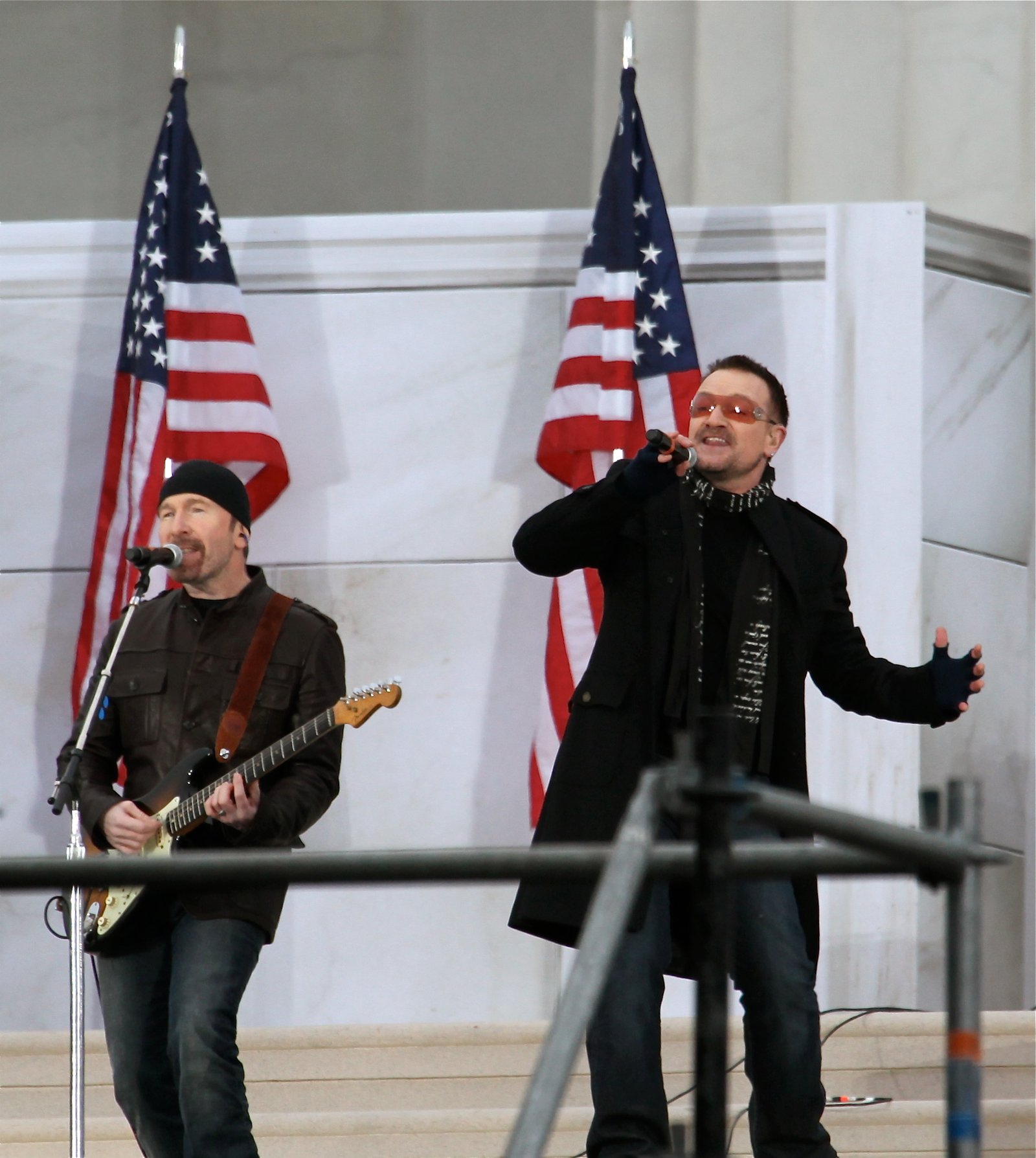
The world knows U2 as the biggest band on the planet — the stadium anthems, the 22 Grammys, the tours that rewrote the record books. But behind the spectacle are four men who have lived remarkably human lives: a schoolboy romance that became rock’s most enduring marriage, a guitarist who waited years for a divorce that Irish law wouldn’t allow, a bassist who nearly drank himself out of the band and was carried home by his friends, a frontman who decided his fame was a tool for saving lives, and children who are now writing their own chapters. This is the story of the hearts behind the hits.
A Schoolboy Romance
In an industry where marriages rarely survive the first tour, Bono and Ali Hewson’s love story is almost defiantly old-fashioned. They met as teenagers at Mount Temple Comprehensive School in Dublin, in the mid-1970s, right around the time the band that would become U2 was forming in Larry Mullen’s kitchen. She was Alison Stewart then — a politics student with her own fierce intelligence, not a rock-star accessory.
On August 21, 1982, with U2 on the verge of breaking through, Paul Hewson married his teenage sweetheart at All Saints Church in Raheny, north Dublin. Bassist Adam Clayton stood as best man. Bono was 22; Ali was 21. More than four decades, four children, and a mountain of stadium shows later, they are still together — Jordan (born 1989), Eve (born 1991, now an acclaimed actor), Elijah (born 1999, the frontman of the band Inhaler), and John (born 2001). Ali, for her part, never settled for being “the wife of.” She built her own career as a businesswoman and activist, co-founding the ethical fashion label EDUN with Bono and working on her own charitable causes.
It hasn’t always been easy. Bono’s activism has dragged him into the messiest global arguments, and the tabloids have periodically invented divorces and affairs that never happened. At the 2016 Glamour Women of the Year Awards, Bono joked that if the marriage ever felt wobbly, they would simply commit to doing the red carpet together. Beneath the joke is something real: in a business built on wreckage, the Hewsons chose, again and again, to stay.
The Edge’s Long Road to Happiness
The Edge’s personal life took a more complicated path. On July 12, 1983, he married his secondary school girlfriend, Aislinn O’Sullivan. They had three daughters — Hollie (1984), Arran (1985), and Blue Angel (1989) — but the marriage faltered, and the couple separated in 1990. Then came a uniquely Irish twist: the country had no provision for divorce at the time. The Edge and Aislinn could not legally end their marriage until Ireland legalized divorce in 1995; they finalized the split in 1996.
Meanwhile, during U2’s Zoo TV Tour, The Edge had met Morleigh Steinberg, an American professional dancer and choreographer working on the tour. They began dating in 1993, and their daughter Sian was born in Los Angeles in 1997, followed by their son Levi in 1999. The couple finally married in France in 2002 — a quiet ceremony, fitting for the band’s most private member — and remain together, splitting their time between Ireland, France, and the United States. It was a long, awkward road — but The Edge, the quietest member of the loudest band, got there in the end.
Adam’s Darkest Night
Every band has a member who tests the friendship. For U2, it was Adam Clayton — the cosmopolitan, fun-loving bassist whose drinking slowly spiraled out of control during the band’s imperial phase. The crisis came on November 26, 1993, at the Sydney Football Stadium, during the colossal Zoo TV Tour. Clayton had been drinking since the afternoon, blacked out, and simply never made it to the stage. The band played the show without him, with his bass technician Stuart Morgan filling in. It was the only U2 concert in history performed without one of the four members.
Clayton later called it his turning point. He sought help — Eric Clapton, of all people, told him bluntly that he needed to change his life, and Pete Townshend of The Who visited him in rehab and, as Clayton put it, “put steel on my back.” He got sober and stayed sober, later describing his recovery as learning to “claim my full potential.”
In 2017, Clayton received the Stevie Ray Vaughan Award from MusiCares for his support of the charity’s addiction-recovery fund, and his acceptance speech was one of the most moving moments in U2’s history. “In our band,” he told the audience, “no one will be a casualty. We all come home, or none of us come home. No one will be left behind.” Then he thanked Bono, The Edge, and Larry for forty years of standing by him. There wasn’t a dry eye in the room.
The Month That Changed Everything
In the autumn of 1985, fresh off Live Aid, Bono and Ali did something no rock star couple was doing: they disappeared to Africa. From September to October, they spent a month working at a feeding centre in Ajibar, Ethiopia, during the famine. Alongside other volunteers, they developed an educational program of songs and one-act plays to teach children about health and hygiene.
The trip rewired Bono. He saw, up close, how corruption, unfair trade agreements, and crushing debt were fueling the poverty around him — and he came home furious. Friends say it was the moment the activist was born, the point where the singer who had always written about justice decided to do something about it. Within a year, Bono and U2 were performing on Amnesty International’s Conspiracy of Hope tour, standing on stage with Sting and Bryan Adams for human rights. Within a decade, he would be in the Oval Office and the Vatican, arguing about debt relief with presidents and popes. It all started in a feeding centre in Ethiopia, with his wife beside him, teaching children songs about washing their hands.
The Activist
What Bono did with his fame is genuinely unprecedented in rock history. He became a key player in the Jubilee 2000 campaign for developing-world debt cancellation. He co-founded the ONE Campaign, which fights extreme poverty and preventable disease, and in 2006 he launched (RED) with Bobby Shriver, partnering with brands like Apple and Starbucks to direct profits to the Global Fund to Fight AIDS. The numbers are staggering: his campaigns have helped raise billions for humanitarian causes.
The honors followed. In September 1999, he met Pope John Paul II to discuss Third World debt — and the Pope playfully put on Bono’s trademark wraparound sunglasses. In 2002, he toured Africa with U.S. Treasury Secretary Paul O’Neill to promote economic development. He was named MusiCares Person of the Year in 2003, Time’s Person of the Year in 2005, and has been nominated for the Nobel Peace Prize. He and Ali even launched EDUN, an ethical clothing line, in 2005.
Not everyone loves the activist Bono — some fans wish he’d just sing, and his forays into business and politics have drawn their share of criticism. But nobody doubts the sincerity. This is a man whose Christian faith runs bone-deep, who has spent thirty years using the biggest platform in music to talk about the poorest people on earth. You can argue with his methods. You can’t argue with his heart. He has often said that his faith demands it — that to whom much is given, much is expected, and that a stadium full of people is a terrible thing to waste. And through it all, Ali has been beside him — not as a prop, but as a partner, running her own businesses and charities, raising their family, and keeping the whole extraordinary enterprise grounded in something real.
The Next Generation
The most charming twist in the U2 family story is that the music didn’t stop with the parents. Eve Hewson, Bono and Ali’s second daughter, has become one of the most acclaimed young actors of her generation, starring in films and series on both sides of the Atlantic. And Elijah Hewson, their third child, picked up a guitar and started a band of his own — Inhaler, the Dublin rock quartet where he sings and plays guitar. Inhaler has topped the charts in Ireland and Britain, which means Bono now gets to experience the surreal joy of watching his son do to him what he once did to the world.
The Edge’s children have grown up mostly out of the spotlight, building their own lives and families. What all of these kids share is something their parents never had: a childhood where rock stardom was normal. Bono has said he tried to give his children the grounded upbringing he had in Dublin — the same streets, the same values, the same insistence that fame is a job, not an identity. Judging by the results, it worked. The Hewson kids are famously down-to-earth, and the Evans kids even more so. For men who spent their lives on the world’s biggest stages, the quietest achievement may be the families waiting at home.
The Pact
Here is the detail that makes U2’s story truly remarkable, and it has nothing to do with record sales. The same four people who met in Larry Mullen’s kitchen in 1976 are still the band. No lineup changes. No bitter breakups. No reunion tours, because they never split up. In an industry built on betrayal, U2’s friendship has held for nearly fifty years — through fame, fortune, addiction, divorce, and everything else life threw at them.
That is what Clayton’s MusiCares speech was really about. “We all come home, or none of us come home.” It is a pact most bands make as teenagers and break by twenty-five. U2 kept it. When Clayton was drowning, the other three carried him. When The Edge’s marriage collapsed, the band gave him space to rebuild. When Bono’s activism made him a punchline, the band backed him anyway. They are not just bandmates. They are the rare thing in rock and roll: a family that chose each other, and kept choosing, for half a century.
The Edge’s ringing guitar, Clayton’s rolling bass, Mullen’s thunderous drums, Bono’s soaring voice — the sound is instantly recognizable within two notes. But the real miracle of U2 was never the music. It was four Dublin schoolboys who decided that no one gets left behind — and meant it. Through marriages and divorces, through addiction and recovery, through fame that would have destroyed lesser friendships, they held the line. The hits will fade, as all hits do. The friendship won’t. That is the legacy that matters, and it is still being written, one show, one family dinner, one act of stubborn loyalty at a time.
Leave a Reply