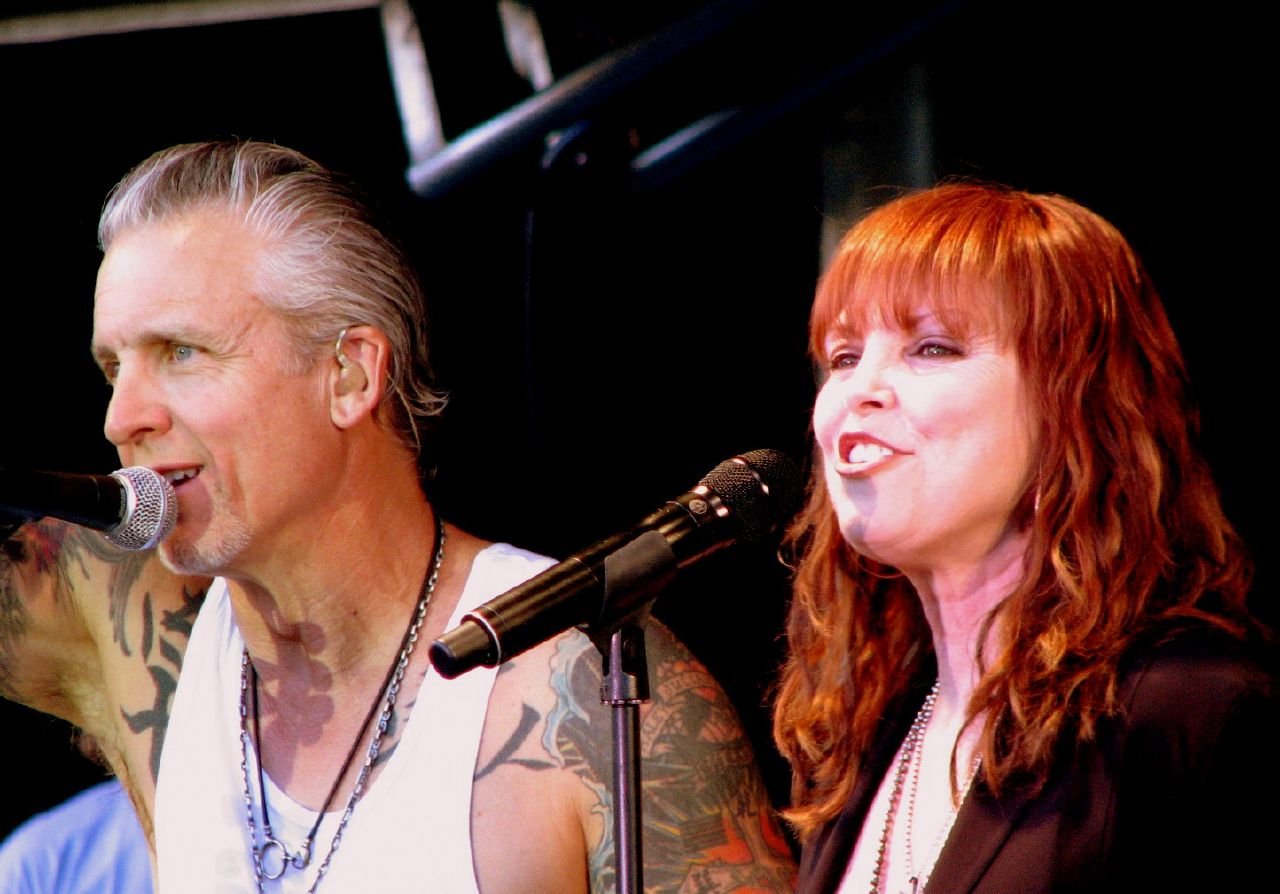
Rock and roll has never been kind to love stories. The history of the music is littered with romances that burned bright and flamed out — marriages dissolved on tour buses, partnerships shattered by fame, creative unions that couldn’t survive success. Then there’s Pat Benatar and Neil Giraldo, who met in a cramped New York rehearsal room in 1979, married in a tiny Hawaiian church in 1982, and spent the next four decades proving that love and loud guitars can not only coexist but thrive. They are rock’s great exception: a frontwoman and her guitarist who built a marriage, a family, and a Hall of Fame career on the same foundation — and never let any of it go.
“Girl, You Have Just Seen the Father of Your Children”
The story begins in 1979, when Pat Benatar was a young singer from Long Island with a powerful voice, a fresh record deal with Chrysalis, and a debut album to make. She needed a musical director and a guitarist — someone who could toughen up her sound and help her find her footing in the rock world. Enter Neil Giraldo, a hungry young guitarist from Cleveland with big ideas and bigger talent.
Benatar has told the story many times, and it never loses its charm. The moment she first saw Giraldo, a thought flashed through her mind with total certainty: “Girl, you have just seen the father of your children.” It was instinct, pure and simple — the kind of knowing that doesn’t wait for permission. Within months, the professional partnership had become a personal one. Giraldo wasn’t just playing guitar in her band; he was arranging her songs, producing her records, co-writing her hits, and shaping the very sound that would make her a star. The music and the romance grew together, inseparable from the start.
It was a complicated beginning in one respect: Benatar was still married to her first husband, Dennis T. Benatar, whom she had wed in 1972 when she was just 19. That marriage, which had given her the surname the world would come to know, ended in divorce in 1979 — the same year her career and her relationship with Giraldo both took flight. She has never hidden from that chapter; it was simply the life she had to live through to get to the one she was meant for.
A Wedding in Hana with Two Strangers as Witnesses
On February 20, 1982, at the absolute peak of their young fame, Pat Benatar and Neil Giraldo slipped away to the island of Maui and got married. The ceremony took place at the Wainanalua Church in Hana, a small town on the lush eastern side of the island. Both had been raised Catholic, but because Benatar had been divorced, they chose a quiet non-denominational ceremony conducted by Reverend Henry Kahula.
The wedding was as un-rock-star as it gets. There was no entourage, no press, no spectacle. According to accounts of the day, the couple persuaded two random strangers to serve as their witnesses, and the rest is history. They married just days before the Grammy Awards — in the middle of the very awards streak their partnership was creating. It was spontaneous, intimate, and completely theirs.
There’s a romantic detail that makes the story even sweeter: their younger daughter, born in 1994, is named Hana — after the Hawaiian town where her parents exchanged their vows. Twelve years after that quiet ceremony, they gave their child the name of the place where it all became official.
Building a Family Between the Tour Buses
If marrying your guitarist sounds like a recipe for chaos, Benatar and Giraldo made it look like the most natural thing in the world. Their daughter Haley was born in 1985, at the height of Benatar’s chart dominance, and Hana followed in 1994. The couple simply folded parenthood into the life they were already living — the studio sessions, the tours, the songwriting, the endless road. The stage, the studio, and the family all became part of one continuous, long-running partnership.
Haley would go on to pursue acting and modeling, building a public profile of her own, while Hana grew up to become a performer and personality in her own right. And then came the development that Benatar seems to relish most: grandchildren. The couple are now grandparents to three — Stevie, Lola, and Cash — a fact that inspired one of their most delightful recent projects, a children’s book titled “My Grandma and Grandpa Rock!,” celebrating the particular joy of being rock-and-roll grandparents.
Through it all, they never stopped working together. Giraldo remained Benatar’s lead guitarist, producer, arranger, and co-writer across every era of her career — from the leather-and-spandex firebrand years through the polished pop-rock of the mid-eighties and into the independent, tour-driven decades that followed. He is, as one profile put it, one of the most important figures in 1980s rock that most people couldn’t pick out of a lineup — the unsung architect behind four Grammy Awards, 15 Top 40 hits, and more than 36 million records sold.
The Unsung Architect Behind the Sound
It’s worth pausing on something the love story sometimes overshadows: Neil Giraldo’s sheer musical importance. When he joined Benatar’s band in 1979, he wasn’t hired to be a sideman — he was brought in as musical director, and he proceeded to build one of the most distinctive sounds in rock from the ground up. He assembled her backing band, arranged the songs, co-wrote the hits, played the searing guitar parts, and produced the records. The snarl of “Heartbreaker,” the defiance of “Hit Me with Your Best Shot,” the sleek modern pulse of “Love Is a Battlefield” — Giraldo’s fingerprints are on all of them.
Guitarists know. Ask players about Giraldo and you’ll hear genuine reverence for his tone, his articulation, and his song-serving discipline — a guitarist who never showboated, who always played exactly what the song needed and not a note more. He was a producer in the truest sense: the person who heard the finished record in his head before anyone else did, and then patiently built it, track by track, in the studio. Benatar has always been generous in sharing the credit, and the Hall of Fame agreed — they were inducted together, as a unit, because the history books couldn’t honestly separate what he built from what she sang.
That creative equality is part of why the marriage worked. This was never a star and her employee. It was two artists who needed each other — her voice giving his arrangements their reason to exist, his arrangements giving her voice its armor. When “Shadows of the Night” needed its cinematic build, when “We Belong” needed its haunting restraint, Giraldo was the one who found the sound. The love story and the music story were always the same story.
The Secret: Never Go to Bed Angry
So how did they do it? How did a rock marriage survive forty-plus years when so many others barely survived forty months? When the couple appeared at the 50th Anniversary Chapin Awards Gala for WhyHunger in 2025, they offered their answer with characteristic candor and humor. The golden rule, they said, is simple: “We never go to bed angry.”
Behind the quip is a real philosophy. They’ve spoken about patience, open communication, and — crucially — a mutual respect for each other’s personal space. That’s no small thing for two people who have spent four decades sharing stages, studios, tour buses, and a home. They learned early that the partnership works because neither one tries to diminish the other. She’s the voice; he’s the architect. She’s the fire; he’s the frame that lets the fire burn brightest. The Rock and Roll Hall of Fame, which inducted them together in 2022, described them as “one of the most formidable power couples in rock history” — a formal recognition of what fans had known for years.
There’s also something to be said for the way they grew up together in public. They met as hungry young musicians, became stars together, raised children together, weathered the industry’s ups and downs together, and arrived at elder-statesman status together. They never had to renegotiate the relationship after fame arrived, because fame arrived after the relationship was already built.
Giving Back: The Humanitarian Chapter
The later years of the Benatar-Giraldo story have added a dimension that goes beyond music. In 2025, WhyHunger announced that the couple would receive the ASCAP Harry Chapin Humanitarian Award at the organization’s 50th anniversary Chapin Awards Gala in New York City — honoring their use of music and influence in support of social justice and hunger relief. It was a recognition not of their record sales but of their character: two artists who understood that a platform is a responsibility.
The award capped a period of remarkable late-career vitality. The couple wrapped their own concert series and then joined Bryan Adams’ “Roll with the Punches Tour” as special guests, still walking onstage night after night with the same crackling chemistry that started in that New York rehearsal room. They published their children’s book. They kept touring, kept playing, kept showing up — for the music, for the fans, and for each other.
Forty-Three Years and Counting
Back in 1982, two young musicians slipped into a small church in Hana and promised to face the noise together. More than four decades, countless gigs, two daughters, three grandchildren, four Grammys, and an entire musical era later, that promise is still holding. They are Hall of Famers, grandparents, authors, humanitarians, and — somehow, wonderfully — still a working band.
What’s remarkable is how little the essentials have changed. Watch a recent performance and you’ll see the same dynamic that was there in 1979: Giraldo stage right, locked in, building the wall of sound; Benatar center stage, that voice cutting through everything, fearless as ever. The venues may be theaters and festivals now rather than arenas, but the chemistry is untouched by time. They still look at each other the way musicians look at each other when the music is exactly right — with total trust.
In a business built on beautiful wreckage, Pat Benatar and Neil Giraldo built something else: a life. The hits will always be there — “Heartbreaker,” “Hit Me with Your Best Shot,” “Love Is a Battlefield,” “We Belong” — but the real masterpiece was never a song. It was the partnership itself: the guitarist and the singer who fell in love in a rehearsal room, married in a little church with strangers as witnesses, and proved, year after year, that the fiercest thing in rock and roll isn’t a power chord. It’s devotion. And if you ever doubted that love could survive the spotlight, just watch them walk onstage together, forty-plus years on, still in perfect tune.
Leave a Reply