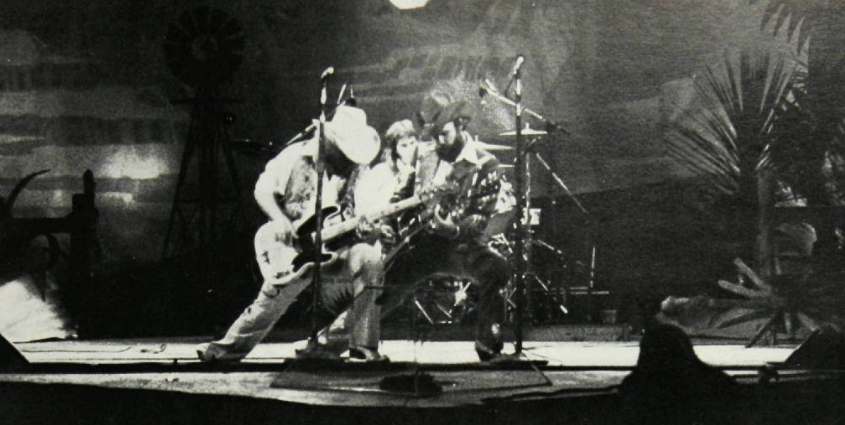
In the summer of 1976, three beardless Texans loaded up 13 trucks with 75 tons of equipment, a 35-ton stage shaped like the state of Texas, a live longhorn steer, a two-thousand-pound buffalo, a pair of vultures, two venomous rattlesnakes, and enough cactus to landscape a desert — and set off to bring Texas to the people — all of it, hooves and all. The Worldwide Texas Tour remains one of the most gloriously excessive undertakings in rock history: eighteen months, 97 shows, and a traveling menagerie that turned every arena into a slice of the Lone Star State. Billboard magazine called it “one of the most ambitious and extensive concert treks ever undertaken by a rock group.” Nearly fifty years later, nothing has quite matched it for sheer, beautiful madness — not the floating pigs, not the giant screens, not the pyrotechnics. This is the story of the tour that put a zoo on wheels and called it rock and roll.
“Bring Texas to the People”
The idea was born from a simple, audacious concept. ZZ Top had spent the first half of the seventies grinding their way up from Texas bar band to national radio fixture on the strength of “Tres Hombres” and “Fandango!” — greasy, irresistible boogie rock with Billy Gibbons’ sly humor baked in. They were about to release their fifth album, “Tejas,” and their manager, Bill Ham, wanted a tour that would announce ZZ Top as something bigger than a band. He wanted a spectacle.
The mission statement, as the band put it, was to “bring Texas to the people.” Not metaphorically — literally. If the crowds in Winston-Salem and Chicago and Detroit couldn’t come to Texas, then Texas — its landscape, its animals, its plants, its sheer scale — would come to them. Stage designer Bill Narum, who had already been designing the band’s album covers and tour posters for years, was handed the impossible assignment: build the state of Texas, 63 feet wide, and make it tourable.
What Narum and Ham dreamed up made every other rock stage of the era look like a high school talent show. This was 1976, the age of Pink Floyd’s flying pigs and the Stones’ lotus stage — and ZZ Top decided to outdo them all with longhorn cattle.
The 35-Ton Stage Shaped Like Texas
The centerpiece was almost beyond belief: a stage built in the shape of the state of Texas itself, measuring 63 feet by 48 feet, tilted at a four-degree angle so the audience could clearly see the outline, and weighing 35 tons — 70,000 pounds of lumber, steel, and Texan ambition. It cost a reported $100,000 to build, an astronomical sum for a stage in 1976, and it took a 40-person crew seven hours to assemble it at every single stop.
Behind the band stretched a 180-foot three-dimensional panorama — a hand-painted backdrop depicting the Santa Elena Canyon in Big Bend National Park on the Rio Grande, built from multiple scrims, each 36 feet by 20 feet, individually lit to show dawn and dusk effects. As the show progressed, the lighting shifted the painted desert from sunrise gold to twilight purple, as if the whole day were passing over West Texas while the band played.
The sound system was state of the art for its day: 260 speakers, 130 light fixtures, 136,000 watts of power. The entire production was insured for $10 million. And then there were the living, breathing, occasionally unpredictable elements — the part of the show no other band on earth could copy.
The Traveling Zoo
To make Texas real, ZZ Top brought Texas with them — alive. The onstage menagerie included a Texas Longhorn steer, a black buffalo (bison) weighing some two thousand pounds, two buzzards (turkey vultures), and two diamondback rattlesnakes. The stage was further dressed with native plants: yucca, agave, and cacti scattered around the performers like a desert garden.
Getting all of this on the road was a logistical saga worthy of its own documentary. Animal trainer Ralph Fisher was hired to procure and handle the creatures, and his preparation was military in its thoroughness. He rented a scissor lift to train the longhorn and the buffalo to walk up a ramp onto a platform. For months, he played loud rock music to the animals on a timer, day and night, complete with a light show — popping firecrackers near them, waving flags, doing everything possible to simulate the chaos of a concert so nothing would spook them onstage.
The rattlesnakes were the trickiest customers. They couldn’t travel in the cattle trailer because they terrified the longhorn and the buffalo, so the head of security carried them from show to show in a steel toolbox with holes drilled in it, covered in biohazard stickers. Crew members would occasionally let one “escape” and stage a dramatic recapture — pure showmanship to grab headlines. The vultures had their own ideas about show business: at one show, a buzzard began swooping and circling over the stage, unable to decide which white hat to land on, until the band had to stop playing while Fisher came out into the spotlight and whistled the bird down onto his head. According to tour lore, the production eventually traveled with six vultures — and every single one of them was named Oscar. The tarantulas that joined the menagerie at various points presumably had names too, though history does not record them.
At the climax of each show, the longhorn and the buffalo were raised up from behind the speakers on scissor jacks, silhouetted against the painted desert — and the crowd went absolutely wild. It was part rock concert, part rodeo, part fever dream.
97 Shows, 18 Months, One Opening Act for the Ages
The tour kicked off on May 29, 1976, at Groves Stadium in Winston-Salem, North Carolina — with a then-rising Southern rock band called Lynyrd Skynyrd as the opening act. Over the next eighteen months, across five legs and 97 shows, ZZ Top hauled their Texas circus to arenas, stadiums, and auditoriums across America, finally closing out on New Year’s Eve 1977 in Fort Worth, Texas — back home where it all started.
The original plan had been a modest 33 dates. But the show was such a phenomenon that it kept growing, mutating into a record-breaking behemoth. Night after night, audiences who had come for “La Grange” and “Tush” found themselves staring at a buffalo silhouetted against a painted Big Bend sunset. It was the kind of spectacle that turned casual fans into lifelong believers.
There’s a telling detail about how seriously the band took the concept: the show opened with a carefully choreographed sequence in which Billy Gibbons would play a note that matched a dog’s howl, the lights would flare, the sun would rise over the painted Santa Elena Canyon, and he’d shift to the note that set the buzzards flapping — and then the band would launch into their first song. Every element, living or otherwise, was part of the performance.
The Tour That Changed What a Concert Could Be
It’s hard to overstate how radical the Worldwide Texas Tour felt in 1976. Rock spectacle existed, of course — but it was abstract: lasers, inflatables, elaborate lighting rigs. ZZ Top did something no one had tried: they made the spectacle literal, regional, and alive. The tour’s full billing said it plainly — “Takin’ Texas to the People” — and every element served that idea. This wasn’t decoration; it was autobiography at arena scale.
The influence rippled outward for decades. When ZZ Top later toured behind “Afterburner” with a futuristic, Disney-designed stage full of cosmic props, it was the same showman’s instinct in a different costume — the lesson of 1976 being that a ZZ Top concert should be an event, not just a gig. Other bands took note too: the era of the truly theatrical rock tour, where the stage itself told a story, owes a genuine debt to three Texans who decided a painted desert and a live buffalo were reasonable tour expenses.
There’s also a quieter legacy. The tour proved that ZZ Top’s identity — Texas, the blues, sly humor, absolute commitment to the bit — could scale to any size without losing its soul. A band that had started out playing Knights of Columbus halls was now filling stadiums, and the show never felt like a compromise. If anything, the excess made them more themselves. The longhorn, the cactus, the tilted stage: it was all a declaration that they would never pretend to be anything other than exactly what they were.
The Price of Excess
By the time the tour finally wound down at the end of 1977, ZZ Top was exhausted. The sheer physical and logistical toll of moving a 35-ton stage and a menagerie across the country for a year and a half had drained the band completely. What followed was the famous hiatus — the extended break during which Gibbons and Dusty Hill stopped shaving and grew the legendary beards that would become their trademark, returning in 1979 looking like entirely different men.
In a way, the Worldwide Texas Tour was the end of ZZ Top’s first chapter: the last great blast of their seventies bar-band incarnation before the beards, before the synths, before MTV turned them into video stars. They had taken the biggest swing of their career — bigger, stranger, and more ambitious than anything their peers attempted — and they had pulled it off. But it cost them. The band needed to disappear for a while just to recover from the scale of what they’d done.
No band before or since has toured quite like that. The Worldwide Texas Tour wasn’t just a concert series; it was a statement of identity — three Texans so proud of where they came from that they rebuilt it, 63 feet wide, in every city in America, and filled it with live animals just to prove they could. It was excessive, impractical, occasionally dangerous, and utterly magnificent.
Think about what it took: the months of animal training, the seven-hour stage builds, the $10 million insurance policy, the toolbox full of rattlesnakes riding with the head of security. Any sensible band would have scaled it back. ZZ Top scaled it up, night after night, for eighteen months, until the whole magnificent contraption finally rolled home to Fort Worth on New Year’s Eve. When people talk about the golden age of rock spectacle, they’re talking about nights like these: a longhorn steer under arena lights, a painted desert at dusk, a buzzard circling over the drums, and that little ol’ band from Texas playing the blues like the whole state was watching. Because for eighteen glorious months, it was.
Leave a Reply