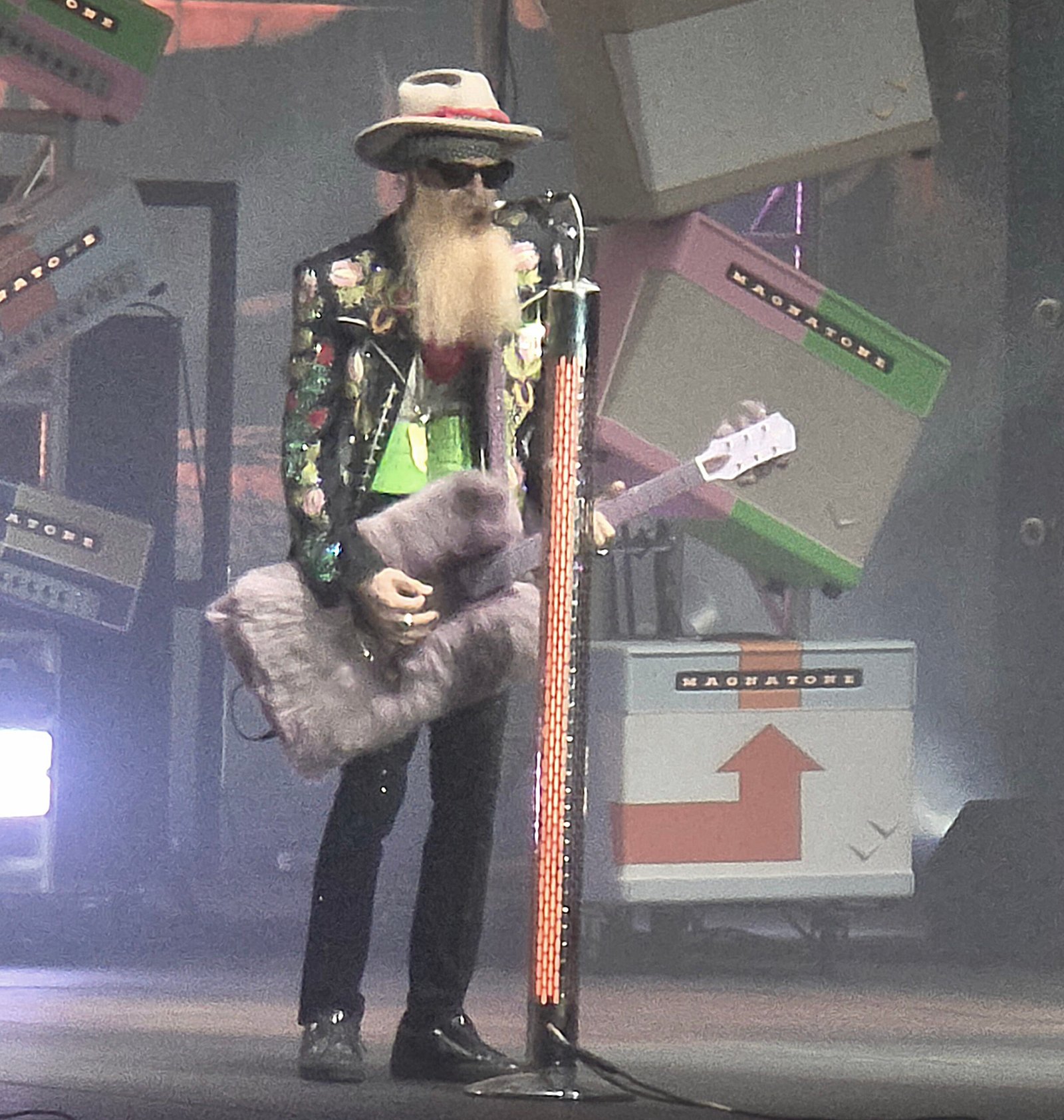
For nearly five decades, ZZ Top held a record no other major rock band could touch: the same three men, playing together without a single lineup change, from a Knights of Columbus hall in Beaumont, Texas, in 1970 until fate finally intervened in 2021. In an industry famous for feuds, firings, and spectacular breakups, Billy Gibbons, Dusty Hill, and Frank Beard simply… stayed. They stayed through changing fashions, through the synth revolution, through MTV stardom and back to the blues clubs. This is the story of the human bond behind the beards — the loyalty, the laughter, the turned-down millions, and the friendship that outlasted almost everything in rock and roll.
Three Texans Who Just Kept Showing Up
The numbers alone are staggering. When ZZ Top was recognized with a Guinness World Record in 2018 as the longest-running active band with no lineup changes, Gibbons, Hill, and Beard had been together for 48 years. Think about what that means: nearly half a century of tour buses, recording studios, soundchecks, and hotel rooms, with the same three personalities in the same three chairs. Most marriages don’t last that long. Most friendships don’t either.
What made it work was something the band rarely talked about but always demonstrated: genuine affection and a complete absence of ego warfare. There was never a public feud, never a tell-all memoir settling scores, never a bitter reunion tour patched together for the money. Gibbons was the visionary and the frontman, Hill the soulful co-vocalist and the band’s warm center, Beard the steady engine room — and each man seemed content with exactly who he was in the equation. In interviews across the decades, they ribbed each other like brothers and praised each other like fans. The joke about Frank Beard — the one member without a beard — never got old precisely because the warmth behind it never did.
Dusty Hill once summed up the band’s philosophy with characteristic understatement. They weren’t chasing trends or reinventing themselves; they were three guys who loved playing the blues together. That simplicity turned out to be the most durable strategy in rock.
Frank Beard: The Quiet Heartbeat
Every great brotherhood has its quiet center, and in ZZ Top that was always Frank Beard. While Gibbons and Hill became visual icons — the beards, the shades, the matching suits — Beard sat behind the drum kit, mustached but beardless, holding the whole thing together with a drummer’s unshowy precision. Fans know the delicious irony of his name, but what mattered musically was his feel: that deep, unhurried Texas groove that made even the synth-driven eighties records swing.
Beard’s steadiness extended offstage. Through every era — the bar-band seventies, the MTV eighties, the long decades of relentless touring that followed — he was the constant, the man who showed up, played brilliantly, and never made it about himself. In a band with two outsized personalities up front, his lack of ego wasn’t a weakness; it was the glue. You can’t keep three strong-willed Texans together for fifty years without someone who understands that the song matters more than the spotlight. That was Frank Beard’s gift, and the band knew it.
There’s a lovely symmetry to it: the man named Beard, the only one without the famous facial hair, was also the one who least needed the costume. His identity was the beat itself.
The Million Dollars They Turned Down
In the mid-1980s, at the absolute peak of their MTV fame, ZZ Top received an offer that would have tested any band’s principles. The razor giant Gillette wanted Gibbons and Hill to shave off their famous beards — on television, in a commercial — and the company was willing to pay $1 million per man for the privilege.
The story had floated around rock folklore for years, but Gibbons finally confirmed it outright in early 2026, speaking on Jay Mohr’s “Mohr Stories” podcast. “They deny it,” Gibbons said of Gillette. “It was a million dollars per man.” Before answering, the band did what they’d always done: they talked it over and called someone they trusted. Gibbons rang legendary rock publicist Bob Merlis for advice. Merlis’s response was perfect: “The money’s good, you might as well consider doing it, but I’m not so sure any of you guys know what’s under there.”
So they passed. “We passed, and our fans loved it,” Gibbons recalled. “Word got out.” Years earlier, in a 2012 interview, Gibbons had put it even more colorfully: “No dice. Even adjusted for inflation, this isn’t going to fly. The prospect of seeing oneself in the mirror clean-shaven is too close to a Vincent Price film… a prospect not to be contemplated, no matter the compensation.”
It wasn’t really about the money — though two million dollars was serious money in 1984. It was about identity. The beards weren’t a costume they could take off for a paycheck; they were who the band had become. Turning down the offer told the fans everything they needed to know about ZZ Top’s priorities. The music came first, the image was earned, and neither was for sale.
“One Word: Lazy” — How the Beards Really Happened
Here’s the part the Gillette story makes even better: the most famous beards in rock weren’t a marketing plan at all. They were an accident born of exhaustion. After the grueling Worldwide Texas Tour ended in late 1977, the band took an extended hiatus — their first real break in years. During that time off, Gibbons and Hill simply stopped shaving.
Years later, when Dan Rather asked Gibbons why the beards happened, the answer was disarmingly honest: “One word: lazy.” They’d been running nonstop for the better part of a decade, and for once, nobody felt like picking up a razor. When the band reconvened for 1979’s “Deguello,” the beards came with them — and stayed for the next forty-plus years.
Gibbons later refined the story with typical Texas poetry: “What started out as a disguise, turned into a trademark.” The beards, the dark sunglasses, the sharp suits, the hats — the whole visual identity that made them MTV icons — grew organically out of two tired musicians deciding not to shave. It’s a reminder that the most enduring images in rock are rarely designed in boardrooms. They’re just what happens when authentic people stop pretending.
The Women Behind the Beards
For all the band’s public mythology, the private lives of its members were remarkably steady — especially by rock standards. Billy Gibbons married his longtime partner Gilligan Stillwater, born Ellen J. Oetjen, on December 14, 2005. They had been together since the late 1980s, weathering the entirety of the band’s MTV superstardom and beyond before making it official. Gibbons told Rolling Stone in 2017 that he could have married several times over the years but had held off: “I finally said, ‘OK, let’s try it out.’ It’s been a splendid thing.” Gilligan, who also serves as a manager for the band’s tours, has been his partner in every sense — and she was his first and only wife.
Dusty Hill’s devotion to the band was matched by his devotion to the life he’d built around it. When his health began failing in 2021, his thoughts weren’t on himself — they were on the music and the men he’d played it with for half a century. His final instruction to Gibbons was pure Dusty: keep the band going, and give his spot to their longtime guitar tech, Elwood Francis. “Give Elwood the bottom end and take it to the top,” he said. It was the act of a man who loved the band more than his own place in it — and the band honored his wish without hesitation.
It’s telling that in all the decades of ZZ Top, the scandals that define so many rock biographies are simply absent. No divorces splashed across tabloids, no band members suing each other, no rehab sagas. The private lives stayed private because there was nothing to hide — just working musicians who went home to the people they loved and came back to the band that felt like a second family.
Carrying On: Elwood and the Beard Tradition
When Dusty Hill passed away in July 2021 at age 72, it ended the longest-running lineup in rock history. But true to Hill’s wishes, ZZ Top didn’t stop. Elwood Francis — the band’s guitar tech of many years, a trusted member of the extended ZZ Top family — stepped in on bass, and the trio became a trio again.
There’s something quietly moving about what’s happened since. Francis hasn’t just filled the bass chair; he’s grown into the visual tradition too, cultivating his own long beard and settling into the band’s unmistakable silhouette. The show goes on with the same chemistry, the same humor, the same boogie — and every night, in the beard on the bass player’s face, there’s a small tribute to the man who asked for exactly this.
It speaks volumes about the culture Gibbons, Hill, and Beard built that the transition felt like a family matter rather than a corporate one. There were no auditions, no press-release drama, no hired gun flown in from Los Angeles. There was just Elwood — the guy who had been there all along, tuning the guitars, earning the trust — stepping forward because Dusty said so. In an industry that treats musicians as interchangeable parts, ZZ Top treated theirs as kin.
Gibbons, now in his mid-seventies, continues to tour with the same evident joy he’s always brought to the stage. The band that hit the road again in 2026 sounds like a group of men who genuinely still love playing together — because they do. Fifty-plus years in, the brotherhood is the whole point. The beards stayed. The band stayed. The promise stayed.
Strip away the beards, the sunglasses, the hot rods, and the spinning guitars, and what you’re left with is something rock and roll almost never produces: three men who liked each other, trusted each other, and kept their promises to each other for half a century. They turned down a fortune to stay themselves. They grew their legend by accident, one unshaven morning at a time. They married for keeps, promoted from within like family, and never once aired their differences in public — because as far as anyone can tell, there were never any differences worth airing.
And when one of them fell, the others carried his wishes forward like family — because that’s what they were. ZZ Top didn’t just outlast everybody. They out-loved everybody, too. And in the end, that’s the real reason the beards became immortal: they were never a gimmick. They were the mark of men who knew exactly who they were, who they belonged with, and never saw a reason to be anyone else.
Leave a Reply